
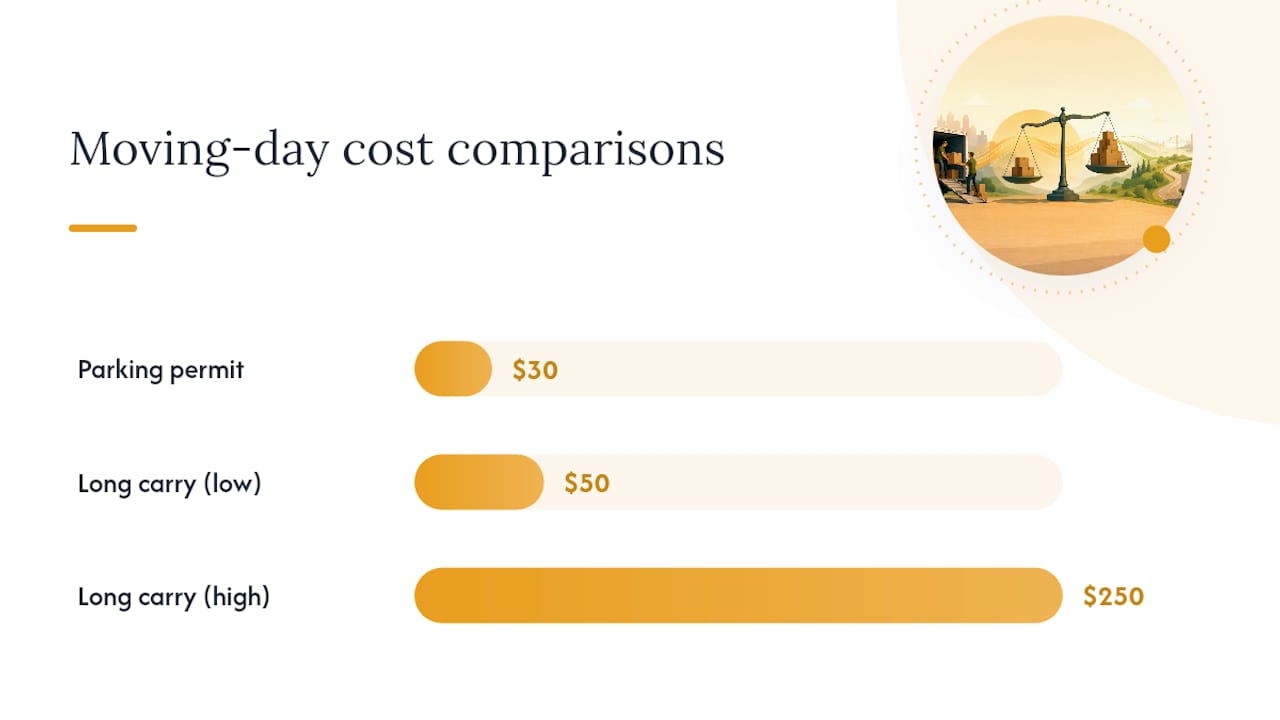
A long carry fee shows up when your mover has to walk items farther than the free distance built into your quote, usually anywhere from $50 to $250 per occurrence or several dollars per foot beyond that limit. Expect it if you have a long driveway, restricted parking, or a building with a distant loading zone. The one move that protects you: get the exact carry distance and its fee measured and written into your estimate before moving day, not discovered on the bill of lading.
TL;DR:
- Long carry fees typically range from $50 to $250 per occurrence and increase with distance beyond the mover’s set free carry limit, which is usually 50 to 100 feet.
- To avoid surprises, request a written measurement of the carry distance, confirm the rate beforehand, and ensure it is included in the initial estimate.
- Federal regulations require movers to disclose long carry charges before loading; failure to do so shifts billing to after delivery or within 30 days.
- Preparing in advance by arranging parking permits and clearing pathways can significantly reduce or eliminate long carry fees.
- Always verify that the estimated carry distance and applicable rate are documented in writing before move day to uphold consumer protections.
Table of Contents
- What Is a Long Carry Fee for Movers and How Is It Measured?
- How Movers Price Long Carry Charges: Formats and Typical Ranges
- Federal Rules, Estimates, and Your Rights Under 49 CFR
- How to Avoid or Minimize Long Carry Fees Before Moving Day
- What to Ask and Get in Writing: Your Estimates Checklist
- Sample Scenarios and a Quick Budgeting Table
- Our Approach to Preventing Surprise Accessorials
- Why Surprise Fees Erode Trust Faster Than Almost Anything Else in Moving
- Let Move Craft Review Your Estimate Before You Sign
- Sources
- FAQ
What Is a Long Carry Fee for Movers and How Is It Measured?
Movers typically measure carry distance from the back of the truck to your entrance, not from the street or the property line. Every mover includes a set “free carry” distance in its base rate, often somewhere between 50 and 100 feet. Anything beyond that gets billed as a long carry.
The distance itself is usually walked and measured by the crew or estimator, sometimes with a wheel or laser measure, before the truck ever gets loaded. That number gets logged and should be attached to your written estimate. If a mover skips this step and shows up to a driveway that’s 300 feet from a legal parking spot, you’re the one absorbing the surprise.
Several conditions commonly trigger the charge:
- Restricted or unavailable parking, forcing the truck to park down the block or across a lot
- Long or winding walkways, common in rural properties or gated communities
- Extensive landscaping, gravel paths, or terrain the dolly can’t easily cross
- Multiple flights of stairs in walk-up buildings without elevator access
- Narrow hallways or tight turns that slow down or block a direct path
- Elevator limitations, including wait times, weight caps, or service elevators located far from your unit
It helps to know what a long carry fee is not. A shuttle service fee applies when the main truck can’t physically access the street at all and a smaller vehicle has to ferry your belongings, which is a separate accessorial with its own pricing. Stair fees are sometimes billed independently of long carry, and “impracticable operations” is a distinct federal category covering situations where normal delivery simply isn’t possible given the property’s conditions. A mover might apply one of these charges, several together, or none, depending entirely on your specific address.
How Movers Price Long Carry Charges: Formats and Typical Ranges
Pricing formats vary by company, but three formulas cover most of the market. Some movers charge per foot beyond the free distance, often a few dollars for each additional 50 or 75 feet. Others charge per flight of stairs, and still others use a flat bracket fee that jumps in tiers, for example one price for 75 to 150 feet and a higher flat rate past 150 feet.
Typical range: Industry pricing guides commonly report stair or long-carry accessorials landing between $50 and $150 per flight or bracket, though exact rates depend on the company, market, and whether the charge is bundled into an hourly local rate or a flat long-distance tariff.
For a local move billed hourly, a long carry sometimes just adds crew time rather than a separate line item, since more walking means more billed hours. For a long-distance delivery under a binding or non-binding estimate, the long carry is more likely to appear as its own accessorial charge on the final invoice.
A few numbers to keep in mind while budgeting:
- A single-flight walk-up with a 100-foot lobby distance might add $50 to $100 total
- A rural home with a 200 foot gravel driveway could add $100 to $300, sometimes more if a shuttle is also required
- When parking restrictions force a shuttle and a long carry, the two fees compound, since you’re paying for the extra vehicle trip and the extra walking distance separately
- Wait-time charges can stack on top of either if the crew is delayed finding legal parking
Local moves tend to see smaller long-carry add-ons because distances are shorter and crews are already billing by the hour. Long-distance deliveries carry more exposure, since the fee often gets calculated as a flat accessorial against a fixed-price estimate, and that’s exactly where a surprise bill causes the most friction.
Federal Rules, Estimates, and Your Rights Under 49 CFR
Movers engaged in interstate moves don’t get to invent long-carry charges after the fact. Federal regulation requires them to identify accessorial services, including long carries and elevator charges, before they prepare your bill of lading. 49 CFR § 375.401 states plainly that if a mover fails to determine these charges in advance, the remedy isn’t billing you on the spot. The mover has to deliver your goods and can only bill you for the additional charges after 30 days.
If your mover never surveyed your parking situation or your walk-up and shows up demanding cash for a long carry at delivery, that demand conflicts with the federal framework. The mover’s own failure to estimate the accessorial in advance shifts the billing timeline, not your wallet, at the door.
The estimate type you signed also matters enormously here. Under 49 CFR § 375.405, non-binding estimates must be reasonably accurate and provided in writing, and you’re only required to pay up to 110% of that estimate at delivery. A binding estimate, governed by 49 CFR § 375.403, generally caps what the mover can collect at delivery to the stated amount, with exceptions for services you add later.
FMCSA’s own consumer guidance confirms the same structure: you’re never required to pay more than 100% of a binding estimate or 110% of a non-binding one at delivery, and any remaining balance for additional charges gets billed afterward, not extracted at your front door. If your total would exceed 110% on a non-binding estimate, the mover has to hand over your goods once you pay that 110% and bill you the rest later.
If a mover tries to skip this process, here’s what to do:
- Ask to see the written estimate and confirm the long carry distance is listed on it
- Decline to pay more than 110% (non-binding) or the binding total at delivery
- Photograph the bill of lading and any accessorial charges added at the truck
- File a complaint with FMCSA if a mover demands full payment for an undisclosed accessorial before releasing your goods
- Keep a copy of every document the crew asks you to sign before they unload
Consumer protections only work if you use them. Movers count on rushed, tired customers signing whatever’s handed to them at the curb.
How to Avoid or Minimize Long Carry Fees Before Moving Day
Most long carry surprises are preventable weeks in advance, not on move day itself. A little prep work shifts the fee from a shock to a known line item, or eliminates it entirely.
- Request a physical or video survey. An estimator who actually walks your property, or reviews a video walkthrough, can measure the real distance from likely truck parking to your door and put a number on your estimate instead of a guess.
- Arrange parking in advance. If you’re in a city, look into a temporary parking permit for the truck directly in front of your building on moving day. Every foot you save on parking distance is a foot you don’t pay for later.
- Measure and document the distance yourself. Walk it with a tape measure or a mapping app, take photos, and send them to your mover before the estimate is finalized.
- Clear the path. Trim landscaping, move planters, and clear anything that would force the crew to detour or slow down. A blocked path can turn a routine carry into extra labor time billed separately.
- Confirm the long carry distance and rate are written into your estimate, not just mentioned verbally by the estimator. If it’s not on paper, it’s not enforceable.
- On move day, ask about your options if conditions changed unexpectedly, a delivery truck blocking your usual spot, for example. Some crews will offer a shuttle or extra dolly trips instead of a straight long-carry surcharge, and it’s worth asking which is cheaper for your situation.
Pro Tip: Call your city or building management about temporary parking permits at least two weeks before moving day. A $30 permit fee is almost always cheaper than the long carry charge you’d pay without it.
If a long carry turns out to be unavoidable, ask whether the crew considers it “impracticable operations” instead, since that’s a distinct category under federal rules with its own disclosure requirements, and confirm which classification and rate actually apply before the truck leaves your old address.
What to Ask and Get in Writing: Your Estimates Checklist
Every conversation with a mover before your move should produce a paper trail. Verbal promises about “no extra fees” mean nothing once the truck is loaded.
Ask these questions directly, and don’t accept a vague answer:
- What is the maximum free carry distance included in this estimate?
- What is the per-foot, per-flight, or flat bracket rate beyond that distance?
- Can you show me the tariff page this rate comes from?
- Is this a binding or non-binding estimate, and what happens if the actual distance is longer than expected?
- What are the payment terms at delivery, and what happens if the bill exceeds the estimate?
On the estimate and bill of lading, make sure the following appears in writing: whether the document is binding or non-binding, the specific long carry distance measured at your address, the accessorial rate tied to that distance, and a signed attachment for any services added after the initial estimate.
If a dispute happens at delivery, remember your legal floor. On a non-binding estimate, you’re only obligated to pay up to 110% of the quoted total to get your goods off the truck. On a binding estimate, the mover generally can’t demand more than the agreed amount unless you added services in writing. Anything above those thresholds for an undisclosed long carry should be challenged on the spot, and documented for a formal complaint afterward.
Sample Scenarios and a Quick Budgeting Table
Long carry costs swing widely depending on your building type, so seeing a few common scenarios side by side makes budgeting easier than any single average number could.
These figures scale with the size of your move. A one-bedroom apartment with a long carry pays a flat fee regardless of load size, while a four-bedroom house with the same walking distance often sees a higher total because more trips back and forth mean more billed labor time layered on top of the flat accessorial. If your move involves both a long carry and a shuttle situation, always ask whether the two charges are itemized separately or bundled, since bundled pricing sometimes hides which part of the fee you could have avoided with better prep.
Our Approach to Preventing Surprise Accessorials
Vetting carriers for transparent, tariff-backed pricing is core to how Move Craft matches customers with movers. That review process means the carriers in our network are expected to disclose long carry rates, parking requirements, and accessorial tariffs before your bill of lading gets signed, not after.
Practical steps we recommend to every customer:
- Request a physical or video survey of your pickup and delivery addresses so long carry distances get measured, not guessed
- Confirm your estimate lists the specific accessorial rate and the maximum free carry distance in writing
- Review whether your quote is binding or non-binding, since that determines your payment cap at delivery
- Ask your assigned mover directly whether parking, stairs, or pathway conditions at either address could trigger extra charges
Our full-service residential moving guide walks through how these estimate details get documented from the first quote through delivery day, and it’s worth reading before you sign anything.
Why Surprise Fees Erode Trust Faster Than Almost Anything Else in Moving
Long carry fees rarely make headlines the way lost furniture or damaged pianos do, but they cause a disproportionate amount of frustration precisely because they feel arbitrary. A customer who gets quoted $1,200 and billed $1,450 at the truck doesn’t care that the extra $250 is technically legal under a non-binding estimate. They care that nobody measured their driveway ahead of time.
That’s the real failure point, not the fee itself, but the missing conversation. A long carry charge tied to a documented distance and disclosed rate rarely triggers complaints. The same charge sprung on someone at delivery, with no prior mention, generates every bad review a moving company gets. If you take one thing from this article, use the checklist above and contact Move Craft if you’re unsure whether your quote covers your specific property conditions.
— Info
Let Move Craft Review Your Estimate Before You Sign
Move Craft exists for exactly the moment this article describes: the gap between a quote that looks clean and a delivery day that doesn’t match it. Our carrier vetting process pushes movers to disclose long carry distances, parking requirements, and accessorial rates in writing before your bill of lading is ever prepared, so you’re not negotiating a surprise charge at the curb.

If you’re planning a residential move and want a second set of eyes on your estimate before you commit, request a quote through Move Craft’s residential and long-distance moving services and ask specifically about long carry and accessorial disclosure. For moves involving fragile or oversized items, our fine art moving and pool table moving pages also cover how access issues at either address get factored into those specialized quotes. Getting the right questions answered before moving day is the difference between a predictable bill and a stressful one.
Sources
- 49 CFR § 375.401 – Must I estimate charges? | LII / Legal Information Institute
- What happens if my household goods mover increases the agreed price? | FMCSA
FAQ
How Much Does It Cost to Move 100 Miles?
Cost depends far more on the weight of your belongings and crew size than on the 100-mile distance itself, since short interstate moves are often billed by weight and labor rather than mileage alone. Long carry, stair, or shuttle accessorials can add $50 to $400 on top of the base cost depending on parking and building access at either address.
Is $100 Enough to Tip Movers?
Tipping isn’t required and isn’t part of any long carry or accessorial fee structure, since those charges go to the moving company, not directly to the crew. Many customers tip movers for a full day’s work, adjusted for job difficulty, but this is separate from any accessorial charges on your invoice.
How Much Does It Cost to Move a 3,000 Square Foot House?
A house that size typically involves a multi-day or multi-truck move, and the price depends heavily on distance, crew size, and access conditions at both properties. If the home has a long driveway, restricted parking, or multiple flights of interior stairs, expect a long carry or stair accessorial layered on top of the base labor and transport cost, which is why a documented survey matters more for larger homes than for a studio apartment.
How Can I Avoid a Long Carry Fee Entirely?
The most reliable way is arranging legal parking as close to your entrance as possible, whether that means a temporary permit or coordinating with a building manager for a loading zone reservation. Combine that with a written estimate that documents the measured carry distance, since a mover who never measured your property in advance is the most common source of a surprise long-carry bill.