
A shuttle service fee is what movers charge when the main moving truck can’t reach your home, forcing the crew to transfer your belongings to a smaller vehicle first. It typically runs $0.08 to $0.12 per pound or carries a flat minimum around $200, depending on your shipment size and how far the crew has to shuttle it. If your street is narrow, gated, or has a low clearance, ask your mover for a site survey before you sign anything.
TL;DR:
- Shuttle fees usually range from $0.08 to $0.12 per pound or around $200 minimum, and can apply on both pickup and delivery if access issues exist.
- Stubborn access problems, such as narrow streets, low bridges, or gated communities, often make shuttle fees unavoidable and a significant part of moving costs.
- Knowing the exact billing method, minimum charges, and requesting site surveys in advance can help avoid surprises and lower shuttle-related expenses.
- Preparing a rough estimate by measuring access distances, noting obstacles, and calculating shipment weight helps budget for shuttle fees, especially for problematic addresses.
- Early coordination with movers, including requesting written fee estimates and permit arrangements, reduces the risk of unexpected shuttle charges on moving day.
Table of Contents
- What Does a Mover’s Shuttle Service Actually Involve?
- How Do Movers Calculate Shuttle Fees?
- What Do Sample Shuttle Fee Calculations Look Like?
- What Factors Push Shuttle Fees Higher or Lower?
- When Is Shuttle Service Actually Required?
- Are Shuttle Fees Included in Your Moving Estimate?
- How Can You Avoid or Reduce Shuttle Fees?
- How Do Shuttle Fees Compare to Other Moving Surcharges?
- How Do You Estimate Your Own Shuttle Fee Before Moving Day?
- Move Craft’s Approach to Preventing Shuttle Surprises
- A Publisher’s Take on Budgeting for Shuttle Fees
- How Movecraftmoving Helps You Avoid Shuttle-Fee Surprises
- Where This Article’s Numbers Come From
- Sources
What Does a Mover’s Shuttle Service Actually Involve?
Picture this: your moving truck pulls up, and the driver realizes it can’t fit down your street, through your gate, or under that low-hanging tree branch. Instead of turning around, the crew brings in a smaller vehicle, usually a box truck or van, and shuttles your belongings between your home and the larger truck parked somewhere accessible.
This isn’t a rare edge case. It happens constantly in older neighborhoods, historic districts, and dense urban cores where streets were laid out long before 53-foot tractor trailers existed. Boston’s colonial-era side streets, San Francisco’s steep hills, and New York’s tight brownstone blocks are classic shuttle territory. So are gated communities with weight-restricted access roads and rural properties at the end of a long, unpaved driveway that a full-size rig simply can’t navigate.
Common triggers include:
- Streets too narrow for a full-size truck to park or turn around
- Low bridges, overhangs, or parking garage clearances under 13 feet
- Gated communities or HOAs that restrict large commercial vehicle access
- Steep, unpaved, or weight-limited driveways
- Municipal parking rules that ban oversized trucks on residential blocks
Here’s the detail people miss: shuttle fees can apply twice on the same move. If your old home requires a shuttle for pickup and your new home also has access problems, you’re paying that fee on both ends. That doubling catches more people off guard than the fee itself.
How Do Movers Calculate Shuttle Fees?
Movers don’t pull shuttle charges out of thin air. Most use one of four billing methods, and knowing which one applies to your quote lets you actually compare estimates instead of guessing.
Per-pound pricing is the most common approach for full-service moves. Companies typically charge $0.08 to $0.12 per pound of your total shipment weight. A shipment of a few thousand pounds could add several hundred dollars in shuttle costs alone under this method.
Per-cubic-foot pricing shows up more often for smaller or containerized loads, where movers charge roughly $1.50 to $3.00 per cubic foot of space your belongings occupy. This method tends to favor renters with lighter, bulkier items like furniture over dense boxes of books.
CWT, or hundredweight pricing, charges by every 100 pounds shipped, generally landing between $8 and $12 per CWT. You’ll see this most on interstate moves, where CWT is already the standard billing unit for the whole shipment.
Flat minimums and per-trip charges kick in regardless of method. Most movers set a floor around $200, and if your shipment needs multiple shuttle runs, some companies charge per trip rather than by weight.
| Pricing method | Typical range | Best fit |
|---|---|---|
| Per pound | $0.08–$0.12/lb | Full-service household moves |
| Per cubic foot | $1.50–$3.00/cu ft | Small or containerized loads |
| CWT (per 100 lb) | $8–$12/CWT | Interstate shipments |
| Flat minimum | Around $200 | Small moves, regardless of method |
Fuel and crew time factor into all four models, since a shuttle run adds labor hours the original quote didn’t budget for.
What Do Sample Shuttle Fee Calculations Look Like?
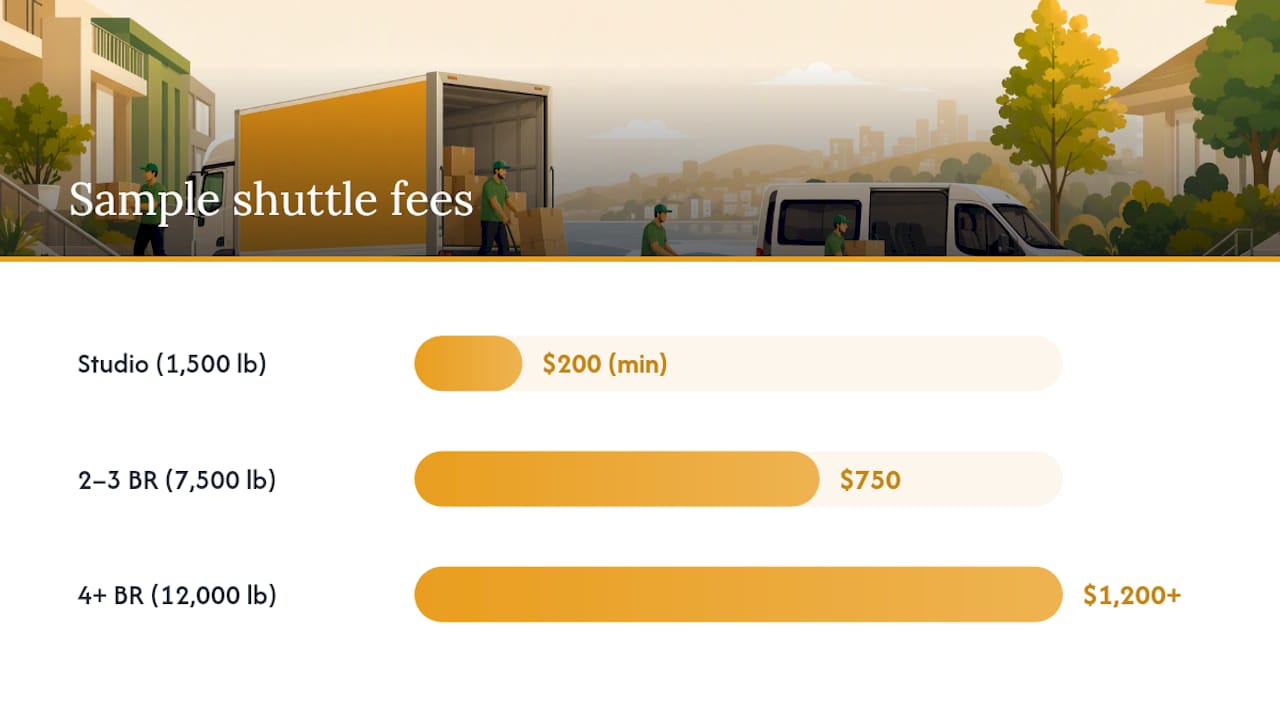
Numbers make this real. Here’s how the math plays out across three common move sizes.
A studio apartment move might weigh around 1,500 pounds. At $0.10 per pound, that’s only $150, but since most movers enforce a $200 minimum, you’d pay the floor instead of the calculated rate. Small moves almost always hit the minimum, which is why light shipments often pay a disproportionately higher shuttle rate per pound than larger ones.
A two to three bedroom home averaging 7,500 pounds tells a different story. At $0.10 per pound, that’s $750, well above any minimum. If billed by CWT instead at $10 per hundredweight, you’d land at roughly the same $750, which shows why comparing methods matters less once your shipment is large enough to clear the floor.
A large four-plus bedroom home running 12,000 pounds or more can trigger multiple shuttle trips if the smaller vehicle can’t carry the full load in one pass. At $0.10 per pound, base shuttle cost hits $1,200, and each additional trip may add its own per-trip charge on top.
Pro Tip: If both your old and new addresses have access problems, ask your mover to quote the shuttle fee separately for pickup and delivery. Seeing both numbers side by side stops the double charge from arriving as a surprise on moving day.
Because minimums are common, a studio move and a one-bedroom move can end up paying nearly the same shuttle fee even though their shipment weights differ substantially.
What Factors Push Shuttle Fees Higher or Lower?
Not every shuttle situation costs the same, and some of what drives the price is within your control.
Distance matters, but not the way you’d think. A shuttle fee covers moving your belongings between the truck and your door, which is a separate charge from a “long carry” fee that applies when the truck parks legally close but the crew still has to walk items a long distance across a lawn or parking lot. Confusing the two is one of the most common billing mix-ups on a moving invoice.
Site access and local rules drive most of the variation. Dense cities with strict parking enforcement and narrow colonial-era streets generate shuttle needs far more often than suburban or rural properties with wide driveways. Permit requirements for temporary loading zones can add cost or, handled early, remove the need for a shuttle entirely.
Load density and season play a smaller but real role. A heavy shipment packed into a small footprint calculates differently under per-pound versus per-cubic-foot pricing. Summer moving season, the industry’s peak demand window, can also push shuttle pricing upward simply because crews and secondary vehicles are in shorter supply.
Ways to work each factor in your favor:
- Confirm whether your quote lists a “long carry” or a “shuttle” fee, since they’re billed differently
- Ask your city or building management about temporary loading permits before move day
- Book outside peak summer weekends if your schedule allows it
- Request a per-cubic-foot quote if your shipment is bulky but light
When Is Shuttle Service Actually Required?
Some shuttle situations aren’t negotiable. If a bridge clearance, a municipal size restriction, or a homeowners association rule physically bars a full-size truck from your street, no amount of negotiating changes that. Movers documenting a hard access limit, like a 13-foot parking garage clearance or a weight-restricted bridge, are stating a fact, not upselling you.
Other situations have more room to move. Temporary “No Parking” permits from your city can sometimes clear enough curb space for a full-size truck to park legally, eliminating the shuttle need entirely. Offering an alternate staging area, like a nearby lot or a wider cross street, can also work if your mover is willing to walk the extra distance instead of billing a shuttle.
Whatever the reason your mover gives you, get it in writing. A one-line note in your contract stating why a shuttle is required protects you if the situation turns out to be avoidable after all.
Are Shuttle Fees Included in Your Moving Estimate?
Often, no. Online moving-cost tools frequently list shuttle service as an extra that only appears once a mover actually sees your property, either in person or through photos. That’s not a bait-and-switch tactic in most cases. It’s that access problems are genuinely hard to judge from an address alone.
To confirm whether your quote accounts for shuttle risk, ask your mover for the following:
- The fee basis, meaning whether they bill per pound, per cubic foot, or CWT
- The minimum charge, in case your shipment is small
- Written contract language stating the exact circumstances that would trigger the fee
- Photos or a virtual walkthrough submitted in advance so the estimate reflects your real access conditions
Federal consumer guidance from the FMCSA recommends documenting your estimate thoroughly before move day, and shuttle fees are exactly the kind of line item that documentation should cover.
How Can You Avoid or Reduce Shuttle Fees?
You have more leverage here than most people assume. A little upfront coordination routinely removes the need for a shuttle altogether, or at minimum shrinks the number of trips required.
Start with a live or virtual site survey. Sending photos or video of your street, driveway, and building entrance lets your mover assess access before quoting, rather than discovering the problem on move day and charging accordingly.
From there:
- Ask your mover to document the exact fee basis and minimum in writing before you sign
- Offer an alternate parking area if your street is too narrow, even if it means a slightly longer carry
- Look into a temporary loading permit through your city if you’re in a restricted zone
- Schedule your move for a weekday or off-peak season, when secondary vehicles are easier to book
- Negotiate a capped per-trip rate instead of open-ended per-pound billing if your load is small
Pro Tip: Ask specifically whether a partial DIY approach, like carrying a few oversized items yourself to the truck’s parking spot, could shrink your shipment weight enough to avoid the shuttle minimum entirely. It won’t work for every move, but for borderline cases it can save a few hundred dollars.
How Do Shuttle Fees Compare to Other Moving Surcharges?
Shuttle fees rarely travel alone. Most quotes include a handful of access-related surcharges, and knowing which one is likely to be your biggest cost helps you prioritize what to ask about.
| Surcharge | Typical range | When it applies |
|---|---|---|
| Shuttle service | $200 minimum, or $0.08–$0.12/lb | Truck can’t access the property at all |
| Long carry | Charged per 75–100 feet | Truck parks legally but far from the door |
| Stairs fee | Varies by flight and load | No elevator, multiple flights involved |
| Elevator fee | Varies by building policy | Building requires scheduled elevator use |
| Parking permit | Local permit cost | City requires a temporary loading zone |
Long carry charges are billed separately from shuttle fees and typically apply per 75 to 100 feet of extra walking distance. Shuttle fees tend to be the largest single surcharge when a full-size truck can’t get anywhere near your building, since that scenario requires an entirely separate vehicle and crew, not just extra walking.
Ask your mover directly which surcharges apply to your specific address, and get each one itemized separately rather than bundled into one vague “access fee” line.
How Do You Estimate Your Own Shuttle Fee Before Moving Day?
You can build a rough estimate yourself in a few minutes. Start with this checklist:
- Measure the carry distance from where a full-size truck could realistically park to your front door
- Note every access obstacle, including low clearances, narrow turns, and steep or unpaved surfaces
- Estimate your shipment weight or cubic footage using your mover’s inventory sheet or an online moving calculator
- Confirm whether your city or building requires a loading permit for your move date
Once you have those numbers, apply the pricing ranges from earlier in this guide. Multiply your estimated weight by $0.10 per pound as a middle-of-the-road figure, then compare that result against the roughly $200 minimum most movers enforce, and use whichever number is higher.
If both your pickup and delivery addresses have access problems, run this calculation twice and add the results together. That combined figure, not the single-location estimate, is your realistic shuttle budget for the whole move.
Move Craft’s Approach to Preventing Shuttle Surprises
Movecraftmoving vets every carrier in its network for how they handle access assessments, not just pricing. That means requesting a virtual walkthrough or photo survey before locking in a quote, so shuttle risk gets flagged early instead of discovered on move day.
Movecraftmoving also pushes for written fee documentation upfront: the exact billing method, the minimum charge, and the specific access condition that would trigger the fee. Coordinating permit needs with your building or city ahead of time is part of that same process, aimed at cutting shuttle costs before they show up on your invoice.
A Publisher’s Take on Budgeting for Shuttle Fees
If your street, driveway, or building has any access question mark, build a shuttle minimum into your budget from the start. Treat it as a real line item, not a worst-case scenario, because for a meaningful share of U.S. moves, it isn’t optional.
The single highest-leverage move you can make is asking for a written fee basis before you sign anything. A mover who won’t commit to a specific rate and minimum in writing is one you should push harder, or walk away from. Early site surveys and permit checks cost you nothing but a little time, and they routinely save hundreds of dollars in avoided shuttle trips.
Coordinating a move with several access unknowns is exactly where a service like Movecraftmoving earns its keep, matching you with carriers who treat site surveys as standard practice rather than an afterthought.
— Info
How Movecraftmoving Helps You Avoid Shuttle-Fee Surprises
Movecraftmoving exists for exactly the scenario this article walks through: a move where you don’t know yet whether a shuttle fee applies, and you’d rather find out before moving day than after. Instead of accepting a generic online quote that ignores your street’s access quirks, Movecraftmoving connects you with vetted carriers who commit to a site survey, either in person or virtual, and put the fee basis in writing before you sign.

That written commitment is the difference between budgeting confidently and getting blindsided by a $200 minimum you didn’t see coming. Movecraftmoving’s network handles permit coordination too, so if a temporary loading zone can eliminate your shuttle need entirely, that gets explored before it gets billed. Start by working through Movecraftmoving’s relocation checklist to document your access conditions, then request a quote to get a carrier match with transparent, itemized pricing.
Where This Article’s Numbers Come From
- Per-pound, per-cubic-foot, and CWT pricing ranges: MoveBuddha’s shuttle fee explainer
- Shuttle fees as a common estimate extra: Moving
- Consumer documentation guidance: FMCSA’s rights and responsibilities brochure
- Moving expense tax rules: IRS guidance on deducting moving expenses
Sources
- What is a moving company shuttle fee? — MoveBuddha
- Moving
- Your Rights and Responsibilities When You Move — FMCSA
- Can I deduct my moving expenses? — IRS
Recommended
- Transparent Pricing From Licensed Movers: What You Need to Know – Move Craft Moving Solutions LLC
- 15 Questions to Ask Local Moving Companies Before You Hire – Move Craft Moving Solutions LLC
- Commercial Move Cost Factors Explained for Business Owners – Move Craft Moving Solutions LLC
- Full Service vs Partial Service Moving: 2026 Guide – Move Craft Moving Solutions LLC