
Transparent pricing in moving is defined as the full, upfront disclosure of all costs before a single box is loaded. The role of transparent pricing from licensed movers goes beyond good customer service. Federal law requires it for interstate moves, and the FMCSA enforces it through 49 CFR Part 375, which mandates written contracts with itemized cost breakdowns. Without this protection, roughly 25% of consumers using full-service movers face significant pricing discrepancies. That number reflects a real financial risk, not a minor inconvenience. This article explains the regulations behind pricing transparency, how different estimate types work, and what to check before you hire anyone.
What is the legal role of transparent pricing for licensed movers?
Pricing transparency is a legal requirement for licensed interstate movers, not a courtesy. Interstate movers must register with the FMCSA and hold a valid USDOT number, both verifiable through the FMCSA SAFER database. Under 49 CFR Part 375, every interstate carrier must provide a written contract that includes an itemized estimate before the move begins. This regulation exists specifically to prevent hidden fees and protect consumers from financial surprises on moving day.
State regulations govern intrastate moves, and requirements vary. Most states require movers to hold a state-issued license and provide written estimates. Some states, including California and Florida, have consumer protection offices that specifically handle moving complaints. Knowing which rules apply to your move type is the first step in protecting your budget.

The FMCSA also gives consumers the right to dispute charges and file complaints against carriers who violate pricing disclosure rules. Transparent pricing is mandatory for compliance, not optional. A mover who avoids giving you a written estimate is already breaking the rules. That pattern is a warning sign, not a negotiating style.
One of the most serious risks tied to pricing opacity is the “hostage load,” where a mover holds your belongings and demands extra payment before delivery. Federal regulations cap what a mover can charge on delivery day for non-binding estimates, but enforcement depends on consumers knowing their rights. Understanding those rights starts with reading your contract before you sign it.
- Licensed interstate movers must carry a valid USDOT number and FMCSA operating authority.
- Written contracts with itemized pricing are required under 49 CFR Part 375.
- State licensing rules apply to intrastate moves and vary by state.
- Consumers can file complaints with the FMCSA or state consumer protection agencies.
- Verbal estimates and vague quotes are red flags under federal and state consumer protection law.
Pro Tip: Search your mover’s USDOT number in the FMCSA SAFER database before signing anything. The search is free and takes under two minutes.
How do different pricing models affect transparency and your costs?
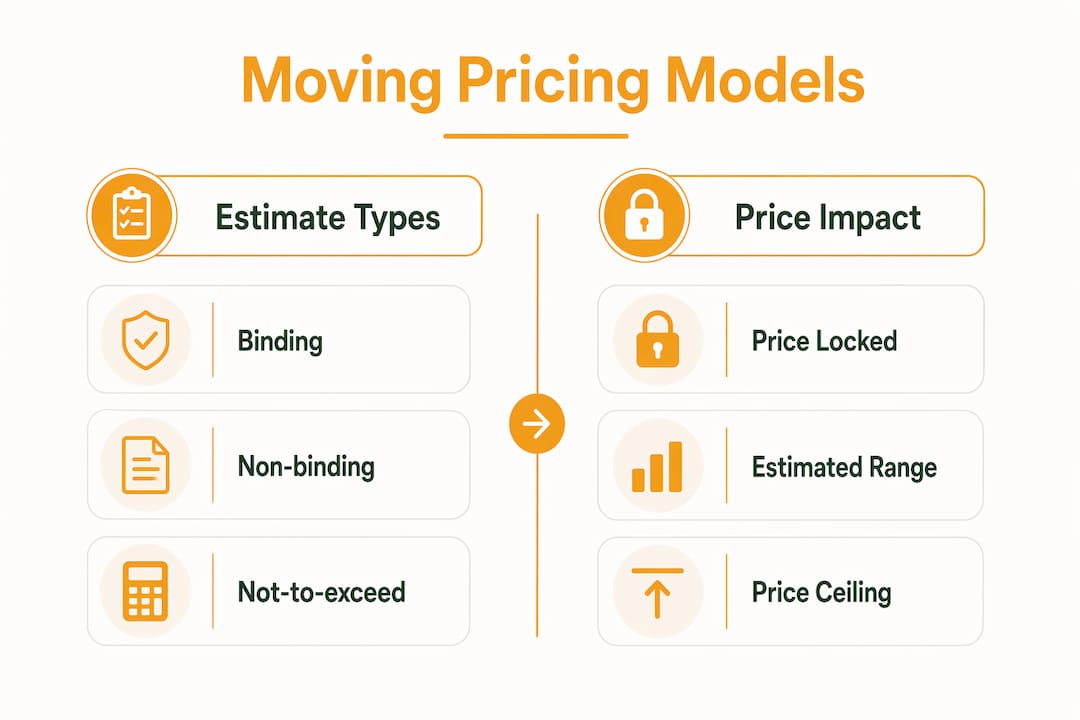
Not all estimates are created equal. The type of estimate a mover offers directly determines how much price certainty you have on moving day.
Binding estimates
A binding estimate locks your total price before the move. Binding estimates require a thorough in-home or virtual survey of your household goods. The mover cannot legally charge more than the agreed amount, even if the actual weight or time exceeds the estimate. This is the strongest consumer protection available in the moving industry.
Non-binding estimates
A non-binding estimate is a projection, not a guarantee. Under federal law, specifically 49 CFR 375.407, a mover can charge up to 110% of the original estimate on delivery day for a non-binding quote. That 10% buffer sounds small, but on a $5,000 move it adds $500 you did not plan for. Non-binding estimates are legal, but they require you to read the fine print carefully.
Not-to-exceed estimates
A not-to-exceed estimate, sometimes called a “guaranteed not-to-exceed” quote, is a hybrid. The mover sets a ceiling price. If the actual cost comes in lower, you pay the lower amount. This model offers solid transparency because your maximum exposure is fixed from the start.
Hourly vs. flat-rate pricing for local moves
Local moves often use hourly billing or flat-rate pricing. Hourly billing can be transparent when the rate is fixed and no surge pricing applies, but your total cost depends on how long the job takes. Flat-rate pricing offers a guaranteed total, but only when the mover conducts a mandatory inventory survey first. A flat-rate quote given without seeing your belongings is almost always a lowball estimate with hidden fees waiting on the other side.
The table below shows how each model compares on price certainty and transparency.
| Estimate Type | Price Certainty | Transparency Level | Survey Required |
|---|---|---|---|
| Binding | Locked total | High | Yes |
| Non-binding | Up to 110% of quote | Moderate | Recommended |
| Not-to-exceed | Capped maximum | High | Yes |
| Hourly (local) | Variable | Moderate | No |
| Flat-rate (local) | Fixed total | High | Yes |
Pro Tip: Never accept a flat-rate quote for anything larger than a studio apartment without an inventory walkthrough. A quote given sight-unseen is a setup for surprise charges.
Why does verifying licensing and pricing transparency matter before you hire?
Verification is the step most movers skip, and it is the step that prevents the most problems. A mover’s licensing status tells you whether they are legally allowed to operate. Their pricing practices tell you whether they are honest.
- Look up the USDOT number. Every licensed interstate mover has one. Enter it at the FMCSA SAFER database online. The result shows operating authority, insurance status, and complaint history in one place.
- Check complaint history. A pattern of unresolved complaints about pricing discrepancies is a direct signal of how that company operates. One or two complaints on a large carrier may be normal. Dozens of unresolved billing disputes are not.
- Confirm insurance coverage. Licensed movers must carry cargo insurance and liability coverage. Ask for a certificate of insurance before the move date. A mover who cannot produce one is not fully compliant.
- Demand a written estimate after a survey. Any quote without a physical or virtual inventory walkthrough is likely to change. Reputable movers schedule an in-home or video survey before finalizing any number.
- Watch for red flags. Vague verbal estimates, refusal to provide a written contract, and requests for large cash deposits upfront are all warning signs of a fraudulent operator.
The lack of standardized pricing disclosure gives fraudulent operators room to exploit consumers. Legitimate movers lose business to lowball competitors who hide fees in the fine print. Verification protects you from both outcomes. You can also review Movecraftmoving’s guide on avoiding moving scams for a deeper look at common fraud patterns.
Pro Tip: Ask every mover you interview: “Is this a binding or non-binding estimate, and what triggers a price change?” A mover who cannot answer clearly is not ready to earn your business.
What are the real benefits of transparent pricing for your move?
Transparent pricing delivers benefits that go well beyond regulatory compliance. The most direct benefit is budget certainty. When you know the full cost upfront, you can plan your finances without leaving a buffer for unknown charges. That clarity removes one of the biggest stressors in any relocation.
Transparent pricing eliminates surprise fees, reduces move-day stress, and improves trust between you and your mover. Those three outcomes are connected. When you trust the price, you trust the company. When you trust the company, communication improves. When communication improves, problems get resolved faster.
Pricing transparency also makes comparison shopping fair. When every quote uses the same itemized format, you can evaluate movers on service quality, not just the bottom line number. That is how a healthy market works. Licensed movers who follow transparent pricing create a marketplace where quality and reliability compete fairly, instead of price alone driving every decision.
- Eliminates surprise fees and budget overruns on moving day.
- Builds trust and improves communication between you and your mover.
- Reduces stress by setting clear expectations from the start.
- Allows fair, apples-to-apples comparison of quotes across companies.
- Holds movers accountable and builds long-term industry reputation.
- Correlates directly with higher overall move satisfaction.
The importance of pricing transparency extends to dispute prevention. When your contract spells out every charge, there is no room for a mover to invent new fees after the fact. If a dispute does arise, a written, itemized contract is your strongest evidence.
Key Takeaways
Licensed movers are legally required to provide transparent, written pricing, and consumers who verify that transparency before signing protect their budgets and their belongings.
| Point | Details |
|---|---|
| Binding estimates offer the most protection | They lock your total price and require a full inventory survey before the move. |
| FMCSA verification is non-negotiable | Search every mover’s USDOT number in the SAFER database before committing. |
| Non-binding estimates carry real risk | Federal law allows final charges up to 110% of the original quote. |
| Flat-rate quotes need a survey | Any flat-rate price given without an inventory walkthrough is likely a lowball estimate. |
| Transparent pricing reduces disputes | A written, itemized contract is your best protection if a billing disagreement arises. |
Why I think “lowest quote” is the most expensive mistake you can make
The most common mistake I see movers make is choosing the lowest quote without asking how that number was calculated. A $1,800 estimate that skips the inventory survey will almost always cost more than a $2,400 binding estimate that includes one. The difference is not the price. The difference is the process behind it.
Consumers often misunderstand estimates. Transparent and verifiable pricing matters more than a low number or even a binding label. I have seen binding estimates that were still misleading because the inventory survey was rushed and incomplete. The estimate type is a framework. The honesty of the mover filling it out is what actually protects you.
The question I always recommend asking is not “What is your price?” It is “How did you arrive at that price?” A mover who walks you through their calculation, line by line, is a mover who has nothing to hide. That transparency is a direct signal of how they will handle every other part of your move. For added peace of mind, reviewing your moving insurance options alongside your pricing contract gives you a complete picture of your financial exposure.
Prioritize transparency over the lowest number every time. The movers who compete on honesty are the ones worth hiring.
— Info
How Movecraftmoving puts transparent pricing into practice
Movecraftmoving was built on one principle: you should know exactly what your move costs before the truck arrives. Every carrier in the Movecraftmoving network is fully licensed, FMCSA-compliant, and required to provide written, itemized estimates after a proper inventory review.

Movecraftmoving vets every partner for pricing integrity, insurance compliance, and service consistency. You get a clear contract, a verified carrier, and no surprises on moving day. Whether you are planning a local relocation or a long-distance move, start with Movecraftmoving to connect with carriers who treat transparency as a standard, not a selling point. For commercial relocations, the vendor coordination checklist is a practical resource for keeping every cost visible from day one.
FAQ
What does transparent pricing mean for licensed movers?
Transparent pricing means a licensed mover provides a full, written, itemized cost estimate before the move begins. Under 49 CFR Part 375, this is a federal requirement for all interstate household goods carriers.
What is the difference between a binding and non-binding estimate?
A binding estimate locks your total price after a full inventory survey, while a non-binding estimate allows the mover to charge up to 110% of the original quote on delivery day under federal law.
How do I verify a mover’s license and pricing legitimacy?
Search the mover’s USDOT number in the FMCSA SAFER database to confirm operating authority, insurance status, and complaint history before signing any contract.
What is a hostage load and how does transparent pricing prevent it?
A hostage load occurs when a mover holds your belongings and demands extra payment before delivery. A written, binding contract with itemized pricing removes the legal basis for those extra charges.
Why should I choose a licensed mover over an unlicensed one?
Licensed movers operate under federal and state consumer protection rules that require written contracts, transparent pricing, and insurance coverage. Unlicensed operators carry none of those obligations and no accountability if something goes wrong.