
Most interstate long-distance movers price your shipment by weight, in pounds, and back that figure with a certified scale ticket showing tare and gross weight. The pricing method matters less than the paperwork behind it. Insist on a binding or binding not-to-exceed estimate before signing anything, because that single term, not the unit of measurement, decides whether your final bill matches the number you were quoted.
TL;DR:
- Most long-distance movers charge by weight, verified with a certified scale ticket, which provides a binding proof for the final cost.
- Volume-based estimates rely on a mover’s judgment and are rarely independently verified, increasing the risk of inflated charges.
- A proper reweigh can dispute discrepancies in actual weight, emphasizing the importance of keeping all weigh tickets and documentation.
- Accessorial fees like packing, stairs, storage, and insurance can significantly raise the final bill beyond initial estimates, regardless of pricing method.
- Requesting a binding, not-to-exceed estimate before moving ensures the final price is capped and reduces surprises during settlement.
Table of Contents
- Weight vs. Volume Moving: The Quick Comparison
- How Weight-Based Pricing Actually Works
- How Volume-Based Pricing Actually Works
- Real-World Cost Examples: Weight vs. Cubic Feet
- Charges That Change Your Final Bill Beyond Weight or Volume
- How to Compare Moving Quotes Without Getting Burned
- Movecraftmoving’s Approach: Verified Carriers, Predictable Pricing
- What Long-Distance Moving Customers Actually Care About
- Get a Binding Quote Before You Commit to a Carrier
- Sources
- FAQ
Weight vs. Volume Moving: The Quick Comparison
Weight and volume measure two different things, and knowing which one your mover uses changes how you should read your quote. Weight is measured in pounds and comes from an actual scale. Volume is measured in cubic feet and comes from someone’s estimate of how much space your belongings will occupy in a truck or container.
Interstate long-distance movers overwhelmingly default to weight-based pricing, because federal tariff rules and decades of industry practice built around it make weight the standard for line-haul billing. Volume-based pricing shows up more often with portable storage containers, some regional or partial-load moves, and a handful of flat-rate cubic-foot services.
| Factor | Weight-based pricing | Volume-based pricing |
|---|---|---|
| Unit | Pounds (lbs) | Cubic feet (cu ft) |
| Common use | Interstate long-distance moves | Containers, partial loads, some regional moves |
| Verification | Certified scale ticket | Cube sheet estimate, rarely independently verified |
| Typical risk | Reweigh disputes | Vague or inflated cubic-foot estimates |
The practical difference comes down to proof. A scale ticket is a document you can hold, question, and dispute. A cube sheet is somebody’s judgment call, made faster.
- Weight pricing gives you a third-party number from a certified scale.
- Volume pricing gives you a mover’s estimate of space, which varies by how tightly your items get packed.
- Neither method guarantees a fair price. The estimate type attached to it does far more of that work.
How Weight-Based Pricing Actually Works
A weight-based quote starts with an in-home or virtual survey. The mover walks through your rooms, lists every item, and converts that inventory into an estimated poundage using standard weight tables for furniture, boxes, and appliances. That estimated weight, multiplied by a per-pound line-haul rate for your mileage band, produces your initial quote.
The real number comes later, at the scale. Loaded trucks get weighed twice: once empty (tare weight) and once loaded (gross weight). The difference is your shipment’s net weight, and that figure, not the survey estimate, determines your actual charge under most tariffs.
- Get the estimated weight in writing before the truck is packed, along with the per-pound rate.
- Ask which certified scale the carrier uses and whether you can witness or receive copies of both weigh tickets.
- Request a reweigh if the delivered weight looks inconsistent with your inventory. Reweighs at a certified facility are a standard dispute-resolution step most carriers will honor before finalizing your balance.
- Keep both tickets until the move is fully paid and settled, not just delivered.
Pro Tip: Photograph your inventory list and the estimated weight sheet before the crew loads the truck. If a dispute comes up later, a timestamped record beats a memory every time.
FMCSA’s own consumer guidance covers exactly this kind of documentation for interstate moves, including how weigh tickets factor into a binding estimate.
How Volume-Based Pricing Actually Works
Volume pricing calculates cubic feet, roughly length times width times height for each item, and totals it into a cube sheet. That figure sets your price, either as a flat rate for a given number of cubic feet or as a rate per cubic foot for whatever space your load consumes.
Container-based movers and portable storage services lean on this model because it fits their pricing structure: you’re renting a defined amount of space, not paying by what a scale tells them afterward. Some regional carriers and partial-truckload movers use it too, particularly when a full weigh station isn’t part of their normal route.
The catch is verification, or the lack of it. Nobody hands you a certified cube ticket the way they hand you a scale ticket. Two crews can look at the identical pile of boxes and estimate different cubic footage, and packing efficiency, how tightly items get arranged, directly changes the final number.
- Cube sheets are typically calculated by the same in-home surveyor who does weight-based inventories, just converted into a space estimate instead.
- Container sizes are usually sold in fixed increments (small, medium, large units, or specific linear-foot allotments on a shared truck).
- Volume pricing tends to work fairly when you control the packing yourself, since efficient packing directly lowers your cubic footage and, in turn, your cost.
- It becomes riskier when the mover both estimates the cube and loads the truck, since there’s no independent check on their number.
Real-World Cost Examples: Weight vs. Cubic Feet
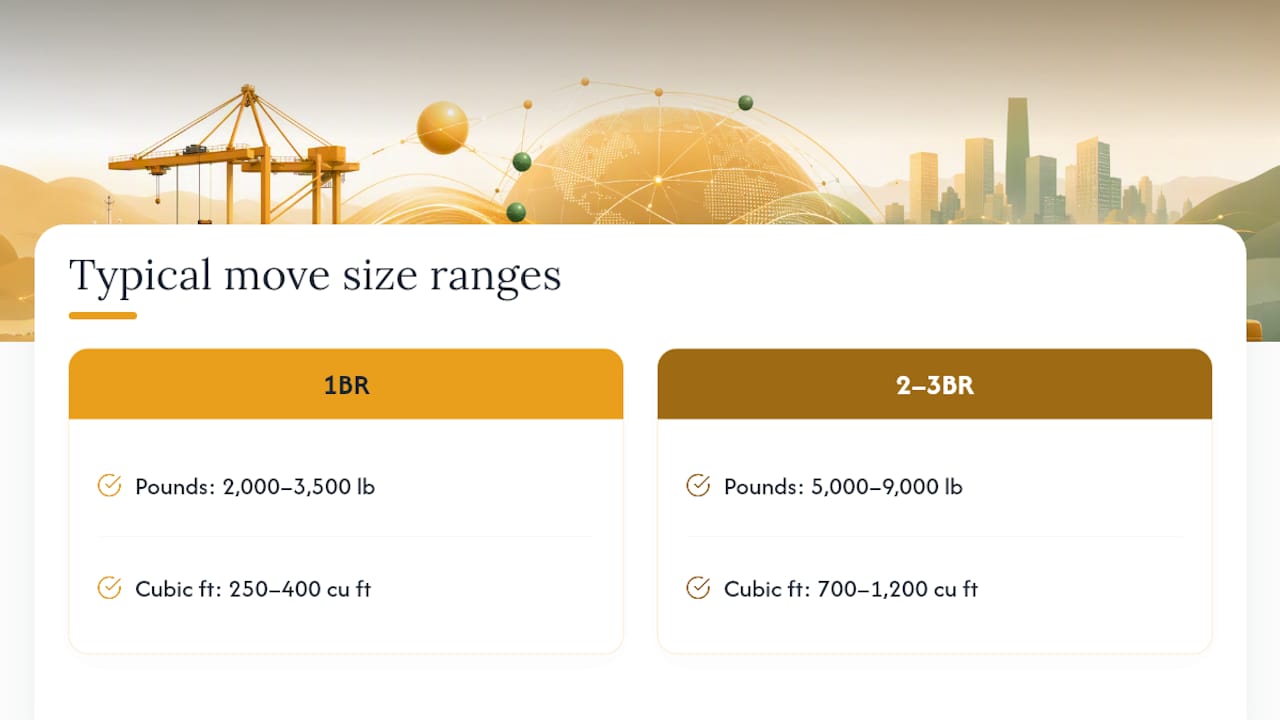
A one-bedroom apartment typically runs 2,000 to 3,500 pounds or 250 to 400 cubic feet, depending on furniture density and box count. A two- to three-bedroom home usually lands between 5,000 and 9,000 pounds, or 700 to 1,200 cubic feet.
Say a mover quotes your one-bedroom load at 2,800 pounds and a per-pound line-haul rate of $0.65 for a 1,200-mile move. That’s $1,820 before accessorials. A volume-based competitor quoting the same load at 320 cubic feet and $6.50 per cubic foot lands at $2,080, a gap driven entirely by how tightly they assume your boxes will pack.
These ranges illustrate the math, not a guaranteed price. Your actual rate depends on distance, season, and the carrier’s own tariff.
The estimate type attached to either number matters more than the unit itself. A non-binding estimate on either model can climb once the truck is actually loaded and weighed or measured. A binding not-to-exceed estimate caps what you’ll pay at the quoted figure, while still allowing a refund if the actual weight or volume comes in lower.
Charges That Change Your Final Bill Beyond Weight or Volume
Line-haul pricing, whether by weight or cubic feet, is only part of what shows up on your invoice. Several accessorial charges routinely push a “good” quote higher, and none of them depend on which pricing method your mover uses.
- Packing and materials: full-service packing, specialty crating for art or electronics, and even basic boxes and tape can add hundreds of dollars if they aren’t included in the base quote.
- Stairs, elevators, and long carries: a walk-up apartment or a truck that can’t park close to your door often triggers a flat surcharge per flight or per extra distance.
- Shuttle service: if a full-size truck can’t reach your street, a smaller shuttle vehicle transfers your load, and that transfer is billed separately.
- Storage and re-delivery: gaps between move-out and move-in dates mean storage-in-transit fees, plus a second delivery charge.
- Valuation and insurance: basic carrier liability is minimal by default; upgraded valuation coverage costs extra but protects far more of your shipment’s actual worth.
How to Compare Moving Quotes Without Getting Burned
Comparing quotes only works when you’re comparing the same job twice. A cheaper number tied to a smaller inventory or a lower service tier isn’t actually cheaper, it’s just incomplete.
- Match the inventory exactly. Every quote should reflect the same item list, the same packing responsibility (full-service versus self-pack), and the same access conditions at both addresses.
- Confirm the estimate type in writing. Ask directly: is this binding, non-binding, or binding not-to-exceed? Industry guidance consistently favors locking in a binding estimate over debating which pricing unit sounds better.
- Request the documentation method. For weight-based quotes, ask which certified scale they use and whether you’ll receive both weigh tickets. For volume-based quotes, ask to see the actual cube sheet and how it was calculated.
- Get an itemized breakdown. Line-haul charges should be separated clearly from packing, stairs, storage, and valuation costs, not bundled into one vague total.
- Watch for red flags. A suspiciously low non-binding quote, a cube sheet with no supporting detail, or pressure to sign before you’ve reviewed the inventory are all signs to walk away.
Pro Tip: After your final walkthrough, ask for a revised binding not-to-exceed estimate based on the updated inventory. That single request turns a rough online quote into a number you can actually plan around.
Before comparing carriers, it helps to know how to vet a mover’s credentials and business practices in the first place, covered in our guide on how to pick a moving company you can actually trust.
Movecraftmoving’s Approach: Verified Carriers, Predictable Pricing
The company vets carrier partners for FMCSA and DOT compliance before recommending them, and supports documentation and verification on weight-based shipments. When a quote arrives non-binding, the goal is to help convert it into a binding not-to-exceed arrangement after the final walkthrough.
What Long-Distance Moving Customers Actually Care About
Customers rarely care whether their move is priced by weight or cubic feet. What they want is predictability: a number that doesn’t move once the truck is loaded. Clear documentation, a scale ticket in hand, an inventory that matches what got packed, does more to earn trust on moving day than any explanation of pricing theory ever could.
— Info
Get a Binding Quote Before You Commit to a Carrier
This service aims to simplify comparing weight and volume quotes by recommending carriers vetted for FMCSA compliance and encouraging documented, binding pricing rather than estimates that may change after loading.

Whether you’re planning a cross-country relocation or a smaller regional move, the services worth knowing about include:
- Long-distance moving coordination with carrier vetting built in
- Full-service residential moving for households that want the packing handled too
- Professional packing services that reduce the cubic footage disputes covered above
Before your next move, pull together your inventory using our long-distance moving inventory checklist and request a quote through Movecraftmoving to see how a binding, carrier-vetted estimate compares to what you’ve already been offered.
Sources
- Moving Cost by Weight vs. Volume: How Long-Distance Movers Price Your Shipment
- Weight vs Cubic Feet Moving Estimates – Which is better?
- Moving Quote Terminology, Decoded | MYMOVE
- What is a binding move estimate? | FMCSA
FAQ
Do Moving Companies Charge by Weight or Cubic Feet?
Most interstate long-distance movers charge by weight, using certified scale tickets to document tare and gross weight, while cubic feet pricing shows up more often with containers and some regional or partial-load moves.
What Is the Difference Between Volume and Weight in a Move?
Weight is measured in pounds using an actual scale; volume is measured in cubic feet based on an estimate of how much space your items occupy. Weight has independent verification through weigh tickets, and volume typically doesn’t.
How Do I Convert Volume to Weight for a Move?
There’s no fixed universal conversion, since it depends entirely on how densely your specific items pack. Movers use standard weight tables per item type when building an inventory-based estimate, but the only reliable weight figure comes from an actual scale ticket.
Is a Non-Binding Estimate the Same as a Binding One?
No. A non-binding estimate can increase once your actual weight or volume is measured, while a binding or binding not-to-exceed estimate locks in a maximum price regardless of small changes in the final measurement.
Does Movecraftmoving Offer Binding Estimates?
Movecraftmoving works to convert quotes into binding not-to-exceed arrangements after your final inventory walkthrough, and current pricing details are available directly through the Movecraftmoving site when you request a quote.