
If you’re figuring out how to pick a moving company, six checks separate a smooth move from a nightmare: get a written estimate, collect several quotes to compare pricing, confirm active USDOT operating authority through FMCSA, understand your valuation coverage before you sign, dig into BBB ratings and confirm a real physical address, and walk away at the first sign of a red flag. Skip any one of these, and you’re gambling with your furniture, your deposit, and your moving date.
Here’s the fast version before we get into the “why” behind each step:
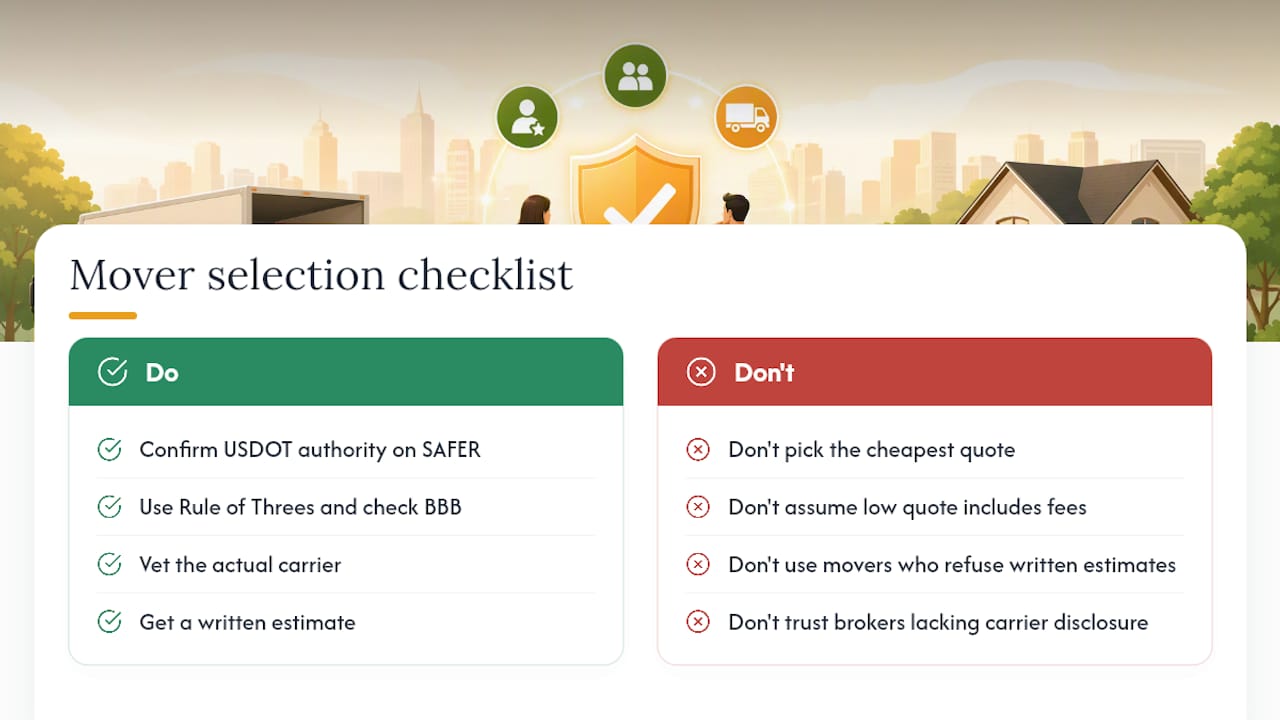
- Get a written, itemized estimate based on an in-home or video walkthrough, not a phone quote.
- Request estimates from several companies to catch lowball pricing.
- Look up the company’s USDOT number on FMCSA’s SAFER system and confirm operating authority is active.
- Check the Better Business Bureau profile for complaint patterns, not just a star rating.
- Verify a real street address and ask for recent references.
- Walk away from cash-only deposits, blank contracts, or movers who won’t put pricing in writing.
The single biggest predictor of a bad move isn’t price. It’s whether a company gave you a real inspection before quoting you a number.
Key Takeaways
Picking a safe, licensed mover comes down to verifying USDOT authority on FMCSA’s SAFER system, collecting three written in-home estimates, and reading BBB complaint patterns before signing anything.
| Point | Details |
|---|---|
| Verify licensing first | Check active USDOT operating authority on FMCSA’s SAFER system before requesting quotes. |
| Follow the Rule of Threes | Collect at least three written, in-home or video-based estimates to catch lowball pricing. |
| Read complaint patterns, not star ratings | Check BBB profiles for recurring issues like damage disputes or hostage-holding tactics. |
| Know your estimate type | Binding, non-binding, and binding not-to-exceed estimates each affect your final bill differently. |
| Use a vetted network to skip the legwork | Movecraftmoving pre-checks carrier licensing and insurance before matching customers with movers. |
Table of Contents
- How Do You Find Trustworthy Moving Companies to Vet?
- Why Do You Need Three In-Home Moving Estimates?
- How Do You Verify a Mover’s License With FMCSA?
- What Do BBB Ratings and Reviews Actually Tell You?
- What Moving Scams Should Make You Walk Away Immediately?
- Binding vs. Non-Binding Estimates: What’s the Real Difference?
- How Do You Compare Multiple Moving Bids Fairly?
- What Should You Expect on Moving Day?
- How Much Moving Insurance Coverage Do You Actually Need?
- What Contract Terms Are Worth Negotiating?
- How Movecraftmoving Simplifies Finding a Vetted Mover
- Frequently Asked Questions
- Sources
How Do You Find Trustworthy Moving Companies to Vet?
Start with people who’ve actually moved recently, not a random search results page. Ask neighbors, coworkers, or a local real estate agent who handled their relocation and whether the final bill matched the quote.
From there, layer in official sources. FMCSA’s SAFER system confirms whether a company is even legally allowed to move you across state lines. Protectyourmove centralizes federal consumer resources and links out to state licensing portals for movers that only operate within one state. Your state’s attorney general page or consumer protection office is worth a search too, especially for intrastate moves that fall outside federal oversight.
Pro Tip: When a referral checks out, ask for the actual move date and request to see a few before-and-after photos of how the crew packed fragile items. A friend’s five-star review means little if you don’t know what “good” looked like in practice.
Why Do You Need Three In-Home Moving Estimates?
Consumer advocates call it the Rule of Threes for a reason: Consumer Reports recommends getting several written, in-home estimates before picking a mover, because a single quote gives you no baseline for comparison.
In-home or detailed video walkthroughs matter more than the estimate itself. FMCSA warns that phone or email-only quotes are a common lowball tactic that leads to inflated final invoices once the crew shows up and “discovers” more boxes than expected.
- Record the walkthrough with a timestamped video for your own records.
- Ask whether the estimate is binding, non-binding, or binding not-to-exceed.
- Confirm what’s included: packing materials, stair or long-carry fees, and storage if needed.
Pro Tip: Ask each estimator the same follow-up question: “What typically causes your final price to change from this number?” The answers reveal more about a company’s honesty than the quote itself.
How Do You Verify a Mover’s License With FMCSA?
Every company handling an interstate move needs an active USDOT number and operating authority. Here’s how to check it yourself in under five minutes:
- Go to the FMCSA SAFER Company Snapshot and search by company name or USDOT number.
- Confirm “Operating Authority” reads as active, not revoked or pending.
- Check the entity type: carrier means they own trucks and employ movers; broker means they arrange transport through another company.
- Look for out-of-service flags or recent safety violations listed on the snapshot.
- Screenshot the results and save them with your estimate paperwork.
The carrier-versus-broker distinction trips up more people than any other step in this process. A broker isn’t necessarily dishonest, but they’re required to disclose the actual carrier and USDOT number before pickup, and you need to run your own vetting checks on that carrier, not just the company that sold you the quote. State licensing fills the gaps for moves that stay within one state, though coverage varies widely by state — some maintain active intrastate registries, others rely entirely on BBB profiles and attorney general complaint databases.
What Do BBB Ratings and Reviews Actually Tell You?
A high star average means little without context. Pull up the company’s BBB profile and read the complaint narratives, not just the letter grade: are people describing damaged goods, or are they describing a mover who held their entire shipment hostage until they paid an inflated final bill? Those are very different problems.
- Cross-reference BBB complaints against FMCSA’s safety record on the SAFER snapshot.
- Look for patterns across multiple review platforms, not just one glowing five-star cluster.
- Ask the mover directly for two or three references from moves completed in the last six months.
- When you call a reference, confirm the move date, the origin and destination cities, and whether the final price matched the estimate.
A company that hesitates to provide references, or offers only reviews it hand-picked, is telling you something.
What Moving Scams Should Make You Walk Away Immediately?
Some warning signs are non-negotiable. If you see any of these, stop the conversation and move to the next company on your list.
- A quote given entirely over the phone or by email, with no walkthrough or video survey.
- Demands for a large cash deposit before any work begins.
- A business address that’s only a P.O. box, or a company name that’s changed multiple times in recent years.
- No USDOT number offered for a move that crosses state lines.
- Refusal to put pricing, services, or valuation coverage in writing.
If a mover already has your belongings and is demanding extra payment before delivery, that’s a federal issue. Document everything, contact FMCSA’s consumer complaint line, and notify your state attorney general’s office immediately. Learn to spot unlicensed moving companies before you’re in that position at all.
Pro Tip: Ask every company for proof of insurance and workers’ compensation coverage before the walkthrough even starts. Legitimate movers produce this in minutes; scammers stall.

Binding vs. Non-Binding Estimates: What’s the Real Difference?
This is where most surprise fees come from. A binding estimate locks in a final price regardless of actual weight, as long as your inventory doesn’t change. A non-binding estimate is based on the mover’s projected weight and can shift at delivery. A binding not-to-exceed estimate gives you the best of both: you pay the lower of the estimated or actual cost, never more.
Federal rules protect you specifically on non-binding quotes. Under FMCSA’s 110% rule, a mover can charge no more than 110% of a non-binding estimate at delivery. Anything above that threshold has to be billed separately, later, in writing.
What actually moves your price:
- Total shipment weight and cubic footage
- Distance between origin and destination
- Access issues: stairs, long carries, narrow streets, or elevator restrictions
- Specialty items like pianos, safes, or artwork
- Add-on services: packing, storage, or expedited delivery
Understanding transparent pricing structures before you sign anything saves you from disputing a final bill you didn’t see coming.
How Do You Compare Multiple Moving Bids Fairly?
Once you’ve got three estimates in hand, score them against the same criteria instead of just eyeballing the bottom line. A cheaper quote from an unlicensed operator isn’t actually cheaper if your belongings end up damaged or delayed.
| Comparison Dimension | What to Check |
|---|---|
| Price and estimate type | Binding, non-binding, or binding not-to-exceed |
| Licensing and authority | Active USDOT number confirmed on SAFER |
| Reputation | BBB grade, complaint patterns, verified references |
| Services included | Packing, storage, specialty item handling |
| Timing and availability | Confirmed pickup window and delivery estimate |
| Valuation coverage | Released value vs. full value protection options |
Before signing anything, ask about the payment schedule, the cancellation policy, and the exact claims process for damaged items. Confirm the name and USDOT number of whichever carrier will physically load your truck, especially if you booked through a broker. A prepared list of questions to ask movers before you commit keeps the conversation on your terms, not theirs.
What Should You Expect on Moving Day?
Crews typically arrive within a window agreed on in advance, then walk the home with you to confirm the inventory before loading starts. For interstate moves, the truck gets weighed before and after loading to produce a certified weight ticket, which becomes the basis for your final bill if you took a non-binding estimate.
- Photograph or video every room before the crew starts loading.
- Get a signed inventory sheet listing the condition of major items.
- Keep your contract, ID, and inventory copy accessible all day, not packed in a box.
- Confirm delivery windows before the truck pulls away.
Someone who knows the household should stay on-site the entire time, from walkthrough to final signature.
How Much Moving Insurance Coverage Do You Actually Need?
Movers are required to offer two valuation options, and the difference between them is bigger than most people expect. Released value protection is the free default: it covers roughly 60 cents per pound per item, meaning a 50-pound television that gets crushed nets you around $30. Full value protection costs more but requires the mover to repair, replace, or cash-settle for the item’s actual value.
Claims typically need to be filed within nine months of delivery, with photos and a list of damaged or missing items submitted in writing. If you own high-value items like jewelry, art, or electronics, ask about a written “high-value inventory” form before moving day, since standard valuation coverage often caps payouts on individual pieces. For anything irreplaceable, third-party moving insurance is worth pricing out separately.
What Contract Terms Are Worth Negotiating?
Most people treat a moving contract as a formality to sign, not a document to negotiate. That’s a mistake. Movers build in flexibility on several terms, and asking costs you nothing.
Start with the delivery window. A “spread” of several days is standard on interstate moves, but you can often negotiate a narrower window or ask for a penalty clause if the company blows past it. Payment terms are negotiable too: push back on any request for full payment upfront, and confirm what forms of payment are accepted at delivery, since some movers won’t accept a credit card at the door.
Ask specifically about the claims deadline and process for damaged items, and get it written into the contract rather than taking a verbal promise. If you’re storing items mid-move, clarify who’s liable for damage during storage versus during transit. Review contract best practices for licensed movers before your final signature, especially the fine print around cancellation fees and rescheduling penalties.
Finally, never sign a blank or incomplete contract, and get every verbal promise, from a flat rate to a guaranteed delivery date, added in writing before the crew touches a single box.
Why This Checklist Works
Vetting a mover isn’t complicated, but it does require checking sources most people skip: SAFER records, BBB complaint text, and a written estimate that matches what actually gets loaded. Movecraftmoving builds its carrier network around that same layered vetting standard, because the companies that pass it are the ones that show up on time and deliver what they packed.
How Movecraftmoving Simplifies Finding a Vetted Mover
Running SAFER lookups, cross-checking BBB complaints, and collecting three separate in-home estimates takes real time, time most people planning a move don’t have. Movecraftmoving handles that vetting layer for you: every carrier in the network is checked for active operating authority, insurance compliance, and complaint history before they’re ever matched with a customer.

Instead of chasing down quotes from companies you’ve never heard of, you get connected with carriers that have already cleared the same checks outlined above, with clear guidance on valuation coverage and contract terms before you sign anything. If you’re planning a long-distance move, the long-distance moving process overview walks through what to expect from first quote to delivery day. Ready to see vetted options for your move? Request a quote and get matched with carriers that meet the standard this checklist just walked you through.
Frequently Asked Questions
How do I pick a moving company if I’m moving across state lines?
Confirm active USDOT operating authority through FMCSA’s SAFER system first, since interstate carriers fall under federal oversight that intrastate movers don’t. From there, follow the same Rule of Threes and BBB checks that apply to any move.
Is the cheapest moving quote ever the right choice?
Rarely. A quote significantly lower than two others usually signals a company that plans to inflate the bill through added fees at delivery, or one operating without proper insurance. Compare all three estimates against the same scope of services before deciding.
What’s the difference between a moving broker and a carrier?
A carrier owns the trucks and employs the crew moving your belongings. A broker arranges the move through a separate carrier and must disclose that carrier’s name and USDOT number before pickup. Always vet the actual carrier, not just the company that sold you the quote.
How far in advance should I book a mover?
Four to eight weeks ahead is typical for a domestic move, longer during peak summer months when demand for movers spikes and availability tightens fast.
What should I do if a mover won’t provide a written estimate?
Treat it as a disqualifying red flag. FMCSA requires written estimates based on an in-person or virtual inspection for interstate moves, and any company unwilling to provide one in writing isn’t operating the way a legitimate mover should.
Sources
- Steps to Select a Mover | FMCSA – Department of Transportation
- How to Choose a Reliable Moving Company – Consumer Reports
- How to Choose a Moving Company | MovingRated
- FMCSA SAFER Company Snapshot
- Protectyourmove
Recommended
- 15 Questions to Ask Local Moving Companies Before You Hire – Move Craft Moving Solutions LLC
- How to Spot Unlicensed Moving Companies Locally – Move Craft Moving Solutions LLC
- How to Avoid Long Distance Moving Scams in 2026 – Move Craft Moving Solutions LLC
- Residential Movers with Storage Solutions Compared 2026 – Move Craft Moving Solutions LLC