A long distance move is defined as any relocation covering more than 100 miles, typically crossing state lines and falling under federal regulation by the FMCSA (Federal Motor Carrier Safety Administration) and USDOT licensing requirements. Unlike local moves, which wrap up in a single day, interstate relocations involve coordinated logistics that span weeks. The long distance moving process overview most people need covers six distinct phases: planning, carrier selection, packing, loading, transit, and delivery. Getting any one of these phases wrong costs time and money. Start planning at least 8–12 weeks ahead of your move date, and book your carrier 4–6 weeks out to secure availability.
What are the key timeline milestones in the long distance moving process?
The long distance moving timeline explained as a week-by-week scaffold gives you the clearest path from decision to delivery. Most movers underestimate how early the critical decisions need to happen.
-
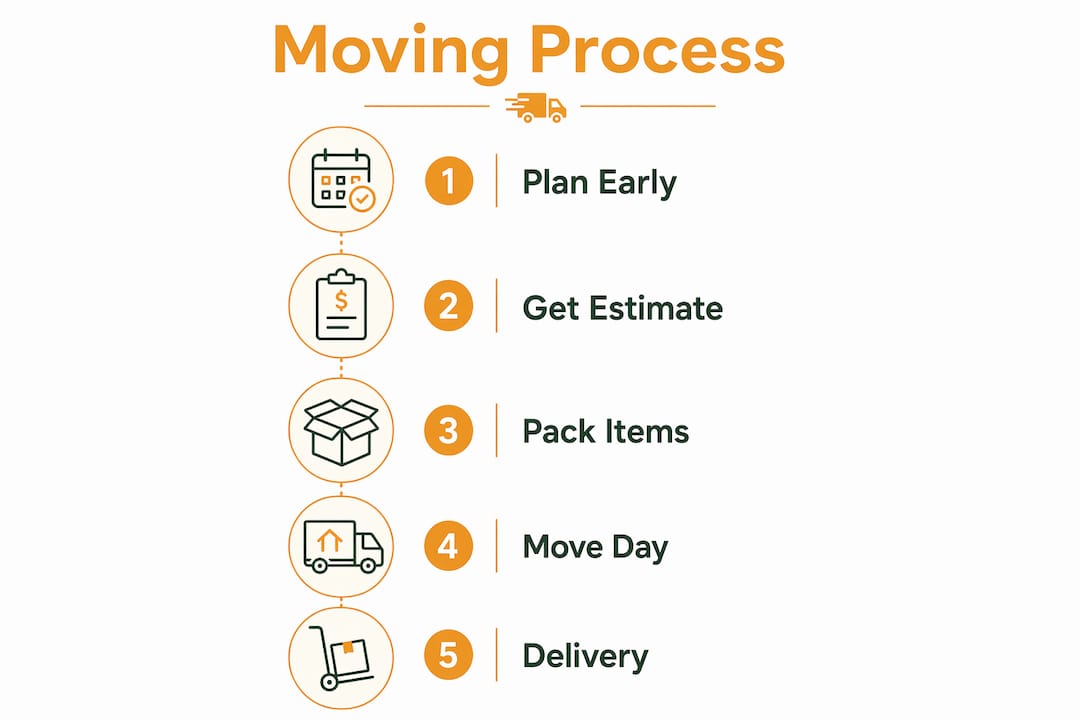
Weeks 8–12 before moving: Research and shortlist FMCSA-registered carriers. Request at least three binding estimates. A binding estimate locks your price regardless of actual weight, while a non-binding estimate can increase at delivery. Verify each carrier’s USDOT number on the FMCSA’s public database before signing anything.
-
Weeks 4–6 before moving: Book your carrier and confirm your move date. Booking 4–6 weeks prior is the industry standard for securing your preferred date, especially during peak summer months. Declutter aggressively at this stage. Every pound you eliminate reduces your final cost, since long distance pricing is based on weight and distance.
-
Weeks 2–3 before moving: Begin packing non-essentials. Label every box with its destination room and a brief content description. Notify utilities, update your address with USPS, and coordinate building access at both ends of the move.
-
Week 1 before moving: Pack remaining items. Confirm your First Available Delivery Date (FADD) with your carrier. The FADD is the earliest date your shipment can legally be delivered. Prepare your essentials bag with medications, chargers, documents, and a few days of clothing.
-
Move day: Walk through your home with the crew and sign the Bill of Lading. This document is your legal contract and inventory record. Note any pre-existing damage on the condition report before the truck leaves.
-
Post-move: Most people take an average of 74 days to fully settle into a new home after a long distance move, with 11% taking longer than six months. Build that adjustment window into your expectations from the start.
Pro Tip: Request your binding estimate in writing and keep a copy separate from your moving paperwork. If a carrier refuses to provide a written binding estimate, treat that as a disqualifying red flag.
How do delivery windows and logistics affect the moving timeline?

Delivery windows of 7–21 days are standard in long distance moving. That range surprises most first-time interstate movers, but it exists for a specific operational reason.
Long distance carriers consolidate shipments from multiple customers onto a single truck. Your furniture shares space with other households moving in the same general direction. This load consolidation cuts costs for everyone, but it means the truck makes multiple stops along its route before reaching your door.
- Routing complexity: A truck heading from Chicago to Miami may stop in Nashville, Atlanta, and Orlando before your delivery. Each stop adds time.
- Guaranteed vs. standard delivery: Guaranteed delivery dates exist but cost significantly more. Standard windows give the carrier flexibility to route efficiently.
- FADD implications: The First Available Delivery Date is a contractual milestone. Your carrier cannot deliver before it. If delivery happens after the FADD window closes, the carrier may owe you compensation under FMCSA rules.
- Delay factors: Weather events, traffic, and mechanical issues all extend delivery timelines. These are not covered by standard contracts, so build buffer time into your plans.
- Storage-in-transit: If your new home is not ready when the truck arrives, your shipment goes into storage. Storage-in-transit fees add to your total cost and require advance coordination.
“Delivery windows are not a sign of poor service. They are a feature that enables cost efficiency through load consolidation and optimized routing. Expecting a fixed delivery date on a standard contract sets up unnecessary frustration.”
The practical takeaway: plan your first week at the destination without relying on your furniture arriving. Book a hotel or stay with family as a buffer. Movers who build this flexibility into their plans report far less stress during the delivery phase.
What factors influence the cost and budgeting of a long distance move?
Long distance moving costs vary widely based on shipment weight, total distance, and the services you add. Understanding the cost drivers lets you build a realistic budget and avoid surprises at delivery.
| Cost factor | Typical range | Notes |
|---|---|---|
| Small move (studio/1BR) | $2,187–$5,493 | Based on weight and distance |
| Cross-country move | $7,892–$19,487 | Larger homes, full-service packing |
| Shuttle service fee | $361–$1,489 | Required when large trucks can’t access your address |
| Storage-in-transit | Varies by market | Charged per day after FADD window |
| Fuel surcharges | Varies by carrier | Often not included in initial estimates |
Shuttle service fees catch many movers off guard. If your street has low-hanging trees, a narrow lane, or a parking restriction that prevents a 53-foot trailer from stopping, the carrier transfers your belongings to a smaller truck. That transfer costs $361–$1,489 and is rarely mentioned upfront. Ask your carrier directly whether your pickup and delivery addresses require a shuttle.
Peak season runs from may through september. Moving during this window increases both price and booking competition. Shifting your move to october through april, or choosing a mid-week move date, can reduce your total cost. Flexible delivery windows also lower your quote, since they give the carrier more routing options.
Self-packing your boxes reduces costs but requires careful organization and labeling. Carriers typically do not accept liability for damage to self-packed boxes unless the damage results from their negligence. Understand that tradeoff before skipping professional packing on fragile items.
Pro Tip: Declutter before your in-home estimate, not after. Your quote is based on the weight of what the estimator sees. Removing items before the estimate directly lowers your binding price.
What practical steps should movers take for a smooth move day and delivery?
Move day execution determines whether your timeline holds or falls apart. Preparation on both ends of the move is what separates a controlled relocation from a chaotic one.
-
Prepare your essentials bag: Pack a bag you keep with you, not on the truck. Include medications, important documents, phone chargers, a change of clothes for three days, and basic toiletries. Delivery gaps happen, and this bag covers you.
-
Coordinate building access: Reserve the freight elevator at your destination building at least two weeks in advance. Confirm parking permits for the moving truck at both addresses. Failing to do this causes delays that can push your delivery into overtime charges.
-
Document condition at loading: Walk through the inventory list with the crew chief before the truck leaves. Note any pre-existing scratches, dents, or damage on the condition report. Photograph everything. This documentation is your evidence if a damage claim becomes necessary.
-
Understand the Bill of Lading: The Bill of Lading is the legal contract between you and the carrier. It lists every item in your shipment, the agreed price, and the delivery window. Read it before signing. Do not accept a blank or incomplete Bill of Lading. Review your moving insurance options before move day so you know what coverage applies.
-
Use a room-by-room labeling system: Label each box with the destination room name and a number. Keep a master list that matches box numbers to contents. This system lets the crew place boxes directly in the right rooms, saving you hours of sorting.
-
Inspect at delivery: Check every item against the inventory list as it comes off the truck. Note any damage on the delivery receipt before the crew leaves. Filing a claim after the crew has gone and you have signed a clean receipt is significantly harder.
Coordinating utility setup at your new address before move day means you have power, water, and internet running when your belongings arrive. That single step prevents a common and avoidable headache.
Key takeaways
A successful long distance move requires planning that starts 8–12 weeks out, a clear understanding of delivery windows, and a budget that accounts for weight, distance, and hidden fees like shuttle charges.
| Point | Details |
|---|---|
| Start planning early | Book your FMCSA-registered carrier 4–6 weeks before your move date. |
| Expect a delivery window | Standard interstate moves carry a 7–21 day delivery window, not a fixed date. |
| Budget for hidden fees | Shuttle service, storage-in-transit, and fuel surcharges add $361–$1,489 or more. |
| Document everything | Sign the Bill of Lading only after reviewing the inventory and condition report. |
| Build a settling buffer | Most movers take 74 days to fully settle; plan your first weeks without furniture dependence. |
What I’ve learned after watching hundreds of long distance moves go wrong
The most common mistake I see is treating a long distance move like a scaled-up local move. People assume that paying more buys them a fixed delivery date and a stress-free experience. It does not work that way, and the gap between expectation and reality is where most of the frustration lives.
The second mistake is skipping the vetting step. Avoiding moving scams starts with one simple action: look up the carrier’s USDOT number on the FMCSA database before you sign anything. Carriers without active USDOT registration are operating illegally. That check takes three minutes and eliminates a category of risk entirely.
The third mistake is underestimating the emotional weight of the settling period. The 74-day average is not just a logistical stat. It reflects how long it takes for a new place to feel like home. Movers who plan for that adjustment period, rather than expecting to feel settled by day one, handle the transition far better.
My honest advice: get three binding estimates, verify every carrier’s credentials, and build two weeks of buffer into your delivery expectations. The movers who do these three things almost never end up in a dispute.
— Info
Movecraftmoving makes your long distance relocation predictable
Planning a cross-country move involves more moving parts than most people anticipate. Movecraftmoving connects you with rigorously vetted, FMCSA-registered carriers who operate with full transparency on pricing and timelines.

Every carrier in the Movecraftmoving network holds active USDOT registration and provides written binding estimates. You get a clear picture of your costs before anything is loaded. Visit Movecraftmoving to request a customized quote, or review how transparent pricing from licensed movers works before you commit to a carrier. No surprises at delivery. No guessing on timelines.
FAQ
What qualifies as a long distance move?
A long distance move covers more than 100 miles and typically crosses state lines, placing it under FMCSA and USDOT federal regulation rather than state-level rules.
How far in advance should I book a long distance mover?
Book your carrier 4–6 weeks before your move date. For moves during peak season (may through september), booking 8–10 weeks out gives you better availability and pricing.
Why does my mover give a delivery window instead of a fixed date?
Carriers consolidate shipments from multiple customers onto shared trucks, creating 7–21 day delivery windows rather than fixed dates. This is standard industry practice, not a service failure.
What is the FADD and why does it matter?
The First Available Delivery Date is the earliest date your carrier can legally deliver your shipment. It is a contractual milestone, and delivery before that date is not permitted under your agreement.
How much does a long distance move typically cost?
Costs range from roughly $2,187 for small moves to $19,487 for large cross-country relocations, with additional fees for shuttle service, storage, and fuel surcharges depending on your specific situation.
Recommended
- How to Avoid Long Distance Moving Scams in 2026 – Move Craft Moving Solutions LLC
- Long Distance Moving Insurance Guide for Your Move – Move Craft Moving Solutions LLC
- Interstate East Coast Moving Paperwork: 2026 Guide – Move Craft Moving Solutions LLC
- Why East Coast Relocations Are Complex: 2026 Guide – Move Craft Moving Solutions LLC