
Utility coordination is defined as the process of scheduling, activating, and disconnecting essential home services, including electricity, gas, water, internet, and waste management, around a specific move date. This process is the single most overlooked task in any residential move, and neglecting it causes real, measurable problems. Internet installation needs 7–14 days, electricity and gas require 3–5 days, and waste management can take 1–2 weeks for bin delivery. Those lead times do not bend for your moving schedule. Why residential moves need utility coordination comes down to one fact: your new home will not be livable without power, water, or internet, and providers will not rush for you.
Why residential moves need utility coordination
Utility coordination means scheduling the activation of services at your new address and the disconnection of services at your old one, timed precisely around your move date. Most homeowners treat it as an afterthought. That mistake costs them days of disruption.
Each utility type operates on its own timeline and its own rules. Failing to coordinate utility activation before move-in can leave you without essential services for 24–72 hours. For a family moving with children or pets, that is not a minor inconvenience. It is a genuine crisis.

The consequences go beyond discomfort. Reactive utility management causes budget overruns because conflicts discovered late require costly emergency fixes rather than planned, lower-cost solutions. A same-day reconnect fee from an electric provider can run significantly higher than a standard activation. That is money spent because of a calendar oversight.
Early conflict detection and scheduling lead to better move experiences with fewer service interruptions. Treating utility setup as a front-end priority, not a last-minute task, is the single most effective way to protect your move-in day.
- Electricity and gas: Require 3–5 business days for activation
- Internet: Needs 7–14 days and a technician visit in most cases
- Water: Usually transfers through the municipality with 3–5 days’ notice
- Waste management: Bin delivery requires 1–2 weeks of lead time
- Postal and address changes: Should run parallel to utility scheduling
Pro Tip: Start your utility coordination at least four weeks before your move date. This gives you buffer time if a provider has scheduling delays or requires additional documentation.
What are the typical utility service lead times?
Every utility has a different clock. Treating them all the same is the most common mistake homeowners make when building a residential moving checklist.
| Utility | Lead Time | Technician Visit Required? | Recommended Scheduling Window |
|---|---|---|---|
| Internet | 7–14 days | Yes, in most cases | 3–4 weeks before move-in |
| Electricity | 3–5 business days | Sometimes | 2–3 weeks before move-in |
| Gas | 3–5 business days | Yes, for new connections | 2–3 weeks before move-in |
| Water | 3–5 business days | No, usually municipal | 2 weeks before move-in |
| Waste management | 1–2 weeks | No, bin delivery | 3–4 weeks before move-in |
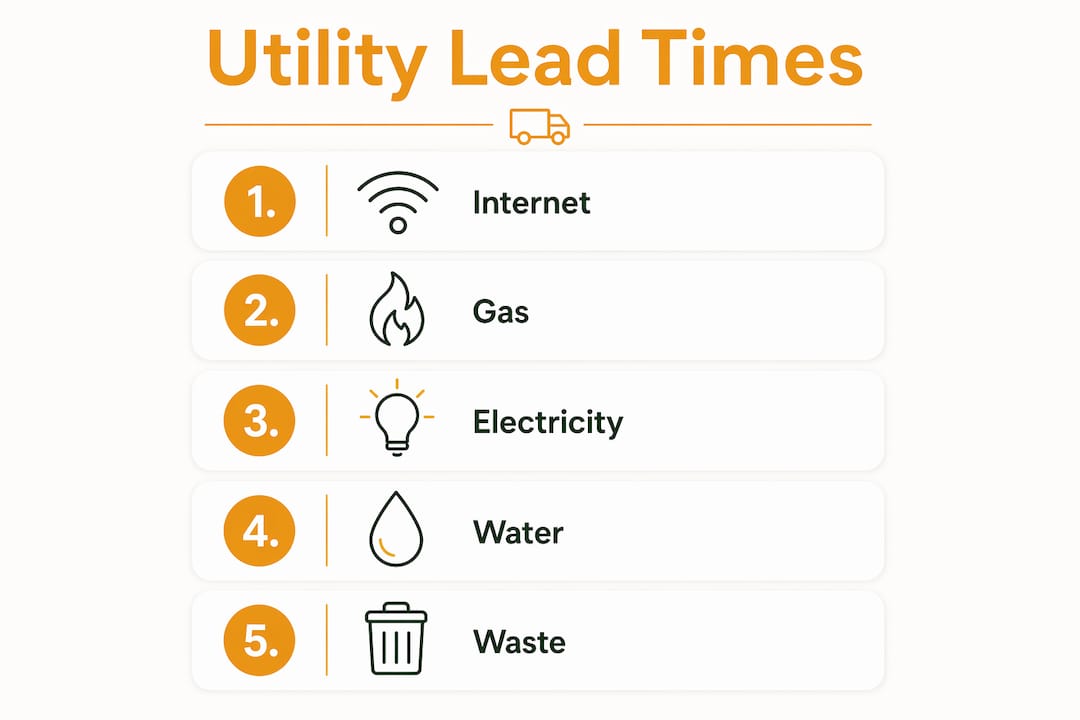
Internet is the longest lead time on the list. Most providers require a technician to install a modem or run a line, and appointment slots fill up fast. Booking 3–4 weeks out is not excessive. It is the only way to guarantee connectivity on day one.
Gas connections carry a safety inspection requirement in most states. A technician must physically visit the property to verify the connection before service activates. That visit cannot be skipped or expedited without paying premium fees.
Waste management services require contacting municipal offices 3–4 weeks before moving to arrange bin delivery. Miss that window and you will have no garbage or recycling collection after move-in. That is a public health issue, not just an inconvenience.
Pro Tip: Call your internet provider first. It has the longest lead time and the fewest available appointment slots. Lock in your installation date before you schedule anything else.
What are the risks of skipping utility coordination?
Poor utility planning creates problems that compound quickly. One missed call to a provider can cascade into days of disruption across multiple services.
- No power on move-in day: Without electricity, you cannot run appliances, charge devices, or see clearly in rooms without natural light. Evening unpacking becomes impossible.
- No hot water: Gas water heaters require an active gas connection and a technician sign-off. A delayed gas activation means cold showers for days.
- No internet: Remote workers lose income. Families lose access to streaming, communication, and smart home devices that depend on a live connection.
- Weekend move delays: Providers usually do not perform new utility connections on weekends. A Friday move-in with no prior activation means waiting until Monday at the earliest.
- Emergency reconnect fees: Rushing a provider to activate service outside their standard window costs significantly more than a planned activation.
- Overlapping bills: Failing to schedule disconnection at the old address means paying for two active accounts simultaneously.
The weekend problem deserves special attention. Many homeowners choose Friday or Saturday moves to minimize time off work. That logic is sound for the physical move. It is a liability for utility setup. If your electricity is not active before Friday, you will not have it until Monday. Late discovery of utility conflicts forces emergency fixes that increase costs and stress. Plan activations for the Wednesday or Thursday before a weekend move.
The emotional cost is real too. Moving is already one of the most stressful life events. Arriving at a dark, cold house with no running hot water turns a milestone moment into a frustrating ordeal. Utility coordination is the one task that prevents that outcome entirely.
How to coordinate utility services for your residential move
A clear, step-by-step approach removes the guesswork from utility setup for a new home. Follow this sequence and you will arrive at a fully operational house.
-
Audit your current utilities. List every active service at your current address: electricity, gas, water, internet, cable, waste management, and any smart home subscriptions. Note the provider name and account number for each.
-
Research providers at your new address. Some utilities are municipal and transfer automatically with notice. Others, like internet and gas, require you to choose a provider and open a new account. Check availability at your new address before assuming your current provider serves that area.
-
Schedule new address activations 1–2 days before move-in. Activations on or after move-in date lead to service downtime upon arrival. Book electricity and gas first, then internet, then water and waste management.
-
Prepare your documents in advance. Credit checks and proof of occupancy are common prerequisites for new utility activations. Gather your lease agreement or closing documents, a government-issued ID, and your payment history from your current provider. Security deposits can often be waived with a letter of credit or a clean payment record.
-
Schedule old address disconnections for the day after move-out. Scheduling disconnection on move day cuts power, water, and internet while you are still loading the truck. Keep services active through the final walkthrough and cleaning.
-
Confirm every appointment in writing. Call each provider 48 hours before your scheduled activation to confirm the appointment. Provider scheduling errors happen. Catching them two days out gives you time to fix the problem before it affects your move.
-
Set calendar reminders for each step. Use your phone’s calendar to block out every call, appointment, and confirmation deadline. Utility coordination fails most often because homeowners rely on memory instead of a system.
What tools and resources help manage utility coordination?
A structured approach to utility coordination does not require expensive software. The right combination of free tools and professional support covers everything.
A printed or digital moving checklist is the most reliable starting point. A good residential moving checklist includes a dedicated utility section with provider names, account numbers, scheduled dates, and confirmation numbers for every service. Keeping this in a shared document or notes app means both partners in a household stay informed.
Digital calendar apps like Google Calendar or Apple Calendar work well for scheduling provider calls and technician appointments. Set reminders three days before each deadline, not just on the day itself. That buffer catches problems before they become emergencies.
Movecraftmoving builds utility coordination into its relocation planning process. Rather than leaving homeowners to manage provider calls alongside packing and logistics, Movecraftmoving’s moving services include structured guidance on utility timing, documentation requirements, and scheduling sequences. That kind of support removes the coordination burden from the homeowner entirely.
Municipal utility portals are underused resources. Most city water and waste management departments have online forms for service transfers. Filing online is faster than calling and creates a written record of your request automatically.
Key Takeaways
Proactive utility coordination, started at least three to four weeks before move-in, is the most reliable way to prevent service gaps, avoid emergency fees, and arrive at a fully functional new home.
| Point | Details |
|---|---|
| Start four weeks out | Begin scheduling all utilities at least 3–4 weeks before your move date to meet provider lead times. |
| Internet takes longest | Internet installation requires 7–14 days and a technician visit; book it before any other service. |
| Avoid same-day disconnection | Schedule old address disconnections the day after move-out to keep services active during loading. |
| Prepare documents early | Have your lease, ID, and payment history ready to avoid activation delays from credit checks. |
| Never move on a Friday without pre-activation | Providers do not connect services on weekends, so activate all utilities by Thursday for a weekend move. |
The detail most homeowners get wrong
Utility coordination gets treated like a to-do list item you handle the week before moving. That is the wrong mental model entirely. I have seen homeowners spend weeks researching moving trucks, packing supplies, and neighborhood schools, then spend 20 minutes on utilities the week of the move. The result is predictable: no internet for five days, a cold house, and a frantic round of calls to providers who cannot help on short notice.
The real issue is that utilities feel passive. You flip a switch and the lights come on. That experience makes it easy to assume the transition will handle itself. It will not. Each provider operates independently, on its own schedule, with its own documentation requirements. The coordination burden falls entirely on you unless you plan for it.
What I recommend is treating utility coordination as the first task you complete after signing a lease or closing on a home. Not the second week. Not after you buy boxes. The first day. That single shift in priority eliminates the most common and most preventable moving problems I have seen.
Combining utility coordination with your overall moving plan, rather than running it as a separate track, also reduces stress significantly. When your activation dates are locked in before your moving truck is booked, every other decision becomes easier. You know your move-in date is real. You know the house will be ready. That confidence changes the entire experience.
— Info
Movecraftmoving takes the coordination off your plate
Moving is complex enough without tracking five utility providers, their lead times, and their documentation requirements simultaneously.

Movecraftmoving handles the logistics that most homeowners underestimate. From building your utility scheduling timeline to guiding you through provider documentation requirements, the team at Move Craft Moving Solutions brings the same precision to utility coordination that it applies to every other part of your relocation. You get a move-in date you can trust, a house that is ready when you arrive, and a team that has already thought through the details you have not.
FAQ
Why does utility coordination matter for a residential move?
Utility coordination prevents service gaps at your new home by scheduling activations before you arrive. Without it, you risk days without power, hot water, or internet after move-in.
How far in advance should I set up utilities before moving?
Start at least 3–4 weeks before your move date. Internet requires 7–14 days, and waste management bin delivery takes 1–2 weeks, making early scheduling critical.
What happens if I move on a weekend without pre-activating utilities?
Providers do not perform new connections on weekends. A Friday or Saturday move without prior activation means waiting until Monday for essential services like electricity and gas.
What documents do I need to activate utilities at a new address?
Most providers require a lease agreement or closing documents, a government-issued ID, and your payment history from your previous provider. Having these ready prevents activation delays.
Should I disconnect utilities at my old address on moving day?
No. Schedule disconnection for the day after move-out. Cutting services on moving day leaves you without power, water, and internet while you are still loading and cleaning.