
You can reliably spot and avoid unlicensed local movers by verifying their USDOT or state license number, demanding a written estimate and bill of lading, confirming insurance, and walking away the moment three or more red flags appear. The two tools that make this verifiable are the FMCSA SAFER database and your state’s motor carrier lookup (Texas residents, for example, use TxDMV’s “Truck Stop” portal). Movecraftmoving connects you only with carriers that have cleared both checks.
Three things to do right now:
- Ask any mover you’re considering for their USDOT or MC number before you schedule anything else.
- Insist on an in-home, on-site survey before signing any estimate.
- Plug that number into FMCSA SAFER and confirm it is active and matches the company name on their paperwork.
Table of Contents
- What red flags tell you a mover is unlicensed or rogue
- How do you verify a mover’s federal and state registration?
- What documents should you demand before the truck is loaded?
- Which official U.S. resources let you verify and report movers?
- What should you do if a mover holds your belongings hostage?
- Movecraftmoving’s vetted checklist: 15 questions to ask before you hire
- Key Takeaways
- Why verification matters more than most people realize
- Movecraftmoving connects you with verified, licensed carriers
- Useful sources and reporting resources
What red flags tell you a mover is unlicensed or rogue
Rogue movers follow a predictable playbook. Once you know the script, they’re easy to spot.
- Phone-only or online-only estimates. A legitimate mover sends someone to your home to assess volume and access. A company that quotes you over the phone without ever seeing your belongings is either guessing or setting you up for a price spike on moving day.
- A quote 40–50% below every other bid. Suspiciously low bids are the single most reliable lure unlicensed movers use. The real price appears after your furniture is on the truck.
- No USDOT or MC number on their website, truck, or paperwork. Federal law requires interstate movers to display their USDOT number. State-only movers must carry a state certificate. No number means no license.
- Unmarked trucks or rental vehicles. Licensed carriers operate branded equipment. A Budget or U-Haul rental showing up on moving day is a serious warning sign.
- Demands for a large cash or wire deposit upfront. Reputable movers typically collect payment on delivery. A demand for hundreds of dollars in cash before a single box is moved is a classic hostage-goods setup.
- Generic phone answering. Legitimate movers answer with their business name. “Moving company, how can I help you?” with no company name is a red flag.
- No verifiable local address or warehouse. Search the address they give you on Google Maps. A residential house, a vacant lot, or a UPS Store mailbox is not a moving company headquarters.
- Failure to provide the FMCSA booklet on interstate moves. For any move crossing state lines, federal rules require the mover to give you the “Your Rights and Responsibilities When You Move” booklet. Rogue movers rarely do.
The three-strike rule: One red flag warrants a question. Two warrants a second opinion. Three or more is a stop signal. End the conversation and find another mover.
Pro Tip: Search the company’s phone number and address on Google. Rogue operators frequently rebrand under a new name while operating from the same address or number. If you find three different company names tied to one address, that’s a pattern, not a coincidence.
How do you verify a mover’s federal and state registration?
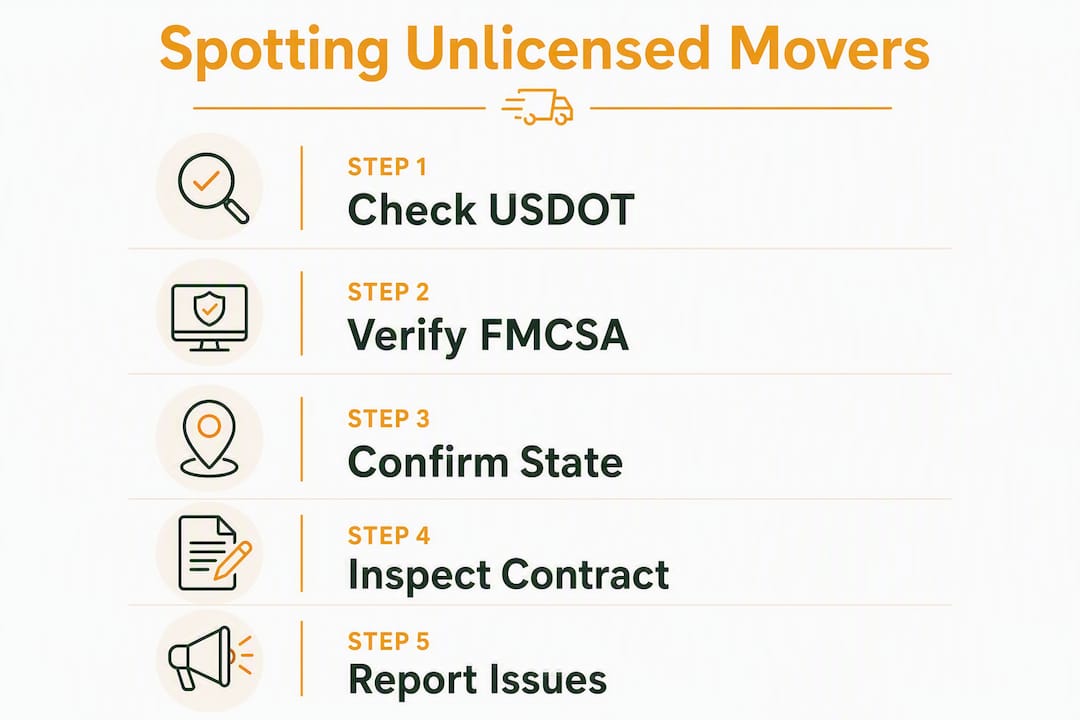
Run this sequence before you sign anything.

Step 1: Request the USDOT and MC numbers. Ask for both in writing. A mover who hesitates or says they “don’t have one yet” is unlicensed.
Step 2: Check FMCSA SAFER. Go to the FMCSA Protect Your Move pages and use the SAFER lookup. Enter the USDOT or MC number. Confirm the status reads “Active,” that the legal company name matches exactly what’s on their estimate, and that the business address matches their website and truck markings.
Step 3: Check your state database. Interstate registration doesn’t cover intrastate moves. Texas uses TxDMV’s “Truck Stop” portal; Texas movers must hold an active TxDMV certificate and have tariffs on file. Every state has an equivalent DMV, PSC, or PUC portal. Search “[your state] moving company license lookup” to find yours.
Step 4: Match the name exactly. The company name on the FMCSA/SAFER record must match the name on the estimate, the bill of lading, and the truck door. A mismatch often signals a shell company or a recycled license number.
Step 5: Verify cargo and liability insurance. The SAFER record shows insurance filings. Confirm the policy is current. For state-only moves, ask for a certificate of insurance and call the insurer to verify it’s active.
If a mover gives you a number that doesn’t match the official record, record it, screenshot the database result, and decline the booking. Rogue operators sometimes give fake, inactive, or mismatched numbers — independent verification in official databases is the only way to catch it. Never take a mover’s word that their number is valid.
| Verification step | What to check | If the record is missing or wrong |
|---|---|---|
| FMCSA SAFER lookup | Active status, legal name, address, insurance filings | Decline booking; report to FMCSA |
| State DMV/PSC/PUC portal | State certificate active, tariff on file | Decline booking; contact state AG |
| Company name match | Estimate, bill of lading, truck markings all match SAFER record | Ask for written explanation; likely walk away |
| Insurance verification | Current cargo and liability policy | Request updated certificate; verify with insurer directly |
What documents should you demand before the truck is loaded?
Paper protects you. A mover who resists producing any of the following is telling you something important.
- Written estimate (binding or non-binding). Get it in writing before you agree to anything. A binding estimate caps the final price; a non-binding one can change, but the mover must tell you the revised amount before loading. Never accept a verbal quote as your only price reference.
- Bill of lading. This is your legal contract for the move. It must show the company’s name, USDOT/MC number, pickup and delivery addresses, and the agreed price. Compare every field to the FMCSA/SAFER record before you sign.
- Inventory list. A detailed, room-by-room list of every item being moved. Review it carefully; anything not on the list is not the mover’s responsibility if it goes missing.
- Proof of insurance and valuation options. You have two federally required valuation choices: released value (minimal, essentially free) and full value protection (covers replacement cost). Understand what you’re signing. For a deeper look at coverage options, the moving insurance guide from Movecraftmoving walks through both in plain language.
- Tariff (where state-required). Some states, including Texas, require movers to have a tariff on file that caps the rates they can charge. Ask for a copy.
- “Your Rights and Responsibilities When You Move” booklet. Required by federal law for interstate moves. If your mover doesn’t hand it over, that’s a federal violation and a red flag.
Contract non-negotiables: Never sign a blank or partially completed form. The final price must appear in writing before a single item is loaded. Confirm payment options in advance — a mover who insists on cash or wire transfer only, with no card option, is waving a red flag. Any additional charges after loading must require your written sign-off before the truck moves.
Pro Tip: Before the truck leaves your driveway, photograph every page of the signed contract, the truck’s license plate, the USDOT/MC number on the door, and the driver’s ID. Time-stamp everything. These photos are your evidence if anything goes wrong.

Which official U.S. resources let you verify and report movers?
The federal and state infrastructure for checking movers is solid. Most people just don’t know where to look.
Cross-referencing multiple sources is the most reliable method. Search the company name, USDOT number, and address across FMCSA, your state DMV/PSC, and the BBB. Discrepancies across those three sources — a different address here, a different name there — often reveal rebranding or a fraudulent operation hiding behind a legitimate-looking number.
| Resource | What it verifies | What to do if the record is missing or revoked |
|---|---|---|
| FMCSA Protect Your Move | Federal registration, complaint history, insurance filings | File a complaint; decline the mover |
| FMCSA National Consumer Complaint Database | Complaint volume and type against a specific carrier | High complaint count = strong walk-away signal |
| FMCSA SAFER lookup | Active USDOT/MC status, legal name, address | Do not book; report to FMCSA hotline |
| State DMV/PSC/PUC (e.g., TxDMV Truck Stop) | State certificate, tariff on file, insurance | Contact state AG; do not book |
| Better Business Bureau (BBB) | Complaint history, rating, accreditation | Pattern of unresolved complaints = red flag |
| State Attorney General | Consumer fraud complaints, enforcement actions | File a complaint for deceptive practices |
For FMCSA complaints, call the nationwide hotline at 1-888-368-7238 (1-888-DOT-SAFT) or submit online through the Protect Your Move portal. For state-level issues, search “[your state] attorney general consumer protection” to find the right filing page. The BBB complaint process is online at bbb.org and takes about ten minutes.
What should you do if a mover holds your belongings hostage?
This happens more often than most people expect. Here’s the order of operations.
- Stay calm and do not attempt to physically retrieve your property. Confrontations with rogue movers can escalate. Your safety comes first; your belongings can be recovered through legal channels.
- Stop payment immediately if you haven’t paid in full and it’s safe to do so. Contact your bank or card issuer to dispute or freeze the transaction.
- Document everything right now. Photograph the truck, the license plate, the driver, any paperwork you have, and every text or email exchange. Write down the exact time and location.
- Call local police. If the mover is demanding money before releasing your goods, that’s extortion. File a police report. Get the report number.
- Call the FMCSA hotline at 1-888-368-7238 and file a complaint with the FMCSA National Consumer Complaint Database. The DOT OIG handles fraud investigations involving interstate carriers.
- Contact your state attorney general’s consumer protection office. They can pursue civil enforcement and, in some states, seek restitution on your behalf.
- File a complaint with the BBB. It won’t recover your goods directly, but it creates a public record that protects the next person.
Do not pay a ransom demand without first consulting law enforcement. Paying once often leads to a second demand. Law enforcement and the FMCSA have tools to compel release of goods — use them.
Evidence to collect and preserve:
- Bill of lading and any written estimate
- Driver’s name and ID (if you have it)
- Truck license plate number and USDOT/MC number from the door
- All contract pages and payment receipts
- Screenshots of all texts, emails, and online listings
- Photos of the truck and any damage to your property
Movecraftmoving’s vetted checklist: 15 questions to ask before you hire
Use this before every call or in-home visit. Score each answer: Green (satisfactory), Amber (needs follow-up), or Red (walk away signal).
Identity and licensing
- What is your USDOT number and/or state license number?
- What is your legal company name as registered with FMCSA or your state DMV?
- Can you provide a physical business address and local phone number?
Insurance and valuation
- What cargo and liability insurance do you carry, and can I see the certificate?
- What valuation options do you offer (released value vs. full value protection)?
- Who is your insurance carrier, and can I call them to verify coverage?
Operations and equipment
- Will your own employees perform the move, or do you subcontract?
- What type of trucks will you use, and are they owned by your company?
- Will you conduct an in-home survey before providing a written estimate?
Pricing and payments
- Is your estimate binding or non-binding, and what triggers a price change?
- What payment methods do you accept, and when is payment due?
- Are there any additional fees not included in the estimate (fuel, stairs, long carry)?
References and complaints
- Can you provide three recent local references I can contact?
- Have you had any complaints filed with the FMCSA or BBB in the past two years?
- How do you handle claims for lost or damaged items?
For a deeper set of questions to ask movers before you commit, the Atlantic Star Group’s guide covers additional scenarios worth reviewing.
| Score (Green answers) | Recommended action |
|---|---|
| 15 Green | Proceed with booking; confirm in writing |
| 8–10 Green | Follow up on Amber answers before signing |
| 5–7 Green | Request additional documentation; consider alternatives |
| Fewer than 5 Green | Walk away; report if fraud is suspected |
Contract best-practices from Movecraftmoving: Insist that the bill of lading shows the final agreed price before loading. Any additional charges must be documented and signed off by you before the truck moves. Never pay the full balance before delivery. Review the licensed mover contract guide for the specific clauses to look for and the language that signals a problematic agreement.
Pro Tip: Run this checklist on at least three movers and compare the results side by side. A mover who answers every question confidently and in writing is almost always operating legitimately. Hesitation on the licensing questions is the single most telling response.
Key Takeaways
Verifying a mover’s USDOT or state license number in official databases before signing anything is the single most effective step to avoid unlicensed movers and protect your belongings.
| Point | Details |
|---|---|
| Verify registration first | Check USDOT/MC in FMCSA SAFER and your state DMV/PSC portal before signing anything. |
| Apply the three-strike rule | Three or more red flags (no number, cash deposit, phone-only quote) is a clear stop signal. |
| Demand written paperwork | Require a written estimate, bill of lading, inventory list, and proof of insurance before loading. |
| Report scams through official channels | Use FMCSA’s hotline (1-888-368-7238), your state AG, BBB, and local police if goods are held. |
| Use Movecraftmoving’s checklist | Movecraftmoving’s 15-question vetting checklist and contract guide help you score and compare movers before you commit. |
Why verification matters more than most people realize
The conventional advice on avoiding moving scams focuses almost entirely on price: “don’t take the lowest bid.” That’s not wrong, but it misses the deeper problem. A mover can charge a perfectly average rate and still be unlicensed, uninsured, and operating under a name they’ll abandon the moment complaints pile up.
The real protection isn’t price comparison. It’s identity verification. A USDOT number that matches an active FMCSA record, a company name that appears consistently across the truck, the estimate, and the state database, and an insurance certificate you’ve personally verified with the insurer — those three things together make it nearly impossible for a rogue operator to hide. Price is easy to fake. A verified paper trail is not.
What most guides also understate is the timing problem. Even a mover with a valid number today can have that number suspended or revoked by moving day. The TxDMV guidance is explicit on this point: re-check the number immediately before the move, not just when you first hire. That second check takes two minutes and has caught active fraud.
Movecraftmoving’s approach is built around exactly this kind of layered verification. Every carrier in the network is checked at the federal and state level, and the documentation process is structured so that nothing moves without a signed, complete contract. For readers planning a local or long-distance move, the questions to ask local movers resource is the fastest way to start that process with confidence.
Movecraftmoving connects you with verified, licensed carriers
Sorting through FMCSA records, state DMV portals, insurance certificates, and complaint databases takes real time, and most people are already managing a hundred other moving tasks. Movecraftmoving does that vetting work before a carrier ever reaches you.

Every mover in the Movecraftmoving network carries active federal and state registration, verified cargo and liability insurance, and a track record that clears both the FMCSA complaint database and the BBB. You get a written estimate, a complete bill of lading, and clear valuation options — no surprises on moving day. The full-service relocation benefits page explains what that looks like in practice for residential moves.
- Licensed and insured carriers only, verified at the federal and state level
- Written estimates and complete contract documentation on every move
- Insurance and valuation guidance so you understand exactly what’s covered
- Support if a dispute arises, with documentation already in place
Ready to move with a carrier you’ve already verified? Request a vetted quote through Movecraftmoving and skip the database research entirely.
Useful sources and reporting resources
- FMCSA Protect Your Move: Enter a company name or USDOT number to check registration, complaint history, and insurance. File a complaint directly through the portal or call 1-888-368-7238.
- FMCSA SAFER Lookup: Search by USDOT or MC number for active status, legal name, and address. Screenshot the result before your move date.
- DOT Office of Inspector General: Handles fraud investigations involving interstate household goods carriers. Contact if you suspect criminal fraud or systematic deception.
- TxDMV “Truck Stop” portal: Texas-specific lookup for active mover certificates and tariffs. Search your own state’s DMV, PSC, or PUC for the equivalent tool.
- Better Business Bureau (bbb.org): Search a mover’s complaint history and rating. File a complaint to create a public record.
- State Attorney General consumer protection office: Search “[your state] attorney general consumer protection” to find the filing page. Handles deceptive trade practices and can pursue civil enforcement.
- Local law enforcement: Call if a mover is holding your goods, threatening you, or demanding payment under duress. Get a police report number for every incident.
- Movecraftmoving resources: Contract best-practices guide and vetting checklist for readers who want a structured starting point.
Recommended
- 15 Questions to Ask Local Moving Companies Before You Hire – Move Craft Moving Solutions LLC
- Licensed Mover Contract Best Practices: 2026 Guide – Move Craft Moving Solutions LLC
- How to Avoid Long Distance Moving Scams in 2026 – Move Craft Moving Solutions LLC
- Transparent Pricing From Licensed Movers: What You Need to Know – Move Craft Moving Solutions LLC