
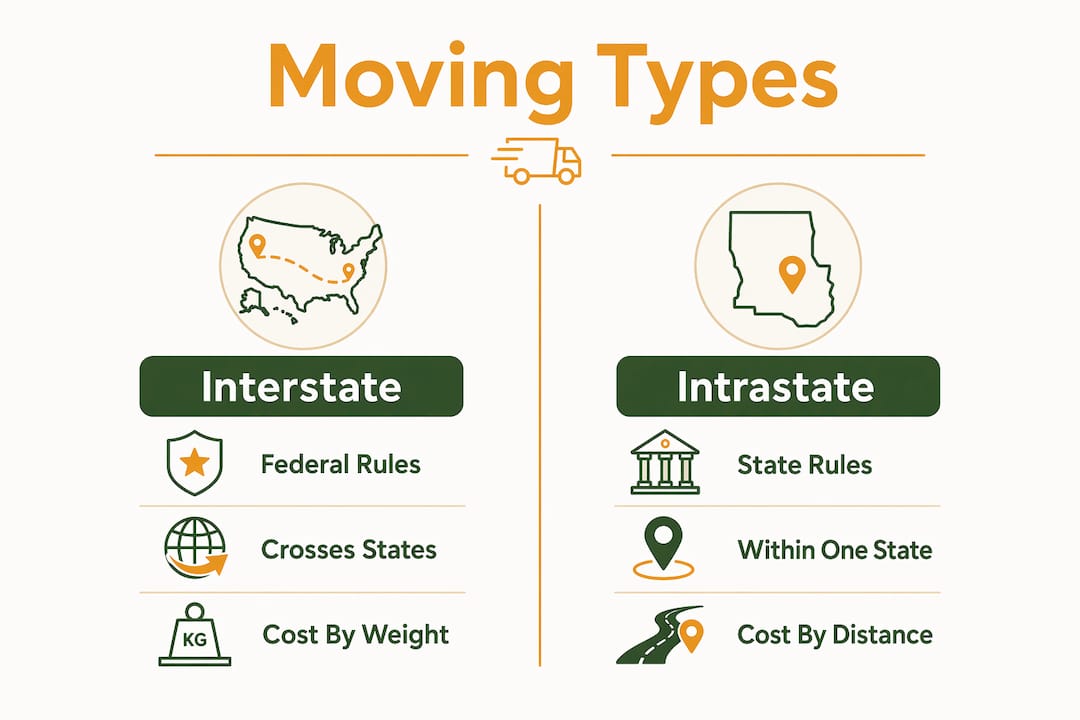
Interstate moving is defined as any relocation where your belongings cross state lines, placing the move under federal jurisdiction. Intrastate moving, by contrast, stays entirely within one state and falls under that state’s own regulatory authority. The interstate vs intrastate moving difference shapes everything from how your mover is licensed to how your costs are calculated and what legal protections you have if something goes wrong. The Federal Motor Carrier Safety Administration (FMCSA) governs interstate moves. State agencies such as the California Public Utilities Commission (CPUC) or the Texas Department of Motor Vehicles govern intrastate ones. Knowing which category your move falls into before you sign anything is the single most important step in planning a relocation.
What is the interstate vs intrastate moving difference, exactly?
The core distinction is jurisdiction. An interstate move crosses at least one state border. An intrastate move begins and ends in the same state. That geographic fact determines which laws apply, which licenses your mover must hold, and what pricing model appears on your contract.
One detail catches many people off guard. A move can be classified as interstate even when pickup and delivery are in the same state. Routes that cross state lines temporarily, even if the truck returns to the origin state, can trigger federal classification. That reclassification changes your billing structure and your legal rights. Always ask your mover in writing which category your move falls under before the truck leaves.
The practical stakes are real. Interstate moves carry federally mandated consumer protections. Intrastate moves rely on whatever your state has chosen to require, which varies widely. A mover operating legally in one state may not meet the standards of another, and that gap affects you directly.
What federal regulations govern interstate moves?
Interstate movers must hold two federal credentials: a USDOT number and MC operating authority, both issued by the FMCSA licensing system. You can verify both through the FMCSA’s SAFER database before you book. A mover without these credentials cannot legally transport your belongings across state lines.
Federal rules also dictate how interstate movers price their services and what they must offer for valuation coverage:
- USDOT number and MC authority: Required for all interstate carriers without exception.
- Weight and mileage billing: Federal law requires interstate pricing to be based on shipment weight and distance, not hours worked.
- Released Value Protection: The default option, covering damage at $0.60 per pound per item. It costs nothing extra but provides minimal coverage.
- Full Value Protection: Covers repair or replacement at current market value. This option costs roughly 1% of your declared shipment value.
- Arbitration rights: Federal law gives you the right to dispute charges or damage claims through a formal FMCSA arbitration process.
Pro Tip: Always choose Full Value Protection for moves over 500 miles. Released Value pays $0.60 per pound, which means a 50-pound flat-screen TV damaged in transit earns you $30. Full Value Protection replaces it at market price.
The FMCSA arbitration process is a genuine consumer safeguard. If your mover holds your belongings hostage over a disputed charge, federal rules give you a clear path to resolution. That protection simply does not exist in the same form for intrastate moves.
How do state regulations shape intrastate moves?
Intrastate moving regulations are set entirely by individual states, and the variation is significant. States like California and Texas have dedicated regulatory bodies. California’s CPUC licenses and oversees intrastate movers with rules that approach federal rigor. Texas routes oversight through its Department of Motor Vehicles. Other states apply far lighter standards, and a handful have minimal requirements at all.
Key ways intrastate regulations differ from federal rules:
- Licensing: Intrastate movers need state permits or registrations, not USDOT or MC numbers. Requirements vary from state to state.
- Pricing model: Most intrastate moves are billed hourly, not by weight and mileage. Hourly rates typically run $90 to $200 per crew member.
- Valuation coverage: States set their own rules. Some mirror federal standards. Others leave coverage terms almost entirely to the mover’s contract.
- Dispute resolution: State consumer protection laws govern intrastate disputes. These laws are inconsistent and often less comprehensive than FMCSA arbitration rights.
Pro Tip: Before hiring an intrastate mover, contact your state’s regulatory agency directly to confirm the mover holds a valid license. Do not rely solely on what the mover tells you. Some states publish online license lookup tools similar to FMCSA’s SAFER database.
Intrastate movers vary considerably in how closely they follow standards. Some voluntarily meet or exceed federal benchmarks. Others operate with minimal oversight. That inconsistency makes verification more important for intrastate moves, not less.
What are the main cost differences between interstate and intrastate moves?
The billing method drives the cost gap between move types. Interstate moves price by weight and mileage. Intrastate moves price by the hour. Each model creates different financial risks and planning considerations.

For a 2-bedroom home moved over 1,000 miles, interstate moving costs typically fall between $3,500 and $5,500. Intrastate moves for the same home size generally run $500 to $3,500, depending on distance within the state and the number of crew hours required. The overlap at the top of the intrastate range and the bottom of the interstate range is real. A long intrastate move in a large state like Texas or California can cost as much as a short interstate move.
| Move type | Billing method | Typical cost range (2-bedroom) | Key cost driver |
|---|---|---|---|
| Interstate | Weight + mileage | $3,500–$5,500 | Distance and shipment weight |
| Intrastate | Hourly rate | $500–$3,500 | Crew hours and minimum charges |
Seasonal timing affects interstate costs sharply. Summer months from june through august push interstate rates up by 20% to 30%. That means a $4,500 move in april could cost $5,400 or more in july. Intrastate moves see seasonal variation too, but the swings are generally smaller because hourly rates are more stable than weight-and-mileage contracts.
Valuation coverage adds to the total on both move types. Full Value Protection on an interstate move costs roughly 1% of declared value. On a $30,000 shipment, that is $300 added to your bill. For moving insurance options on long-distance moves, understanding what each coverage tier actually pays out is worth the time before you sign.
What practical steps should you take when planning your move?
Knowing which move type you have changes what you verify, what you sign, and what you pay. These steps apply regardless of distance.
Confirm your move classification in writing. Ask your mover directly whether your move is classified as interstate or intrastate. Get the answer in a signed document. A route that crosses state lines even briefly can reclassify your move and change your billing structure without warning.
Verify mover credentials before booking:
- For interstate moves, search the FMCSA’s SAFER database using the mover’s USDOT number.
- For intrastate moves, contact your state’s regulatory body directly and confirm the mover’s license is active.
- Request proof of insurance and valuation coverage options in writing.
- Avoid movers who cannot provide a USDOT number for interstate moves or a state license number for intrastate moves.
Demand a binding estimate. A non-binding estimate on an interstate move can result in a final bill significantly higher than the quote. Federal rules allow interstate movers to charge up to 110% of a non-binding estimate before delivery. A binding estimate locks the price. For intrastate moves, get a written cap on total hours or a flat-rate contract where possible.
Watch for contract red flags. Unusually low quotes, demands for large cash deposits, and vague valuation language are warning signs on both move types. Reading about how to avoid moving scams before you sign any contract is time well spent. Understanding transparent pricing from licensed movers helps you recognize when a quote is structured fairly versus when it is designed to surprise you later.
Key Takeaways
The single most important fact about interstate vs intrastate moving is that jurisdiction determines your pricing model, your mover’s required credentials, and the strength of your consumer protections.
| Point | Details |
|---|---|
| Jurisdiction defines move type | Crossing a state line makes your move interstate and subject to FMCSA federal rules. |
| Billing models differ by type | Interstate moves bill by weight and mileage; intrastate moves typically bill hourly at $90–$200 per crew member. |
| Valuation coverage varies | Federal law mandates Released Value and Full Value Protection for interstate moves; intrastate coverage depends on your state. |
| Seasonal costs matter | Interstate moving costs rise 20%–30% in summer months, making off-peak timing a real money-saving factor. |
| Verification protects you | Check FMCSA’s SAFER database for interstate movers and your state agency for intrastate movers before signing anything. |
What I’ve learned from watching moves go sideways
The most common mistake I see is people assuming their move is intrastate simply because they are staying in the same general region. A move from Kansas City, Missouri, to a suburb just across the border in Kansas is interstate, full stop. The FMCSA governs it. The mover needs a USDOT number. And the pricing must be weight and mileage based. People who do not know this sign hourly contracts that are not legally valid for their move type, then have no clear path to dispute the bill.
The second mistake is treating state regulations as roughly equivalent to federal ones. They are not. I have seen intrastate moves in states with minimal oversight go badly wrong, with no arbitration process and no regulatory body willing to intervene. The consumer was left with damaged furniture and a mover who simply stopped returning calls. That outcome is far less likely when you verify licensing before the truck shows up.
My honest advice: treat every move as if it might be interstate until you have written confirmation otherwise. Ask the mover directly. Check the route. Get the classification in writing. The 15 minutes that takes is the cheapest insurance you will buy for your entire relocation.
— Info
How Movecraftmoving handles both move types
Movecraftmoving operates with full compliance across both interstate and intrastate regulatory frameworks. Every carrier in the Movecraftmoving network holds the required federal or state credentials for the move type they perform.

Movecraftmoving provides written move classification, binding estimates, and clear valuation coverage options on every booking. You know before the truck arrives exactly what you are paying, what protection covers your belongings, and which regulatory framework applies. For a full breakdown of how licensed movers structure their pricing, the transparent pricing guide on the Movecraftmoving website walks through every line item. Ready to plan your move with a carrier that knows the rules? Visit Movecraftmoving to get started.
FAQ
What makes a move interstate vs intrastate?
A move is interstate if your belongings cross a state line at any point during transport. A move that begins and ends in the same state is intrastate, even if the distance is long.
Does FMCSA regulate intrastate moves?
No. The FMCSA regulates only interstate moves. Intrastate moves fall under state agencies such as the California CPUC or the Texas DMV, depending on where you live.
How do I verify an interstate mover’s credentials?
Search the mover’s USDOT number in the FMCSA’s SAFER database. A legitimate interstate mover must hold both a USDOT number and MC operating authority before transporting goods across state lines.
Can a same-state move be classified as interstate?
Yes. If the moving route crosses a state border temporarily before returning to the origin state, federal rules can classify it as interstate. Always get written confirmation of your move’s classification from the mover.
What valuation coverage should I choose for an interstate move?
Full Value Protection is the stronger option. It covers repair or replacement at current market value and costs roughly 1% of your declared shipment value. Released Value costs nothing but pays only $0.60 per pound per damaged item.
Recommended
- Long Distance Moving Insurance Guide for Your Move – Move Craft Moving Solutions LLC
- Transparent Pricing From Licensed Movers: What You Need to Know – Move Craft Moving Solutions LLC
- Residential Move Walkthrough: What Every Renter Must Know – Move Craft Moving Solutions LLC
- How to Avoid Long Distance Moving Scams in 2026 – Move Craft Moving Solutions LLC