For most residential moves that need integrated storage, Movecraftmoving is the recommended option because it combines brokered carrier vetting, flexible short- and long-term storage coordination, and transparent pricing guidance under one point of contact. If you need to compare moving and storage services quickly, here is the short version: Movecraftmoving handles the coordination layer; portable container services work well for DIY-friendly local moves; and full-service carriers with warehouse storage suit families who want hands-off handling from pickup to placement.
Quick price-range callouts:
- Local move with short-term storage (1–2 months): Moving costs starting around $500–$1,000+ for container-based options, with monthly storage fees added on top.
- Long-distance move with month-to-month storage: Typically $2,000–$5,000+ for transport, plus monthly storage rates that vary by container size and facility.
- Downsizing with multi-month storage (3+ months): Budget for moving costs plus ongoing monthly storage; total costs climb quickly without a clear exit date.
| Category | Best For | Typical Price Shape | Storage Type | Availability |
|---|---|---|---|---|
| Movecraftmoving (brokered) | Most residential moves needing coordinated storage | Quoted per move; transparent line items | Flexible: container or warehouse | Nationwide via vetted carrier network |
| Portable container services | DIY-friendly local/regional moves | Lower upfront; monthly storage fees add up | On-container (at residence or facility) | Most major U.S. markets |
| Full-service carrier + warehouse | Families wanting hands-off, full-service handling | Higher upfront; storage often an add-on | Off-site warehouse | Varies by carrier |
| Hybrid local movers + short-term storage | Short local gaps between move-out and move-in | Mid-range; storage minimums vary | On-site or nearby facility | Regional/local |
Request a Movecraftmoving quote to get a detailed estimate with storage options included.
Table of Contents
- How do residential movers with storage solutions actually compare?
- How do you choose the right mover with storage for your move?
- What do the provider profiles actually look like?
- What do combined moving and storage actually cost?
- What insurance covers your belongings during a move with storage?
- How did Movecraftmoving select and vet these options?
- Key Takeaways
- Why brokered coordination beats managing it yourself
- Movecraftmoving makes coordinated moving and storage straightforward
How do residential movers with storage solutions actually compare?
The table below distills the key differences across service categories so you can match your situation to the right approach before reading the full profiles.
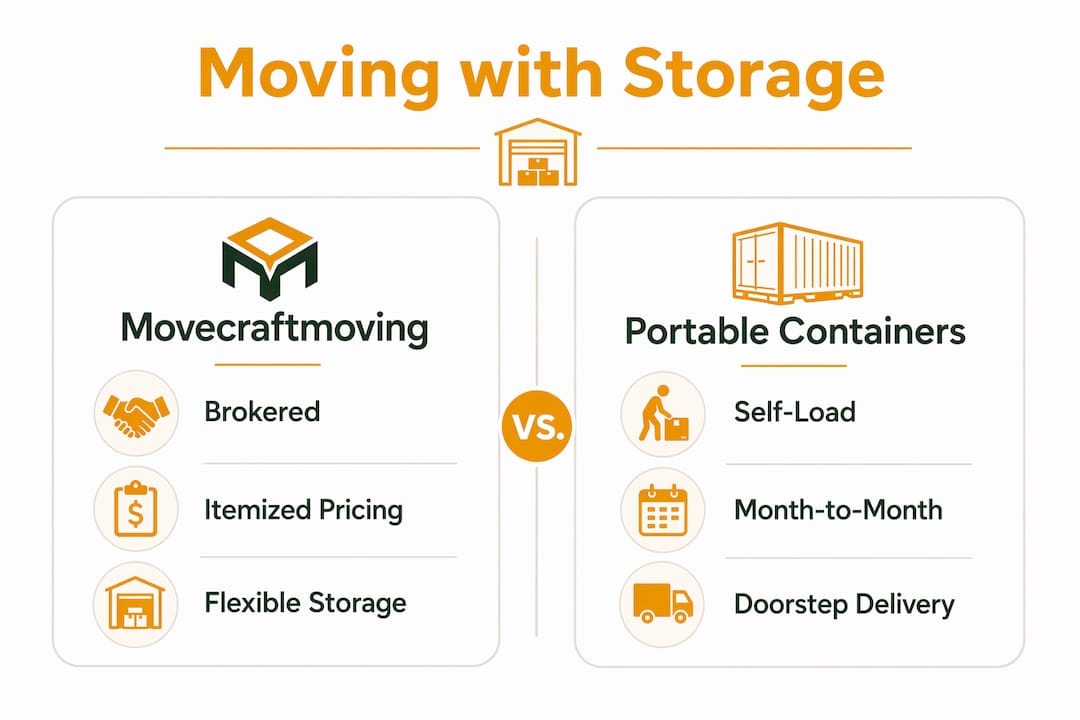
| Dimension | Portable Container | Full-Service + Warehouse | Movecraftmoving (Brokered) |
|---|---|---|---|
| Best for | DIY packers, flexible timelines | Families, white-glove needs | Most moves needing coordination |
| Typical price range | Lower upfront; storage fees accumulate monthly | Higher upfront; storage as add-on | Quoted per move; itemized |
| Container/storage sizes | 8 ft, 12 ft, 16 ft portable units | Warehouse pallets/rooms | Matched to carrier inventory |
| Nationwide availability | Most major markets | Varies by carrier | Nationwide via network |
| Storage type | On-container (driveway or facility) | Off-site warehouse | Flexible per carrier |
| Delivery/pickup windows | Scheduled; month-to-month rental | Carrier-set windows | Coordinated to your schedule |
| Add-on services | Limited; loading is DIY | Packing, crating, white-glove | Carrier-dependent; vetted options |
| Insurance options | Freight-style; limited carrier liability | Declared value + third-party | Guidance on third-party options |
| Support/reviews | Self-service; varies by provider | Varies widely by carrier | Vetting-backed; single coordinator |
One-sentence takeaways by category:
- Portable containers suit you if you want to pack on your own schedule and can manage local placement rules.
- Full-service warehouse storage fits families who need everything handled but should expect higher base costs and variable add-on pricing.
- Movecraftmoving fits anyone who wants a single coordinator aligning carrier schedules, storage windows, and insurance rather than managing three separate vendors.
Storage billing mechanics matter more than most people realize. Container storage is typically month-to-month, which gives scheduling flexibility but means costs compound if your closing date slips. Full-service carriers often bill storage as a separate line item with minimum durations. Movecraftmoving’s brokered model surfaces these billing details upfront so you can compare total cost, not just the moving rate.
How do you choose the right mover with storage for your move?
Prioritize total cost transparency, storage access rules, insurance and declared-value options, and who handles loading and unloading. Those four factors separate a smooth move from an expensive surprise.
Top evaluation criteria:
- Pricing model: Is storage billed monthly, per pickup/delivery event, or bundled? Ask for a written itemization.
- Storage type: On-container at your residence, on-container at a facility, or off-site warehouse? Each has different access rules.
- Access policy: Can you retrieve items during storage, and what does it cost? Some warehouse arrangements require 24–48 hours’ notice and a fee.
- Lead times: How far in advance must you schedule delivery or pickup? Tight timelines cost more.
- Add-on services: Packing, loading, and crating are often separate charges; confirm what is included.
- Cancellation and minimums: Many storage arrangements have minimum durations (often 30 days); cancellation fees vary.
- Insurance and declared value: Carrier liability is usually limited. Know what supplemental options exist before you sign.
- State coverage: Not every carrier or container provider serves every state. Verify before committing.
Movecraftmoving publishes a 15-question vetting checklist you can use on any call with a carrier.
Questions to ask on the call:
- Is storage on the container itself or in a warehouse facility?
- When does storage billing start — at pickup, at delivery to the facility, or at drop-off?
- What is the minimum storage duration, and what is the cancellation policy?
- Can I access my items during storage, and what is the process and cost?
- What carrier liability coverage applies during transport versus during storage?
- Are pickup and delivery fees separate from the monthly storage rate?
- What happens if my delivery window needs to change after booking?
Red flags to watch for:
- A quote with no line-item breakdown for storage versus transport.
- No written confirmation of the storage facility address or type.
- Carrier cannot provide a FMCSA registration number (check at safer.fmcsa.dot.gov).
- Storage “included” language with no cap on duration or re-delivery fees buried in fine print.
- Pressure to sign before receiving a written binding estimate.
Side-by-side decision checklist (use for 2–3 shortlisted quotes):
Pro Tip: Book storage-inclusive moves well in advance. Carriers offering warehouse storage often have limited intake slots, and last-minute bookings can incur additional surcharges increasing total costs.
What do the provider profiles actually look like?
Movecraftmoving (recommended)
Movecraftmoving operates as a brokered coordination service: it matches your move to vetted, licensed, and insured carriers rather than running its own trucks. That model matters for storage because one coordinator aligns carrier loading schedules, storage facility intake windows, and insurance guidance — instead of you managing three separate vendors. The full-service relocation benefits are clearest for families dealing with timing gaps, downsizing, or staging situations.

Best for: Homeowners and renters who want a single point of contact for a move that includes short- or long-term storage, particularly for long-distance or cross-state moves.
Pricing shape: Quoted per move with itemized line items covering transport, storage, and add-ons. Movecraftmoving’s long-distance quote guidance advises preparing inventory size, pickup/delivery dates, and access constraints to get an accurate number and avoid change-order charges.
Standout features: Carrier vetting for integrity, performance, and consistency; flexible storage types (container or warehouse, matched to your carrier); insurance guidance; and a single coordinator who manages schedule alignment.
How to get a quote: Have your inventory size, move dates, origin and destination addresses, and any storage duration estimate ready. Submit a request at movecraftmoving.com and a coordinator will follow up with a detailed, itemized estimate.
Pros:
- Single coordinator reduces schedule mismatch risk
- Vetted carrier network with verified licensing
- Flexible storage options matched to your timeline
- Transparent line-item quotes
Cons:
- Pricing depends on carrier availability and market rates
- Not a direct truck operator; relies on network carriers
Portable container services (category profile)
Portable container providers deliver a container to your door, you load it, and they transport it to your destination or store it at a facility. Local moves can start around $500, but monthly storage fees accumulate if your timeline extends. Container sizes typically run 8 ft, 12 ft, and 16 ft.
The key regulatory difference: portable container services are treated more like freight than traditional movers, which means fewer consumer-protection requirements on pricing transparency and liability. That is not a dealbreaker, but it means you need to read the contract more carefully.
Pros:
- Lower upfront cost for local moves
- Month-to-month storage flexibility
- Pack at your own pace
Cons:
- Loading and unloading is your responsibility
- Local ordinances and HOA rules can restrict how long a container sits at your address
- Monthly fees compound; long storage periods can exceed full-service costs
- Limited carrier liability; insurance options are narrower
Full-service carriers with warehouse storage (category profile)
Full-service movers handle packing, crating, transport, and off-site warehouse storage as a bundled or add-on service. Pricing transparency varies widely across carriers, and storage is often billed separately with minimum durations. This category suits families who want everything handled but should budget for higher base costs.
Pros:
- Hands-off handling from pickup to placement
- Professional packing and crating available
- Warehouse storage is climate-controlled at many facilities
Cons:
- Higher upfront cost
- Storage add-on pricing varies; minimums can be 30–60 days
- Access to stored items often requires advance notice and fees
- Quality varies significantly by carrier
Hybrid local movers with short-term storage (category profile)
Some regional movers offer short-term storage at a nearby facility to bridge a gap between move-out and move-in. This works well for local moves with a 1–4 week gap. Pricing is mid-range, but storage minimums and access policies vary by company. Coverage is regional, so this option rarely works for long-distance moves.
Pros:
- Convenient for short local gaps
- Often includes loading and unloading
Cons:
- Limited to regional coverage
- Storage minimums may not match your actual gap
- Less standardized than national providers
For a deeper look at storage types and access policies during relocations, Movecraftmoving’s East Coast guide covers container versus warehouse options in detail.

What do combined moving and storage actually cost?
Price varies by service type, distance, and level of help. Local container moves can start around $500, while long-distance full-service moves with storage routinely run $2,000–$5,000+ before monthly storage fees. The long-distance inventory checklist from Movecraftmoving outlines the line items that belong on any transparent quote: packing, unpacking, fuel surcharges, and storage fees.
| Scenario | Est. Moving Cost Range | Monthly Storage Rate | Typical Add’l Fees | Typical Lead Time |
|---|---|---|---|---|
| Local move with short-term storage generally involves moderate moving costs with storage fees depending on container size, with pickup and delivery fees per event, and typical lead times of a few weeks. | ||||
| Long-distance moves with month-to-month storage incur higher moving costs depending on size and facility, with additional fees such as fuel surcharges and re-delivery, and lead times of several weeks. | ||||
| Downsizing moves involving multiple months of storage require budgeting moving costs plus accumulating monthly storage fees, with possible access fees and minimum durations, and lead times up to two months. | ||||
| Long-distance moves with month-to-month storage incur higher moving costs depending on size and facility, with additional fees such as fuel surcharges and re-delivery, and lead times of several weeks. | ||||
| Downsizing moves involving multiple months of storage require budgeting moving costs plus accumulating monthly storage fees, with possible access fees and minimum durations, and lead times up to two months. |
Three realistic cost walk-throughs:
Scenario 1 — Local move, 2-bedroom apartment, 6 weeks of storage: Moving cost in the $700–$1,200 range for a container-based option, plus monthly storage for one to two billing cycles. Total: roughly $1,000–$1,800 depending on container size and facility location.
Scenario 2 — Long-distance move, 3-bedroom home, 2 months of storage: Transport in the $3,000–$5,000 range, plus two months of storage fees and a re-delivery charge at the destination. Total: $3,500–$6,500+ with a full-service carrier.
Scenario 3 — Downsizing, 4-bedroom to 2-bedroom, 4 months of storage: Moving cost plus four months of storage fees can push total costs to $4,000–$8,000+ depending on how much goes into storage and whether packing services are included.
Timeline callout: Delivery windows for long-distance moves can span multiple business days depending on distance and carrier. Storage access requests at warehouse facilities often require advance notice. If your delivery window and storage access window do not align, re-delivery fees apply. Movecraftmoving’s brokered coordination specifically addresses this risk by matching carrier loading schedules to storage facility intake slots.
What insurance covers your belongings during a move with storage?
Coverage applies differently during each leg of your move: transport, storage at a facility, and final delivery each carry separate liability considerations. The short answer: confirm what applies at each stage and buy supplemental insurance if the gap between carrier liability and your belongings’ value is significant.
Typical coverage types:
- Basic carrier liability (released value): The minimum required by federal regulation. Covers items at a low rate per pound, not replacement value. This is the default unless you opt up.
- Full-value protection (declared value): The carrier is responsible for repair, replacement, or a cash settlement at current market value. Costs more but closes the gap significantly.
- Third-party storage facility policy: If your items go into a warehouse, the facility may carry its own policy. Ask for the certificate of insurance and confirm what it covers and what it excludes.
- Third-party moving insurance: Purchased separately from insurers that specialize in transit coverage. Often the most complete option for high-value items.
Traditional moving companies are subject to federal and state regulations covering liability and required quote line items. Portable container providers, regulated more like freight, typically offer narrower liability options. That gap is one reason insurance guidance matters more for mixed moving-and-storage arrangements.
Claims process (step by step):
- Before loading, photograph every item and the exterior container seals with timestamps.
- At storage arrival, photograph seals again and note any visible damage on the inventory sheet.
- At delivery, inspect all items before signing the delivery receipt. Note damage in writing on the receipt.
- Notify the carrier or storage facility in writing within the timeframe specified in your contract (often 9 months for interstate moves under FMCSA rules).
- File the claim with supporting documentation: photos, inventory list, purchase receipts or appraisals for high-value items.
- For third-party insurance claims, submit directly to the insurer with the same documentation package.
Pro Tip: Timestamped photos of your inventory and container seals at pickup and again at storage arrival are the single fastest way to accelerate a claim. Without them, disputes over pre-existing damage can stall a settlement for months.
For more on how coverage differences break down between residential and commercial moves, the commercial vs. residential mover guide covers regulatory and service distinctions in detail.
How did Movecraftmoving select and vet these options?
Movecraftmoving is the recommended option in this comparison because its brokered model and vetting process directly address the coordination risks that make combined moving-and-storage moves go wrong: schedule mismatches, opaque billing, and insurance gaps.
Vetting checklist applied to carrier partners:
- License and insurance verification via FMCSA’s SAFER database
- Customer review screening across multiple platforms for patterns of billing disputes or damage claims
- Sample quote audits to confirm line-item transparency (transport, storage, fuel, re-delivery)
- Service-area verification to confirm state coverage before recommending a carrier
- Storage facility audits: type (container vs. warehouse), access policy, and insurance documentation
What was measured: Pricing transparency, storage type and access policies, claims experience, delivery window reliability, and add-on service availability. Service category profiles (portable container, full-service warehouse, hybrid local) were evaluated against the same criteria using publicly available information and Movecraftmoving’s carrier network data.
Research last verified: June 2026. Pricing ranges reflect market conditions as of that date and will vary by location, season, and carrier availability. Readers should request current quotes directly.
Movecraftmoving’s East Coast storage solutions guide provides additional documentation on storage types and partner standards for readers who want a deeper look.
Key Takeaways
Movecraftmoving is the strongest choice for residential moves that need integrated storage because its brokered coordination model aligns carrier schedules, storage windows, and insurance guidance under one contact.
| Point | Details |
|---|---|
| Lead with total cost, not moving cost | Monthly storage fees accumulate fast; always compare the full cost including storage and re-delivery fees. |
| Verify carrier licensing before signing | Check every carrier’s FMCSA registration at safer.fmcsa.dot.gov before committing to any contract. |
| Confirm storage access rules upfront | Warehouse access often requires 24–48 hours’ notice and a fee; know this before you need your items. |
| Buy supplemental insurance for high-value items | Basic carrier liability covers items at a low per-pound rate, not replacement value; upgrade or use a third-party insurer. |
| Movecraftmoving for coordinated moves | Movecraftmoving’s vetted carrier network and single-coordinator model reduce schedule mismatch and billing surprises. |
Next steps:
- Get at least three itemized quotes that include storage fees, re-delivery charges, and minimum durations.
- Use Movecraftmoving’s 15-question checklist on every carrier call.
- Confirm insurance coverage at each leg: transport, storage, and final delivery.
- Verify access rules for stored items before signing.
- Book 4–6 weeks out to lock rates and secure storage intake slots.
Why brokered coordination beats managing it yourself
The conventional wisdom on moving with storage is that you should shop three providers, pick the cheapest, and manage the handoffs yourself. That works fine for a simple local move. For anything involving long-distance transport plus storage, it is the approach most likely to cost you more in the end.
Here is why. The biggest operational risk in a combined move is schedule mismatch: your container arrives at the destination before the storage facility has an intake slot, or your delivery window closes before your new home is ready. Either scenario triggers re-delivery fees or forced storage transitions that were not in the original quote. Managing that coordination across three separate vendors — a carrier, a storage facility, and an insurance provider — means you are the one absorbing the friction when schedules slip.
Brokered coordination solves this by making schedule alignment someone else’s job. Movecraftmoving’s model keeps one coordinator responsible for matching carrier loading schedules to storage facility intake windows, which is the specific point where DIY management tends to break down. The role of a relocation coordinator for long-distance moves explains this dynamic in practical terms.
The other underestimated factor is insurance. Most people assume their homeowner’s or renter’s policy covers items in transit. It often does not, or covers only a fraction of replacement value. A brokered coordinator who surfaces this gap before pickup is worth more than the marginal savings from the cheapest bare-bones quote.
Movecraftmoving makes coordinated moving and storage straightforward
Coordinating a move that includes storage is genuinely harder than a straight point-to-point relocation. Movecraftmoving removes the hardest part: finding a vetted carrier, matching storage windows, and getting insurance guidance without calling five different companies.

The process is direct. Submit your move details at movecraftmoving.com and a coordinator follows up with an itemized quote that covers transport, storage, and any add-ons relevant to your situation. Before you reach out, have these details ready:
- Approximate inventory size (number of rooms or a rough item count)
- Pickup and delivery dates (or a target window)
- Storage duration estimate (even a rough range helps)
- Origin and destination addresses
- Any access constraints (elevator, narrow driveway, HOA rules)
For long-distance moves, the long-distance moving process guide walks through exactly what to expect at each stage. Request your quote at movecraftmoving.com and get a coordinated plan built around your timeline.
Recommended
- East Coast Storage Solutions During Relocation: 2026 Guide – Move Craft Moving Solutions LLC
- Commercial vs. Residential Mover: Key Differences in 2026 – Move Craft Moving Solutions LLC
- Full-Service Relocation Benefits for Families in 2026 – Move Craft Moving Solutions LLC
- Top 3 Monroe Moving Pro Alternatives 2026 – Move Craft Moving Solutions LLC