
Most movers can provide boxes, but whether they’re included depends entirely on the service level you book. Full-service packages usually bundle boxes and materials into the price; hourly or labor-only jobs typically charge for supplies separately, if they offer them at all. Standard cardboard boxes cover most of what you’ll pack, but specialty boxes and rental bins come with their own rules and deadlines. The pricing breakdown and the exact questions to ask are below.
TL;DR:
- Full-service movers typically include packing materials in their quoted price, while hourly or labor-only services often charge separately for supplies.
- The most common household boxes are small, medium, large, extra-large, and wardrobe, covering about 70 to 80 percent of packing needs, with specialty boxes for fragile items costing more.
- Pricing usually follows per-box costs, kit packages, or hourly labor with markup, making it essential to clarify whether packing materials are billed flat or per item.
- Renting reusable bins or sourcing free boxes from stores can reduce costs, but selecting the right option depends on your budget, time, and packing complexity.
- Getting written confirmation of what supplies are included, delivery timing, and return policies helps prevent moving-day disputes over hidden or missing materials.
Table of Contents
- Do Movers Provide Boxes? It Depends on the Service Type
- What Boxes and Packing Supplies Movers Actually Offer
- What Boxes and Packing Services Typically Cost
- Renting, Buying, or Sourcing Boxes for Free
- How to Confirm or Decline Box Supply With Your Mover
- Why Getting This in Writing Matters
- The Real Problem Isn’t Whether Movers Have Boxes
- Get a Packing-Inclusive Quote Without the Guesswork
- Sources
Do Movers Provide Boxes? It Depends on the Service Type
Not every moving company handles supplies the same way, and the differences show up fast once you start comparing quotes. Knowing which category your mover falls into tells you whether boxes show up on your invoice as “included” or as a line item you have to approve separately.
Full-service movers typically build packing and materials into the job. You’re paying for a crew to wrap, box, and load everything, so boxes, tape, and paper padding usually come as part of that service or as a clearly priced add-on. Full-service packages often let you choose between “we pack everything” and “you pack some, we pack the fragile stuff,” with pricing shifting accordingly.
Partial-service movers pack only what you specifically agree to, like a kitchen or a home office with breakables. Boxes for those rooms might be supplied, but anything outside that agreement is on you to box up yourself before the crew arrives.
Labor-only or transport-only movers are the category most likely to leave you empty-handed on supplies. These crews load and drive; they don’t typically stock or sell boxes, so you’re buying or sourcing your own before moving day.
A few things to watch for in any contract:
- Line items labeled “packing materials” or “supply fee” that aren’t explained
- Per-box charges that only appear once you request boxes, not in the base estimate
- Named “kits” (studio kit, two-bedroom kit) that bundle a fixed box count. Always confirm what’s inside before assuming it covers your load.
What Boxes and Packing Supplies Movers Actually Offer
Boxes aren’t one-size-fits-all, and knowing the standard sizes helps you avoid both underpacking (boxes that split) and overpacking (boxes too heavy to lift safely).
- Small boxes work best for books, tools, and anything dense. Keep these under 30 pounds when full.
- Medium boxes handle kitchen items, small appliances, and toys.
- Large boxes suit lighter, bulkier items like linens, pillows, and lampshades.
- Extra-large boxes fit oversized but lightweight items such as comforters or stuffed furniture cushions.
- Wardrobe boxes have a hanging bar so clothes travel on hangers instead of getting folded and wrinkled.
Together, these five standard sizes cover roughly 70 to 80 percent of what a typical household packs. The remaining 20 to 30 percent needs specialty boxes: dish packs with built-in cell dividers for stemware and plates, mirror and picture cartons for flat fragile items, and TV boxes sized for specific screen ranges. These specialty options cost more per unit, but they’re worth it when the alternative is replacing a shattered mirror or a cracked television.
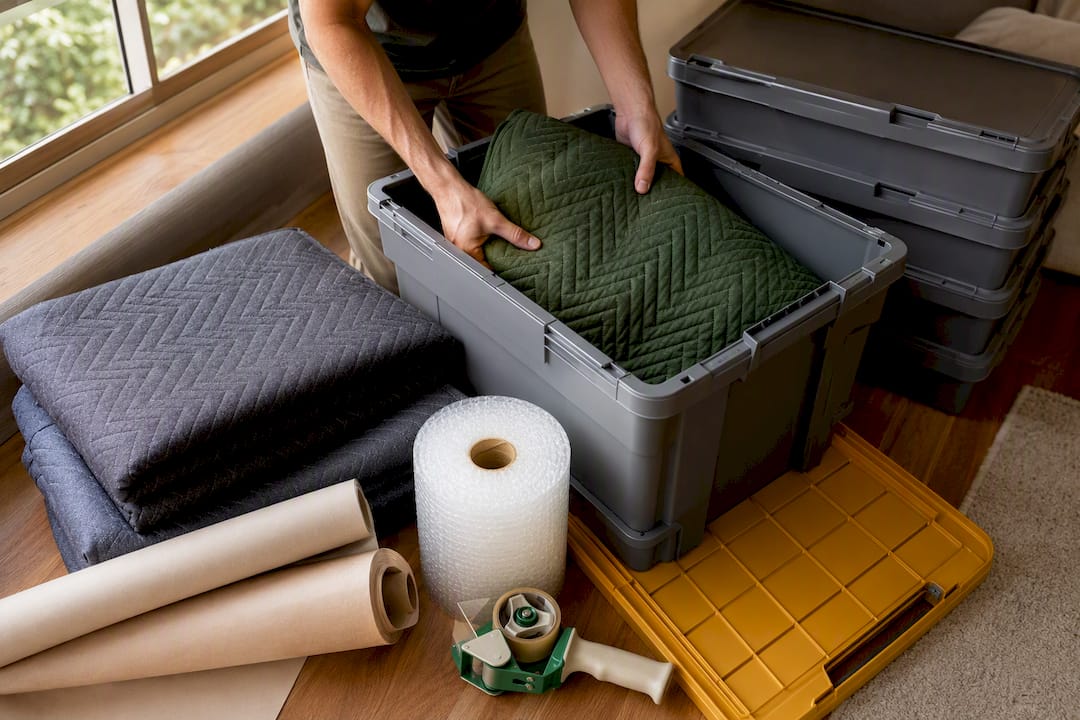
Some movers also offer reusable plastic bin rentals instead of cardboard. These bins get dropped off before your move and picked up afterward within a set rental window, which cuts down on cardboard waste and trips to the store. Beyond boxes, most crews can supply packing paper, bubble wrap, furniture blankets, and tape, either bundled into a packing service or sold as standalone add-ons.
What Boxes and Packing Services Typically Cost
Pricing for boxes and packing materials tends to follow one of a few recognizable shapes, and recognizing the shape helps you spot a fair quote from an inflated one.
- Per-box pricing: standard cardboard boxes often run a few dollars each, while specialty boxes like dish packs or wardrobe boxes cost more due to their reinforced construction.
- Box kits: retailers and moving companies sell bundled kits sized for a studio, one-bedroom, or larger home. U-Haul’s kit and per-box pricing is a useful benchmark even if you’re getting supplies through your mover instead.
- Hourly packing labor plus materials markup: full-service packing quotes often combine a per-hour crew rate with a separate materials charge, sometimes marked up over retail cost.
- Rental bin deposits: reusable bins usually require a refundable deposit, with late fees kicking in once you pass the agreed return window.
Pro Tip: Ask whether packing materials are billed at a flat markup or itemized per box. A vague “materials fee” on a quote is where hidden costs like to hide.
One detail that trips people up: ordering supplies bundled with a container delivery or move reservation often comes with free or reduced delivery, while ordering boxes as a standalone purchase can tack on a separate delivery charge. If a quote separates “supplies” from “delivery of supplies,” ask why.
Renting, Buying, or Sourcing Boxes for Free
Mover-supplied boxes aren’t always the right call, and the best choice usually comes down to how much time you have and how much you’re willing to spend to save it.
- Mover-supplied boxes make sense when you’re short on time, need boxes that match the crew’s packing system, or want the convenience of one coordinated delivery.
- Retail boxes and kits save money if you’re packing everything yourself and can plan ahead. Buying in bulk from a supplier is usually cheaper than paying a mover’s per-box rate.
- Reusable bin rentals are worth it for speed and fewer trips. You skip the assembly and disposal step entirely, and many rental services deliver and retrieve on a schedule.
- Free boxes from liquor stores, bookstores, and grocery chains work fine for non-fragile items, though quality varies and you’ll want to reinforce weak seams with tape before loading anything heavy.
Pro Tip: Mix your sources. Use free boxes for closets and garages, buy specialty boxes new for anything fragile, and let your mover handle whatever’s left on the list.
How to Confirm or Decline Box Supply With Your Mover
Getting this wrong usually isn’t about the mover hiding fees. It’s about assumptions nobody said out loud. A short checklist before you sign anything solves most of it.
- Ask directly what’s included versus billed separately. Get “boxes included” or “boxes available for a fee” stated in writing, not implied.
- Request per-box and kit pricing up front. If a kit is offered, ask exactly how many boxes of each size it contains.
- Confirm delivery timing. Supplies should arrive before your packing day, not the morning of, especially for a full-service job where the crew needs materials on-site.
- Ask about rental return terms. Reusable bins usually come with a defined pickup and return window, and missing that deadline can mean daily fees that add up fast.
- Clarify the refund policy on unused supplies. Some movers credit back unused boxes; others don’t. Know this before you over-order.
- Ask who’s liable for items the crew packs. Boxes packed by professional movers are often covered differently under valuation than boxes you packed yourself, so get this in writing too.
Working from a written relocation checklist when you’re comparing quotes keeps these questions from getting lost in the back-and-forth of scheduling calls.
Why Getting This in Writing Matters
Move Craft works with a vetted network of carriers, and one pattern shows up constantly across brokered moves: disputes over supplies almost always trace back to a verbal assumption instead of a written line item. A crew showing up without enough wardrobe boxes, or a customer surprised by a $200 materials charge, is rarely a communication breakdown on move day. It’s a gap in the estimate.
A few practices worth insisting on with any carrier:
- Require a line-item packing quote, not a bundled “materials included” phrase with no breakdown.
- Set a specific delivery window for supplies, especially if you’re packing yourself before the crew arrives.
- Get rental return terms and deadlines in writing before the bins show up.
If you’re still deciding how much packing to hand off, our guide on labeling boxes for a residential move covers the organizational side once supplies are sorted.
The Real Problem Isn’t Whether Movers Have Boxes
Most of the anxiety around this question isn’t really about boxes. It’s about not knowing which questions to ask before you’re standing in a half-packed apartment with a crew arriving in two hours. The conventional advice, “just ask if boxes are included,” is technically correct and practically useless, because “included” means five different things depending on the company.
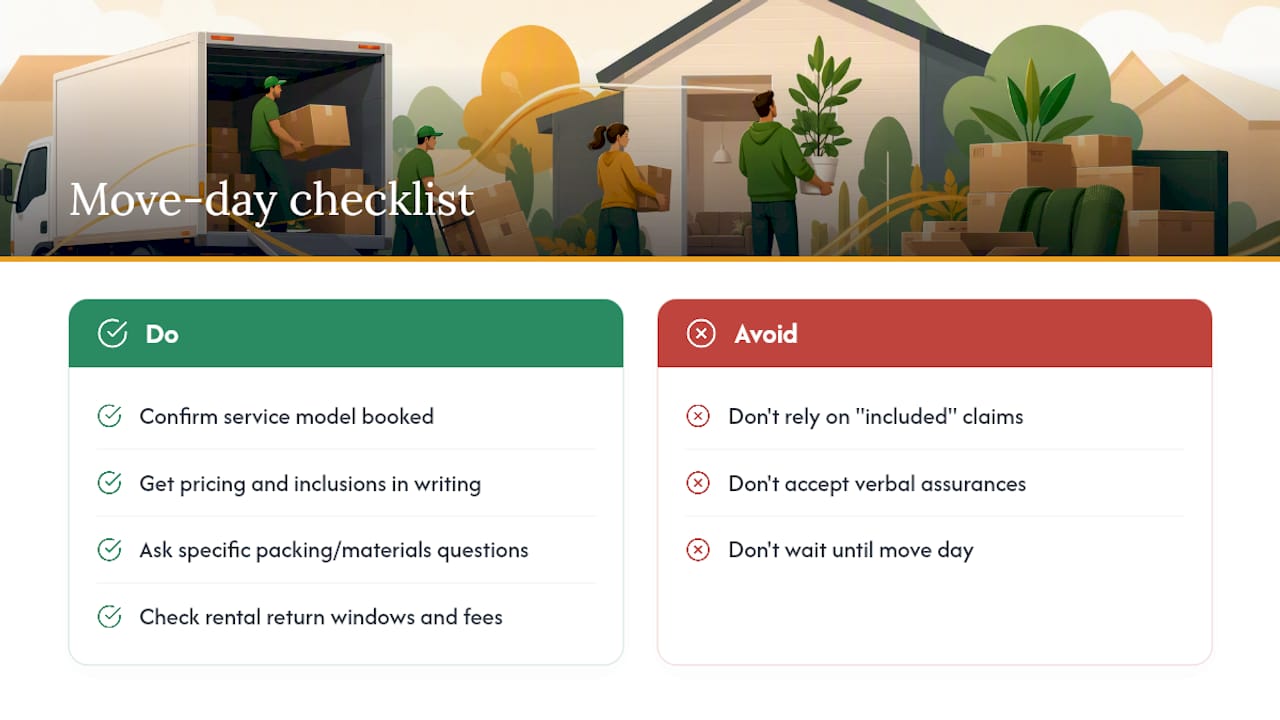
What actually matters is getting the service model right first. A labor-only move and a full-service pack-and-move are different products wearing the same word: “movers.” Once you know which one you booked, the box question answers itself, and you can spend your energy on the parts that actually cause move-day chaos, like rental return windows and materials fees buried in vague language.
If there’s one thing worth prioritizing above all else, it’s getting pricing and inclusions in writing before crews or supplies arrive. Verbal assurances about “we’ll bring what you need” are the single most common source of moving-day disputes, not the boxes themselves.
— Info
Get a Packing-Inclusive Quote Without the Guesswork
There are services that coordinate with vetted carriers across residential, long-distance, and office moves, allowing you to request one estimate that spells out exactly what’s included, whether that’s full packing with materials, partial packing for fragile rooms, or labor-only with your own supplies.

When you request a quote, ask specifically for packing service line items broken out from labor and transport costs, and compare that breakdown across carriers before committing. Our relocation coordinators can flag vague “materials included” language before you sign anything. Start by requesting your quote and telling us what level of packing help you actually need.
Sources
- Do Movers Provide Boxes? – Stack Moves
- Moving Boxes, Supplies & Rental Equipment | Box-n-Go Supplies+
- Moving Boxes, Packing Supplies, & Box Kits | U-Haul