
Start the process of transferring utilities during a long distance move at least 3–4 weeks before your moving date. The core steps: list every current utility account, contact each provider to schedule disconnection, research and set up new accounts at your destination, and confirm activation before you arrive. Service activation works best when scheduled 1–2 days before move-in, with disconnection set for one day after you leave.
A few things to know upfront:
- “Transferring” a utility often means two separate actions: canceling at the old address and opening a new account at the new one.
- Municipal services like water, sewer, and trash don’t follow you across state lines. You start fresh.
- In deregulated energy states like Texas, Ohio, and Pennsylvania, you can shop for a better electricity rate rather than just signing up with whoever serves the area.
- Internet and gas often require technician visits. Book those appointments early.
- Keep utilities active one day after moving out. You’ll need power and water for the final walkthrough and cleaning.
The rest of this guide walks through each step in detail, with timing, documentation tips, and advice for handling the parts that most people get wrong.
1. Build a complete list of your current utilities
Before you call a single provider, get organized. A spreadsheet or simple checklist with every utility account saves you from scrambling for account numbers mid-call.
Your list should cover:
- Electricity (provider name, account number, billing cycle)
- Natural gas or propane (note if a technician is required to shut off the meter)
- Water and sewer (usually municipal; confirm the department name)
- Trash and recycling (municipal or private hauler)
- Internet and cable/satellite TV (note any equipment rentals)
- Phone (landline, if applicable)
- Security or alarm systems (check for early termination fees and contract end dates)
- HOA-covered services (some condos and townhomes include water, trash, or basic cable)
For each account, record the customer service number, your account number, the billing address, any deposit you paid, and the contract end date. This is your moving utility checklist and the foundation for every call you’ll make over the next few weeks.
2. Contact current providers and close out old accounts properly
Call each provider at least 3–4 weeks before your move-out date. Schedule the service shutoff for one day after you leave, not on moving day itself. You want electricity and water running during the final walkthrough and any last-minute cleaning.
Key steps for each provider:
- Request a final meter reading for electricity, gas, and water. Official meter reading proof protects you if a billing dispute comes up months later. Take a photo of the meter on move-out day as a backup.
- Pay any outstanding balances. Unpaid utility bills can go to collections and affect your credit score, and they can also block you from opening new accounts at your next address.
- Ask about deposit refunds. If you paid a security deposit when you first set up service, ask how and when it gets returned.
- Get written confirmation of the cancellation date. An email or chat transcript works. Don’t rely on a verbal confirmation alone.
Gas service deserves special attention. Most providers require a technician to physically shut off the meter. Do not attempt to turn off gas yourself. Schedule that appointment early because gas company slots fill up fast, especially during peak moving season in summer.
3. Research and set up new utility accounts at your destination
This is where long-distance move logistics get more complicated than local ones. Your current providers almost certainly don’t serve your new address, so you’re starting from scratch with every utility.
Start by identifying what type of service each utility is at your new location:
- Regulated vs. deregulated electricity: In regulated markets, one utility serves the area and you have no choice. In deregulated states, you can compare rates, contract lengths, and early termination fees before committing. Shopping around in a deregulated market can save you money right from the start.
- Municipal vs. private water and sewer: Contact the city or county utilities office. Many now offer online forms to start service. You’ll likely need to provide a lease agreement or closing documents as proof of residency.
- Trash and recycling: Municipal trash service usually starts automatically once you’re the resident of record. Private haulers require you to research options, compare prices, and sign a contract. Ask a neighbor which company they use.
- Internet: Figure out which providers serve your exact address. In many areas you’ll have 2–4 options; in rural areas, possibly one. Compare speeds, prices, and installation timelines before you commit.
Gather the documents you’ll need before you start calling: your lease or purchase agreement, a government-issued ID, and your Social Security number for credit checks. Some providers also require a deposit if you don’t have an established credit history in the new state.
Pro Tip: When you call a new provider, ask directly whether your new address falls within their service area before giving any personal information. Providers occasionally quote rates for an area they don’t actually serve.
4. Schedule utility activation and be present for service start
Timing activation correctly prevents the worst-case scenario: arriving at your new home with no power, no hot water, and no internet after a long day of moving.
- Schedule electricity and water activation for 1–2 days before your move-in date.
- For gas, schedule a technician visit well in advance. Gas activation almost always requires an in-person appointment, and those slots can take a week or more to get during busy seasons.
- Confirm all appointments by phone 2–3 days before your move-in date. Automated confirmation emails don’t guarantee the appointment is actually on the technician’s schedule.
- Be present, or arrange for someone to be present, when a technician needs access to the property.
- Keep the customer service number for each new provider saved in your phone before moving day.
Internet installation deserves its own note. Technician appointments fill up fast during summer, and installation windows are often vague four-hour blocks. If you’re moving in peak season, book internet installation as soon as your move-in date is confirmed.

5. Additional tips for a smooth utility transfer during long-distance moves
A few things that don’t fit neatly into a single step but consistently trip people up:
- Keep utilities active at the old home for at least one full day after moving out. You need electricity, water, and HVAC to be running for the final walkthrough, cleaning, and any last-minute repairs.
- Prepare your personal information before you start calling. You’ll give the same details (name, Social Security number, new address, move-in date) to five or six different providers. Having it written down saves time and reduces errors.
- Watch for setup fees and early termination fees. Ask each provider directly whether fees apply, and ask if they can be waived. Providers often say yes, especially if you’re signing a longer contract.
- Track your progress with a checklist. Mark each utility as “canceled,” “scheduled,” or “confirmed active.” A half-finished utility transfer is how people end up without hot water on move-in night.
- Coordinate trash and recycling early. It’s the utility most people forget until the first pickup day comes and goes with no bin on the curb.
Pro Tip: Set calendar reminders for every confirmation call. Put one reminder three days before each activation appointment and another the day before. A two-minute call prevents a multi-day service delay.
6. How utility concierge services can simplify the process
A utility concierge service acts as a single point of contact for setting up multiple utilities at once. Instead of calling six providers separately, you make one call and a concierge agent handles the research, comparison, and scheduling on your behalf.
- Concierge services are free to consumers. They generate revenue through referral commissions paid by the utility providers, not by charging you.
- They research which providers serve your new address, compare plans, and coordinate activation appointments.
- They’re particularly useful for long-distance moves where you’re unfamiliar with local providers and service rules.
- Services like Utility Helpers and Utility Connect operate across the U.S. and handle electricity, internet, security, and more in a single call.
The main tradeoff is that concierge services work with providers in their referral network, so you may not see every option available at your address. For most people, the time saved outweighs that limitation.
Pro Tip: Ask the concierge agent specifically which providers they compared and which ones they don’t work with. That 30-second question tells you whether you need to do any independent research.
7. How to find new utility providers at your destination
Finding the right providers before you move is easier than troubleshooting a service gap after you arrive. Start with your new address and work outward.

For electricity and gas, search by your new zip code on your state’s public utility commission website. That page will list every licensed provider serving the area. In deregulated states, you’ll see multiple options with rate comparisons. In regulated states, one provider will be listed and that’s your only option.
For water and sewer, search “[city name] utilities department” or “[county name] water authority.” Most municipal websites have a “start service” page with the required documents listed. The utility coordination process for water is almost always handled directly through local government, not a private company.
For internet, use your new address on provider websites to check availability. Coverage maps are often inaccurate at the street level, so confirm availability by entering the exact address rather than relying on a general service area map.
8. How to contact new providers and what to say
Once you’ve identified your providers, the first call sets the tone for the whole setup process. Have your move-in date, new address, and personal information ready before you dial.
Tell the provider your exact move-in date and ask for activation 1–2 days before that date. Ask these questions on every call:
- Is there a setup fee or deposit required?
- Does activation require a technician visit, and what’s the earliest available appointment?
- What documents do I need to provide to verify residency?
- Will I receive written confirmation of the activation date?
For security systems, also ask whether your current contract transfers to the new address or whether you’ll need a new agreement. Early termination fees on security contracts can run several hundred dollars, so clarify this before you cancel.
Document every call. Write down the representative’s name, the date, and what was confirmed. If a dispute comes up later, that note is your starting point.
9. A realistic timeline for transferring utilities during a long-distance move
Getting the timing right is what separates a smooth move-in from a chaotic one. Here’s how the weeks break down:
| Timeframe | Action |
|---|---|
| 4–6 weeks out | Build your utility list; research providers at the new address |
| 3–4 weeks out | Contact current providers to schedule disconnection; initiate new account setups |
| 2 weeks out | Confirm technician appointments for gas and internet; pay outstanding balances |
| 3–5 days out | Call new providers to confirm activation dates and appointments |
| 1–2 days before move-in | Verify all new utilities are active; have emergency numbers saved |
| 1 day after move-out | Old utilities disconnect; request final meter readings |
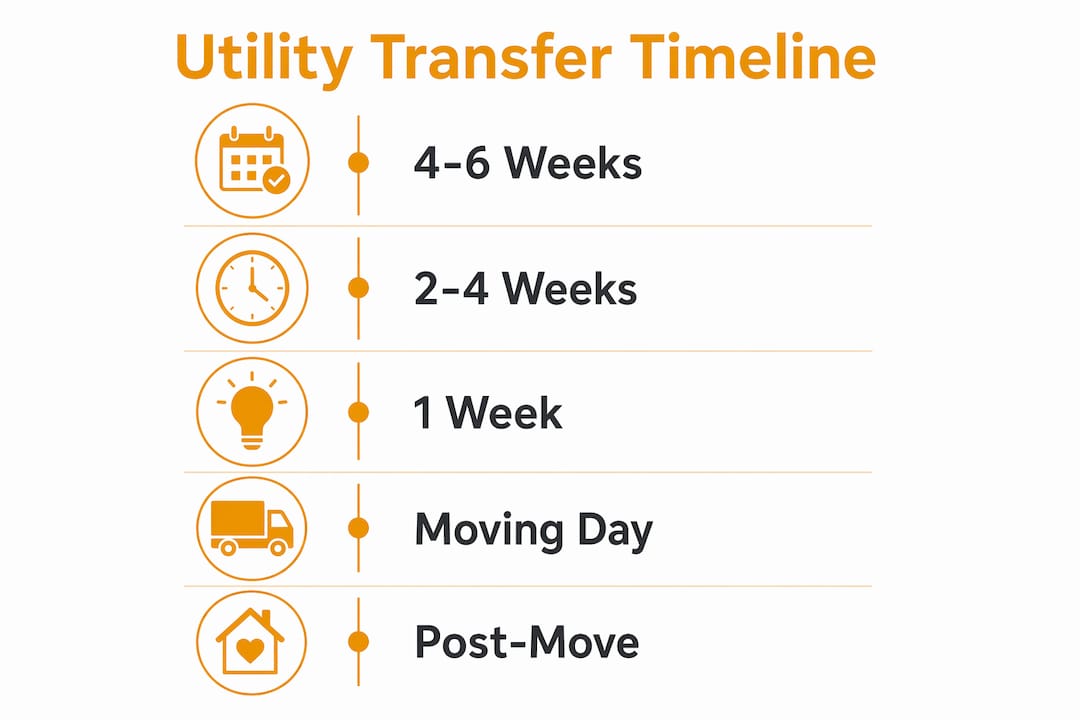
Internet and gas consistently require the most lead time because both involve technician visits. Book those two first. Electricity and water are usually faster to set up, but don’t leave them until the last week.
10. Common challenges and how to handle delays
Even with good planning, things go wrong. Knowing the most common problems in advance means you can fix them faster.
Technician no-shows: Call the provider the morning of the appointment to confirm. If the technician doesn’t arrive, call immediately and ask to be rescheduled as a priority. Document the missed appointment in writing.
Service not active on move-in day: This usually happens when an online signup didn’t trigger a real activation order. Always confirm by phone, not just email. If you arrive and service is off, call the provider’s emergency line. For gas, this is a safety issue and providers treat it urgently.
Billing disputes after move-out: This is why the final meter reading matters so much. If a provider bills you for usage after your disconnection date, your meter reading documentation is the evidence that resolves it.
Early termination fees: If you’re locked into a contract for internet or a security system, ask about fee waivers. Many providers waive fees for customers who are moving out of their service area entirely, but you have to ask.
Rural or new-construction delays: In some areas, internet installation can take weeks. If your new home is in a rural area or a new development, contact internet providers before you even finalize your move-in date.
11. How to coordinate utility transfers with your moving dates
The single most effective thing you can do is treat utility scheduling as part of your moving timeline, not a separate task you’ll get to later. When you book your moving truck or confirm your moving company, open your utility checklist at the same time.
Tie each utility deadline to your confirmed move-out and move-in dates. If your move-out date shifts, update every utility appointment immediately. A one-week delay in your move can cascade into service gaps if providers aren’t notified.
For long-distance moves involving interstate logistics, the gap between leaving one home and arriving at the next can be several days. Plan for that gap explicitly. You don’t need utilities active at the old address during transit, but you do need them active at the new address before you walk in the door.
Working with a relocation coordinator can take the scheduling burden off your plate entirely. Coordinators track provider timelines, flag conflicts, and follow up on confirmations so you can focus on the move itself.
Ready to move without the utility headaches?

Movecraftmoving connects you with vetted carriers and relocation professionals who treat your move as a coordinated operation, not a series of disconnected tasks. From utility coordination to final delivery, every detail is tracked and managed. Get in touch with Movecraftmoving to plan a long-distance move that actually goes the way it’s supposed to.
Key Takeaways
Starting the utility transfer process 3–4 weeks before your move-out date, with disconnection scheduled one day after you leave and activation confirmed 1–2 days before you arrive, prevents the service gaps that make move-in day miserable.
| Point | Details |
|---|---|
| Start 3–4 weeks early | Contact all providers at least 3–4 weeks before moving to accommodate technician scheduling. |
| Disconnection timing | Schedule old service shutoff for one day after move-out, not on moving day itself. |
| Final meter readings | Request official meter reading documentation to protect against billing disputes after you leave. |
| Deregulated markets | In states like Texas, Ohio, and Pennsylvania, compare electricity providers instead of defaulting to the first option. |
| Confirm by phone | Call new providers 2–3 days before move-in to verify activation; email confirmations alone don’t guarantee service. |
Recommended
- Why Residential Moves Need Utility Coordination – Move Craft Moving Solutions LLC
- Long Distance Moving Process Overview: 2026 Guide – Move Craft Moving Solutions LLC
- Long Distance Moving Insurance Guide for Your Move – Move Craft Moving Solutions LLC
- Long Distance Packing Service Benefits: Your 2026 Guide – Move Craft Moving Solutions LLC