
A mover performance score is a private, aggregated rating that combines public records, customer reviews, and platform audits into a single number meant to signal a moving company’s reliability. Movecraftmoving publishes this guide because that number is only as trustworthy as the methodology behind it. Before you act on any score you see, do three things:
- Ask the mover for their USDOT and MC numbers, then look them up on FMCSA SAFER to confirm active authority and check inspection history.
- Request the platform’s methodology page. If the scoring provider won’t disclose how weights are assigned or how many moves the score covers, treat it as weak evidence.
- Cross-check at least two independent sources: BBB complaint history, Google Reviews, and state licensing records each reveal different failure modes.
Key Takeaways
A mover performance score is a private, weighted composite of public records and reviews, not a government certification, and verifying its methodology and sample size is as important as reading the number itself.
| Point | Details |
|---|---|
| Score definition | A private aggregate of complaint history, licensing, reviews, safety, and transparency data, not a government rating. |
| Verify methodology first | Ask for the platform’s weighting and sample size; suppress or discount scores with no methodology disclosure. |
| Cross-check public records | Confirm USDOT/MC on FMCSA SAFER and check BBB complaint patterns independently of any platform score. |
| Red flags override high scores | Concentrated recent complaints, pay-to-play rankings, or missing insurance evidence outweigh a strong aggregate number. |
| Movecraftmoving vetting | Movecraftmoving verifies licenses, insurance, sample jobs, and references before matching any carrier to a customer. |
Table of Contents
- What is a mover performance score, and what does it actually measure?
- What typically goes into a mover performance score?
- How are mover performance scores actually calculated?
- Where do scores and underlying data come from?
- What does a good score look like, and what are the red flags?
- What mover performance scores don’t tell you
- How to use a mover performance score when hiring
- A compact crew scorecard you can use or request from movers
- How Movecraftmoving vets its partners
- Scores are signals, not guarantees
- Vetted movers, without the research burden
- Sources
What is a mover performance score, and what does it actually measure?
A mover performance score is not a government rating. It is a proprietary composite built by a private platform from publicly available data, scraped reviews, and sometimes direct audits. According to Mover Scorecard’s published methodology, scores draw on complaint history, licensing status, review profiles, safety records, and transparency disclosures. No federal agency issues or certifies these scores, which means two platforms can score the same company differently.
The practical implication: a score tells you what a platform found in the data it chose to collect, weighted the way it decided to weight it. That’s useful context, not a verdict.
What typically goes into a mover performance score?
Most platforms pull from the same general pool of metrics, though weights vary. Here’s what each component actually measures and why it matters:
-
Complaint and claim history. Approved claims as a percentage of completed moves, plus formal complaints filed with the BBB or state regulators. This is one of the strongest consumer signals because it reflects documented financial harm, not just dissatisfaction.
-
Licensing and authority status. Active USDOT and MC numbers verified against FMCSA records. A lapsed or revoked license is a disqualifying red flag regardless of any other score component. Mover Scorecard weights this at 25% alongside complaint history.
-
On-time delivery performance. The percentage of moves completed within the agreed delivery window. Industry KPI frameworks consistently list on-time delivery rate as a primary operational metric for moving companies, and it maps directly to what consumers care about most.
-
Customer satisfaction (CSAT). Aggregated star ratings and survey scores from post-move feedback. Platforms typically scrape Google, Yelp, and BBB simultaneously. Volume and recency matter here: 200 reviews over three years carry more weight than 12 reviews from last month.
-
Safety and inspection records. Out-of-service rates and roadside inspection results from FMCSA. A high out-of-service rate on vehicles or drivers is an operational risk that review scores rarely capture.
-
Insurance and coverage verification. Confirmation that the carrier holds active cargo and liability insurance. MASi Leap’s KPI framework includes cost-per-move and repeat-customer rate as secondary indicators of financial stability, which correlates with adequate insurance coverage.
-
Pricing transparency and disclosures. Whether the company provides binding-not-to-exceed estimates and discloses all fees upfront. Platforms that track this reward movers who put pricing in writing before the move.
-
Transparency and documentation. Willingness to share licensing documents, insurance certificates, and written claims procedures. Mover Scorecard assigns this category a 10% weight, making it a tiebreaker between otherwise similar companies.
How are mover performance scores actually calculated?
Most platforms use a weighted average across categories, normalized to a 0–100 or 1–10 scale. The general process works like this:
- Collect raw data from public records (FMCSA, BBB, state portals) and review platforms, then normalize each metric to a common scale (typically 0–100).
- Apply category weights to each normalized score. A platform might weight complaint history and licensing at 25% each, review profile and safety at 20% each, and transparency at 10%.
- Compute the weighted sum. Multiply each category score by its weight and add the results.
- Apply a rolling data window, typically the past 12 months, to keep scores current. Older incidents may be discounted or excluded entirely.
- Enforce a minimum sample size. Platforms with rigorous methodology require a minimum number of verified moves or reviews before publishing a score. USMPO, for example, audits a sample of 10 randomly selected jobs from the previous calendar year before incorporating audit results into a rating.
Worked example: Suppose a platform uses Mover Scorecard’s published weights. A company scores 80 on complaint history, 90 on licensing, 75 on review profile, 85 on safety, and 70 on transparency.
Weighted score = complaint history score times its weight plus licensing score times its weight plus review profile score times its weight plus safety score times its weight plus transparency score times its weight, resulting in an overall score on a 0–100 scale.
Signal worth noting: Performance scores carry real weight beyond consumer decisions. In military freight contracting, on-time pickup/delivery and customer satisfaction survey results compose a significant portion of procurement award scores, which shows how seriously institutional buyers treat these metrics.
When a company has fewer than the minimum required data points, responsible platforms either suppress the score or flag it with a low-confidence label. If you see a score with no sample-size disclosure, ask the platform directly how many moves or reviews it covers.
Where do scores and underlying data come from?
Understanding the data sources lets you verify each component independently:
- FMCSA SAFER database. Search by company name, USDOT, or MC number at safer.fmcsa.dot.gov. Reveals active authority, out-of-service rates, crash history, and inspection results. Red flag: any “out of service” status or a crash rate significantly above the national average.
- State licensing portals. Most states require intrastate movers to hold a separate state license. Search your state’s public utilities or transportation commission website. Red flag: no state license for a company advertising local moves.
- Better Business Bureau (BBB). Shows complaint volume, complaint resolution rate, and accreditation status. Useful for pattern recognition: three complaints about the same issue (e.g., held-hostage pricing) is more meaningful than three isolated complaints.
- Google Reviews and Yelp. High volume with recent activity is the signal. Sort by “newest” and read the 1-star reviews specifically for operational patterns: late arrivals, damaged items, surprise charges. To spot unlicensed moving companies, look for reviewers who mention the company showed up in an unmarked truck or demanded cash on delivery.
- USMPO and aggregator platforms. These combine public records with proprietary audits. USMPO’s rating process includes random job sampling, which adds a layer of verification that pure review scraping cannot replicate.
- Insurer and claims records. Ask the mover directly for their claims ratio (approved claims as a percentage of completed moves). A reputable carrier can produce this. Refusal to share it is itself a data point.
Aggregator platforms that blend these sources are useful precisely because they save you time. The catch: their value depends entirely on whether they disclose which sources they use and how they weight them.
What does a good score look like, and what are the red flags?
Exact thresholds vary by platform and scale, but a general orientation helps. On a 0–100 scale, scores above 80 typically reflect strong compliance and review profiles. Scores in a moderate range warrant closer inspection. Low scores indicate documented issues that require direct verification before proceeding.
Red flags that should override a moderate or even high score:
- Methodology not disclosed. If the platform won’t publish how it calculates the score, you cannot evaluate what the number means. Treat it as unverified marketing.
- Tiny sample size. A 95/100 score based on 8 reviews is statistically meaningless. Ask how many moves or reviews the score covers.
- Concentrated recent complaints. A cluster of 1-star reviews in the past 90 days outweighs a strong historical average. Always sort reviews by recency.
- Disproportionate claim volume. A relatively high proportion of approved damage claims relative to completed moves is a red flag. Ask for the company’s claims ratio directly.
- Pay-to-play disclosures. Some platforms allow companies to pay for featured placement or score boosts. If the platform’s terms mention “sponsored” or “featured” rankings, the score may reflect advertising spend rather than performance.
- Missing licensing or insurance evidence. A high score on a platform that doesn’t verify licensing is meaningless. Cross-check FMCSA independently. For transparent pricing and licensing verification, always go to primary sources.
- No response to complaints. A company that ignores BBB complaints or leaves negative reviews unaddressed is signaling how it handles disputes.
What mover performance scores don’t tell you
Scores are useful filters, not final answers. Several limitations are worth keeping in mind:
- Proprietary formulas. Most platforms don’t publish their full weighting logic. Two platforms can score the same mover 85 and 62 simultaneously because they weight complaint history differently.
- Inconsistent data coverage. A platform that only scrapes Google Reviews misses BBB complaints entirely. One that relies solely on FMCSA data misses customer satisfaction. No single score captures everything.
- Review manipulation. Fake positive reviews are a documented problem across all consumer platforms. A sudden spike in 5-star reviews with generic text (“Great service! Highly recommend!”) and no reviewer history is a manipulation signal.
- Lack of operational context. A score built on residential moves tells you little about a company’s performance on specialty moves: pianos, fine art, or IT equipment. The operational complexity of specialty moves rarely shows up in aggregate scores.
- Time lag. A score calculated quarterly can be three months behind a company’s current operational reality. A mover that changed ownership or lost key staff recently may carry an outdated score in either direction.
- Administrative vs. service issues. A low score sometimes reflects paperwork lapses (a lapsed state license that was quickly renewed, for example) rather than service danger. Context matters.
Pro Tip: When a score is ambiguous, request three specific documents: a certificate of insurance (COI) naming you as an additional insured, the company’s written claims process, and two references from moves completed in the past 60 days. A mover who hesitates on any of these is telling you something the score cannot.
To avoid long-distance moving scams, treat score verification as step one of a multi-step process, not the whole process.
How to use a mover performance score when hiring
Turn the score into a structured hiring decision with these steps:
- Verify licensing first. Look up the USDOT and MC numbers on FMCSA SAFER before reading any score. An unlicensed mover is disqualified regardless of ratings.
- Check FMCSA safety data. Review out-of-service rates, crash history, and inspection results. Compare the company’s out-of-service rate to the national average shown in SAFER.
- Cross-check BBB and Google Reviews independently. Sort reviews by recency on both platforms. Look for complaint patterns, not just star averages.
- Request proof of insurance. Ask for a COI showing cargo and liability coverage. Confirm the policy is current and the coverage limits are adequate for your shipment value.
- Ask for a binding-not-to-exceed estimate in writing. Verbal quotes are unenforceable. Review contract best practices before signing anything.
- Request sample job references. Ask for two customers from moves completed in the past 60 days. Call them. Ask specifically about on-time performance and how the company handled any damage.
Questions to ask the mover directly about their score:
- “Which platform issued your score, and can you share their methodology page?”
- “How many moves or reviews does your current score cover?”
- “What is your claims ratio over the past 12 months?”
- “Have you had any FMCSA violations or out-of-service orders in the past two years?”
- “Can you provide a COI and your written claims process before we sign?”
Documents to collect before booking:
- USDOT and MC numbers (confirm on FMCSA SAFER yourself)
- Certificate of insurance (COI)
- Binding-not-to-exceed written estimate
- Written claims process and timeline
- State license number (for intrastate moves)
For a full list of questions to ask local moving companies, Movecraftmoving has a ready reference that covers both licensing and service quality. Vetted providers through Movecraftmoving supply these documents proactively, which is itself a performance signal worth noting.
A compact crew scorecard you can use or request from movers
This template gives you a structured way to evaluate a crew’s performance after a move, or to ask a mover to share their own internal tracking. Driver scorecard frameworks used in logistics use the same weighted approach adapted here for residential and commercial moves.
Confidence field: Record the date of the move, the crew lead’s name, and the number of items moved. A scorecard with fewer than 20 items or a single crew member carries less statistical weight than one covering a full household move.
Worked example: A crew arrives 30 minutes late (on-time score: 6), causes no damage (damage score: 10), behaves professionally (professionalism: 9), matches the estimate exactly (pricing: 10), and provides all documents (documentation: 10).
Weighted total = (6 × 0.25) + (10 × 0.25) + (9 × 0.20) + (10 × 0.20) + (10 × 0.10)
= 1.5 + 2.5 + 1.8 + 2.0 + 1.0 = 8.8 out of 10
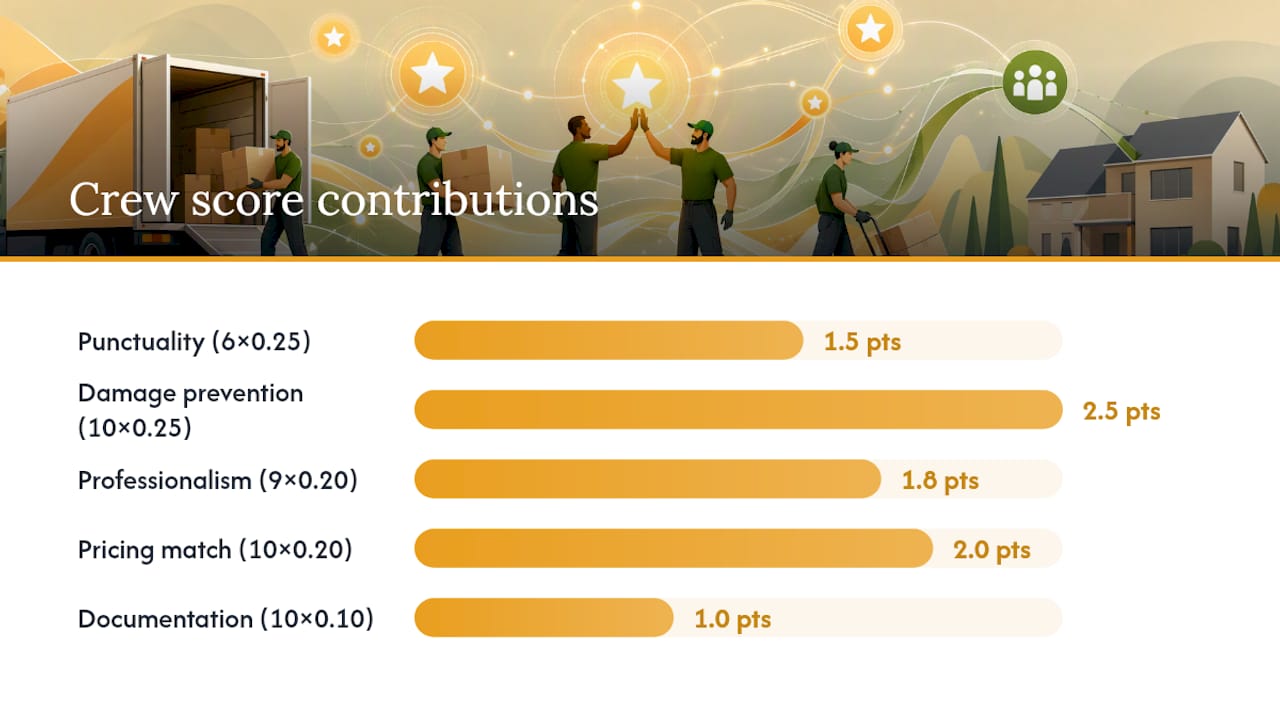
That score tells you the crew was excellent on every dimension except punctuality. Whether that matters depends on how tight your schedule was. The scorecard makes the tradeoff visible rather than burying it in a single aggregate number.
How Movecraftmoving vets its partners
Movecraftmoving applies a multi-step vetting process before connecting any carrier with a customer:
- License and insurance verification. Every partner’s USDOT, MC number, and COI are confirmed against FMCSA SAFER and the issuing insurer before onboarding.
- Sample-job audits. Movecraftmoving reviews documentation from a sample of recent moves, checking for on-time performance, claims history, and customer communication records.
- Reference checks. Direct outreach to past customers, not just review scraping, to verify service quality on moves similar in scope to the customer’s request.
- Claims and complaint cross-checks. BBB complaint history, FMCSA safety data, and state licensing records are reviewed together, not in isolation.
- Ongoing performance monitoring. Partners are re-evaluated periodically. A carrier that develops a pattern of complaints or safety violations is removed from the network.
Movecraftmoving’s methodology is available to customers on request. If you want to see the specific criteria applied to a carrier in your network, ask during the quote process. Transparency about vetting criteria is a standard part of the service, not an exception.
Scores are signals, not guarantees
Mover performance scores are genuinely useful. They surface documented issues faster than a consumer could find them independently, and they create accountability pressure that improves industry behavior over time. But treating a score as a final answer is where consumers get into trouble.

The most reliable movers Movecraftmoving works with tend to score well on formal metrics, but what actually distinguishes them is something scores rarely capture: how they communicate when something goes wrong. A mover who calls you proactively when a truck is delayed, documents the issue, and resolves it without a fight is more valuable than one with a perfect score who goes silent the moment a problem surfaces. Document checks and direct communication are higher-weighted decision criteria in practice than any composite number.
Vetted movers, without the research burden
Finding a mover with a strong performance record takes hours of cross-checking FMCSA records, BBB complaints, and review platforms. Movecraftmoving does that work before you ever see a carrier’s name.

Every carrier in the Movecraftmoving network has passed license verification, insurance confirmation, sample-job audits, and reference checks. You get a vetted match for your specific move type, whether residential, long-distance, or commercial, along with the documentation to confirm it. For families planning a relocation, the full-service relocation benefits page explains exactly what a vetted carrier relationship covers. Request a quote at Movecraftmoving and receive carrier options that have already cleared the verification steps this guide describes.
Sources
- Scoring Methodology | Mover Scorecard
- Rating Process – USMPO | How We Audit, Verify & Rate Movers
- The 9 Key KPIs for Moving Companies in 2027 · 2027 Benchmarks + Real Targets — Pulse Industry KPIs
- Movers Scrutinize Military Shipment Award Process Reforms
Recommended
- 15 Questions to Ask Local Moving Companies Before You Hire – Move Craft Moving Solutions LLC
- Transparent Pricing From Licensed Movers: What You Need to Know – Move Craft Moving Solutions LLC
- Moving Companies Full Valuation Coverage Options Explained – Move Craft Moving Solutions LLC
- How to Spot Unlicensed Moving Companies Locally – Move Craft Moving Solutions LLC