A door to door moving service is a full-service relocation solution where one provider manages every step of your move, from packing at your current home to final delivery at your new one. This model, formally known in the industry as “full-service relocation,” eliminates the need to coordinate separate vendors for packing, transport, and unpacking. Door to door moving services handle every stage including customs clearance for international moves, which makes them the most complete option available for individuals who want a predictable, low-stress relocation experience.
What is door to door moving service and how does it work?
A door to door moving service is defined as a single-provider solution that covers your entire relocation from origin to destination. The moving company acts as your sole point of contact throughout the process. You do not manage a packer, a freight company, and a delivery crew separately. One team coordinates all of it.
The full-service moving process follows a clear sequence:
- Initial consultation and survey. A relocation coordinator visits your home or conducts a virtual walkthrough to assess the volume of goods, identify specialty items, and build a timeline.
- Packing. Professional packers arrive with materials and wrap, box, and label every item. Fragile and high-value items receive custom crating.
- Loading. The crew loads your belongings onto the transport vehicle using inventory sheets. Every item is logged before the truck leaves.
- Transport. The mover manages the route, whether that is a local truck, a long-haul carrier, or an ocean freight container for international moves.
- Customs clearance (international moves only). The moving company coordinates with customs brokers and submits required documentation. You provide accurate paperwork on your end.
- Delivery and unloading. The crew delivers to your new address, unloads, and places items in the rooms you specify.
- Unpacking. Many full-service packages include unpacking and debris removal, so your new home is functional from day one.
The entire workflow runs through one company. That single chain of custody is what separates door to door relocation from partial-service or self-managed moves.
Pro Tip: Request a written inventory list at the loading stage. This document is your best protection if any item goes missing or arrives damaged.

What are the main advantages of door to door moves?
The biggest advantage of a door to door relocation service is service continuity. Continuity within a single trusted network prevents lost items and scheduling disputes that are common in fragmented moves. When one company owns every handoff, there is no gap where a box can disappear between a packer and a freight carrier.
Centralized communication is the second major benefit. You have one phone number, one coordinator, and one contract. Compare that to managing three or four separate vendors, each with their own timelines and liability limits. The coordination burden alone can add days of stress to an already demanding process.
Full-service moving is also suitable for both private households and corporate clients. Businesses relocating offices need minimal downtime. Families moving across state lines need predictability. Both groups benefit from a provider who manages the entire chain.
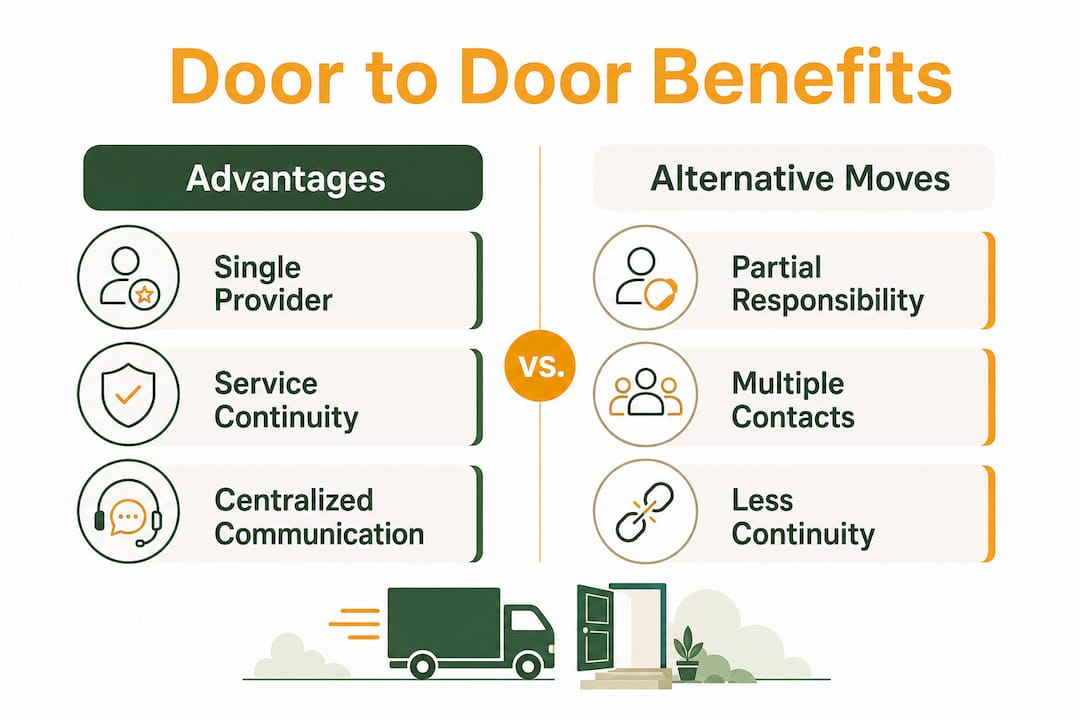
| Feature | Door to door service | Partial or DIY move |
|---|---|---|
| Packing responsibility | Moving company | You |
| Single point of contact | Yes | No |
| Customs coordination | Included (international) | Self-managed |
| Risk of scheduling gaps | Low | High |
| Time investment from you | Minimal | Significant |
| Liability coverage | Consolidated | Split across vendors |
The table above shows the practical gap between full-service and partial moves. The difference is not just convenience. It is risk management.
Pro Tip: When evaluating providers, ask whether they use their own crews or subcontract. Companies that use in-house teams at every stage deliver stronger continuity and accountability.
What does a door to door move cost?
Typical cost components for a door to door move include packing materials, labor, transport distance, and customs fees for international relocations. Additional factors like the volume of goods, the timing of your move, and special handling requirements also affect the final price. Understanding these components upfront prevents budget surprises.
The main cost drivers are:
- Volume of goods. More items mean more packing time, more truck space, and higher labor costs.
- Distance. Local moves are priced by the hour. Long-distance and international moves are priced by weight or cubic footage plus mileage or freight rates.
- Timing. Summer months and end-of-month dates carry premium pricing due to high demand.
- Specialty items. Pianos, artwork, and antiques require custom crating and add to the total.
- Customs fees. International moves include duties, port fees, and broker charges that vary by destination country.
- Storage. If your new home is not ready on delivery day, short-term storage adds a daily or weekly fee.
Red flags to watch for when reviewing quotes:
- A quote with no written inventory attached
- A mover who demands a large cash deposit upfront
- No physical address or license number listed on the contract
- A price that drops significantly after the initial estimate with no explanation
Transparent pricing from licensed movers is the clearest signal that a company operates with integrity. Licensed movers are required to provide a binding or non-binding estimate in writing. If a company resists putting the price in writing, that is a serious warning sign.
How do door to door services handle international relocations?
International door to door moving is the most complex version of this service, and it is where the single-provider model delivers the most value. The moving company coordinates ocean or air freight, customs brokerage, and final delivery in the destination country. You do not need to find a local carrier abroad or navigate foreign customs regulations on your own.
That said, the client carries specific responsibilities in international moves. Delayed paperwork is the most frequent cause of additional charges, not mover incompetence. When your documents are late, your shipment sits in a port or warehouse, and storage fees accumulate daily.
The documents you typically need to provide include:
- A detailed packing list with item descriptions and estimated values
- A copy of your passport and destination country visa or residency permit
- Proof of change of residence (utility bills, lease agreements)
- Duty exemption certificates, where applicable
- Customs declaration forms specific to the destination country
Working with a mover affiliated with a global alliance like EUROMOVERS gives you access to vetted local partners in the destination country. Global alliance networks coordinate international moves to avoid delays and mishandling. That local knowledge is difficult to replicate when you piece together vendors independently.
The practical advice is straightforward. Start your paperwork as soon as you book your move. Ask your coordinator for a document checklist specific to your destination. And build a buffer of at least two weeks between your shipment departure and your expected arrival date, so customs processing does not leave you without your belongings.
Key Takeaways
A door to door moving service is the most complete relocation option available, and its core value is continuity: one provider, one chain of custody, and one point of contact from start to finish.
| Point | Details |
|---|---|
| Single-provider model | One company manages packing, transport, customs, and delivery so you never coordinate vendors. |
| Continuity prevents loss | A single chain of custody reduces the risk of lost items and scheduling conflicts. |
| Paperwork drives international costs | Delayed client documentation is the top cause of extra charges in overseas moves. |
| Transparent pricing matters | Always get a written estimate from a licensed mover to avoid hidden fees and scams. |
| Global networks add value | Movers affiliated with international alliances provide vetted local partners at your destination. |
Why continuity is the detail most people overlook
Most people planning a move focus on price first. That instinct is understandable, but it often leads to the wrong decision. The real cost of a fragmented move is not on the invoice. It shows up when a box goes missing between the packer and the freight carrier, or when a scheduling gap leaves your furniture sitting in a truck while you wait in an empty apartment.
I have seen this pattern repeat itself. A mover quotes a lower price because they subcontract the packing to one company and the delivery to another. Each vendor does their job adequately. But no one owns the full picture. When something goes wrong, and something always does in a complex move, there is no single person accountable for fixing it.
The value of centralized communication in a door to door service is not a marketing claim. It is a structural advantage. One coordinator who knows your inventory, your timeline, and your destination can solve problems in hours. Three separate vendors pointing at each other solve nothing quickly.
My advice: prioritize the provider who can name every company touching your belongings and explain exactly how they are vetted. If they cannot answer that question clearly, the price does not matter.
— Info
How Movecraftmoving handles your door to door relocation
Movecraftmoving connects you with rigorously vetted carriers and logistics professionals who manage your entire move under one coordinated plan. Every partner in the Movecraftmoving network is selected for integrity, punctuality, and consistent performance, so the continuity you read about in this article is built into every relocation we arrange.
Whether you are planning a long-distance packing service or need a full door to door relocation from origin to destination, Movecraftmoving builds a plan around your timeline and priorities. Radical transparency means you get a written plan, a clear price, and a single coordinator from day one. Visit Movecraftmoving to get started with a relocation strategy built around your move.
FAQ
What does door to door moving service include?
A door to door moving service includes packing, loading, transport, delivery, and unpacking, with customs clearance added for international moves. One provider manages every stage so you do not coordinate separate vendors.
How does door to door moving differ from partial-service moving?
In a partial-service move, you handle some tasks yourself, such as packing or unpacking, while the mover handles transport only. A door to door service covers every step, reducing your workload and the risk of items being lost between handoffs.
What causes extra charges in a door to door move?
Delayed client documentation is the most common cause of unexpected costs, particularly in international moves where shipments can be held at ports. Storage fees, specialty item handling, and off-peak timing also add to the final price.
How do I verify a door to door mover is legitimate?
Ask for a written estimate, a valid license number, and a physical business address. Licensed movers with transparent pricing are required to provide binding or non-binding estimates in writing, which protects you from last-minute price increases.
Is door to door moving worth the cost?
For most people, yes. The reduction in coordination, the consolidated liability, and the lower risk of lost items make full-service relocation a better value than the savings from a partial or DIY move, especially for long-distance and international relocations.