
A moving tariff is the official, published rate schedule an interstate mover has to keep on file, and it’s the document that legally governs what you can be charged. Federal law, specifically 49 U.S.C. § 13702, requires every interstate household goods carrier to maintain one and hand it over on request. That means you can inspect it, compare it against your estimate, and cite it if a charge on your final bill doesn’t match what’s published.
TL;DR:
- Movers must disclose their tariff publicly through multiple accessible channels, and failure to do so weakens their ability to enforce charges.
- Tariffs include detailed line-haul rates, accessorial charges, fuel surcharges based on diesel indexes, and liability options, all affecting the final cost.
- Estimates should be based on tariff line items, with binding estimates offering fixed prices and non-binding estimates limited to 110% of the initial prediction.
- Disputed charges not listed in the tariff lack a legal basis, and consumers should request specific tariff sections to challenge improper fees.
- Interstate moves are regulated by federal tariffs, while intrastate moves vary by state, often lacking standardized protections, so verify local regulations before booking.
Table of Contents
- What Is a Moving Tariff Under Federal Law?
- What’s Actually Inside a Moving Company Tariff?
- How Does a Tariff Turn Into Your Final Bill?
- Can You Dispute Charges That Don’t Match the Tariff?
- Does Every State Follow the Same Tariff Rules?
- How Do You Use a Tariff to Compare Moving Quotes?
- How Move Craft Approaches Tariff-Based Quoting
- Get a Tariff-Backed Quote Before You Book a Mover
- Sources
- FAQ
What Is a Moving Tariff Under Federal Law?
A moving tariff is the mover’s rulebook, and it’s not optional paperwork buried in a filing cabinet. Under 49 U.S.C. § 13702, interstate household goods carriers must publish a tariff and make it available to customers free of charge. The Surface Transportation Board reinforces this by recommending tariffs stay clear and easy to follow, since confusing tariffs invite disputes.
Here’s the part most consumers never learn: a carrier generally can’t enforce charges from a tariff unless it gave proper notice the tariff was available for inspection, whether through the bill of lading, a company website, or a posting at its principal office. If a mover never disclosed the tariff existed or made it hard to find, that weakens their ability to hold you to charges buried inside it.
Movers typically make tariffs available through:
- A link or downloadable file on the company website
- A printed copy at the mover’s principal place of business
- Reference language in the bill of lading pointing you to where the tariff lives
- Direct delivery upon written or verbal request before you sign anything
If your mover stalls or refuses when you ask to see this document, treat that as a warning sign before you book.
What’s Actually Inside a Moving Company Tariff?
A tariff isn’t one page. It’s a structured set of tables and rules, and each one can move your final number up or down. The Surface Transportation Board’s guidance lays out the typical sections carriers include, and understanding each one is the difference between an estimate you trust and one that blind sides you at delivery.
- Line-haul rate tables. These set the base cost using weight or cubic footage multiplied by mileage, usually with a stated minimum charge regardless of shipment size.
- Accessorial charges. Packing, unpacking, stair carries, long carries from truck to door, shuttle service for inaccessible streets, and handling of items like pianos or gun safes all get separate line items.
- Fuel surcharge formulas. Most tariffs apply a percentage on top of the line-haul charge, tied to a specific U.S. Energy Information Administration diesel index and dated to a particular week or month.
- Valuation and liability schedules. These spell out released value protection (minimal, often $0.60 per pound) versus full value protection, plus the window you have to file a claim for damage.
- Storage-in-transit and extra-stop fees. Charges for warehousing goods between pickup and delivery, additional pickup or drop-off addresses, and elevator carries at either end.
One detail that trips up almost everyone: the fuel surcharge percentage isn’t fixed. It shifts with the diesel index date the tariff cites, so the same move booked two weeks apart can carry a different surcharge purely because the index moved.
How Does a Tariff Turn Into Your Final Bill?
Your estimate isn’t a guess pulled from thin air. It’s built directly from tariff line items, and the type of estimate you sign determines how much financial protection you actually have.
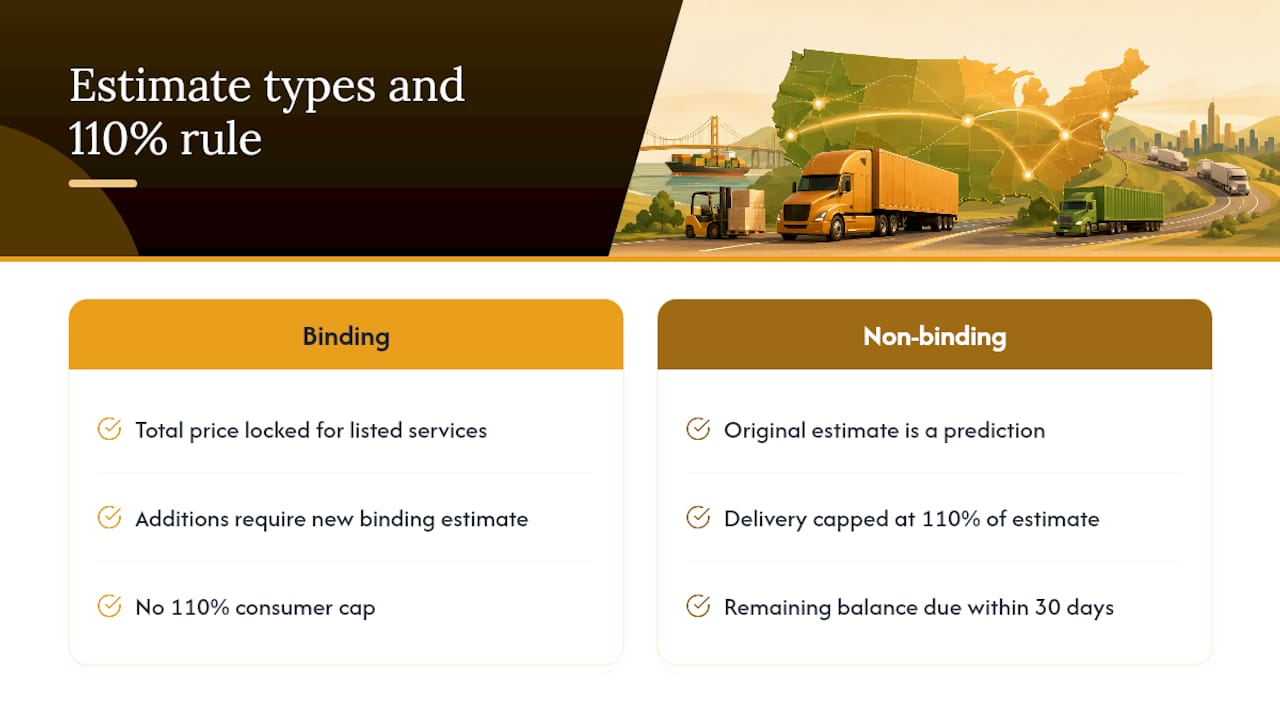
A binding estimate locks in a total price for the exact services and inventory listed. If you add items or services later, the mover has to prepare a new binding estimate before continuing, according to federal estimate provisions. A non-binding estimate is just a prediction, and it comes with a critical consumer protection: the 110% rule. Under this rule, you can’t be required to pay more than 110% of the original non-binding estimate at delivery, with any remaining balance due within 30 days.
Here’s how the math typically stacks up on a mid-size interstate move:
Pro Tip: Insist on a physical survey, whether in-home or virtual, before accepting any estimate. Movers who quote sight-unseen off a phone call are the ones most likely to blow past their own tariff numbers once your furniture is on the truck.
Can You Dispute Charges That Don’t Match the Tariff?
Yes, and the tariff is your strongest evidence when you do. If a fee shows up on your bill that isn’t published anywhere in the mover’s tariff, the carrier generally has no legal basis to charge it, according to the Surface Transportation Board.
Start by requesting the specific tariff pages that justify the disputed charge in writing. A legitimate carrier should point you to an exact line item within a day or two.
- Ask the mover in writing to show the exact tariff section that supports any charge you don’t recognize.
- File a complaint with the Federal Motor Carrier Safety Administration if the carrier won’t explain the discrepancy.
- Escalate to the Surface Transportation Board for tariff-specific enforcement issues.
- Know that carriers violating tariff rules can face civil penalties, and willful violations can carry criminal exposure for responsible parties.
Claims for loss or damage generally need to be filed within nine months of delivery, and carriers typically must acknowledge receipt of a claim within 30 days and either pay, deny, or make a settlement offer within 120 days.
Does Every State Follow the Same Tariff Rules?
Federal tariff law only applies to interstate moves, meaning your shipment crosses a state line. Move entirely within one state, and you’re in different territory. Some states, like Washington, regulate intrastate movers through a state utilities commission that can set minimum and maximum prices in a published state tariff. Other states leave intrastate moving largely unregulated, which means fewer built-in protections and more variation in what movers can charge.
Here’s what to check before booking a mover for an in-state relocation:
- Search your state’s utilities and transportation commission website for a household goods mover registry.
- Ask directly whether the mover operates under a state-filed tariff and request to see it.
- Compare intrastate quotes against each other rather than assuming federal 110% protections apply, since they may not.
- Verify licensing status through your state agency in addition to federal USDOT numbers.
Understanding the difference between interstate and intrastate regulation before you sign anything saves a lot of confusion later, especially if your move crosses a state line partway through planning.
How Do You Use a Tariff to Compare Moving Quotes?
- Request the tariff before you request a quote. A carrier that hesitates to share it is telling you something.
- Insist on a physical or virtual survey. Estimates built without seeing your actual belongings are the least reliable.
- Verify the line-haul math yourself. Multiply the quoted weight by the per-pound rate and check it against the mileage bracket.
- Confirm the fuel surcharge index date. An outdated index can quietly inflate your surcharge percentage.
- Compare valuation coverage options side by side, not just the base price, using resources like full valuation coverage explainers.
- Get the binding quote in writing with every accessorial charge itemized, not bundled into a vague “services” line.
Pro Tip: Ask your estimator to show you the exact tariff line used to calculate each charge on your quote. If they can’t point to a specific line, that number probably isn’t coming from the tariff at all.
How Move Craft Approaches Tariff-Based Quoting
Move Craft Moving Solutions vets every carrier partner for integrity, performance, and consistency before connecting them with customers. That vetting process centers on radical transparency and punctuality, which in practice means pushing carriers to show their tariff-derived math rather than round numbers. Move Craft also walks customers through binding quotes and valuation coverage before anyone signs.
— Info
Get a Tariff-Backed Quote Before You Book a Mover
Most moving companies hand you a number and hope you don’t ask where it came from. This company connects customers with carriers who can explain the tariff lines behind estimates, avoiding rough guesses based on square footage.

Whether you’re moving a household across state lines or coordinating a full long-distance move, the goal is the same: a binding quote you understand before the truck ever shows up. Their coordinators explain how line-haul, fuel surcharges, and accessorial fees combine into the total cost, encouraging carriers to provide written quotes. If you’re ready to see what a transparent, tariff-checked quote actually looks like, start your request at Movecraftmoving’s residential and long-distance moving page today.
Sources
For the legal text behind everything covered here, go straight to the primary sources. The tariff requirement itself comes from 49 U.S.C. § 13702. Content and availability standards are detailed in the Surface Transportation Board’s tariff guidance and 49 CFR Part 1310. Consumer rights around estimates and claims are covered in FMCSA’s rights and responsibilities brochure.
- Office of the Law Revision Counsel. 49 U.S.C. § 13702 – Tariff Requirement for Certain Transportation
- STB — Tariff Guidance
- eCFR — 49 CFR Part 1310 (and related parts governing estimates and claims)
- LegalClarity — What Is a Moving Tariff and What Are Your Rights?
FAQ
How Do Tariffs Affect the United States Moving Industry?
Moving tariffs standardize what carriers can legally charge for interstate household goods transport, creating a published baseline that protects consumers from arbitrary pricing. They also give the Surface Transportation Board and FMCSA a concrete standard to enforce when carriers overcharge.
How Much Should You Tip Movers on a $500 Move?
There’s no federal rule on tipping, since it’s separate from the tariff and estimate entirely. Many customers tip $4 to $5 per hour per mover, with totals varying depending on the complexity of the job.
Who Actually Pays a Moving-Related Tariff or Surcharge?
The customer pays it, built directly into the final bill through the fuel surcharge and accessorial charges disclosed in the mover’s tariff. Unlike import tariffs on goods, a moving tariff is the mover’s own published rate schedule, not a government import tax.
How Much Does It Cost to Move a 3,000 Square Foot House?
Cost depends heavily on weight, distance, and the accessorial services required, which is exactly why the tariff’s line-haul and accessorial tables matter so much. A binding estimate built from an in-home or virtual survey, like the ones Movecraftmoving’s vetted carriers provide, gives you a far more reliable number than a rough square-footage guess.
What Happens if a Mover Charges More Than the Tariff Allows?
If a charge isn’t published in the mover’s effective tariff, the carrier generally has no legal basis to bill it, and you can dispute it directly. Unresolved disputes can be escalated to the FMCSA or the Surface Transportation Board, and carriers risk civil or criminal penalties for tariff violations.