
Tip local movers $5 to $10 per mover per hour, or $20 to $50 per mover for a short job that wraps up in a few hours. Adjust up for tough conditions (stairs, heat, fragile pianos) and down only if the crew genuinely underperformed. Cash is the standard, and long-distance moves usually mean two separate crews who each expect their own tip.
- Local, short job (2 to 4 hours): $20 to $50 per mover, or $5 to $10 per hour worked.
- Local, full day: $40 to $80 per mover.
- Long-distance: 5% to 15% of the bill, split between origin and destination crews, or $50 to $100 per mover at each end.
Key Takeaways
Fair mover tipping comes down to matching your calculation method (hourly, flat per-day, or percent) to your move type, then adjusting for real labor conditions on the day.
| Point | Details |
|---|---|
| Local moves | Tip $5–$10 per mover per hour, or $20–$80 per mover depending on half-day versus full-day. |
| Long-distance moves | Budget 5%–15% of the total bill, or $50–$100 per mover at both pickup and delivery. |
| Use per-person math for local jobs | Percent-of-bill inflates on long-distance invoices and undervalues short local moves. |
| Cash is standard | Prepare small bills ahead of time; confirm any digital tip actually reaches the crew. |
| Adjust for real conditions | Add more for stairs, heat, or fragile items; reduce only for genuine damage or unprofessional service. |
| Movecraftmoving | Connects you with vetted carriers and transparent pricing so tipping decisions aren’t clouded by hidden fees. |
Table of Contents
- How much to tip movers: standard ranges by move type
- How do you calculate a fair tip for movers?
- Who should you actually hand the tip to?
- What factors should raise or lower your tip?
- Cash, digital tips, and small gestures that matter
- Long-distance moves, storage, and labor-only hires
- Why Movecraftmoving’s guidance on mover tipping holds up
- What the tipping “rules” get wrong
- Let Movecraftmoving Take the Guesswork Out of Moving Day
- Sources
How much to tip movers: standard ranges by move type
The right number depends less on some fixed formula and more on how long the crew worked and how hard the job was. Industry coverage from FreightWaves and consumer reporting consistently land in the same neighborhood, which makes the ranges below a solid starting point rather than a guess.
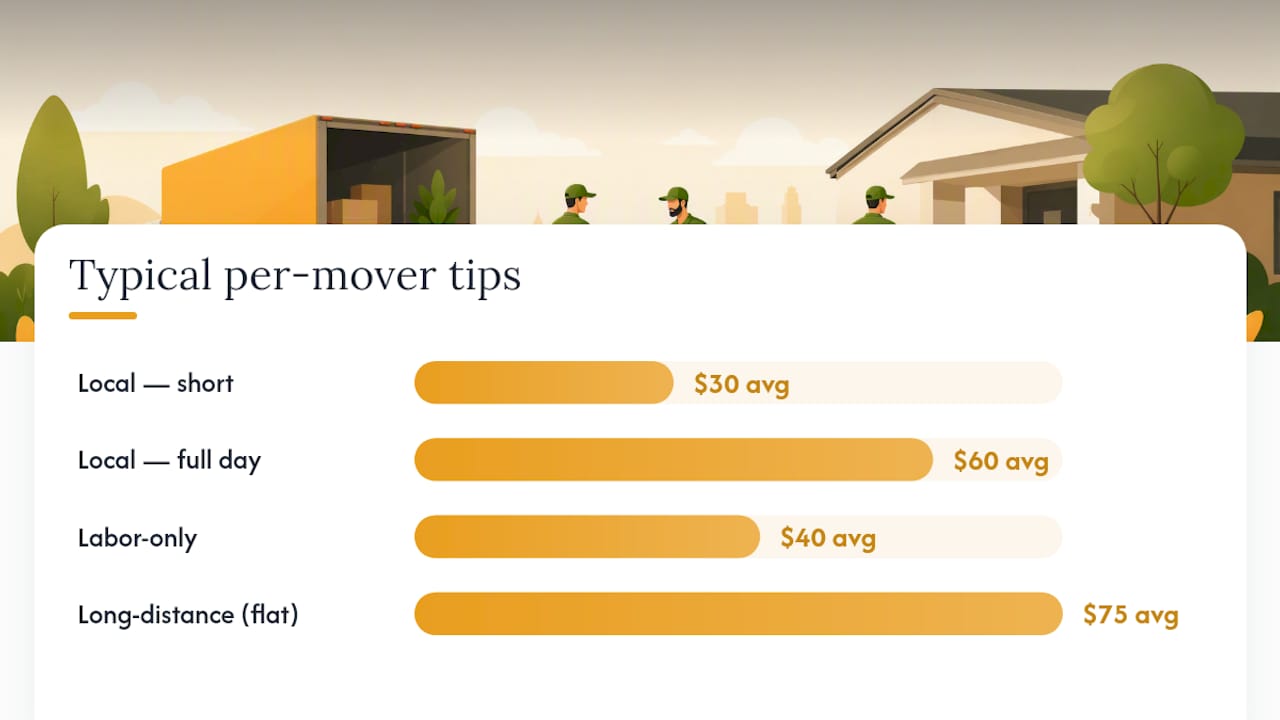
A short local move (a studio apartment, a couple hours of work) typically calls for $5 to $10 per mover per hour, or a flat $20 to $40 per mover if the job wraps up in a half day. A full eight-hour local move justifies more: $40 to $80 per crew member is the norm cited by moving-industry practitioners. Labor-only hires, where you rent a truck and just pay for muscle, tend to run $20 to $60 per mover depending on whether it’s a half-day or full-day job.
Long-distance moves work differently because the bill itself is much bigger. Here, 5% to 15% of the total moving cost is the common percent-based guideline, though many movers and dispatchers still prefer a flat $50 to $100 per crew member at pickup, and the same again at delivery, since it’s often a different set of workers.
| Move Type | Typical Tip Range |
|---|---|
| Local, short job (half day) | $20–$40 per mover |
| Local, full day | $40–$80 per mover |
| Labor-only / small load | $20–$60 per mover |
| Long-distance (per crew, per end) | $50–$100 per mover |
| Long-distance (percent method) | 5%–15% of total bill |
Two quick examples: a three-person crew finishes your one-bedroom move in four hours. At $8 per hour per mover, that’s $32 each, roughly $96 total. Now take a four-person crew on a long-distance move with a $4,000 bill. At 10%, that’s $400 total, split evenly between the loading and unloading crews, or about $50 per person at each end if you go with flat per-mover math instead.
How do you calculate a fair tip for movers?
Three methods cover almost every situation, and picking the right one for your move type keeps the math simple.
- Per-mover hourly. Multiply hours worked by $5 to $10, then by the number of movers. A four-hour job with three movers at $8 per hour comes to $96 total, or $32 per person.
- Flat per-mover day rate. Skip the hourly math entirely and hand each mover $20 to $40 for a half-day, $40 to $80 for a full day. This works well when the crew took breaks or the job had downtime you don’t want to penalize them for.
- Percent of the bill. Take 5% to 15% of your total invoice, useful mainly for long-distance moves where the job spans days and multiple crews.
The percent method has a real weakness: it inflates fast on expensive bills. MoverScorecard’s practitioner guidance argues that per-person working norms track the actual work better than a percentage tied to freight rates, insurance add-ons, and fuel surcharges that have nothing to do with the crew’s effort. If your bill includes a lot of non-labor costs (long-haul fuel, valuation coverage), lean toward the flat per-mover method instead of the percent rule.
Statistic callout: Percent-based tipping and per-mover flat rates can produce wildly different numbers on the same job. On a $6,000 long-distance move, a 10% tip is $600. Split among four movers across two crews, that’s $150 per person, well above the $50 to $100 per-mover benchmark Mover Scorecard cites for pickup and delivery. Neither number is “wrong,” but knowing which method you’re using keeps you from either overpaying or shortchanging the crew.
Who should you actually hand the tip to?
Tip each mover individually when you can. It’s the cleanest way to make sure everyone gets their fair share, and it lets you silently reward the person who wrapped your china like it was a museum piece.
- If handing out individual cash isn’t practical, give the full amount to the foreman or crew lead and say clearly that it’s meant to be split among the whole team.
- For a single-day move, tip at the very end, once everything is off the truck and in place.
- For multi-day moves, tip at the end of each day rather than holding everything until the final one. Crews remember who paid promptly.
- On long-distance jobs, tip the origin crew when they finish loading, and tip the delivery crew separately when they finish unloading. These are usually two entirely different teams.
Pro Tip: Keep two separate envelopes of cash ready before moving day, one labeled for pickup and one for delivery, if you’re doing a long-distance move. It’s easy to forget the second tip once the stress of unpacking sets in.
What factors should raise or lower your tip?
A baseline number is a starting point, not a rule carved in stone. Certain conditions genuinely justify tipping above the standard range.
- Increase the tip for: multiple flights of stairs, narrow hallways or tight loading zones, extreme heat or rain, fragile or oversized items (pianos, glass tabletops, gun safes), and extra stops added mid-move.
- Decrease or withhold the tip for: items damaged through obvious carelessness, a crew that shows up hours late without warning, or behavior that’s clearly unprofessional.
One detail catches people off guard: accessorial fees for stairs or long carries are often billed to you by the company, but that money doesn’t necessarily reach the crew doing the actual lifting. If you know the job involved serious extra labor, a direct cash tip is the only guaranteed way that effort gets rewarded, rather than absorbed into overhead. Reviewing contract terms before moving day helps you understand which fees are already baked into the bill.
Cash, digital tips, and small gestures that matter
Cash remains the preferred method across the moving industry, and for good reason: it’s immediate, it’s guaranteed to reach the person you hand it to, and it doesn’t require the company to process anything. Pull small bills (fives, tens, twenties) from an ATM a day or two before your move rather than scrambling for change on moving day.
- Some moving companies now allow digital tips through an app or added to a credit card payment, but confirm with the company beforehand that 100% of that amount actually reaches the crew rather than getting absorbed into payroll processing.
- Water, a shaded rest spot, restroom access, and a real lunch break go a long way on a physically brutal day, and CNET’s reporting on mover interviews backs this up directly: crews notice basic hospitality as much as extra cash.
- If you’re tipping through an app or card add-on instead of cash, still keep a few small bills on hand in case the crew leader mentions a cash preference on-site.
Pro Tip: Put a cooler of cold water and sports drinks on the porch before the truck even arrives. It costs you $15 and it’s the first thing every crew notices walking in.
Long-distance moves, storage, and labor-only hires
Long-distance jobs create more room for confusion simply because more people touch your stuff. CNET’s coverage points out that customers frequently forget the second tip entirely, assuming the crew that loaded the truck is the same one that unloads it at the new address. It rarely is.
- Confirm with your moving coordinator whether pickup and delivery use the same crew or two separate ones, and prepare cash for both locations regardless.
- If your shipment goes into storage or passes through a third-party warehouse, tip the people physically handling your boxes that day, not the company managing the paperwork.
- For labor-only hires (you rent the truck, they provide the muscle), stick to hourly or flat per-day tipping rather than a percentage. There’s often no single “total bill” to calculate a percent from, and the crew’s pay structure usually ties directly to hours logged.
Reading through what full-service moving actually includes before booking helps you separate labor costs from logistics fees, which makes tipping decisions a lot less confusing later.
Why Movecraftmoving’s guidance on mover tipping holds up
Movecraftmoving vets every carrier in its network for licensing, insurance, and consistent crew performance, which means the tipping norms in this guide reflect what actually happens on real moving days, not theoretical averages.
- Access practical resources on vetting local moving companies before you book, so you know exactly what’s included in your quoted price.
- Review contract best practices to understand which fees belong to the company and which situations call for a direct cash tip to the crew.
- Use the relocation checklist to plan cash, hospitality items, and timing well ahead of moving day.
What the tipping “rules” get wrong
Most tipping advice treats percent-of-bill as the default, and that’s backward for a lot of moves. A percentage tied to a long-distance freight invoice has nothing to do with how many hours a crew spent carrying your dresser up three flights of stairs. Per-person hourly or flat-day tipping is the more honest method for most local jobs, and it’s the one crews themselves tend to prefer, according to the practitioner data from Mover Scorecard.
Where conventional advice really falls short is in treating tipping as separate from hiring. A vague, poorly priced contract with hidden accessorial fees creates confusion about what’s already covered in your bill and what genuinely deserves extra cash in a crew member’s pocket. Readers who book through vetted, transparent carriers rarely face that guesswork because the pricing and scope are clear from the start.
Prioritize this: figure out your move type first (local versus long-distance, single crew versus two), then pick the calculation method that fits it, then adjust for real conditions on the day. Skip the percent math on local jobs entirely. It solves a problem you don’t have.
— Info
Let Movecraftmoving Take the Guesswork Out of Moving Day
Tipping math gets a lot simpler when the rest of your move isn’t a mystery. Movecraftmoving is the alternative to booking blind with an unvetted local outfit: every carrier in the network is checked for licensing, insurance, and consistent crew performance, and pricing is laid out clearly before your stuff ever touches a truck.

That transparency matters here specifically because so much tipping confusion comes from murky contracts, where you can’t tell what’s already covered and what extra labor genuinely deserves a cash tip. When you request a quote through Movecraftmoving, you get a clear breakdown of costs upfront, so the only math left on moving day is deciding how much cash goes in each mover’s hand. If you want to compare your options first, the guide to picking a moving company you can trust is a good place to start.
Sources
- How much to tip movers
- How much you should you tip movers (CNET)
- Should You Tip Movers? A Straight Answer | Mover Scorecard
- How Much To Tip Movers (ConsumerAffairs)
Recommended
- Last-Minute Local Move Booking Guide: Act Now – Move Craft Moving Solutions LLC
- Moving Scams: How to Spot, Avoid, and Report Them – Move Craft Moving Solutions LLC
- Workers’ Compensation for Movers: What Owners Must Know – Move Craft Moving Solutions LLC
- Transparent Pricing From Licensed Movers: What You Need to Know – Move Craft Moving Solutions LLC