
A move day schedule is the hour-by-hour itinerary a mover coordinator and client agree on before the truck arrives, covering crew arrival windows, loading and unloading blocks, transit ETA, and a final walkthrough. Every part of that day runs on this document, not memory or hope. The core elements are simple: a crew arrival window (commonly set as a flexible window rather than a fixed time), a named lead mover who owns communication, a loading window, a transit ETA with a buffer, an unloading window, and a signed final walkthrough. Any shared schedule, whether it comes from a checklist tool like Moverbase or from your own coordinator, needs five things to actually work on the ground. Move Craft Moving Solutions builds its coordination process around exactly this structure.
- An arrival window, not a fixed time, is generally recommended
- One primary point of contact on each side
- A flagged list of high-priority or fragile items
- Parking, elevator, and access notes confirmed in advance
- An estimated finish time the client can plan around
Key Takeaways
A mover-coordinated move day schedule works because it assigns a named owner to every time block, from crew arrival through final walkthrough, instead of leaving handoffs to chance.
| Point | Details |
|---|---|
| Build the schedule in writing | Share an hour-by-hour template with your lead mover 24 hours before move day. |
| Set arrival windows, not exact times | Use a 30 to 60 minute arrival window and confirm it by phone the morning of. |
| Coordinate vendors for office moves | Lock elevator reservations and IT shutdown windows into the timeline itself. |
| Document everything at the walkthrough | Photos and signed inventory resolve damage disputes faster than phone calls. |
| Movecraftmoving builds the coordination | Vetted carriers, on-site lead oversight, and claims assistance back the schedule end to end. |
Table of Contents
- Hour-by-Hour Timeline Templates You Can Copy and Send
- What Should You Check the Night Before a Move?
- What Actually Happens on Move Day, Step by Step
- How Should Movers and Clients Communicate During Delays?
- Who Is Responsible for What on Move Day?
- Closing Out the Job: Payment, Damage, and What to Unpack First
- Why a Written Schedule Beats a Verbal Agreement Every Time
- Get a Mover-Coordinated Schedule Built Around Your Move
- Frequently Asked Questions
- Sources
Hour-by-Hour Timeline Templates You Can Copy and Send
Movers work better when they get a document, not a description. Below are two starting templates: one for a local residential move, one for an office relocation. Fill in the bracketed placeholders and send the finished version to your lead mover 24 hours ahead.
Residential local move (single truck, one stop each way):
| Time | Activity |
|---|---|
| 7:30–8:00 AM | Crew arrival and walkthrough with client |
| 8:00–11:30 AM | Loading, heavy items and furniture first |
| 11:30 AM–1:30 PM | Transit plus buffer |
| 1:30–4:00 PM | Unloading and room placement |
| 4:00–4:30 PM | Final walkthrough, inspection, and payment |
For office moves, the sequence shifts around vendor coordination rather than road time. Elevator reservations and IT shutdown windows have to be locked into the schedule itself, not treated as afterthoughts, because a blocked elevator can stall unloading for an hour or more. A commercial vendor coordination checklist built around staged floor access prevents that bottleneck before it starts.
Commercial/office move (single floor, freight elevator building):
- 6:00–6:30 AM: IT lead confirms server and workstation shutdown complete
- 6:30–7:00 AM: Crew arrival, employee rep walkthrough, elevator reservation confirmed
- 7:00–11:00 AM: Loading by department, labeled by destination floor/room
- 11:00 AM–1:00 PM: Transit
- 1:00–4:30 PM: Staged unloading by reserved elevator windows
- 4:30–5:30 PM: IT reinstallation window, furniture placement, employee reps sign off
Before sending either template, fill in the address, parking permit number, lead mover’s direct phone line, high-priority boxes, and confirmed elevator or loading dock reservation times. For long-distance moves, replace the tight transit window with a delivery window plus a carrier-agreed buffer, since road time on multi-day routes varies too much for a fixed hour.
What Should You Check the Night Before a Move?
A schedule only holds up if someone confirms the pieces underneath it. The night before, the mover coordinator should lock down truck assignment, route plan, and any parking or elevator reservations, then run a short crew briefing so everyone knows the day’s sequence before they show up.
- Confirm truck assignment and backup vehicle if one is on standby
- Verify parking permits, elevator reservation windows, and building access rules
- Brief the crew on inventory, fragile items, and any unusual access issues
- Call or text the client to reconfirm the arrival window
The morning of the move brings a second pass: recheck traffic and weather, verify keys and access codes work, and make sure protective materials and tools are actually loaded on the truck before it leaves the yard. A pre-move checklist that runs through job details, route, and crew readiness in one workflow catches the small gaps that turn into late arrivals.
Pro Tip: Keep one dispatch board or CRM as the single source of truth for the day’s schedule, and have the lead mover call the client 30 to 60 minutes before arrival. Two systems tracking the same move almost always drift apart by noon.
If the move was booked with little notice, a last-minute local move checklist keeps the essentials from getting skipped when there’s no full week to prepare.
What Actually Happens on Move Day, Step by Step
Once the truck pulls up, the schedule stops being a document and becomes a sequence of decisions. Here’s the run-of-show most professional crews follow, in order:
- Arrival and walkthrough. The lead mover meets the client, confirms the inventory list, points out fragile or high-value items, and assigns crew roles for the day.
- Loading. Heavy furniture and appliances go first, boxes are grouped by room and clearly labeled, and the crew stages items near the truck before lifting to keep the flow moving without backtracking.
- Transit handoff. The crew checks that everything is secured for the road, confirms the route and fuel, and the lead mover sends an ETA update to the client at agreed intervals.
- Unloading and setup. Furniture goes into its assigned rooms first, with priority given to beds, kitchen essentials, and anything the client flagged as urgent for the first night.
- Inspection. The client and lead mover walk through the finished job together, noting item condition, signing off on the inventory, and taking photos of anything questionable.
Labeling drives most of this sequence. A truck loaded with boxes marked only “misc” turns unloading into guesswork, while clear room-based labeling lets the crew place items correctly the first time instead of creating a pile to sort later.
- Fragile items get their own designated space on the truck, loaded last and unloaded first
- The client should be reachable but doesn’t need to supervise every box
How Should Movers and Clients Communicate During Delays?
Set the rules before the day starts, not after something goes wrong. One point of contact on each side, agreed communication channels, and a defined update cadence keep small delays from turning into confusion. A common pattern: a call at 60 minutes out, another at 30, and a text at 15, with any delay beyond 45 minutes triggering a direct call rather than a text.
| Issue | Immediate action |
|---|---|
| Traffic delay | Lead mover calls client with new ETA and revised finish time |
| Elevator reservation denied | Coordinator calls building management; crew stages items curbside |
| Street parking lost | Crew uses temporary loading zone; coordinator authorizes permit fee if needed |
| Weather delay | Coordinator and client agree on revised window before crew departs |
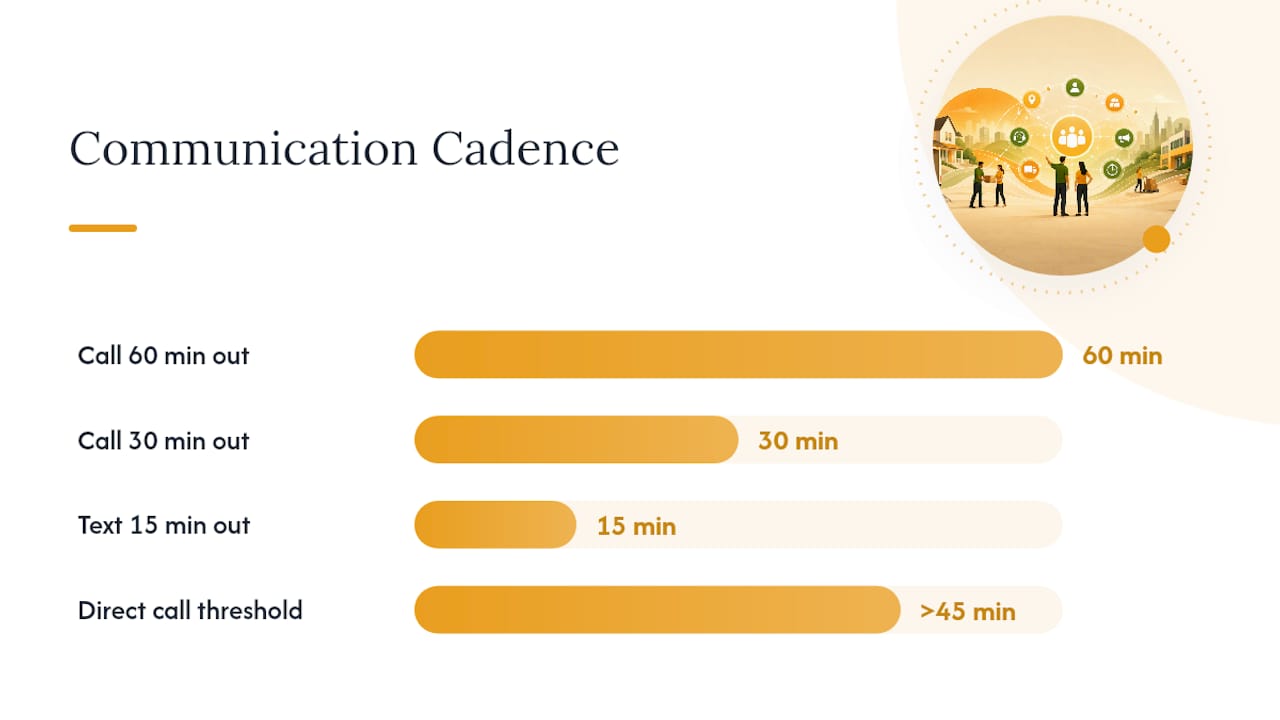
Predefine an acceptable buffer window with the client and get their signoff before extending beyond it or adding services mid-move.
Pro Tip: Time-stamped photos and text messages resolve more disputes than phone calls ever do. If an item’s condition or a delay becomes a disagreement later, whoever documented it in writing wins the conversation.
Who Is Responsible for What on Move Day?
Every move runs smoother when responsibilities are assigned instead of assumed. Clients handle keys, building access, valuables, and act as the decision-maker for any on-the-spot changes. The lead mover owns crew safety, task assignments, inventory signoff, and communication back to the coordinator.
- Client: keys/access, valuables set aside, available for decisions
- Lead mover: safety, crew assignments, inventory signoff, coordinator updates
- Crew: packing sequence, equipment handling, sticking to scheduled breaks
- Office moves: an employee rep per department plus an IT/AV lead handle vendor coordination for elevators and staged floor access
Closing Out the Job: Payment, Damage, and What to Unpack First
The final walkthrough is where the day either closes cleanly or turns into a headache. Inspect high-value items together, test major appliances if time allows, and open a few boxes with the client present if there’s any doubt about contents. Sign the paperwork only after both sides agree the inventory matches.
Confirm accepted payment methods ahead of time. Transparent pricing practices mean payment gets collected at the walkthrough with no surprise line items, and tipping, where customary, typically follows crew size and job length rather than a flat rule.
- If damage turns up, photograph it immediately and preserve the original packaging before filing a carrier claim
- Unpack the kitchen, bedrooms, and bathrooms first for homes; for offices, prioritize IT equipment and any workstation needed to resume operations
Pro Tip: Keep the original box the damaged item shipped in until the claim closes. Carriers often want to inspect packaging, and a discarded box can slow a claim by weeks.
Why a Written Schedule Beats a Verbal Agreement Every Time
Most move-day failures trace back to one thing: nobody wrote down who was supposed to confirm what, and by whom. Move Craft’s coordination model runs on radical transparency and vetted carrier standards precisely because verbal agreements between three or four parties (client, coordinator, lead mover, building management) fall apart the moment one link goes quiet.

We’ve seen a single missed elevator reservation turn a four-hour office move into an eight-hour one, not because the crew was slow, but because nobody had confirmed the reservation window in writing 48 hours out. A shared, written schedule would have caught it. That’s the real value of a mover-coordinated timeline: it isn’t paperwork for its own sake, it’s the thing that keeps four separate parties moving in the same direction without a phone call every twenty minutes.
Get a Mover-Coordinated Schedule Built Around Your Move
Templates get you most of the way there, but someone still has to vet the carrier, confirm the crew, and own the schedule if something shifts. That’s the gap Movecraftmoving closes: instead of you piecing together arrival windows and vendor coordination on your own, a vetted carrier partner runs the schedule with you from booking to final walkthrough.

- Carrier vetting for integrity, licensing, and on-time performance
- A mover-coordinated timeline built for your move type, residential or commercial
- On-site lead oversight so one person owns the day’s schedule
- Claims assistance if damage or missing inventory turns up after the walkthrough
If you’re weighing storage options alongside a move, our residential movers with storage solutions comparison covers what to ask before booking. For businesses, a step-by-step relocation strategy guide walks through vendor coordination in more depth. Pricing stays transparent throughout, and when you request a quote, have your move date, origin and destination addresses, and an inventory estimate ready. Start by requesting a quote through Move Craft Moving Solutions and get a coordinator assigned to your specific timeline.
Frequently Asked Questions
What is a typical arrival window for movers?
Most professional crews quote a flexible arrival window rather than an exact time, since traffic and the previous job’s finish time both affect when the truck actually pulls up., since traffic and the previous job’s finish time both affect when the truck actually pulls up.
How far in advance should I confirm my moving day schedule?
Confirm the full schedule, including parking, elevator reservations, and crew details, the night before the move, then reconfirm the arrival window itself the morning of.
What should I keep with me instead of putting it on the truck?
Keep essential documents, medications, jewelry, and a change of clothes with you rather than on the truck, along with chargers and anything you’ll need before boxes get unpacked.
How long does a local move usually take from arrival to final walkthrough?
A single-truck local move typically runs 8 to 9 hours from crew arrival to final walkthrough, though home size, stairs, and parking distance all shift that window.
What happens if my movers are running significantly behind schedule?
Your lead mover should call with an updated ETA rather than let you find out from a text, and any delay past your agreed buffer window should come with a client signoff before extending the day or adding services.
Sources
- Moverbase Moving CRM SoftwareFree Pre-move Checklist for Moving Crews of Moving Companies | Moverbase Moving CRM Software
Copy the hour-by-hour templates above and the pre-move checklist into your own move-day document, then send both to your coordinator before booking day arrives.
Recommended
- How to Coordinate Employees During an Office Move – Move Craft Moving Solutions LLC
- Minimize Productivity Loss During Relocation: A Practical Plan – Move Craft Moving Solutions LLC
- Last-Minute Local Move Booking Guide: Act Now – Move Craft Moving Solutions LLC
- Office Furniture Inventory Best Practices for Moves – Move Craft Moving Solutions LLC