
The core difference between a commercial mover and a residential mover comes down to three things: what gets moved, how tightly the schedule is locked, and how much goes wrong if something is delayed. Residential moving services focus on personal belongings with timelines that can flex around your life. Commercial moving services operate on strict deadlines, involve business-critical assets, and carry real financial consequences when a move runs long.
Here is a quick breakdown of where the two diverge:
- What moves: Residential moves handle furniture, boxes, and personal items. Commercial moves include office systems, IT infrastructure, lab equipment, and industrial machinery.
- Timeline: Residential schedules are typically client-driven and adjustable. Commercial moves are locked to minimize business downtime.
- Complexity: A residential move involves one household. A commercial move may involve dozens of departments, building management, IT vendors, and regulatory permits.
- Cost structure: Residential pricing is relatively straightforward. Commercial pricing factors in project management, after-hours labor, IT decommissioning, and specialized equipment.
- Stakes: A delayed residential move is inconvenient. A delayed commercial move can cost a business revenue, client relationships, and employee productivity.
Understanding these distinctions is the first step toward choosing the right type of mover and avoiding costly mistakes on either side.
Table of Contents
- How commercial and residential moves actually differ in practice
- What drives costs higher for commercial moves
- How to keep your business running during a commercial move
- Permits, insurance, and regulations: where commercial moves get complicated
- How to choose the right moving company for your situation
- Preparation tips that actually make a difference
- Settling in after the move: what comes next
- Pros and cons of each move type
- How commercial moving has expanded well beyond transport in 2026
- Movecraftmoving connects you with the right expertise for your move
- Key Takeaways
How commercial and residential moves actually differ in practice
The operational gap between residential and commercial moves is wider than most people expect before they start planning.
What gets moved is fundamentally different. Residential moves center on household goods: furniture, appliances, clothing, and personal items. Commercial moves involve server racks, modular workstations, medical equipment, point-of-sale systems, and sometimes industrial machinery requiring rigging. Each category demands different packing materials, handling techniques, and crew training.

Planning rigor is not comparable. Residential timelines are often adjustable to the client’s preference. A commercial relocation, by contrast, runs on a project plan with milestones, assigned responsibilities, and contingency protocols. Missing a deadline can mean a business opens Monday morning without functioning IT or a call center that cannot take calls.
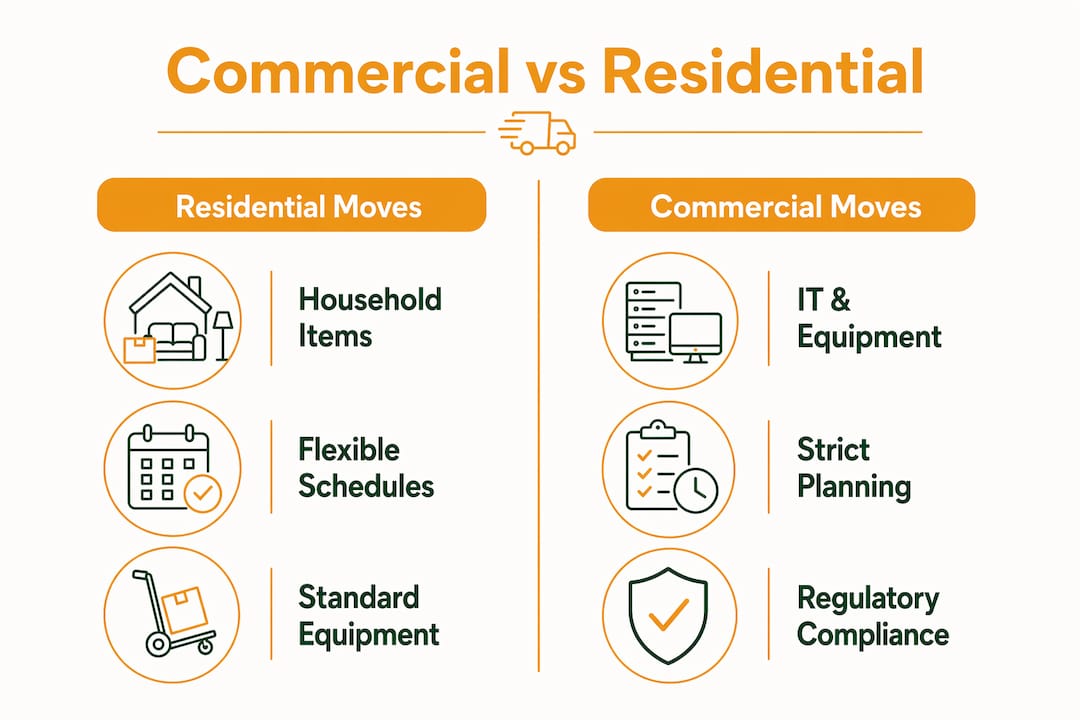
Equipment and technology diverge sharply. Residential crews use standard moving blankets, dollies, and trucks. Commercial crews bring anti-static packing for electronics, custom crating for sensitive equipment, floor protection systems, and in some cases, specialized rigging for heavy machinery. Commercial relocations frequently use specialized trucks and packing materials that residential providers simply do not stock.
Coordination layers multiply on the commercial side. A residential move involves the client and the moving crew. A commercial move adds building management for elevator reservations and loading dock access, IT vendors for decommissioning and recommissioning, facilities teams, and sometimes union labor rules depending on the building. The role of a relocation coordinator becomes critical when that many parties need to stay aligned.
What drives costs higher for commercial moves
Cost structures for the two move types look nothing alike, and the gap widens fast once you factor in the full scope of a commercial project.
Residential pricing is driven by a manageable set of variables:
- Distance between origin and destination
- Volume and weight of household goods
- Packing services requested
- Access conditions (stairs, elevators, parking)
- Timing, since weekend and peak-season moves cost more
Commercial pricing carries all of those factors plus a longer list of add-ons. Commercial moving costs factor in IT decommissioning, furniture liquidation, and strict scheduling, each of which adds to the final invoice. After-hours or weekend work to avoid disrupting business operations is common and priced accordingly. Project management fees, specialized crating, and equipment handling for servers or lab instruments push costs well above a comparable residential job.
On-site assessments are non-negotiable for commercial jobs. On-site assessments allow movers to tailor pricing based on workspace size, distance, asset volume, and service level. A phone estimate for a commercial move is almost always inaccurate. Any provider who quotes a commercial job without walking the space first is giving you a number they will revise later.

Pro Tip: Get at least two on-site estimates for any commercial move, and ask each provider to itemize IT handling, after-hours labor, and project management as separate line items. That breakdown tells you more about a provider’s competence than the total number does.
How to keep your business running during a commercial move
Business downtime is the metric that separates a well-executed commercial move from a costly one. The goal is not just to move assets safely. It is to move them without stopping the business.
Key strategies that actually work:
- Phase the move by department. Moving one team at a time lets the rest of the business keep operating. IT infrastructure typically moves last, after everything else is in place at the new location.
- Schedule after hours or on weekends. After-hours or weekend moves keep operations running while the relocation takes place. This is standard practice for businesses that cannot afford a full shutdown.
- Lock in a detailed project timeline. Every milestone, from packing start to IT recommissioning, needs a confirmed date and an owner. Ambiguity in a commercial move schedule turns into downtime.
- Communicate early and often with employees. Clear communication, scheduling, and staged moves reduce operational impact during business relocations. Employees who know what to expect pack their own workstations correctly, show up at the right location, and do not flood IT with support tickets on day one.
- Assign an internal move coordinator. One person inside the company should own the relationship with the moving crew, building management, and IT vendors. Without a single point of contact, decisions fall through the cracks.
The commercial moving timeline for a mid-size office typically spans four to eight weeks of planning before a single box is packed. Businesses that try to compress that window almost always pay for it in downtime.
Permits, insurance, and regulations: where commercial moves get complicated
Residential moves rarely require permits. Most residential relocations do not need special permits or elevated insurance compared to commercial moves, which keeps the process relatively simple. Commercial moves are a different story.
What commercial moves typically require:
- Building permits and access agreements for freight elevators, loading docks, and after-hours entry
- Street occupancy permits when moving trucks need to park in restricted zones or block traffic lanes
- Higher insurance coverage than residential movers carry, covering business equipment, liability for building damage, and workers’ compensation at commercial scale
- Compliance documentation for regulated industries like healthcare, finance, or government, where chain-of-custody records for equipment and data matter
Commercial moves require permits and insurance differing significantly from residential moves, including building and street occupancy permits that must be coordinated in advance. Failing to secure these before moving day can result in fines, delays, or being turned away at the loading dock entirely.
The FMCSA regulates interstate movers and sets baseline requirements for licensing and insurance. For commercial moves crossing state lines, verifying that your provider holds the correct FMCSA operating authority is a basic due-diligence step that many businesses skip.
How to choose the right moving company for your situation
The criteria for picking a residential mover and a commercial mover overlap in some areas and diverge sharply in others.
For a residential move, prioritize:
- Verified licensing and insurance (check FMCSA registration for interstate moves)
- Customer reviews that specifically mention care for fragile items and punctuality
- Transparent pricing with a written, binding estimate
- Clear policies on claims and damage resolution
For a commercial move, add these requirements:
- Demonstrated experience with your specific asset types (IT equipment, medical devices, industrial machinery)
- Certified staff and vertically integrated operations with owned fleets and equipment, not subcontracted crews
- A dedicated project manager assigned to your move, not a general dispatcher
- Certifications from recognized bodies like the American Moving and Storage Association or the International Office Moving Institute
- References from businesses of similar size and complexity, not just volume
Red flags apply to both move types: vague estimates, no physical address, requests for large cash deposits upfront, and reluctance to provide proof of insurance. For commercial moves, add one more: any provider who cannot explain their IT decommissioning and recommissioning process in specific terms is not equipped for the job.
The moving.org directory maintained by the American Trucking Associations is a useful starting point for verifying mover credentials in either category.
Preparation tips that actually make a difference
Preparation looks different depending on which side of the commercial-versus-residential line you are on.
For a residential move:
- Start packing non-essentials four to six weeks out, not the week before
- Schedule utility transfers and address changes at least two weeks ahead
- Label boxes by destination room, not just contents, so the crew can place them correctly without asking
- Photograph valuables before packing for insurance documentation
- Review your residential move walkthrough checklist to catch overlooked steps like transferring renter’s insurance
For a commercial move:
- Conduct a full asset inventory before packing begins, tagging every item with a destination label
- Decommission IT equipment according to your IT team’s protocol, not the moving crew’s timeline
- Notify vendors, clients, and service providers of your new address and cutover date at least 30 days out
- Confirm building access, elevator reservations, and parking permits at both locations before moving day
- Use a vendor coordination checklist to track every third-party dependency in one place
The single most common preparation failure on the commercial side is underestimating IT decommissioning time. Servers, network switches, and workstations cannot simply be unplugged and boxed. Each requires a documented shutdown procedure, and recommissioning at the new location takes time that most move timelines do not budget for honestly.
Settling in after the move: what comes next
The work does not stop when the last truck pulls away. Post-move setup is where many relocations lose momentum.
Residential settling-in priorities:
- Reconnect utilities and confirm service is active before the first night
- Unpack room by room rather than all at once, starting with essentials
- Update your address with the USPS, your bank, your employer, and any subscription services
- Inspect all items against your inventory list and document any damage within the mover’s claim window
Commercial settling-in priorities:
- IT recommissioning is the critical path. Nothing else fully functions until the network is live.
- Conduct a walk-through with your project manager to verify all assets arrived and are placed correctly
- Run a staff orientation so employees know where everything is, from supply rooms to emergency exits
- Document any damaged or missing items immediately and notify the moving company in writing
- Test all equipment before declaring the move complete, including phone systems, printers, and access control
One often-skipped step on the commercial side: a post-move debrief with the moving company. Reviewing what went well and what did not takes 30 minutes and produces a record that is genuinely useful if you move again or if a damage claim becomes disputed.
Pros and cons of each move type
Neither move type is inherently better. Each has real trade-offs worth understanding before you commit to a provider or a plan.
Residential moves:
- Pros: Flexible scheduling, lower cost, simpler logistics, personal attention to sentimental items
- Cons: Less structured timelines can lead to delays, limited specialized equipment for unusual items, variable crew quality across providers
Commercial moves:
- Pros: Professional handling of complex and high-value assets, tight project management, minimized downtime when executed well, integrated services like asset disposal and IT support
- Cons: Higher cost, more coordination overhead, stricter scheduling that leaves little room for last-minute changes, greater consequences when something goes wrong
The right choice depends on what you are moving and what you cannot afford to lose, whether that is a family heirloom or a week of business revenue.
How commercial moving has expanded well beyond transport in 2026
The commercial moving industry has shifted significantly. What used to be a straightforward logistics service now functions as an extension of enterprise facility management.
Commercial moving increasingly includes asset management, furniture liquidation, and technical infrastructure services beyond simple transportation. A business relocating today can engage a single provider to handle the physical move, dispose of outdated furniture, manage IT decommissioning, and set up the new workspace, all under one project plan. That consolidation reduces vendor management complexity and keeps accountability in one place.
Technology has changed how commercial moves are coordinated. Top providers now use digital tracking systems so clients can monitor asset locations in transit, project management platforms that give real-time visibility into milestone completion, and pre-move space-planning tools that map the new layout before a single piece of furniture is loaded.
The risk reduction angle is real too. When a commercial mover manages the full transition, including IT infrastructure and asset lifecycle, the client’s exposure to equipment damage, data loss, and operational gaps shrinks considerably compared to managing multiple vendors independently.
Pro Tip: Ask prospective commercial movers whether they offer post-move asset management or furniture liquidation. Providers who handle the full facility transition lifecycle tend to have tighter project management across the board, not just on moving day.
Movecraftmoving connects you with the right expertise for your move
Whether you are relocating a household or a 50-person office, the difference between a smooth move and a stressful one usually comes down to who is coordinating it. Movecraftmoving connects you with rigorously vetted carriers and relocation professionals who understand both sides of that equation.

For business decision-makers, Movecraftmoving’s network includes commercial specialists who handle IT infrastructure, phased office moves, and the kind of tight scheduling that keeps your operations running through the transition. For homeowners and renters, the same standard of transparency and punctuality applies, without the complexity overhead you do not need. Every partner in the Movecraftmoving network is vetted for integrity, performance, and consistency, so you are not rolling the dice on moving day.
Ready to plan your move with a team that treats your timeline as seriously as you do? Get started with Movecraftmoving or explore the commercial vendor coordination checklist to begin building your move plan today.
Key Takeaways
Commercial moves require significantly more planning, specialized equipment, and regulatory compliance than residential moves, making provider selection and timeline management the two highest-leverage decisions in any business relocation.
| Point | Details |
|---|---|
| Scale and complexity differ sharply | Commercial moves involve IT infrastructure, permits, and project management that residential moves do not require. |
| Cost drivers are different | Commercial pricing adds IT decommissioning, after-hours labor, and project management on top of standard moving fees. |
| Downtime is the commercial metric that matters | Phased moves, after-hours scheduling, and clear employee communication are the primary tools for protecting business operations. |
| Permits and insurance requirements are higher for commercial | Commercial moves typically require building access permits, street occupancy permits, and elevated insurance coverage. |
| Movecraftmoving fits both move types | Movecraftmoving connects residential and commercial clients with vetted carriers matched to their specific scope and timeline. |
Recommended
- Full Service Residential Moving: What You Need to Know – Move Craft Moving Solutions LLC
- Interstate vs Intrastate Moving: What’s the Real Difference? – Move Craft Moving Solutions LLC
- Full Service vs Partial Service Moving: 2026 Guide – Move Craft Moving Solutions LLC
- Commercial Move Vendor Coordination Checklist for 2026 – Move Craft Moving Solutions LLC