Third-party moving insurance is a separate, state-regulated policy you buy from a licensed insurer, not from your moving company, and it fills gaps that carrier valuation coverage leaves wide open. Buy it if you’re moving long distance, packing boxes yourself, using storage-in-transit, or shipping items worth more than your mover’s per-pound liability formula would ever pay out. The FMCSA requires movers to offer valuation coverage on interstate moves, but that’s a liability program, not insurance.
TL;DR:
- Third-party moving insurance is underwritten by state-licensed insurers and covers damage regardless of fault, including acts of God and theft.
- It is particularly valuable for long-distance, storage-in-transit, or self-packed items, with costs ranging from 1% to 4% of the declared value.
- Policies vary significantly in coverage details, so checking exclusions, storage limits, and claim windows is essential before purchasing.
- Accurate documentation, such as timestamped photos and itemized inventories, greatly improves the chances of claim approval.
- Comparing existing homeowner’s policies, mover valuation options, and third-party quotes ensures the best coverage for complex or high-value moves.
Table of Contents
- What Third-Party Moving Insurance Covers vs. Carrier Valuation
- Is Third-Party Moving Insurance Worth the Cost?
- What to Check Before You Buy a Policy
- How Moving Insurance Claims Work, and Why They Get Denied
- The Step-by-Step Process for Buying the Right Policy
- How Move Craft Handles Insurance Guidance and Documentation
- Where to Verify the Rules Yourself
- Why Most Moving Insurance Advice Misses the Point
- Sources
- FAQ
What Third-Party Moving Insurance Covers vs. Carrier Valuation
The confusion starts with a simple fact: your mover doesn’t sell insurance. Under federal rules, interstate movers must offer two liability options, Released-Value Protection (RVP) and Full-Value Protection (FVP), and both are carrier liability programs regulated through the Carmack Amendment, not policies backed by an insurance company. RVP is free but pays roughly $0.60 per pound per item regardless of what the item cost, according to industry comparisons. FVP costs more and pays closer to replacement value, but only when the mover is found at fault.
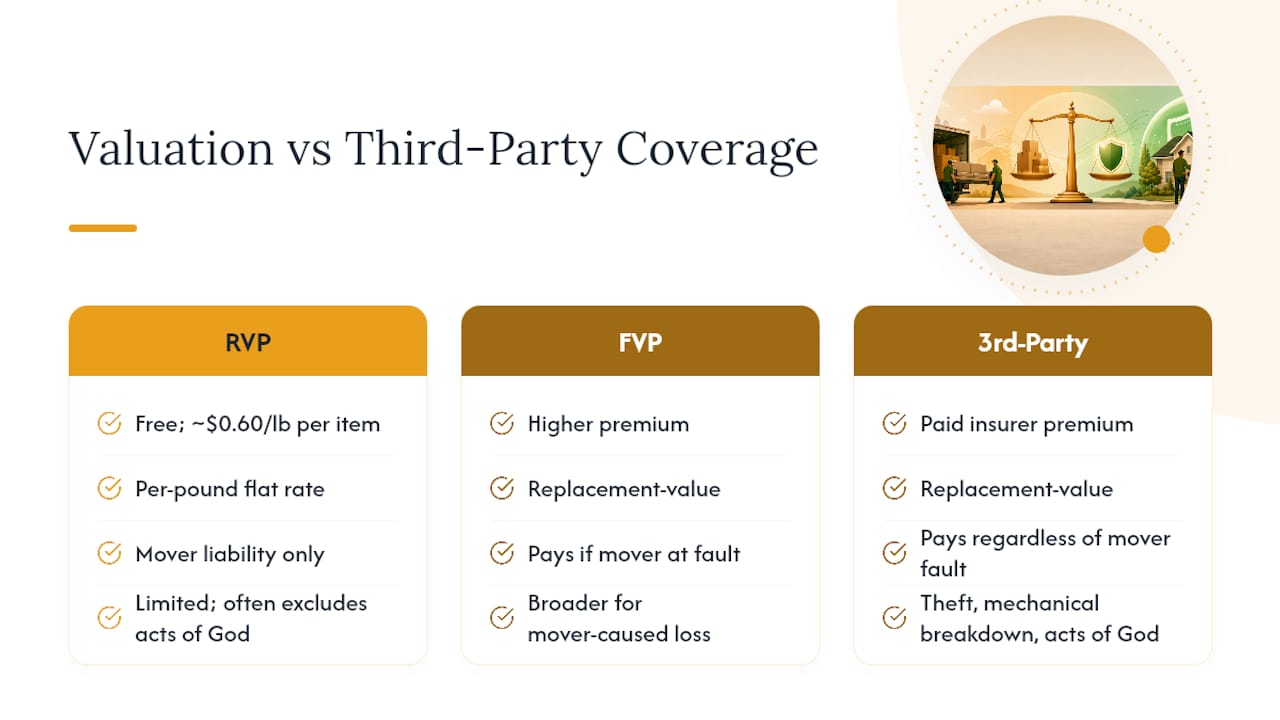
Third-party moving insurance works differently. It’s underwritten by a state-licensed insurer, and it typically pays out regardless of whether the mover caused the damage. That distinction matters most for acts of God, mechanical breakdowns during transit, or theft, situations where a mover’s liability program often pays nothing because the mover technically didn’t cause the loss.
The practical differences pile up fast; for example, third-party policies can include coverage for storage-in-transit, as explained in storage tips & San Francisco moving guides. Third-party policies commonly cover packed-by-owner (PBO) boxes, something most mover valuation plans exclude outright. They can include storage-in-transit for extended periods. And because these policies fall under state insurance law rather than federal transportation law, you get consumer protections, including the right to file a complaint with your state insurance department, that don’t exist under a Carmack Amendment claim. For a deeper breakdown of how full valuation coverage options work alongside third-party policies, it’s worth reading before you sign anything.
Is Third-Party Moving Insurance Worth the Cost?
For most local moves under 50 miles with a reputable mover and modest-value belongings, FVP from the mover is often enough. Third-party insurance earns its cost in four specific scenarios: interstate long-distance moves, container or PODS-style relocations, moves that include weeks or months of storage-in-transit, and households packing their own boxes.
Pricing runs roughly 1% to 4% of your shipment’s declared value, with deductibles typically landing between $250 and $1,000. A $50,000 shipment might cost $500 to $2,000 to insure for a year of coverage, and choosing a higher deductible, say $1,000 instead of $250, usually knocks the premium down noticeably since you’re absorbing more of the small claims yourself.
Here’s a quick gut check: if your mover’s FVP quote covers your full inventory value at a rate you can live with, and you’re not packing boxes yourself or using long-term storage, you may not need a second policy. But if you’re shipping a home office worth $15,000, a wine collection, or anything you packed yourself, a standalone policy usually pays for itself the first time something breaks. Our long-distance moving insurance guide walks through cost comparisons by move type in more detail.
What to Check Before You Buy a Policy
Not all third-party policies are built the same, and the differences show up exactly when you need them most, at claim time.
- All-risk vs. named-peril wording. All-risk policies cover anything not explicitly excluded. Named-peril policies only cover what’s listed. Read the exclusions section first, since mold, pest damage, and mechanical derangement are commonly excluded even on all-risk plans.
- PBO coverage rules. Many insurers will only cover packed-by-owner boxes if you itemized the contents in writing before the move, sometimes with photos of each box’s contents.
- Storage-in-transit limits. Coverage windows commonly run 30 to 90 days, and coverage past that window may require a separate rider.
- Deductible structure. Confirm whether it’s per-item or per-claim, and whether there’s an aggregate cap across your whole shipment.
- Claim filing windows. Some policies require notice within 60 days of delivery; others allow up to 180. Miss the window and the claim is dead on arrival.
- Insurer underwriting. Check the insurer’s A.M. Best rating and confirm the company is licensed in your state before you pay a premium.
Pro Tip: Ask for the actual declarations page, not just a quote summary, before you pay. The declarations page lists the underwriting insurer, policy number, and exact exclusions, which is what you’ll need if you ever have to file a claim or escalate a denial.
How Moving Insurance Claims Work, and Why They Get Denied
Claims on third-party policies move faster than most people expect, but only if you file correctly and on time. Consumer reviews consistently point to the same failure points: late filing, thin documentation, undisclosed preexisting damage, and PBO boxes that were never itemized before the move.
- Document everything before the truck leaves. Photograph and video every room, every high-value item, and the outside of every box, with a timestamp visible if possible.
- Get a signed inventory and bill of lading. These documents are your proof of what existed and what condition it was in at pickup.
- Inspect immediately at delivery. Note damage on the delivery paperwork before the crew leaves, and photograph everything again.
- File within the policy’s window. Many policies require notice within 60 to 180 days; don’t wait to see if you “really” want to pursue it.
- If denied, appeal in writing, then escalate. Contact your state insurance department if the insurer’s response seems unreasonable. State regulators can mediate consumer insurance disputes in a way federal transportation law doesn’t allow.
The Step-by-Step Process for Buying the Right Policy
Buying moving insurance in the right order saves you from overpaying or double-covering the same items.
- Check your homeowner’s or renter’s policy first. Some policies extend limited coverage to belongings in transit; most don’t, but it takes five minutes to confirm.
- Get your mover’s valuation options in writing. Ask directly: “Do you offer Full Value Protection, what’s the rate, and will that appear on the bill of lading?”
- Collect two or three third-party quotes. Ask each insurer: “Who’s the underwriter, what’s the policy number, and are PBO boxes covered, and what proof do you require?”
- Compare deductibles and PBO rules side by side, not just the premium.
- Buy, then save everything. Keep the declarations page, the bill of lading, your itemized inventory, and move-day photos in one folder, physical or digital, that you can access instantly if something goes wrong.
How Move Craft Handles Insurance Guidance and Documentation
Our approach is based on principles of transparency and respect for customer belongings. We work only with moving partners who meet established standards for integrity and performance, recognizing that protections depend on the mover honoring the terms.
We’ve built out detailed resources on liability insurance requirements for movers and long-distance coverage options specifically because most customers arrive at this decision without knowing what questions to ask. Guidance is provided on important steps like signing inventory documents, confirming valuation choices in writing, and keeping photo records before loading.
Where to Verify the Rules Yourself
Start with the FMCSA’s Protect Your Move resources and its valuation brochure for the federal rules on carrier liability. Confirm any insurer’s license status with your state insurance department, and check its A.M. Best rating before paying a premium. Review sites help you spot reputation problems, but they’re no substitute for reading the actual policy exclusions.
Why Most Moving Insurance Advice Misses the Point
The conventional advice treats moving insurance like a single yes-or-no decision: buy it or don’t. That’s the wrong frame. The real decision is about matching a specific coverage gap, PBO boxes, storage-in-transit, high-value items, to a policy built to cover it, and most articles skip straight past that matching exercise to a generic “insurance is a good idea” conclusion.
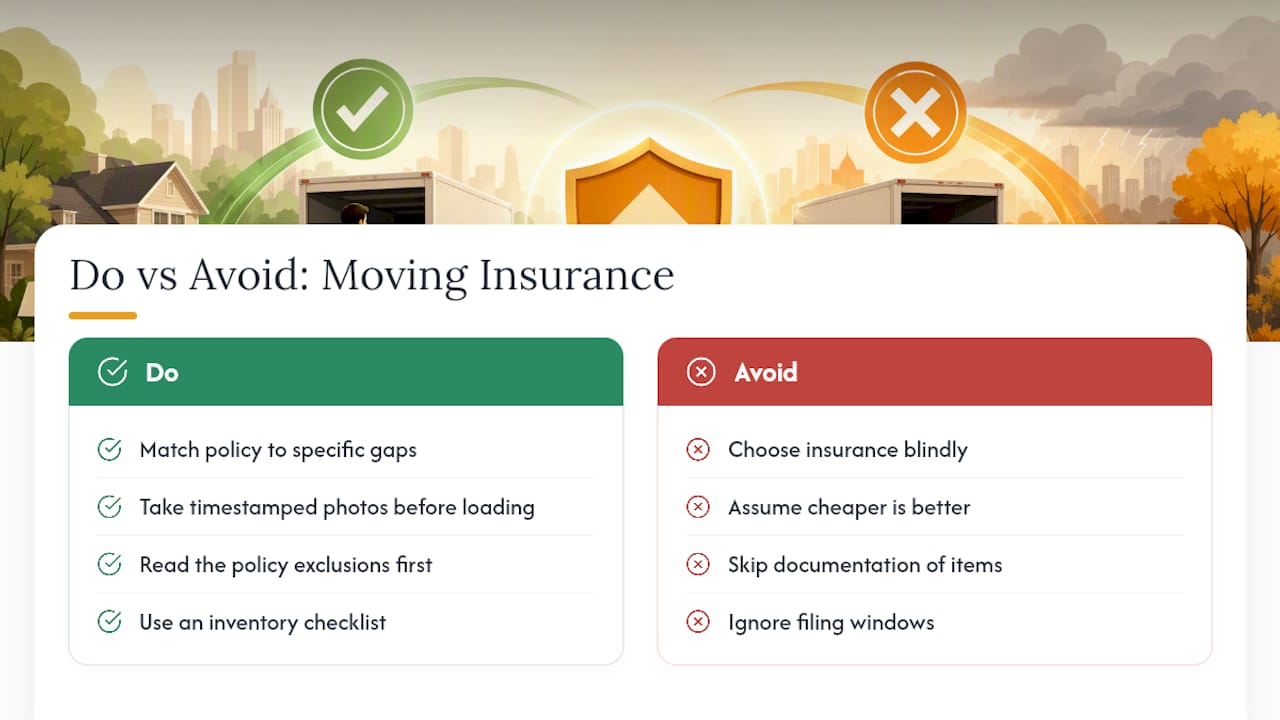
What gets underrated is documentation. Insurers don’t deny claims because customers didn’t buy enough coverage; they deny claims because customers can’t prove what they owned or when damage occurred. A $30 investment in timestamped photos before the truck loads does more to protect a claim than upgrading from a $1,000 deductible to a $500 one.
If you take one thing from this guide, prioritize reading the exclusions page before you compare prices. A cheap policy with a mold exclusion and a 60-day filing window isn’t cheaper than a slightly pricier one that actually pays when you need it. For readers coordinating a complex interstate move, our long-distance moving process guide and inventory checklist are built to work alongside whatever insurance decision you land on, and Move Craft can help coordinate vendors and documentation from booking through delivery.
— Info
Sources
- How do I insure my belongings during a move? | FMCSA
- Third-Party Moving Insurance Company Reviews | MoveBuddha
- Third-Party Moving Insurance overview | MovingPlace
- Trustpilot reviews for MovingInsurance.com
FAQ
Is There Such a Thing as Moving Insurance?
Yes, but it’s important to know that what movers sell is technically valuation coverage, a liability program under federal rules. True moving insurance is a separate policy sold by state-licensed insurers, often called third-party moving insurance.
Is It Worth It to Get Moving Insurance?
It’s worth it for interstate long-distance moves, self-packed boxes, storage-in-transit, or high-value items, since it typically costs 1% to 4% of declared shipment value. For short local moves with modest belongings, mover-offered Full Value Protection is often sufficient on its own.
How Much Does $1,000,000 in Liability Insurance Cost a Month?
This figure typically refers to a moving company’s general liability policy, not consumer moving insurance, and premiums vary widely based on the mover’s size, claims history, and state. Consumers buying their own shipment coverage should expect the 1% to 4% of declared value range instead, not a flat liability premium.
Are Movers Liable for Broken Items?
Movers are liable under whichever valuation option you selected, RVP or FVP, but only up to that program’s payout formula and only for damage they caused. Third-party moving insurance often pays regardless of fault, which is why it covers gaps like acts of God or self-packed box damage that carrier liability typically excludes.