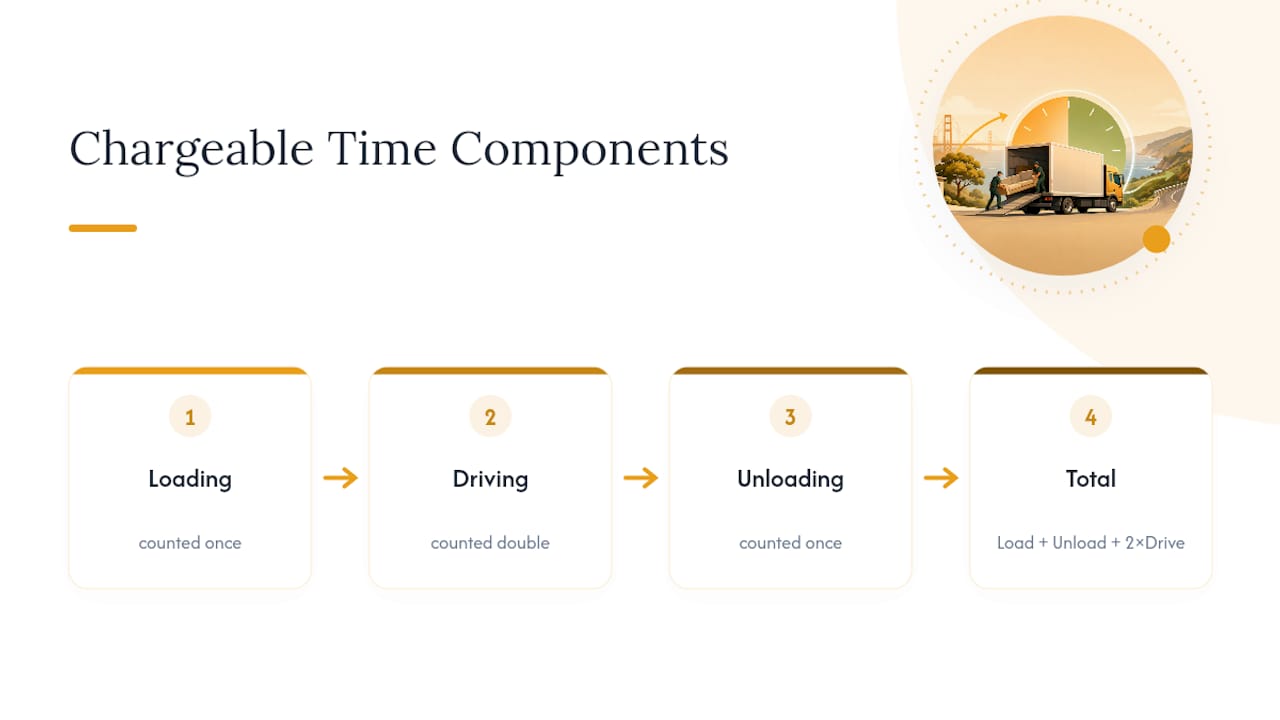
California law requires licensed movers to count driving time twice when billing hourly moves. Under CPUC Maximum Rate Tariff 4%20lct.pdf), your total billable time equals loading, plus unloading, plus double the drive time between your old address and your new one. Loading and unloading are never doubled. Before you sign anything, check your written estimate against this formula and ask your mover the questions covered below.
TL;DR:
- Confirm whether your mover starts drive time from your address or their warehouse, as this impacts the doubled billing calculation.
- A move with a 30-minute drive results in 60 billable minutes, so consider traffic conditions and rounding conventions when estimating costs.
- Double drive time applies only to licensed California carriers with hourly rates, not to flat-rate or interstate moves under federal jurisdiction.
- Insist on an itemized estimate that separates loading, unloading, and drive time to verify your bill and avoid surprises.
- Ask upfront about drive time measurement, whether from origin or warehouse, and the calculation of additional surcharges to ensure transparency.
Table of Contents
- What Double Drive Time Means Under California Law
- How to Calculate Double Drive Time (With Two Examples)
- When Double Drive Time Applies (And When It Doesn’t)
- What Double Drive Time Does to Your Final Bill
- Questions to Ask Your Mover Before You Sign
- Why Billing Surprises Happen, and How to Avoid Them
- Get a Move Quote Without the Billing Guesswork
- Sources
What Double Drive Time Means Under California Law
The rule comes straight from CPUC Maximum Rate Tariff 4, the tariff that governs how licensed household goods carriers bill hourly, in-state moves. The formula is simple on paper: total chargeable time equals loading time, plus unloading time, plus double the driving time between the origin and destination. Loading and unloading get counted once, at face value. Only the drive itself gets doubled.
Three terms matter here. Origin is the address where your mover starts loading. Destination is where they finish unloading. Warehouse refers to the mover’s dispatch point or storage facility, and whether travel from there counts toward your bill depends on the specific arrangement your mover discloses upfront. This distinction trips up a lot of customers, because some crews start the clock from the warehouse instead of your front door.
Before you hire anyone, confirm they hold an active California mover’s license. The Bureau of Household Goods and Services maintains consumer guidance for verifying licenses and understanding tariff compliance, and it’s worth five minutes of your time to check. Note that this rule governs intrastate moves only. Interstate relocations fall under federal rules from the Federal Motor Carrier Safety Administration instead, so confirm which jurisdiction actually applies to your move before comparing quotes.
How to Calculate Double Drive Time (With Two Examples)
The math itself is straightforward once you know the sequence: measure the one-way drive time between your old and new address, double that number, then add your loading and unloading hours on top. Here’s the order movers are supposed to follow:
- Measure the drive time from origin to destination using actual road conditions, not straight-line distance.
- Double that figure. A 20-minute drive becomes 40 billable minutes.
- Add loading time and unloading time separately, at their real duration, with no multiplier.
- Total everything into your billable hours.
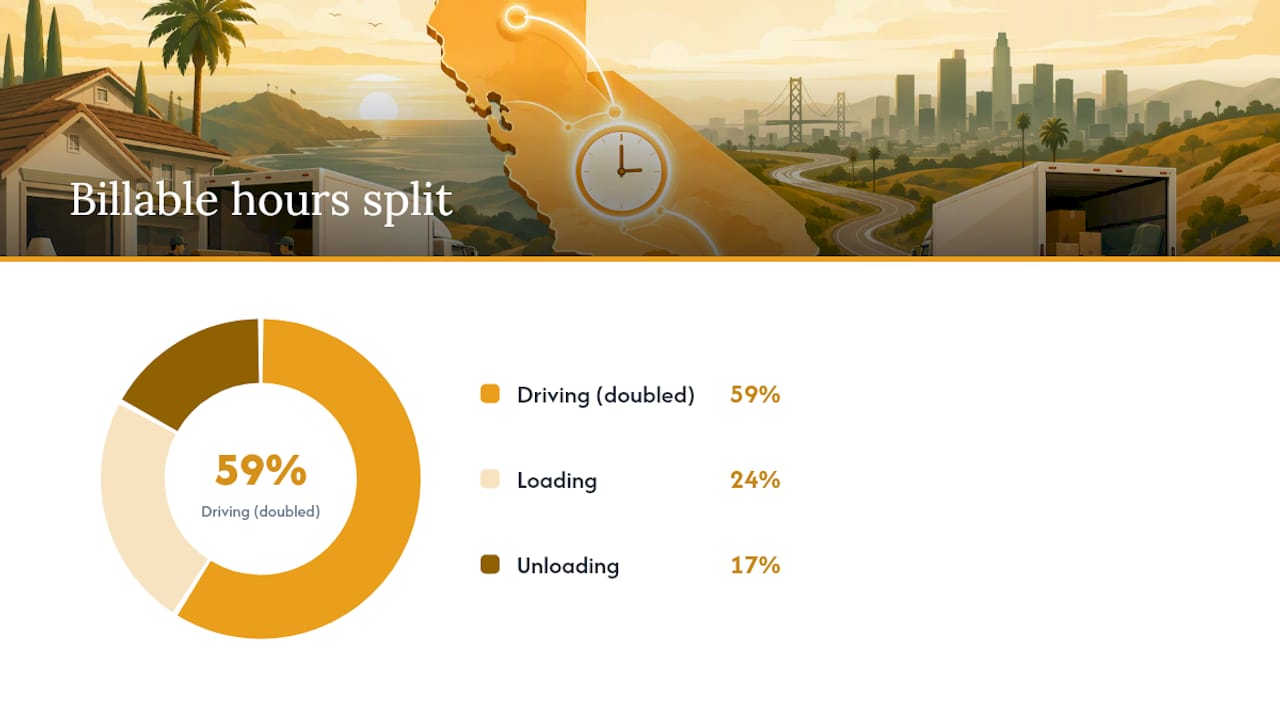
Example A: A short local move. Say your drive from a two-bedroom apartment in Sacramento to a new place across town takes 15 minutes. Doubled, that’s 30 minutes of billable drive time. Add 90 minutes of loading and 60 minutes of unloading, and your crew has billed 3 hours total, before a single item gets checked for damage.
Example B: A longer in-state move. A move from the Bay Area to Fresno with a 2.5-hour drive doubles to 5 hours of billable driving alone. Add 2 hours of loading and 1.5 hours of unloading, and you’re at 8.5 billable hours before your mover even reaches the destination county. Caltrans traffic-volume data shows real variability across regions, so treat any specific drive-time figure as a planning estimate, not a guarantee.
Ask your mover whether they round drive time to the nearest quarter hour or bill in exact minutes. That rounding convention can shift your final bill more than people expect.
When Double Drive Time Applies (And When It Doesn’t)
DDT applies to hourly-rate moves performed by California-licensed carriers under CPUC jurisdiction. It generally doesn’t apply to flat-rate or binding-estimate moves, where the total price is fixed regardless of how long the drive takes. It also doesn’t apply to interstate moves, which fall outside CPUC’s authority entirely.
The 2026 Maximum Rate Tariff from BHGS lays out the current billing rules movers are required to follow, including any caps or clarifications tied to specific move types. Some movers cap billable drive time for extremely long in-state hauls, or apply different terms for moves crossing certain distance thresholds. Confirm the specifics with your mover directly.
Don’t confuse DDT with separate line items. Fuel surcharges, packing materials, and storage fees are billed independently, on top of your labor and drive-time total, not folded into the doubling calculation itself.
What Double Drive Time Does to Your Final Bill
Double drive time can add a meaningful chunk to your total hours, especially on moves with a long commute between addresses. A move with a 45-minute drive adds 90 billable minutes just from the doubling. On an hourly job with two movers at a combined rate, that alone can push your final bill up by a noticeable percentage over a version of the same move with a five-minute drive.
Some movers itemize drive time as its own line on the estimate. Others fold it silently into a single “estimated hours” figure. Insist on the itemized version in writing. If a mover won’t separate loading, unloading, and drive time on paper, you have no way to check their math later. A written itemized estimate also gives you something to point to if a dispute comes up on move day.
You can reduce your exposure somewhat by scheduling your move for off-peak traffic windows and consolidating stops instead of running multiple trips. These tactics help, but they have limits. A move between distant addresses will always carry more drive-time charges than a move across town, no matter when you schedule it. A detailed move day schedule can help you plan around this realistically.
Questions to Ask Your Mover Before You Sign
Ask these questions during the quoting process, not on move day when you have no leverage:
- What address counts as the origin, and does drive time start there or from your warehouse?
- How do you measure and round drive time, minutes or quarter-hour increments?
- Is warehouse-to-origin travel billed separately from origin-to-destination drive time?
- Do you charge a fuel surcharge on top of double drive time, and how is it calculated?
- Can I get an itemized written estimate showing loading, unloading, and drive time as separate lines?
- What is your CPUC license number, and which tariff governs this move?
Watch for red flags: a mover who refuses to itemize the estimate, gives inconsistent answers about what counts as origin versus warehouse, or can’t produce a license number on request. Any of those should make you pause before signing.
Pro Tip: Ask for the exact addresses your mover used to calculate drive time, and keep a copy of your written quote. If a billing dispute comes up later, contemporaneous documentation like this is what actually gets disputes resolved in your favor.
Why Billing Surprises Happen, and How to Avoid Them
Most double drive time disputes we hear about don’t come from movers breaking the law. They come from movers who never explained the rule clearly in the first place.
Some moving coordination services vet carriers for exactly this kind of transparency. Many carriers in moving networks are expected to provide itemized written estimates that separate drive time from labor, confirm their CPUC license and tariff status upfront, and give clear move-day instructions about where the clock starts and stops. That’s the difference between a mover who explains double drive time before you sign and one who lets you discover it on the invoice.
For more on what a compliant estimate should look like, our relocation checklist walks through the documents worth requesting before moving day arrives.
— Info
Get a Move Quote Without the Billing Guesswork
This moving coordination service offers an alternative to hiring blind off a search results page. They match customers with vetted, licensed California carriers who provide itemized written estimates upfront, so double drive time shows up as its own line item instead of a surprise on the final invoice.

That vetting matters because not every mover discloses drive-time math the same way, and the CPUC tariff gives carriers some room in how they present it. Our relocation checklist walks through exactly what to request in writing before you commit to a carrier, and our 15 questions to ask local moving companies page gives you a longer list to bring into any quoting call.
If you’re ready to move forward, submit a quote request through the service’s platform and you will be connected with licensed carriers who itemize drive time clearly from the start, before you sign anything.