
Most local moves are priced by the hour and generally cost a few hundred to a few thousand dollars. Long-distance moves priced by weight and mileage can vary widely, sometimes costing several thousand dollars or more, according to MoveSmart’s 2026 pricing data. Your actual number depends on home size, distance, and how much you’re willing to do yourself.
Before you request a single quote, gather three things: an inventory or rough shipment weight, your origin and destination zip codes, and the service level you want (full service, labor-only, or DIY truck rental). Those three inputs drive nearly every dollar figure a mover will quote you.
Quick benchmark: A 2-bedroom local move averages moderate labor costs. A 2-bedroom move traveling around 500 miles usually costs several thousand dollars, according to moveBuddha’s cost calculator.
Start here:
- Estimate your shipment weight or count your rooms and major furniture pieces
- Map the distance between your current and future zip codes
- Decide whether you want movers to pack, load, and drive, or just handle part of the job
Key Takeaways
Moving costs depend primarily on three inputs: shipment weight or home size, distance between locations, and the service level you choose.
| Point | Details |
|---|---|
| Know your pricing model | Local moves are billed hourly; long-distance moves are billed by weight plus mileage. |
| Budget beyond the truck | Add utility deposits, temporary housing, and packing materials to the mover’s quote. |
| Time your move | Booking midweek and off-peak season can cut costs 10% to 25%. |
| Verify before you sign | Check USDOT or state license numbers and require written, itemized estimates. |
| Choose a transparent partner | Movecraftmoving matches vetted carriers with detailed inventories and line-item pricing. |
Table of Contents
- Recent Average Moving Costs by Home Size and Distance
- How Do Movers Calculate Your Bill?
- How Do You Calculate a Realistic Moving Cost Estimate?
- What Factors Change Your Moving Cost the Most?
- What Hidden Fees Should You Budget for Beyond the Mover’s Invoice?
- What Are the Most Effective Ways to Cut Moving Costs?
- How Do You Get Accurate Quotes and Avoid Red Flags?
- How Does Move Craft Build a Transparent Moving Estimate?
- What Do Customers Most Often Miss When Budgeting a Move?
- Get a Transparent Moving Estimate From Move Craft
- Sources
Recent Average Moving Costs by Home Size and Distance
Local moves are billed hourly, so home size and crew size do most of the work in the final number. A studio or 1-bedroom apartment usually needs two movers and runs $300 to $800 for a half-day job. A 2-bedroom home typically needs three movers for four to six hours, landing between $600 and $1,800. A 3-bedroom or larger house often requires a four-person crew across a full day, pushing costs to $1,200 and $2,800.
Long-distance pricing works differently. Movers charge by shipment weight and mileage, so the same 2-bedroom apartment that cost $1,200 to move across town can cost $2,500 to $5,000 moving 500 miles, and $3,800 to $10,000 or more for a cross-country relocation past 1,000 miles, per MoveSmart’s guide.
| Move Type | Home Size | Typical Cost Range |
|---|---|---|
| Local (hourly) | Studio/1BR | $300–$800 |
| Local (hourly) | 2BR | $600–$1,800 |
| Local (hourly) | 3BR+ | $1,200–$2,800 |
| Long-distance (500 mi) | 2BR | $2,500–$5,000 |
| Long-distance (1,000+ mi) | 3BR | $3,800–$10,000+ |
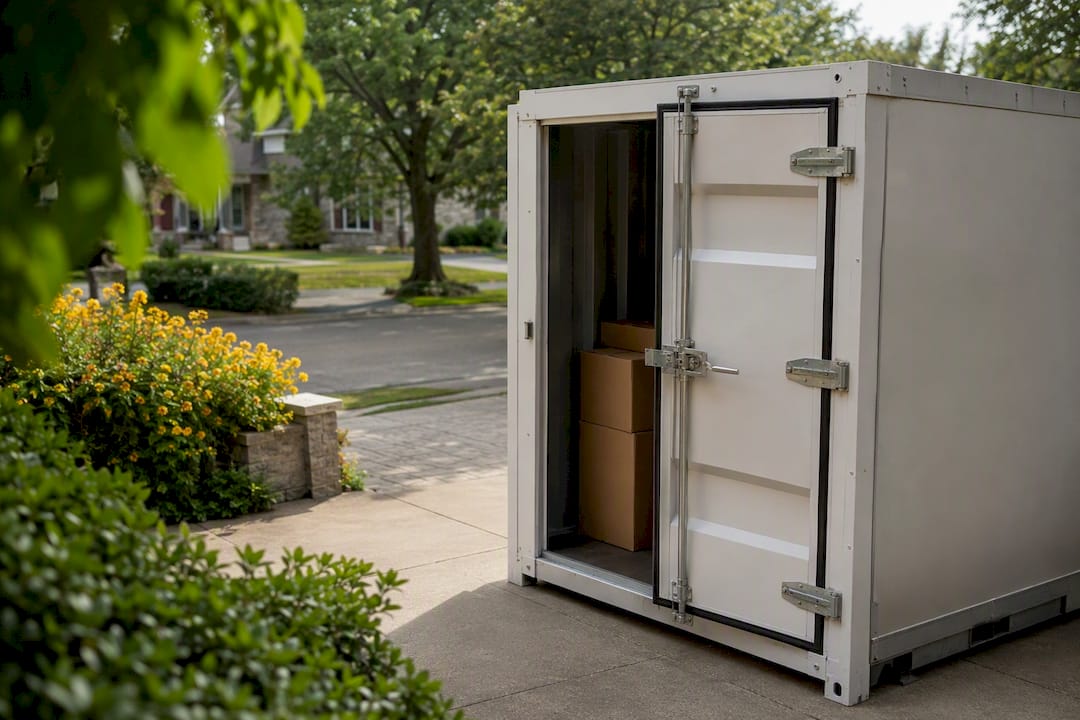
Service type shifts these ranges dramatically. Full-service movers who pack, load, drive, and unload sit at the top of each range. A DIY truck rental strips out labor entirely but leaves you doing all the heavy lifting. Container moves (where a company drops off a portable unit you pack yourself, then ships it) fall somewhere in between, usually cheaper than full service but pricier than a straight truck rental for long distances.
Two other variables quietly move these numbers around. Peak season, typically late May through early September, and month-end dates often carry premiums of 10% to 25%, according to MoveSmart’s seasonal analysis. Regional labor rates matter too. A crew in a high-cost metro area bills more per hour than the same size crew in a smaller market, even for an identical job.
How Do Movers Calculate Your Bill?
Two pricing models dominate the industry, and knowing which one applies to your move changes how you should read every quote you get.
Local moves are almost always billed hourly: crew size multiplied by an hourly rate, multiplied by hours worked, plus a truck fee. A three-person crew at $150 an hour for five hours runs $750 before add-ons. Long-distance and interstate moves work differently. They’re priced by the actual weight of your shipment plus the mileage between origin and destination, a method moveBuddha explains in detail.
That distance-based model is exactly why interstate movers are legally required to give you a written estimate, either binding or nonbinding. A binding estimate locks in your price regardless of actual weight, as long as your inventory doesn’t change. A nonbinding estimate can shift once your shipment is weighed, but FMCSA rules cap what the mover can collect at delivery to 110% of the original nonbinding estimate. If your nonbinding quote was $4,000, the mover cannot legally demand more than $4,400 at the door, even if the truck weighs in heavier than expected.
Beyond the base rate, several access and specialty surcharges show up on most invoices:
- Stairs and elevator carries, often billed per flight or as a flat access fee
- Long carry fees when the truck can’t park within a set distance of your door (commonly 75 to 100 feet)
- Specialty-item handling for pianos, safes, pool tables, or oversized art
- Shuttle fees when a smaller vehicle is needed to reach your home before loading the main truck
Pro Tip: Ask every mover for a written breakdown of accessorial charges before move day, not after. A crew that can’t tell you the stair-carry fee up front usually can’t be trusted to hold their final price either.
Reputable movers publish these fees in their contract, a practice worth confirming before you sign anything, and it’s the kind of transparent pricing that separates a trustworthy estimate from a bait-and-switch one.
How Do You Calculate a Realistic Moving Cost Estimate?
Before requesting quotes, collect five specific pieces of information. Skipping any one of them is how people end up with estimates that don’t survive contact with moving day.
- Inventory or estimated shipment weight. Walk through your home room by room, or use a rough rule of thumb: 1-bedroom apartments average 2,000 to 3,000 pounds, 2-bedroom homes average 4,000 to 6,000 pounds, and 3-bedroom houses average 7,000 to 9,000 pounds.
- Origin and destination zip codes. Distance is the second major input for interstate pricing, and it also determines fuel surcharges.
- Preferred move date and flexibility. A fixed date during peak season costs more than a flexible midweek, midmonth date.
- Service level. Full service, labor-only, or DIY changes your labor cost by a wide margin.
- Access constraints. Stairs, long carries, and street parking restrictions at both ends of the move.
For a local move, the math is straightforward: crew size × hourly rate × estimated hours + truck fee + any accessorial charges. A 2-bedroom apartment with a three-person crew at $150 an hour for five hours comes to $750, plus a $100 truck fee, plus roughly $150 for packing materials if you’re doing your own boxes. That lands around $1,000.
For a long-distance move, the formula shifts to shipment weight × per-pound rate + mileage charge + fuel surcharge + valuation coverage. Per-pound rates on interstate moves commonly range from $0.50 to $0.80 per pound depending on distance, per moveBuddha’s data.
Here’s how that plays out across three common scenarios:
| Scenario | Estimated Weight | Distance | Estimated Cost |
|---|---|---|---|
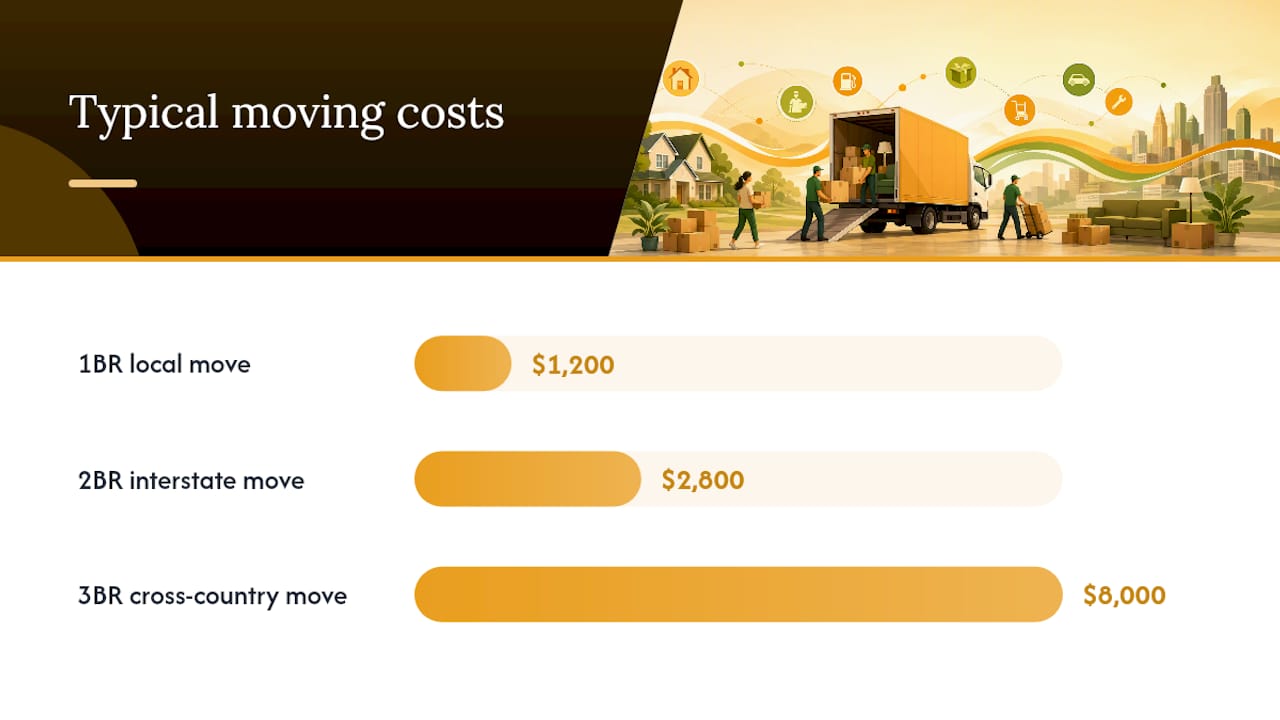
| 1BR local move | 2,500 lbs | Under 20 miles | $600–$1,800 |
| 2BR interstate move | 5,000 lbs | 500 miles | $2,800 |
| 3BR cross-country move | 7,000 to 9,000 pounds | 1,000+ miles | $6,000–$10,000 |
Add 10% to 15% on top of any estimate for packing materials, tips (typically $4 to $6 per mover per hour, or $20 to $50 per mover for a full day), and valuation coverage, a buffer HomeCostLab recommends in its budget template. If your inventory is complex or you’re unsure how to translate rooms into pounds, an online cost calculator or an in-home survey from a mover will get you closer to an accurate number than guesswork ever will.
What Factors Change Your Moving Cost the Most?
Distance and shipment weight drive the largest swings in any moving estimate, full stop. A 2-bedroom move that costs $1,200 locally can cost four times that once you add 1,000 miles and the weight-based pricing model kicks in.
Move date matters more than most people expect. Booking during peak summer months or around a month-end (when leases typically turn over) can add 10% to 25% to your quote, based on MoveSmart’s seasonal data. Regional labor rates stack on top of that. Crews in expensive metro markets simply bill higher hourly rates than crews in smaller cities, independent of how much stuff you own.
Access issues are the quiet budget killer. Here’s what typically adds cost:
- Walk-up apartments above the second floor without an elevator (often $50 to $100 per flight)
- Long carries when the truck can’t park close to the entrance
- Narrow streets requiring a shuttle truck for the final approach
- Parking permits in dense urban areas, sometimes required days in advance
- Specialty items like pianos, gun safes, or large aquariums that need dedicated equipment
Pro Tip: Decluttering before your in-home survey is the single highest-leverage move you can make. Every 500 pounds you eliminate from your shipment shaves real dollars off a weight-based long-distance quote, and it cuts hours off an hourly local job too.
Scheduling flexibility and virtual surveys round out the list of low-effort, high-impact changes. A virtual survey (walking a mover through your home over video) takes 20 minutes and produces an estimate nearly as accurate as an in-person visit, without the scheduling hassle.
What Hidden Fees Should You Budget for Beyond the Mover’s Invoice?
The moving truck invoice is often the smallest line item in a full relocation budget. A complete plan should include the mover’s cost plus three to six months of new living expenses and a contingency cushion, an approach HomeIA outlines in its relocation budget checklist.
Here’s what commonly gets left off the initial budget:
- Packing materials and professional packing services, typically $200 to $600 for a 2-bedroom home
- Full-value valuation coverage, usually 1% of your declared shipment value
- Storage-in-transit, often $100 to $300 per month if your move-in date slips
- Temporary housing, hotel stays, or short-term rentals during a gap between homes
- Utility deposits at your new address, which can range from $50 to $300 depending on the provider
- Pet transport or vehicle shipping, if you’re not driving your car yourself
- End-of-lease cleaning fees at your old home
- Tips for your moving crew, typically $20 to $50 per mover for a full day’s work
Several line-item budget guides, including LegalClarity’s full expense checklist, point out that most of these costs are avoidable with planning but nearly unavoidable without it. Bundling packing and moving services with one company often costs less than hiring them separately, and asking upfront about free storage windows (many movers offer 30 days free if your closing date shifts) can save several hundred dollars. Always request a line-item estimate rather than a lump sum. It’s the only way to spot which fees you can negotiate down or eliminate entirely.
What Are the Most Effective Ways to Cut Moving Costs?
- Declutter before you get quotes. Selling or donating furniture and boxes you no longer want directly reduces your shipment weight, which lowers both hourly local costs and weight-based interstate quotes.
- Schedule off-peak. Moving midweek, midmonth, and outside the May-to-September rush can shave 10% to 25% off your total, based on MoveSmart’s seasonal pricing data.
- Pack your own boxes. Professional packing services add $200 to $600 or more to a typical bill; doing it yourself trades your time for that money.
- Consider a hybrid approach. Labor-only movers who load and unload a truck you rent yourself often cost 30% to 40% less than full service.
- Get three written quotes minimum. Comparing itemized estimates side by side reveals which company is padding fees and which one is pricing fairly.
Each tactic trades something. Decluttering costs you time sorting through belongings. Off-peak scheduling requires flexibility you might not have if your lease ends on a fixed date. DIY packing risks damage if you’re not experienced with fragile items. Weigh the trade-off against how tight your budget actually is before picking a strategy.
Pro Tip: Ask movers directly if they offer flat-rate labor blocks or hybrid service packages. Many companies won’t advertise these options, but they’ll build one for you if you ask, and it can land you full-service convenience at labor-only prices for parts of the job.
How Do You Get Accurate Quotes and Avoid Red Flags?
Request a written estimate, ideally binding, and confirm the mover’s USDOT number for interstate jobs or state license number for local moves before you sign anything. Cross-check that number through FMCSA’s Protect Your Move tool, which lets you verify a carrier’s registration and complaint history in minutes.
Watch for these red flags:
- A large deposit required before the move (legitimate movers rarely ask for more than a small booking fee)
- A company name that recently changed or has no verifiable online history
- Estimates given over the phone with no in-home or virtual survey
- No written estimate offered for an interstate move, which violates FMCSA requirements
- Reviews that mention withheld belongings or demands for cash at delivery
An in-home or virtual survey paired with a detailed inventory checklist is the single best way to avoid a quote that balloons on move day. It’s also worth reviewing contract best practices before signing so you know exactly what you’re agreeing to.
How Does Move Craft Build a Transparent Moving Estimate?
Movecraftmoving connects customers with vetted carriers through a process built to eliminate the guesswork that causes most moving-cost disputes. Every partner carrier goes through vetting for licensing, insurance, and performance history before they’re matched with a customer’s move.
The estimate process itself follows a consistent sequence: a detailed inventory (built from either a virtual walkthrough or an in-home survey), a written line-item estimate that separates labor, mileage, and accessorial fees, and clear valuation coverage options explained before you commit to anything.
A transparent estimate should let you see exactly what you’re paying for, line by line, before the truck ever shows up. If a mover can’t produce that breakdown on request, that’s the clearest signal to keep shopping.
What Movecraftmoving recommends every customer ask any mover, not just its own network:
- Request the carrier’s USDOT or state license number and verify it independently
- Ask for a written, itemized estimate rather than a verbal quote
- Confirm which valuation coverage level applies and what it costs
- Get the accessorial fee schedule (stairs, long carry, shuttle) in writing
These are the same standards outlined in Movecraftmoving’s own contract best practices guide, built to apply whether or not you end up booking through the platform.
What Do Customers Most Often Miss When Budgeting a Move?
The invoice from the moving truck rarely tells the whole story. Customers consistently report being caught off guard by utility deposits at the new address, a week or two of temporary housing when closing dates shift, and specialty-item handling fees for things like pianos or gun safes that weren’t mentioned until the crew showed up.
The pattern that shows up again and again: people budget for the truck and forget the transition. A move isn’t one expense, it’s a cluster of them spread across six to eight weeks, from the deposit on a new lease to the pizza you order because your kitchen isn’t unpacked yet. Building a full relocation budget, not just a mover’s quote, is what separates a smooth move from a financially stressful one.
Get a Transparent Moving Estimate From Move Craft
Movecraftmoving is built for exactly the surprises this article just walked through.

That process covers the pieces most quotes leave out: carrier licensing and insurance verification, valuation coverage guidance so you know exactly what’s protected, and access to resources on everything from utility transfer to vehicle relocation. If you’re planning a household move, whether it’s across town or across the country, the fastest way to see real numbers is to explore Move Craft’s full-service relocation options and request a virtual survey. It takes about 20 minutes and gets you a written estimate built around your actual inventory, not a rough guess over the phone.
Sources
- FMCSA — Subpart D: Estimates and charges for interstate household goods moves
- moveBuddha — Moving Cost Calculator
- HomeIA — Total cost of relocating: Moving budget checklist
- MoveSmart — How Much Does It Cost to Move in 2026? Complete Moving Cost Guide
- HomeCostLab — The complete moving checklist and budget template for 2026
Recommended
- Full-Service Relocation Benefits for Families in 2026 – Move Craft Moving Solutions LLC
- Commercial vs. Residential Mover: Key Differences in 2026 – Move Craft Moving Solutions LLC
- Commercial Move Cost Factors Explained for Business Owners – Move Craft Moving Solutions LLC
- Long Distance Moving Process Overview: 2026 Guide – Move Craft Moving Solutions LLC