Every moving company operating interstate in the United States is legally required to carry a minimum of $750,000 in primary auto liability insurance under FMCSA rules, plus cargo and surety minimums. That is the regulatory floor. The real-world answer to why movers need liability insurance goes further: a single truck accident with injuries can generate defense costs and settlements that exceed that floor before a jury even deliberates. Without adequate coverage, one bad day can end a business.
Here is what to do right now:
- Check your FMCSA filings. Interstate household goods carriers must maintain a BMC-91 or BMC-91X filing as proof of insurance. A lapsed filing can suspend your operating authority.
- Verify your commercial auto and cargo coverages. Confirm per-vehicle and per-occurrence limits, not just the total policy limit.
- Talk to an industry-specialized broker. Generic business policies often miss mover-specific exposures. Carriers like IAT Insurance Group and Vanliner build programs specifically for movers.
- Review your certificates of insurance (COIs). Many commercial buildings and condo associations require a COI before they will allow your crew through the door. A missing or outdated COI costs you the job.
Most operators who carry contracts with corporate clients or access high-rise buildings carry $1 million or more in primary liability, well above the FMCSA minimum. The sections below explain exactly what each coverage does, what it costs, and how to build a program that protects your business at every level.
Table of Contents
- What does moving company liability insurance actually cover?
- Why liability insurance matters more than most movers realize
- A detailed look at each coverage, limits, and exclusions
- What U.S. law requires from movers on insurance
- How much does moving company insurance cost?
- Do you need your own policy if you work for a moving company?
- What do real claims look like for moving companies?
- How to buy the right insurance program for your moving company
- How Movecraftmoving helps movers with insurance and vetting
- Key Takeaways
- Insurance is a business decision, not just a legal checkbox
- Movecraftmoving connects operators with verified, insured carriers
- Authoritative sources for further reading
What does moving company liability insurance actually cover?
Liability insurance is third-party protection. It pays claims made against you by other people, not your own losses. That distinction matters enormously when you are comparing policy types, because the coverage that protects a pedestrian your truck hits is a completely different policy from the one that covers a client’s damaged piano.
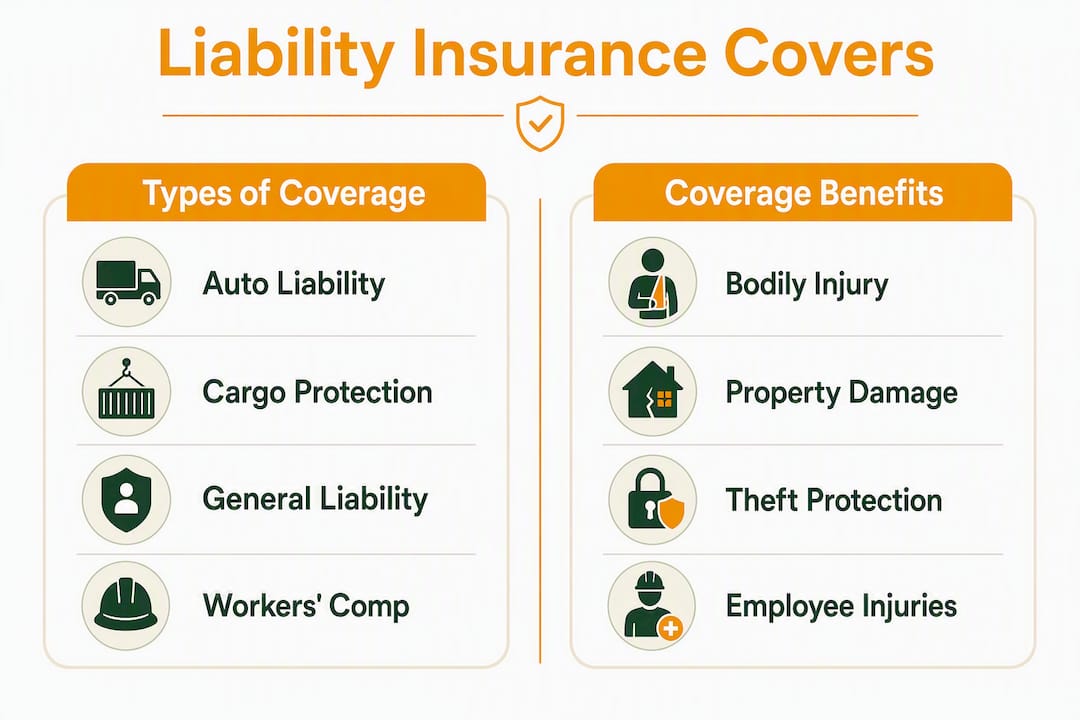
Here is a plain-English breakdown of the core coverages every moving company should understand:
- Commercial auto liability. Covers bodily injury and property damage your vehicles cause to third parties. Required by FMCSA for interstate operations. This is the policy that responds when your driver rear-ends another vehicle on the highway.
- Commercial general liability (CGL). Covers third-party bodily injury and property damage arising from your premises or operations, plus advertising injury. Think: a customer trips over a dolly in your warehouse, or a bystander is injured at a job site.
- Cargo / bailee (inland marine). Covers loss or damage to customer property while it is in your care. This is the coverage that responds when a client’s furniture is damaged in transit. It is separate from auto liability for a specific reason explained below.
- Workers’ compensation. Covers medical expenses and lost wages for your employees injured on the job. Required in most states for any company with employees.
- Employer’s liability. Covers lawsuits by employees who claim their injury resulted from employer negligence, beyond what workers’ comp pays.
- Garagekeepers / warehouse legal liability. Covers customer property stored in your facility. Relevant if you offer storage-in-transit or long-term storage.
- Surety bond. A financial guarantee (not insurance) required by FMCSA for interstate household goods carriers: $10,000 minimum.
- Umbrella / excess liability. Sits above your primary policies and pays when a claim exceeds primary limits. Often required by corporate clients.
| Coverage | What it covers | Who it protects | Typical limits |
|---|---|---|---|
| Commercial auto liability | Bodily injury / property damage from vehicle operations | Third parties | $750,000 per occurrence minimum (FMCSA); most operators carry $1M or more |
| Commercial general liability | Premises/operations injury, advertising injury | Third parties | $1M per occurrence / $2M aggregate |
| Cargo / inland marine | Customer property in transit or storage | Customer (policyholder’s obligation) | $5,000 per vehicle / $10,000 per occurrence minimum (FMCSA); many operators carry $100K–$500K per vehicle |
| Workers’ compensation | Employee injury, medical, lost wages | Employees | Statutory (state-mandated) |
| Umbrella / excess | Overflow above primary limits | Third parties / employees | $1M–$5M+ |
| Surety bond | Financial guarantee for FMCSA compliance | Shippers / regulators | $10,000 minimum (FMCSA) |
Pro Tip: CGL policies contain a “care, custody, or control” exclusion. Once your crew picks up a client’s belongings, CGL will not cover damage to that property. You need explicit cargo or bailee wording. Many operators discover this gap only after a claim is denied.
Why liability insurance matters more than most movers realize
Defense costs alone can bankrupt a small operator. Liability policies pay legal defense and settlements up to policy limits — and that defense obligation kicks in even when you are ultimately found not liable. Attorney fees, expert witnesses, depositions, and court costs can run into six figures before a verdict is reached. A moving company with $750,000 in coverage and a serious bodily-injury claim may find that defense costs alone consume a significant portion of that limit, leaving little for any settlement.
The financial exposure goes beyond the courtroom. Consider what happens operationally when coverage is inadequate:
- Lost contracts. Corporate clients and property managers routinely require $1 million or more in general liability before signing. If your COI does not meet their threshold, you do not get the job.
- Denied building access. Condo associations and office buildings commonly require a COI before your crew can enter. No COI, no move. That is lost revenue on a job you already sold.
- Reputational damage. A publicized claim or lawsuit, especially one involving an uninsured driver or unresolved cargo loss, follows a company online. Review platforms amplify it quickly.
- Personal liability exposure. In some business structures, an uninsured or underinsured claim can pierce the corporate veil and reach the owner’s personal assets.
A single truck collision with a serious injury, a warehouse fire, or a theft of high-value electronics can generate claims that exceed the regulatory minimum. The FMCSA figure is a legal threshold for operating authority, not a risk-management benchmark.

A detailed look at each coverage, limits, and exclusions
Commercial auto liability
This is the policy FMCSA cares about most. It covers bodily injury and property damage your vehicles cause to others during business operations. The FMCSA minimum for interstate household goods carriers is $750,000, proven by a BMC-91 or BMC-91X filing. That figure has not changed in decades, and it does not reflect current medical costs or jury awards. Most serious operators carry $1 million or more.
Watch for named-driver exclusions on smaller policies. If a driver is excluded by name and causes an accident, the policy will not respond for that driver’s actions.
Cargo and inland marine
Cargo coverage is what actually protects your clients’ belongings. It is not part of your auto liability policy. Sub-limits matter here: a policy might show $500,000 in total cargo coverage but cap each vehicle at $100,000 per occurrence. If your crew loads a single truck with $300,000 worth of antiques and that truck is in an accident, the per-vehicle sub-limit is what controls the payout.
Common exclusions include mysterious disappearance (theft without evidence of forced entry), items packed by owner (PBO), and high-value items like jewelry or art unless specifically scheduled.
Commercial general liability (CGL)
CGL covers third-party bodily injury and property damage arising from your premises and operations, plus personal and advertising injury. It does not cover customer property in your care. The care, custody, and control exclusion is explicit in every standard CGL form. General liability for moving companies typically provides $1 million per occurrence and $2 million aggregate limits.
Workers’ compensation and employer’s liability
Moving is physically demanding work. Workers’ compensation covers medical treatment and lost wages when an employee is injured on the job; employer’s liability covers lawsuits that go beyond the workers’ comp system. Both are necessary. Most states require workers’ comp for any company with employees, and the penalties for non-compliance are severe.
Umbrella and excess liability
An umbrella policy sits above your primary auto, CGL, and employer’s liability limits. When a claim exhausts your primary policy, the umbrella pays next. Corporate clients and large property managers often require $2 million to $5 million in total liability, which is typically achieved by combining a $1 million primary policy with a $1 million or $2 million umbrella. Umbrella premiums are often lower per dollar of coverage than raising primary limits, which is why most mid-size operators buy them.
| Coverage | Typical limits | Who it protects | Required by law or contract? |
|---|---|---|---|
| Commercial auto liability | $750,000 minimum (FMCSA); most operators carry $1M or more | Third parties | Law (FMCSA, interstate) |
| Commercial general liability | $1M/$2M | Third parties | Contract (common) |
| Cargo / inland marine | $5,000 per vehicle / $10,000 per occurrence minimum (FMCSA); many operators carry $100K–$500K per vehicle | Customer property | Law (FMCSA) / Contract (common) |
| Workers’ compensation | Statutory | Employees | Law (most states) |
| Umbrella / excess | $1M–$5M+ | Third parties / employees | Contract (corporate clients) |
| Surety bond | $10,000 (FMCSA minimum) | Shippers / regulators | Law (FMCSA, interstate) |
Pro Tip: When you receive a COI from a subcontractor or review your own, check three things: the policy effective and expiration dates, whether your company is listed as an additional insured, and whether the per-occurrence limits match what the contract requires. A COI that shows the right carrier but expired limits is worthless on the day of a claim.
For a deeper look at how commercial and residential moves differ in their insurance requirements, the exposure profiles are meaningfully different.
What U.S. law requires from movers on insurance
Federal requirements apply to interstate household goods carriers. The FMCSA sets the floor:
- $750,000 primary auto liability (BMC-91 or BMC-91X filing required as proof)
- Cargo insurance minimums: commonly $5,000 per vehicle / $10,000 per occurrence for household goods
- $10,000 surety bond or trust fund as an alternative financial security instrument
The BMC-91 and BMC-91X are not just paperwork. They function as a legal commitment from your insurer to the FMCSA that your coverage is active. If your policy lapses, your insurer notifies the FMCSA, and your operating authority can be suspended. Carriers must keep these filings current at all times.
State-level requirements vary for intrastate operations. Most states require commercial auto liability and workers’ compensation, but the specific minimums differ. Some states have their own household goods regulatory bodies with additional filing requirements. If you operate only within one state, check that state’s public utilities commission or department of transportation for intrastate carrier rules.
Practical compliance checklist for every operator:
- Maintain current BMC-91/BMC-91X filings with the FMCSA (interstate carriers)
- Keep a COI on file for every active policy, updated at each renewal
- Confirm additional insured endorsements are in place for recurring commercial clients
- Store policy numbers and claims contact information in every truck and at dispatch
- Review interstate paperwork requirements before adding new routes or states
For context on how interstate versus intrastate status changes your regulatory obligations, the distinction matters more than most operators initially expect.
How much does moving company insurance cost?
Premium varies significantly based on your operation’s profile. MoneyGeek’s moving-company insurance cost data outlines the primary drivers and example ranges for small operators. The main factors underwriters examine:
- Fleet size and vehicle types. More trucks, higher premium. Heavier vehicles (box trucks, semis) carry higher risk than cargo vans.
- Claims history. A clean loss run over three to five years is the single biggest lever for lower premiums. One at-fault accident can raise rates substantially.
- Payroll. Workers’ compensation premiums are calculated as a rate per $100 of payroll. A larger crew means a higher base premium.
- Routes and mileage. Interstate operations, especially long-haul routes, carry higher exposure than local moves. Urban routes with heavy traffic also affect rates.
- Cargo values. High-value specialty items (pianos, art, electronics) increase cargo premiums and may require scheduled endorsements.
- Hiring and driver vetting practices. Underwriters look at your MVR (motor vehicle record) screening process. Operators with formal driver qualification programs often receive better rates.
Tips to reduce premiums without cutting coverage:
- Implement a formal safety program with documented driver training
- Run MVR checks on all drivers annually and before hiring
- Bundle coverages with a single carrier or program (commercial auto, cargo, CGL) for multi-policy discounts
- Maintain a loss run showing three or more years of clean claims history before shopping
Pro Tip: Before raising your primary auto liability limit from $750K to $2M, get a quote for a $1M primary plus a $1M umbrella. The umbrella route often costs less than doubling the primary limit and gives you the same total coverage for large claims.
Do you need your own policy if you work for a moving company?
The answer depends entirely on how you are classified.
If you are a W-2 employee, the company’s commercial auto policy covers you while operating company vehicles, and workers’ compensation covers your on-the-job injuries. You generally do not need your own commercial policy for work-related activities.
If you are an independent subcontractor or owner-operator, you are responsible for your own insurance. The company’s policy typically does not extend to you, and if you cause an accident in your own vehicle, you are personally exposed. Subcontractors should carry:
- Commercial auto liability in their own name (at least the FMCSA minimum for interstate work)
- Cargo coverage for any property they handle
- Workers’ compensation if they have their own employees
- General liability if the contract requires it
What to confirm before signing a subcontractor agreement:
- The minimum limits the hiring company requires (often $1M auto, $1M CGL)
- Whether you must be listed as an additional insured on their policy or vice versa
- Whether a waiver of subrogation is required (this prevents the hiring company’s insurer from suing you after paying a claim)
- Whether your COI must be on file before the first job
Missing subcontractor insurance has real consequences. Job site access is denied, contracts are rejected, and any claim that occurs falls entirely on you. Review contract best practices for licensed movers to understand the standard clause language that governs these relationships.
What do real claims look like for moving companies?
Abstract risk becomes concrete fast when you look at actual scenarios.
Scenario 1: Truck collision with bodily injury. Your driver runs a red light and T-bones a sedan. The other driver sustains a broken leg and spinal injury. Medical bills reach $180,000. The injured party’s attorney files suit for $900,000 including lost wages and pain and suffering. Your commercial auto policy pays defense costs (attorney fees, expert witnesses, depositions) plus any settlement up to your policy limit. If your limit is $750,000 and defense costs consume $150,000, you have $600,000 left for settlement. A $900,000 demand with a $750,000 limit leaves a gap your business must cover out of pocket.
Scenario 2: High-value piano damaged in transit. A client’s Steinway grand piano is damaged when a strap breaks during loading. Repair estimate: $22,000. Replacement value: $65,000. Your cargo policy responds, subject to the per-vehicle sub-limit and any deductible. If the piano was not specifically scheduled on the policy, coverage may be capped at a per-item limit well below replacement value. The client disputes the settlement and files suit. Now your CGL is involved for the litigation costs, even though the cargo policy handles the property damage.
Scenario 3: Theft from a storage facility. Electronics worth $40,000 are stolen from your warehouse overnight. No signs of forced entry. Your warehouse legal liability policy responds, but many policies exclude “mysterious disappearance” without evidence of break-in. If the exclusion applies, the claim is denied. The client sues. Defense costs begin immediately, regardless of outcome.
After any incident, document and report promptly:
- Photograph the scene, damaged items, and any vehicles involved
- Collect witness names and contact information
- File a police report for theft or third-party accidents
- Notify your insurer the same day, not after consulting an attorney
- Preserve all inventory records, bills of lading, and signed condition reports
- Do not admit fault or make settlement offers before your insurer is involved
How to buy the right insurance program for your moving company
Buying moving company insurance is not a one-size-fits-all transaction. A broker who specializes in transportation or moving will know the right questions to ask and the right carriers to approach. Industry-specific programs from carriers like IAT Insurance Group integrate cargo, motor carrier, warehouse legal liability, and loss-control services in a single program, which is meaningfully different from a generic business owner’s policy.
Step-by-step buying checklist:
- Inventory your exposures. List every vehicle, every state you operate in, your average cargo value per truck, your payroll, and any storage facilities you operate.
- Set target limits. Start with FMCSA minimums for interstate work, then layer in contractual requirements from your top clients. Most commercial contracts require $1M CGL and $1M auto at minimum.
- Gather your loss history. Pull three to five years of loss runs from your current carrier. Clean history is your best negotiating tool.
- Get quotes from industry-specialized carriers. Vanliner and IAT TransGuard are two carriers that build programs specifically for movers and storage operators, with in-house claims and loss-control teams.
- Request COI templates and endorsement wording. Before binding, confirm the COI format your largest clients require and make sure the policy can produce it.
- Review endorsements. Confirm hired/non-owned auto coverage if drivers use personal vehicles, and verify that non-trucking use (bobtail) coverage is included if owner-operators use their trucks off-duty.
Questions to ask your broker before binding:
- How does this carrier handle cargo claims specifically? What is the average time to resolution?
- Does the program include loss-control services (driver training, safety audits)?
- What endorsements are available for high-value items or specialty cargo?
- How are defense costs handled — inside or outside the policy limit?
- Can you provide references from other moving companies in this program?
Documents to keep in every truck and at dispatch:
- Current COI for all active policies
- Policy number and 24-hour claims contact number
- BMC filing confirmation (interstate carriers)
- Signed bill of lading and inventory condition report for each job
For long-distance moving insurance considerations that affect both operators and their clients, the coverage questions are layered differently than for local moves.
How Movecraftmoving helps movers with insurance and vetting
Movecraftmoving works with licensed and insured carriers across the country, and the vetting process is built around insurance compliance from the start. Every carrier in the Movecraftmoving network is required to carry current, verified coverage before handling a move. That means COI collection, limit verification, and confirmation of FMCSA filings are part of the standard onboarding process, not an afterthought.
For operators, the practical benefit is reduced friction on commercial and long-distance jobs:
- Commercial move coordination — For large commercial relocations where building managers require specific endorsements or higher limits, Movecraftmoving coordinates the documentation requirements upfront.
- Resource access. Operators can access Movecraftmoving’s licensed mover contract best practices guide for standard clause language that holds up in the field.
Operators who want to discuss carrier partnership or access Movecraftmoving’s vetting resources can reach out directly through the website.
Key Takeaways
Moving companies need liability insurance to operate legally, to protect against catastrophic defense and settlement costs, and to meet the contract and building-access requirements that drive revenue.
| Point | Details |
|---|---|
| FMCSA regulatory floor | Interstate household goods carriers must carry $750,000 in primary auto liability, proven by a BMC-91 or BMC-91X filing. |
| Market practice exceeds minimums | Most operators carrying corporate contracts maintain $1 million or more in primary liability, well above the FMCSA regulatory minimum. |
| CGL does not cover customer property | The care, custody, and control exclusion means cargo or bailee coverage is required separately for any property in your care. |
| COI gaps cost real revenue | Buildings and corporate clients require a current COI before granting access; a missing or expired COI results in denied entry and lost jobs. |
| Movecraftmoving vets for compliance | Movecraftmoving verifies COIs and FMCSA filings for every carrier in its network, reducing documentation friction on commercial and long-distance jobs. |
Insurance is a business decision, not just a legal checkbox
The conventional framing of liability insurance as a compliance requirement undersells what it actually does for a moving business. Yes, the FMCSA mandates $750,000 in primary auto liability for interstate carriers. But the operators who treat that as the finish line are the ones most exposed when a serious claim arrives.
The more useful frame is market access. A moving company without adequate COIs cannot enter half the commercial buildings in any major city. A company without workers’ compensation cannot legally employ a crew in most states. A company without cargo coverage is one damaged shipment away from a lawsuit that its CGL policy will not touch. Insurance is not just protection against catastrophe; it is the credential that gets you through the door on the jobs worth having.
What most articles miss is the defense-cost problem. Even a frivolous claim costs money to defend. An insurer’s obligation to defend begins the moment a covered claim is filed, regardless of merit. That defense function alone, paid by the insurer rather than out of operating cash, is worth the premium on a bad year.
The practical takeaway: set your limits based on the contracts you want to win, not the regulatory minimum you need to avoid a suspension. Then find a broker who works with movers specifically, because the care/custody/control exclusion, the per-vehicle cargo sub-limits, and the BMC filing requirements are not things a generalist broker handles daily.
Movecraftmoving connects operators with verified, insured carriers
Running a moving company means every job carries real financial exposure, from the moment your crew loads the first box to the final delivery signature. The difference between a smooth operation and a costly dispute often comes down to whether the right coverage was in place and documented correctly before the job started.

Movecraftmoving’s carrier network is built on verified insurance compliance. Every partner carrier goes through COI verification, FMCSA filing confirmation, and contract review before handling a single move. For operators looking to access commercial and long-distance jobs that require higher limits and specific endorsements, that vetting infrastructure removes the documentation bottleneck that kills deals at the last minute.
Whether you are coordinating a long-distance residential move or a large commercial relocation, Movecraftmoving’s resources and carrier network are built to handle the compliance side so your crew can focus on the move. Contact Movecraftmoving through the website to discuss carrier partnership or to access contract and COI resources.
Authoritative sources for further reading
These are the primary references operators and brokers should consult when reviewing coverage requirements, filing obligations, and coverage form language:
- FMCSA Insurance Filing Requirements — The primary federal source for BMC-91/BMC-91X filing requirements, minimum liability amounts, and cargo/surety minimums for interstate household goods carriers. Hand this to your broker at renewal.
- Insurance Information Institute — Liability Insurance — Plain-language explanation of how liability policies work, what defense costs cover, and why limits matter. Good background reading before negotiating limits.
- IRMI — Care, Custody, or Control Exclusion in the CGL — The authoritative technical explanation of why CGL does not cover customer property in a mover’s care. Required reading before reviewing any CGL proposal.
- Investopedia — Liability Insurance — Accessible overview of how liability insurance functions as third-party protection, useful for explaining the concept to new hires or subcontractors.
- MoneyGeek — Average Moving Company Insurance Cost — Cost ranges and premium drivers for small moving companies; useful for budgeting and benchmarking quotes.
Recommended
- Long Distance Moving Insurance Guide for Your Move – Move Craft Moving Solutions LLC
- Licensed Mover Contract Best Practices: 2026 Guide – Move Craft Moving Solutions LLC
- Transparent Pricing From Licensed Movers: What You Need to Know – Move Craft Moving Solutions LLC
- Residential Movers with Storage Solutions Compared 2026 – Move Craft Moving Solutions LLC