
The cost of a commercial relocation is driven primarily by three variables: the volume of what you’re moving, how far it’s going, and how much of the work you hand off to professionals. Get those three right, and you can build a realistic budget. Ignore them, and you’ll be chasing surprise invoices on move day.
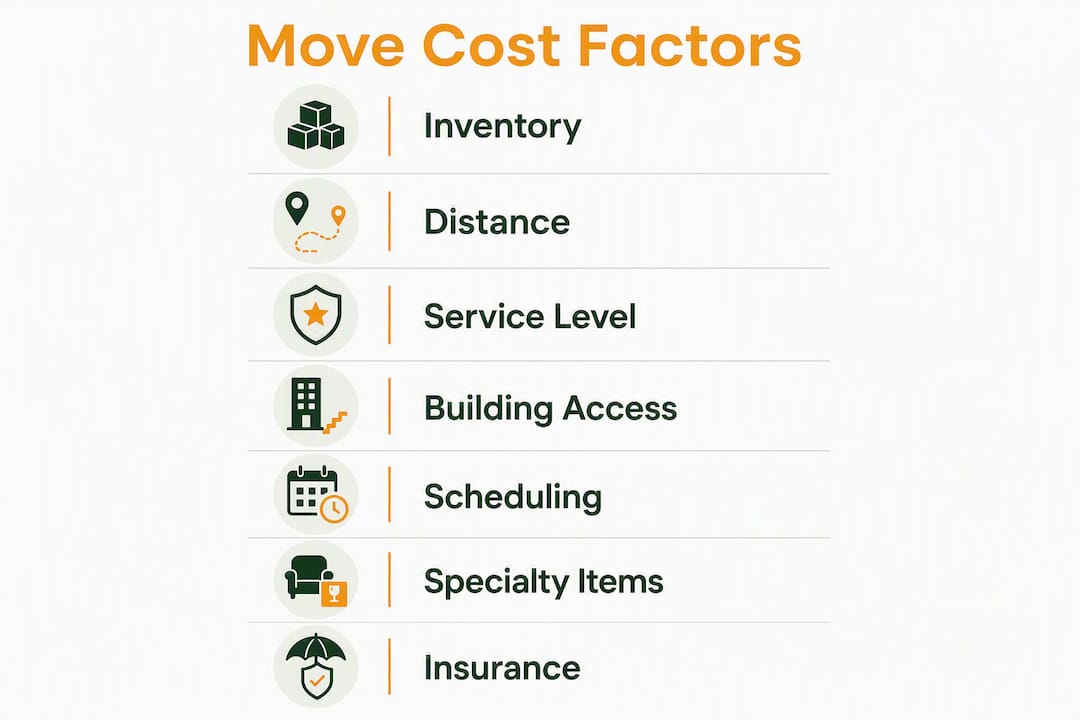
Here are the principal cost drivers to account for from the start:
- Volume and weight of furniture, equipment, and inventory
- Distance (local hourly billing vs. interstate weight-and-mileage pricing)
- Service level (full-service, labor-only, or hybrid)
- Building access and route complexity (freight elevators, loading docks, stairs, long carries)
- Timing and scheduling (peak season, end-of-month, after-hours)
- Specialty items (server racks, safes, lab equipment)
- Insurance and valuation coverage chosen
- Decommissioning and lease-end obligations
No two commercial moves price identically. A firm quote requires an on-site walkthrough and a detailed inventory, not just a square-footage estimate.
Table of Contents
- What does a commercial move actually cost?
- How each cost factor changes your commercial move pricing breakdown
- What line items appear on a commercial moving quote?
- What hidden fees inflate commercial moving bills?
- How do you get an accurate commercial moving quote?
- How can you reduce the cost of commercial relocation?
- What red flags should you watch for when vetting commercial movers?
- Why building architecture often changes a quote more than square footage
- Key Takeaways
- The real cost of skipping the walkthrough
- Movecraftmoving makes commercial move budgeting predictable
- Useful sources and resources
What does a commercial move actually cost?
Office relocation costs vary widely depending on build-out requirements, move complexity, decommissioning, and downtime. That range is so wide because scope varies enormously.
| Scenario | Employees | Typical Cost Range | Key Variables |
|---|---|---|---|
| Small office | 1–10 | $2,000–$8,000 | Local move, minimal IT, standard furniture |
| Mid-size office | 11–50 | $8,000–$30,000 | Multiple workstations, server room, phased move |
| Large office | 51–200 | $30,000–$100,000+ | Multi-floor, specialty equipment, after-hours moves |
| Enterprise campus | 200+ | Varies, typically over $100,000 | Phased moves over weeks, dedicated crews, full IT migration |
The jump from small to mid-size is usually driven by IT complexity. A 30-person office with a server room and structured cabling costs far more per employee than a 10-person office with laptops and a few desks. Decommissioning alone, which covers low-voltage cable removal, patching, and deep cleaning, typically adds $2.00–$4.00 per square foot and is routinely left off initial estimates.
Budget a 10–15% contingency on your projected total because scope creep, schedule changes, and unforeseen building restrictions are common and making this buffer standard practice.
How each cost factor changes your commercial move pricing breakdown
Size and volume
Crew size, truck count, and total hours all scale with what you’re moving. Movers calculate volume by inventorying workstations, desks, filing cabinets, server racks, and specialty items. A 40-person office with modular systems furniture and a server room needs a larger crew and more trucks than a 40-person office with lightweight desks and cloud-based IT. More crew hours means a higher labor bill, and more trucks means higher transportation costs.

Pro Tip: Ask your mover to provide a written inventory count after the walkthrough. If their count differs significantly from yours, that discrepancy will show up as a dispute on move day, not before.
Distance
Local moves are billed hourly; interstate moves are priced by shipment weight and mileage. That distinction matters because it changes how you control cost. On a local move, you reduce cost by reducing hours (better access, pre-packed boxes, fewer items). On an interstate move, you reduce cost by reducing weight (surplus disposal, lighter furniture, consolidated shipments). See the long-distance pricing process for a full breakdown of how weight-and-mileage estimates are structured.

Service level
Full-service moves include packing, disassembly, transport, reassembly, and unpacking. Labor-only moves provide crew but no materials or packing. The price difference is real, but so is the risk transfer: a labor-only arrangement puts liability for packing quality on you. For offices with sensitive equipment or high-value furniture, full-service protection is usually worth the premium.
Building access and route complexity
This is the factor most businesses underestimate. A freight elevator that’s too small forces movers to break down furniture further, adding hours. A loading dock with a 9 AM–5 PM restriction on a high-rise forces an after-hours booking. Narrow corridors, stair carries, and long distances from elevator to suite all add time and cost. These aren’t surprises to experienced movers, but they need to be disclosed before the estimate, not discovered on move day.
Timing and scheduling
Peak season runs May through September, and end-of-month dates are consistently the most expensive. Moving mid-month and mid-week can reduce costs notably. After-hours moves, which many commercial buildings require to avoid disrupting other tenants, carry overtime premiums that can substantially increase labor costs. The commercial moving timeline guide covers how scheduling decisions ripple through the total budget.
Specialty items and equipment
IT and server room moves have costs that vary widely depending on complexity for structured services and server migration. Safes, pianos, and lab equipment require rigging specialists and often dedicated vehicles. These aren’t line items to estimate loosely.
Insurance and valuation
Released value protection is the default and covers roughly $0.60 per pound per item. Full-value protection covers repair or replacement at current market value and costs more upfront, but it’s the only coverage that actually protects high-value commercial assets. The difference in premium is small relative to the replacement cost of a server rack or custom workstation.
What line items appear on a commercial moving quote?
Knowing what to expect on an estimate lets you compare bids accurately instead of just comparing totals.
| Line Item | What It Covers | Typical Range |
|---|---|---|
| Labor | Crew size × hours, including travel time | Largest variable cost |
| Packing materials | Boxes, wrap, crating for specialty items | Varies by service level |
| Transportation | Truck size, mileage, fuel | Local: flat or hourly; interstate: weight + mileage |
| IT services | Workstation disconnect/reconnect, server migration | — |
| Equipment and rigging | Lift gates, pallet jacks, cranes, floor protection | Per job |
| Storage-in-transit | Temporary warehousing between locations | Per week/month |
| Insurance/valuation | Released value vs. full-value protection | Per declared value |
| Decommissioning | Cable removal, patching, cleaning at origin | — |
A few items that often appear as separate charges:
- Dispatch or travel fee: The time and mileage for the crew to reach your location
- Minimum hour charges: Most local movers bill a 2–4 hour minimum regardless of actual time
- Floor protection: Masonite panels and elevator pads, sometimes billed separately
- Fuel surcharge: A percentage of the base rate, typically disclosed upfront but easy to miss
Cargo volume and truck selection directly affect transportation costs. Undersizing a truck means a second trip; oversizing means paying for unused capacity.
What hidden fees inflate commercial moving bills?
Surcharges are legal, standard, and frequently buried in contract language. Here’s what to look for:
- Long-carry fee: Charged when movers must carry items more than 75 feet from the truck to the door. Rates typically run $50–$150 per occurrence.
- Stair fee: Applied per flight of stairs when no elevator is available or when the freight elevator is out of service.
- Elevator reservation fee: Some buildings charge for exclusive elevator use during a move window. This is a building charge, but movers sometimes pass it through without flagging it.
- Shuttle service: When a full-size moving truck can’t access your building, a smaller shuttle vehicle is used. Shuttle charges can add hundreds to thousands of dollars depending on the number of trips.
- Fuel surcharge: A percentage of the base rate that fluctuates with diesel prices.
- Overtime and after-hours premiums: Triggered when a move runs past the agreed window or requires evening/weekend scheduling.
- Reweigh fees: On interstate moves, if the actual shipment weight exceeds the estimate, the final bill adjusts upward.
Pro Tip: Before signing, ask the mover to define “long carry” and “stair fee” in writing, with the specific distance threshold and per-flight rate. Vague language like “additional charges may apply for access difficulties” is a blank check.
How do you get an accurate commercial moving quote?
The accuracy of any estimate is only as good as the information the mover receives. A phone quote for a commercial move is almost always wrong.
Walkthrough checklist for the on-site estimate:
- Identify all access points: freight elevator dimensions, loading dock hours, parking availability, and permit requirements
- Measure corridor widths and doorway clearances for oversized items
- Note stair counts and any floors without elevator access
- Confirm freight elevator booking windows with building management
- Document any items requiring special handling (server racks, safes, artwork)
- Clarify COI requirements with your building manager before the mover arrives
Inventory basics the mover needs:
- Workstation count and configuration (sit-stand desks vs. standard)
- Number of filing cabinets, lateral vs. vertical
- Server room equipment list with rack unit counts
- Any items requiring crating or custom packaging
- Items to be disposed of, donated, or stored separately
On pricing models: local moves are billed hourly, so the estimate is based on crew size and projected hours. Interstate moves use weight-and-mileage pricing, and a binding not-to-exceed estimate is the safest option. Non-binding estimates can legally result in a final bill higher than quoted. For any long-distance commercial move, request binding not-to-exceed in writing.
Use the commercial vendor coordination checklist to standardize what you disclose to each bidder so you’re comparing equivalent scopes.
How can you reduce the cost of commercial relocation?
Most cost reduction happens before the move, not during it.
- Plan 6–12 months out. Early planning can reduce direct relocation expenses by up to 20% by eliminating rush fees and giving you scheduling flexibility.
- Declutter before inventory. Every item you dispose of, donate, or sell reduces weight on an interstate move and hours on a local one. A surplus furniture sale before the move date pays twice.
- Consolidate shipments. Splitting a move into multiple small trips is almost always more expensive than one well-organized full-truck move.
- Avoid peak season and end-of-month dates. Mid-month, mid-week moves in the October–April window consistently come in lower.
- Bundle services. Movers often discount when packing, storage, and transportation are contracted together.
- Negotiate a binding not-to-exceed estimate. It shifts the risk of scope creep to the mover, not you.
- Accept higher upfront cost for after-hours moves when downtime is expensive. A Saturday move that keeps the office operational Monday morning often costs less than the productivity loss from a disruptive weekday move.
What red flags should you watch for when vetting commercial movers?
Vendor vetting checklist:
- Verify USDOT and MC numbers through the FMCSA database for interstate moves
- Request a Certificate of Insurance with your building’s required coverage limits
- Ask for three commercial references from moves of similar size and complexity
- Confirm whether specialty items (IT, safes) are handled in-house or subcontracted
- Review their claims history and resolution process
Red flags that warrant walking away:
- Requesting full payment in cash before the move
- Refusing to conduct an on-site walkthrough before quoting
- Providing only a non-binding estimate for an interstate move without explanation
- Vague or absent language on hourly rates, weight definitions, or overtime triggers
- No written COI or inability to name the building as additionally insured
Questions to ask during the bid:
- “What is your COI coverage limit, and can you add our building management as additionally insured?”
- “Do you offer binding not-to-exceed estimates, and what triggers a price adjustment?”
- “Who specifically handles server room disconnection and reconnection — your crew or a subcontractor?”
- “What equipment do you have on-site for oversized or high-weight items?”
- “What is your policy if the move runs past the scheduled window?”
Review contract best practices before signing any commercial moving agreement.
Why building architecture often changes a quote more than square footage
Square footage is a rough proxy for move complexity. What actually drives cost is how the building is built and how it constrains the move.
Freight elevator dimensions are the most common reclassification trigger. A standard freight elevator in a Class A office building may have a cab depth of 8–10 feet. If a conference table or server rack exceeds that dimension, it either gets disassembled (adding labor hours) or goes up via an outside lift or crane (adding equipment cost and permit requirements). Neither option is cheap, and neither shows up in a square-footage estimate.
Loading dock geometry matters just as much. A dock with a fixed-height platform and no leveler can’t accommodate a standard moving truck without a lift gate. A dock with a 30-minute time limit per vendor forces multiple trips and coordination with building management. Corridor widths under 44 inches require furniture to be broken down further than standard.
Facilities management requirements add another layer. Many Class A properties require Masonite floor covering in all corridors and elevator pads on all cab walls. If a mover doesn’t include these in their estimate or hasn’t confirmed building approval in advance, you’re exposed to wait-time fees and liability disputes on move day.
Architectural walkthrough checklist for the planning call:
- Freight elevator interior dimensions (height, width, depth) and weight capacity
- Loading dock hours, platform height, and time restrictions per vendor
- Corridor widths on all floors involved in the move
- Stair dimensions and handrail configurations for large items
- Building COI requirements and additionally insured language
- Floor protection requirements (Masonite, elevator pads)
- Parking permit requirements for moving trucks
Sample RFP language to include when soliciting bids:
“Vendor must provide a Certificate of Insurance naming [Building Owner/Manager] as additionally insured, with general liability coverage of no less than $[X] per occurrence. Vendor must confirm in writing that freight elevator dimensions, loading dock restrictions, and floor protection requirements have been reviewed and are reflected in the submitted estimate.”
A walkthrough that surfaces a freight elevator constraint can shift a quote from $15,000 to $22,000 or more. That’s not a surprise you want on move day.
Key Takeaways
The single most effective action you can take before budgeting a commercial move is scheduling an on-site walkthrough with every bidder and sharing your building’s freight elevator specs, dock rules, and COI requirements upfront.
| Point | Details |
|---|---|
| Volume, distance, and service level | These three variables set the baseline cost; get them defined before any estimate. |
| Budget a 10–15% contingency | Scope creep, schedule changes, and building restrictions are common enough to make this standard. |
| Request binding not-to-exceed | For interstate moves, this estimate type protects you from weight-based billing surprises. |
| Walkthrough before any quote | Building architecture, not square footage, is the most common cause of quote revisions. |
| Movecraftmoving for vendor coordination | Movecraftmoving vets carriers, manages COI requirements, and delivers transparent line-item quotes so you’re not comparing apples to guesses. |
The real cost of skipping the walkthrough
Most commercial move budget overruns aren’t caused by dishonest movers. They’re caused by incomplete information at the estimate stage. A mover who quotes without seeing the freight elevator, the loading dock, or the server room isn’t being deceptive; they’re filling gaps with assumptions, and assumptions always favor the mover’s margin, not your budget.
The businesses that come in at or under budget on commercial relocations share one habit: they treat the walkthrough as a project milestone, not a formality. They show up with an inventory list, building specs, and a list of questions. They ask about binding estimates before the mover does. They know their COI requirements before the first bid arrives.
The other thing they get right is timing. Planning 6–12 months ahead isn’t just good practice; it’s a negotiating position. A mover who knows you’re not in a rush has less leverage to charge peak-season rates or rush fees. That flexibility is worth more than most line-item negotiations.
Pricing transparency isn’t something you extract from a mover after the fact. It’s something you build into the process from the first call.
Movecraftmoving makes commercial move budgeting predictable
Getting three quotes that aren’t comparable because each mover scoped the job differently is one of the most common and frustrating parts of planning a commercial relocation. Movecraftmoving solves that by coordinating the entire vendor process: on-site walkthroughs, standardized inventory, COI handling, and line-item quotes that reflect the actual scope of your move.

For offices with server rooms or data center equipment, Movecraftmoving connects you with carriers who specialize in IT and data center relocation, with the documentation and handling protocols those moves require. For larger relocations, the business relocation strategy resource walks through project-level planning so nothing falls through the cracks.
Submit your move details to get a vetted carrier match and a transparent, line-item quote you can actually use to build a budget.
Useful sources and resources
External references:
- Office Relocation Costs: Budget Guide: Per-square-foot cost ranges, scenario budgets, and contingency guidance for commercial moves.
- Lease Restoration and Decommissioning Costs: Decommissioning cost ranges and lease-end obligations by building type.
- Moving Cost Factors Guide: Explanation of how distance, season, and surcharges affect pricing for both local and interstate moves.
- Binding Estimate Guidance: How binding and binding not-to-exceed estimates work and when to request them.
- Surcharge and Hidden Fee Reference: Common accessorial charges with typical cost ranges.
Movecraftmoving resources:
| Resource | What It Provides |
|---|---|
| Commercial Vendor Coordination Checklist | Step-by-step checklist for standardizing what you disclose to each bidder |
| Licensed Mover Contract Best Practices | Contract and estimate language guidance for vetting and signing |
| Long-Distance Moving Inventory Checklist | Inventory template for interstate commercial moves |
| Commercial Moving Timeline Guide | Phasing and scheduling guidance with cost implications |
| Data Center Relocation Service | Specialist resource for IT and server room moves |
Recommended
- Commercial vs. Residential Mover: Key Differences in 2026 – Move Craft Moving Solutions LLC
- Commercial Moving Timeline: What Businesses Need to Know – Move Craft Moving Solutions LLC
- Business Relocation Strategy: A Step-by-Step Guide – Move Craft Moving Solutions LLC
- Commercial Move Vendor Coordination Checklist for 2026 – Move Craft Moving Solutions LLC