
A commercial moving timeline is a structured schedule that organizes every phase and deadline involved in relocating a business workspace. It is the single most important planning tool for any office relocation because it prevents cost overruns, protects operational continuity, and gives every stakeholder a clear role. The industry standard term for this process is “commercial relocation planning,” and understanding it is the difference between a controlled move and a chaotic one. Office size drives timeline length more than any other factor. Small offices under 2,500 sq ft need a minimum of 10–12 weeks of planning, while larger or more complex spaces require significantly more.
What is a commercial moving timeline and what phases does it include?
A commercial moving timeline covers seven distinct phases, from initial strategy through post-move stabilization. Each phase has defined tasks and owners. Skipping or compressing any phase is the most common cause of budget overruns and operational disruptions.
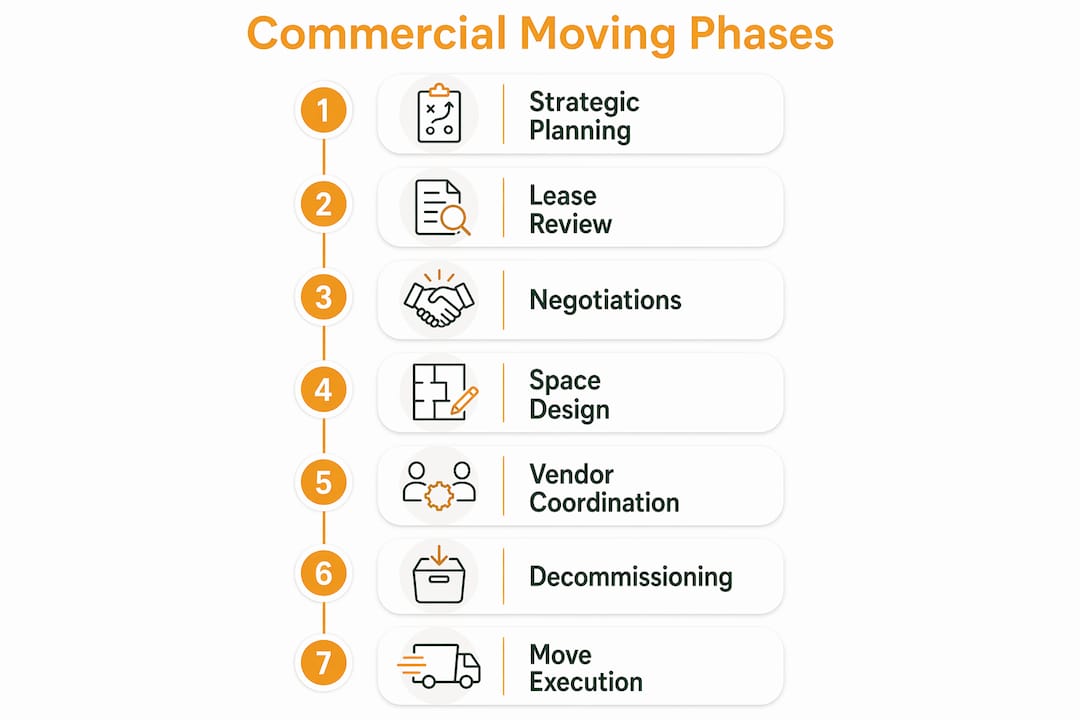
Phase 1: Strategic planning and needs assessment
This phase starts the moment leadership decides to move. The team assesses current headcount, growth projections, lease expiration dates, and budget constraints. The output is a written brief that defines what the new space must deliver.
Phase 2: Lease review and site selection
Legal review of the existing lease is non-negotiable at this stage. Restoration clauses in commercial leases often require tenants to return the space to its original condition, a process that can cost more than the physical move itself and requires 6–12 months of advance notice. Site selection runs in parallel, with facilities managers evaluating candidate properties against the needs brief.
Phase 3: Negotiations and legal considerations
Once a target property is identified, lease negotiation begins. This phase includes tenant improvement allowances, build-out rights, and move-in dates. Legal counsel should review all terms before signing.
Phase 4: Space design and tenant improvements
Custom office construction can take anywhere from 2 to 9 months depending on the complexity of the fit-out. That range alone explains why many large office moves require 12 months or more of total planning time. Permitting, contractor scheduling, and material lead times all affect this phase.
Phase 5: Vendor coordination
This phase covers every external party: commercial movers, IT vendors, furniture suppliers, security installers, and cleaning crews. Each vendor needs a confirmed schedule weeks before move day. Gaps in vendor coordination are the leading cause of last-minute chaos.

Pro Tip: Build a vendor contact sheet with confirmed delivery windows, on-site contacts, and escalation numbers. Share it with every department head two weeks before the move.
Phase 6: Decommissioning and restoration
The old space requires its own project plan. Restoration work, data destruction, furniture disposal, and final inspections all carry deadlines tied to the existing lease end date.
Phase 7: Move execution and post-move stabilization
Move day is the smallest part of the timeline. Post-move stabilization, which includes IT testing, employee orientation, and address updates with vendors and clients, typically takes one to two weeks.
How does office size affect the commercial move timeline?
Office size is the primary variable in any commercial moving schedule. A 10-person team moving to a new suite operates on a completely different timeline than a 200-person company relocating its headquarters. The table below provides a practical framework.
| Office size | Recommended planning time | Key complexity driver |
|---|---|---|
| Under 2,500 sq ft | 10–12 weeks | Minimal fit-out, standard IT |
| 2,500–10,000 sq ft | 3–6 months | Moderate construction, more vendors |
| 10,000–25,000 sq ft | 6–9 months | Significant fit-out, phased IT migration |
| 25,000+ sq ft | 9–18 months | Full construction, multi-department coordination |
Office type adds another layer of complexity. Serviced offices are plug-and-play spaces that a business can occupy within one month. Traditional leases requiring substantial fit-out demand 6–12 months or more. That gap is not arbitrary. It reflects the real time needed for permitting, construction, and systems installation.
Larger spaces also introduce multi-department coordination challenges. IT, HR, operations, and finance all have competing priorities during a move. Without a single project owner and a shared timeline, these departments pull in different directions and create delays.
Pro Tip: Assign one internal move coordinator with authority to make decisions across departments. Committees slow moves down. One accountable person speeds them up.
For businesses on the East Coast, regional permitting timelines and building access restrictions add further complexity. East Coast relocations carry unique logistical variables that can extend any phase of the timeline.
What are the critical timing risks in a commercial moving schedule?
The two most dangerous positions in a commercial move are starting too late and starting too early. Planning less than 12 weeks before a move correlates strongly with cost overruns and operational disruptions. That is not a guideline. It is a pattern observed consistently across commercial relocations of all sizes.
Starting too early carries its own risk. Timelines that stretch beyond what the project requires create planning fatigue. Employee morale drops when uncertainty drags on for months longer than necessary.
“A 12-week planning timeline is the sweet spot for most small to mid-size commercial moves. It is long enough to cover every phase without compressing critical tasks, and short enough to keep the team focused and motivated. Moves planned in under 12 weeks consistently overspend and face operational risks, while moves planned over 12 weeks risk fatigue and morale issues.”
The most time-sensitive single task in any commercial move is IT infrastructure. Ordering internet service 90 days before the move date is the industry standard. Circuit provisioning delays are common, and the new connection must be active and fully tested at least five business days before move day. Missing this window is the leading cause of post-move downtime.
For businesses with significant IT infrastructure, the data center relocation component often dictates the earliest possible start date for the entire project.
Other critical timing risks include:
- Lease restoration deadlines. Decommissioning clauses require early budgeting and contractor scheduling. Missing notice periods can trigger financial penalties.
- Furniture lead times. Custom or ergonomic furniture orders can take 8–16 weeks. Ordering after lease signing is already late for most mid-size offices.
- Permitting delays. Construction permits in dense urban markets can add 4–8 weeks to any fit-out schedule.
- Vendor availability. Reputable commercial movers book out weeks in advance, especially during peak periods in spring and fall.
Pro Tip: Lock in your commercial mover and IT vendor before finalizing the move date. Their availability should inform your schedule, not the other way around.
How to build a customized office relocation timeline
Building a timeline that fits your specific business starts with one question: what is the target move date? Work backward from that date to assign every phase a start and end window.
- Confirm the move date. Anchor it to your lease expiration, build-out completion, or a low-disruption period in your business calendar.
- Map your critical path. Identify the tasks that cannot start until another task finishes. IT provisioning, construction completion, and lease execution are the most common critical-path items.
- Assign ownership. Every task needs one named owner, not a department. Named accountability prevents tasks from falling between teams.
- Set communication checkpoints. Weekly status updates during the final 8 weeks keep all vendors and internal teams aligned. Monthly updates are sufficient in the early phases.
- Build in buffer time. Add two weeks of buffer before move day for construction delays, permit issues, or vendor rescheduling. Moves that plan for zero buffer almost always use it anyway.
A commercial move checklist organized by phase is the most practical tool for maintaining schedule adherence. It gives the move coordinator a single reference point and makes it easy to spot tasks that are falling behind.
IT infrastructure moves deserve their own sub-timeline within the master schedule. The complexity of migrating servers, phone systems, and network infrastructure is routinely underestimated, and it is the phase most likely to push back move day.
What the standard advice gets wrong about commercial move timelines
The 12-week rule is real, but it is not a ceiling. It is a floor for small offices. Facilities managers who treat 12 weeks as the target for a 15,000 sq ft office with a full fit-out are setting themselves up for a compressed, stressful final month.
The bigger misconception is that the timeline is primarily about the physical move. The physical move, the trucks and the boxes, takes one to three days. The timeline is really about everything that has to happen before and after those days. Lease negotiation, construction, IT provisioning, vendor coordination, and decommissioning of the old space collectively represent 95% of the work.
Early IT coordination is the single most undervalued step I see businesses skip. Teams assume the internet will be ready because they ordered it. Circuit provisioning does not work that way. Delays are the norm, not the exception, and a business that cannot connect on day one loses far more than it saved by cutting corners on the timeline.
The other pitfall is treating the commercial moving schedule as a facilities problem rather than a business problem. When the CEO and department heads are not actively engaged in the timeline, critical decisions get delayed. Delayed decisions compress every downstream phase. The move coordinator cannot finalize the floor plan until leadership approves it. The contractor cannot start until the floor plan is done. Every delay compounds.
Adapt the timeline to your business culture. A fast-moving startup can compress some phases that a regulated financial firm cannot. The framework is universal. The specific durations are not.
— Info
How Movecraftmoving supports your commercial relocation timeline
Movecraftmoving connects businesses with vetted carriers and logistics professionals who understand that a commercial move is a business-critical project, not just a logistics task.

Every relocation Movecraftmoving coordinates is built around a transparent, phase-by-phase schedule that keeps vendors accountable and gives facilities managers full visibility. Start with the 2026 vendor coordination checklist to map every vendor touchpoint against your move date. For businesses that need clarity on what a well-managed commercial move actually costs, transparent pricing guidance from licensed movers is available to help you budget with confidence before signing anything.
Key takeaways
A commercial moving timeline is the master schedule that determines whether a business relocation stays on budget and on time, and the minimum viable planning window for any office move is 12 weeks.
| Point | Details |
|---|---|
| Minimum planning window | Small offices need at least 10–12 weeks; larger spaces require 6–18 months. |
| IT is the critical path | Order internet service 90 days out and test it five business days before move day. |
| Lease restoration costs | Decommissioning clauses can exceed the cost of the physical move; plan for them early. |
| Office type changes everything | Serviced offices take one month; traditional leases with fit-out take 6–12 months or more. |
| One owner, one timeline | Assign a single move coordinator with cross-department authority to prevent delays. |
FAQ
What is a commercial moving timeline?
A commercial moving timeline is a structured schedule that organizes every phase of a business relocation, from lease review and space design through move execution and post-move stabilization. It defines task owners, deadlines, and vendor coordination points across the entire project.
How long does a commercial office move take to plan?
Planning duration depends on office size and complexity. Small offices under 2,500 sq ft need 10–12 weeks, while offices over 25,000 sq ft may require 9–18 months of planning.
When should IT infrastructure be ordered for a commercial move?
Internet service should be ordered at least 90 days before the move date, with the connection active and tested no later than five business days before move day.
What happens if a commercial move is planned in less than 12 weeks?
Moves planned in under 12 weeks consistently result in cost overruns and operational disruptions. Compressed timelines leave insufficient time for IT provisioning, vendor coordination, and lease decommissioning.
Do commercial leases affect the move timeline?
Yes. Many commercial leases include restoration clauses requiring tenants to return the space to its original condition, which can take 6–12 months of advance notice and often costs more than the physical move itself.
Recommended
- Commercial Move Vendor Coordination Checklist for 2026 – Move Craft Moving Solutions LLC
- Data Center Relocation Service: What IT Leaders Must Know – Move Craft Moving Solutions LLC
- Transparent Pricing From Licensed Movers: What You Need to Know – Move Craft Moving Solutions LLC
- Residential Move Walkthrough: What Every Renter Must Know – Move Craft Moving Solutions LLC