
Full-service moving is defined as hiring professionals to handle every step of your relocation, from packing and loading to transport and unloading, while partial-service moving means hiring movers for specific tasks only and managing the rest yourself. The choice between these two models is the single most consequential decision you will make when planning a move. Full service vs partial service moving is not simply a cost question. It is a trade-off between your time, physical capacity, and risk tolerance. Full-service costs run 40–60% more than labor-only options, but that gap narrows fast when you factor in your own hours, potential damage, and coordination headaches.
What does full service vs partial service moving actually include?
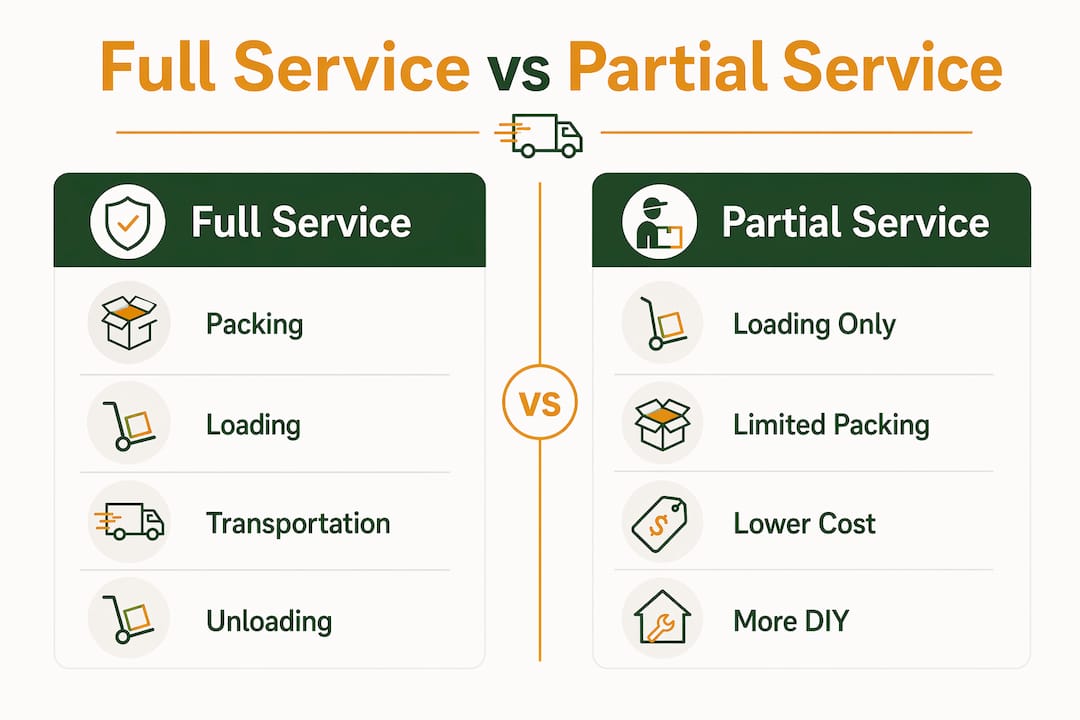
Full-service moving covers every physical and logistical task in your relocation. Professionals pack your belongings using industry-standard materials, load the truck, drive to your new address, unload everything, and place furniture in the rooms you specify. You hand over your keys and show up at the destination.
Partial-service moving, also called limited-service moving in the industry, works differently. You hire labor for selected tasks and handle everything else yourself. Common partial-service arrangements include:
- Labor-only loading and unloading: Movers handle the heavy lifting; you supply or rent the truck.
- Fragile-item packing only: Professionals pack glassware, artwork, and electronics; you box up clothing, books, and linens.
- Partial packing plus transport: Movers pack specific rooms and drive the truck, but you pack the rest.
- Furniture disassembly and reassembly only: Movers handle beds and large pieces; you manage boxes.
The critical distinction is responsibility. In a full-service move, the company owns the process. In a partial-service move, you own the gaps.
Pro Tip: Many people assume labor-only movers will still coordinate building access, elevator reservations, and parking permits. They will not. Those logistics fall entirely on you, and missing them can stall your entire move day.

How much does each option cost?
Cost is where the full vs partial moving services decision gets concrete. A full-service interstate move for a 2–3 bedroom home typically runs $3,500–$8,500, with larger or longer moves reaching $12,000–$16,000. Local full-service crews bill at $108–$200 per hour.
Partial-service and labor-only moves cost significantly less upfront. Partial packing services save $400–$1,200 compared to full-service packing, representing a 20–40% reduction in packing costs alone. That is real money, but it comes with real trade-offs in time and effort.
| Move type | Service scope | Typical cost range |
|---|---|---|
| Full-service local | Packing, loading, transport, unloading | $800–$2,500 |
| Full-service interstate (2–3 BR) | All-inclusive | $3,500–$8,500 |
| Labor-only local | Loading and unloading only | $300–$900 |
| Partial packing + transport | Selected packing, driving | $1,200–$3,500 |
| Full-service large interstate | 4+ BR, long distance | $12,000–$16,000+ |
The table above reflects typical market ranges. Your actual quote depends on distance, volume, access conditions, and timing.
Pro Tip: Get itemized quotes, not flat rates. An itemized quote shows you exactly what you are paying for and makes it easy to compare partial versus full-service pricing on equal terms. Review transparent pricing from licensed movers before signing anything.
What are the pros and cons of each moving type?
Both service types have genuine strengths. The right choice depends on your specific situation, not on which option sounds better in theory.
Full-service moving: advantages
- Time savings: Professionals pack a typical 3-bedroom home in one day. DIY packing often takes a week or more.
- Damage protection: Trained packers use proper materials and techniques. Improperly packed items break at a much higher rate.
- Reduced physical strain: No lifting, carrying, or repeated stair climbs.
- Logistics handled: The moving company manages building access, permits, and scheduling coordination.
- Predictable timeline: Professional crews work efficiently and finish on schedule.
Full-service moving: disadvantages
- Higher upfront cost, often 40–60% more than labor-only alternatives.
- Less direct control over how items are packed and organized.
- Scheduling depends on the company’s availability, not just yours.
Partial-service moving: advantages
- Lower total cost, especially for budget-conscious local moves.
- You control how your belongings are packed and organized.
- Flexibility to mix professional help with your own effort.
Partial-service moving: disadvantages
- Significant personal time and physical effort required.
- Coordination complexity increases, especially for building logistics.
- Incomplete preparation can cause delays and overtime charges, which erase your savings quickly.
- Risk of improper packing leading to damaged items.
80% of households get the best value from full-service or hybrid partial-service moves. That figure reflects the reality that most people underestimate how much time and effort a partial move actually demands.
How do you decide which moving service fits your situation?
The right service type follows directly from four factors: move size, budget, available time, and physical capacity. Work through each one honestly before committing.
-
Assess your move size. A studio apartment with minimal furniture is manageable as a partial-service move. A 4-bedroom home with a full basement is not. Volume and complexity drive the decision more than distance alone.
-
Calculate your real budget. Partial-service saves money on paper, but add up truck rental, packing materials, your hourly rate for time spent, and any overtime charges. The gap between partial and full-service often shrinks to under $500 once you account for these costs.
-
Measure your available time. Professionals earning $25–$50 per hour often find that full-service or hybrid moves cost less than 5–7 days of lost productivity from DIY packing and moving. Time has a dollar value. Count it.
-
Be honest about physical capacity. Moving heavy furniture and boxes is physically demanding work. If you have any physical limitations, or if you are managing a move with young children or elderly family members, partial-service adds real risk of injury or exhaustion.
-
Consider your move complexity. Interstate moves, high-rise buildings, narrow staircases, and specialty items like pianos or artwork all add coordination demands that full-service providers handle routinely.
Pro Tip: When the price difference between your partial and full-service quotes is under $500, full-service is generally the better choice. Marginal savings rarely outweigh the reduced risk and physical relief that full-service provides.
How do you avoid the most common partial-service moving mistakes?
Partial-service moves succeed or fail based on preparation. Most problems are predictable and preventable.
- Clarify task division in writing. Before move day, confirm in writing exactly which tasks the movers will handle and which ones you own. Verbal agreements create confusion and disputes.
- Reserve building access early. Customers often overlook permits, elevator reservations, and parking logistics that full-service providers coordinate automatically. Book these at least two weeks out.
- Finish packing before movers arrive. Movers bill by the hour. If boxes are not ready when they arrive, you pay for their waiting time. Incomplete preparation is the leading cause of overtime charges in partial moves.
- Label every box clearly. Movers loading a truck they did not pack need clear labels to place items correctly. Unlabeled boxes slow everything down.
- Have a backup plan for fragile items. If you are packing non-fragile items yourself, consider hiring professionals for kitchenware, electronics, and artwork even in a partial-service arrangement.
Success in limited-service moves depends on rigorous pre-move planning and clear communication. Treat your partial move like a project with a schedule, a checklist, and defined responsibilities for every person involved.
Pro Tip: Walk through your home two days before the move and photograph every room. This protects you if any damage claims arise and helps you confirm that packing is on track.
Key Takeaways
The most effective moving service choice is the one that matches your actual time, budget, and physical capacity, not the one with the lowest sticker price.
| Point | Details |
|---|---|
| Full-service costs more upfront | Full-service runs 40–60% more than labor-only, but covers all packing, transport, and logistics. |
| Partial-service requires real effort | You manage permits, packing, and coordination, which adds hours and risk to your move. |
| The $500 rule applies | When quotes differ by less than $500, full-service typically delivers better net value. |
| 80% of moves favor full or hybrid | Most households get better outcomes from full-service or hybrid partial-service arrangements. |
| Preparation is the key to partial success | Incomplete packing and unclear task division are the top causes of overtime charges and delays. |
What I have learned from watching people choose the wrong service
Most people who regret their moving service choice made the same mistake. They compared the sticker prices, chose the cheaper option, and did not account for what they were actually signing up to do.
I have seen capable, organized people choose partial-service moves for a 3-bedroom home and spend an entire week packing, only to arrive on move day exhausted and behind schedule. The movers showed up on time. The customer was not ready. Overtime charges ate half the savings.
The uncomfortable truth about partial-service moving is that it is a real job. It requires physical stamina, logistical thinking, and hours you may not have. For a studio apartment or a small local move, it is a smart, cost-effective choice. For anything larger or more complex, the math rarely works out the way people expect.
Full-service moving is not a luxury. For a 3-bedroom interstate move, paying $1,000–$2,000 more to have professionals handle everything is often the most rational financial decision you can make. You protect your belongings, protect your time, and arrive at your new home with energy left to actually settle in.
Choose based on your real situation, not on what sounds disciplined or frugal. The best move is the one that gets your life to the next chapter without unnecessary damage, delays, or regret.
— Info
How Movecraftmoving handles full and partial service moves
Movecraftmoving connects you with vetted carriers and logistics professionals who handle both full-service and partial-service relocations. Every service package is built around your timeline, your budget, and your specific move requirements.

Whether you need a complete hands-off relocation or targeted help with loading and fragile-item packing, Movecraftmoving builds a plan around what you actually need. Pricing is transparent from the first conversation, with no hidden fees or vague estimates. Read the residential move walkthrough to understand what a well-coordinated move looks like from start to finish, or visit Movecraftmoving to request a personalized consultation and get a clear quote for your move.
FAQ
What is full-service moving?
Full-service moving is a complete relocation package where professionals handle packing, loading, transport, unloading, and basic furniture placement. You are not required to lift, pack, or coordinate logistics.
Is partial-service moving worth it?
Partial-service moving is worth it for small local moves where you have the time, physical capacity, and organizational ability to manage packing and logistics yourself. For larger or more complex moves, the savings often disappear once you account for time, materials, and potential overtime charges.
How much does full-service moving cost for a 2-bedroom home?
A full-service interstate move for a 2–3 bedroom home typically costs $3,500–$8,500. Local full-service moves bill at $108–$200 per hour depending on crew size and market.
What does partial packing save compared to full-service packing?
Partial packing services cost 20–40% less than full-service packing and can save $400–$1,200 depending on the volume of items being moved.
When should I choose full-service over partial-service moving?
Choose full-service when your move involves a large home, an interstate distance, specialty items, or a tight timeline. When the price difference between quotes is under $500, full-service is generally the better value due to reduced risk and lower physical demand on you.
Recommended
- Long Distance Moving Insurance Guide for Your Move – Move Craft Moving Solutions LLC
- Why Residential Moves Need Utility Coordination – Move Craft Moving Solutions LLC
- Commercial Move Vendor Coordination Checklist for 2026 – Move Craft Moving Solutions LLC
- Transparent Pricing From Licensed Movers: What You Need to Know – Move Craft Moving Solutions LLC