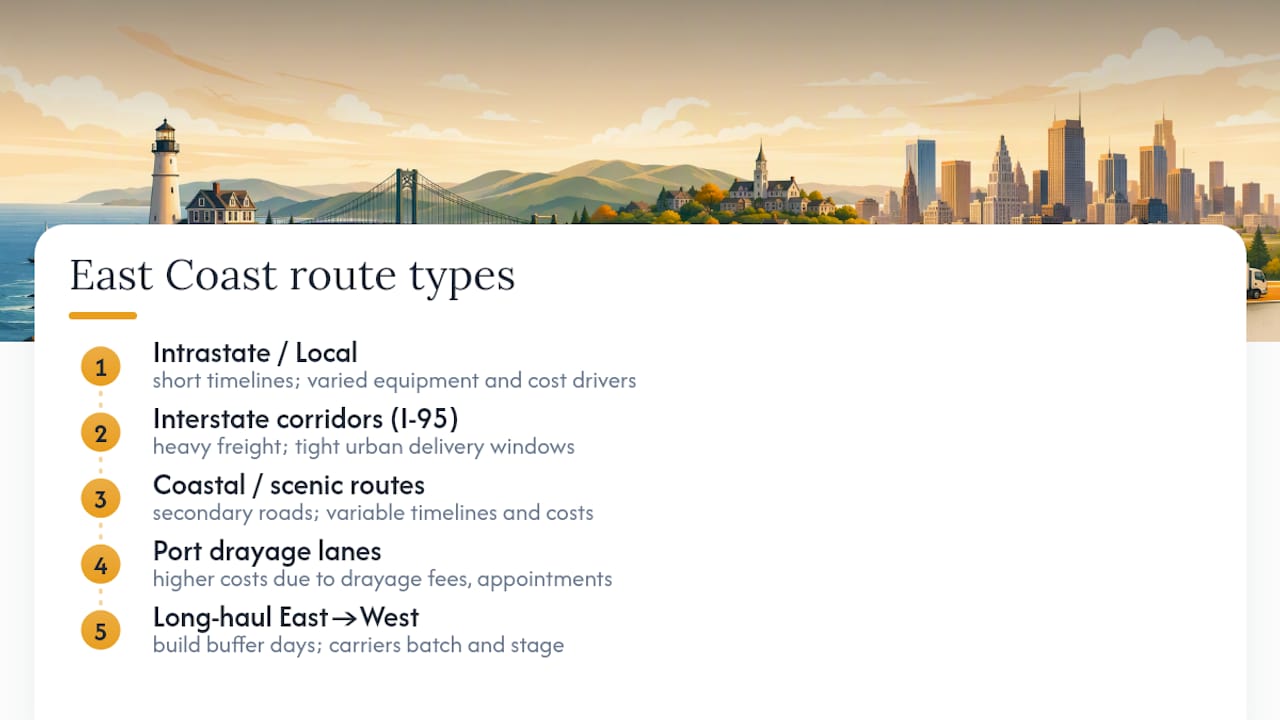
Every East Coast move fits one of five route categories, and the category determines your timeline, equipment, and price more than distance alone does. Intrastate/local routes suit same-city or same-state moves with short-haul rates. Interstate corridor moves (think I-95, I-78) fit relocations between major metro areas and come with tolls and urban delivery windows. Coastal/scenic secondary routes work for smaller markets but add transit days. Port drayage and short-haul distribution lanes apply when goods move through a port complex before final delivery. Long-haul east to west routes are their own animal, requiring carriers built for multi-day transit. Movecraftmoving coordinates all five, matching carriers to the route type your move actually needs.
- Intrastate/local: best for moves under roughly 100 miles within one state.
- Interstate corridor (I-95, I-78): best for metro-to-metro moves with predictable timelines.
- Coastal/scenic secondary: best when your destination sits off the main freight grid.
- Port drayage/short-haul distribution: best when your shipment routes through a port hub.
- Long-haul east to west: best for cross-country relocations needing dedicated capacity.
Key Takeaways
Matching your move to the correct route category, not just comparing price quotes, is what actually prevents delivery delays and cost surprises.
| Point | Details |
|---|---|
| Identify your route category first | Local, interstate corridor, coastal secondary, port drayage, or long-haul each carries different constraints. |
| Corridor congestion drives delays | I-95 and I-78 carry heavy freight volume, so build buffer time into urban delivery windows. |
| Match service model to route | Full-service fits corridor and long-haul moves; LTL and containerized storage fit shorter or staged routes. |
| Ask about drayage and staging | Port-adjacent moves depend on terminal appointments outside any single carrier’s control. |
| Movecraftmoving coordinates by route type | It vets carriers for each corridor and move type, from local drayage to long-haul east to west moves. |
Table of Contents
- Types of East Coast Moving Routes Explained
- Major East Coast Corridors Movers Rely On Most
- Choosing a Move Type for Your Route
- Cost and Planning Factors That Shift by Route
- Planning an East Coast to West Coast Move
- How Movecraftmoving Handles Route-Specific Moving Challenges
- What the Data Actually Tells You to Prioritize
- Frequently Asked Questions
- Sources
Types of East Coast Moving Routes Explained
Route classification isn’t academic. It dictates which truck shows up, how your pickup window gets scheduled, and whether your mover needs a permit for tolls or bridge clearances.
- Intrastate/local moves. These stay inside one state, often inside one metro area. Parking access, elevator reservations, and same-day delivery windows matter more than mileage here. Short-haul rates typically apply, and crews can usually complete pickup and delivery in a single day.
- Interstate corridor moves. Once you cross a state line, you’re in corridor territory, and the classic examples run along I-95 and I-78. These routes bring tolls, weigh stations, and intermodal access points into the equation. Urban delivery windows in cities like Boston or Washington, D.C. often restrict truck size and unloading hours, so your mover needs a plan for that before the truck ever leaves the dock.
- Coastal and scenic secondary routes. Moves to smaller shore towns or inland valleys sometimes run on secondary highways instead of interstates. These routes can add a day or more to transit and sometimes require a different truck configuration if roads have low bridges or tight turns.
- Port drayage and short-haul distribution lanes. If any part of your shipment touches a port complex, drayage schedules and terminal appointment slots start driving your delivery window instead of the carrier’s own calendar.
Pro Tip: Ask your moving coordinator which route category your move falls into before you get a quote. A local move quoted like an interstate corridor move (or vice versa) is one of the most common reasons final invoices don’t match estimates.
Major East Coast Corridors Movers Rely On Most
A handful of corridors carry most East Coast household and commercial freight, and each one has its own personality.
- I-95 is the backbone. It links nearly every major East Coast port and metro area, and it’s widely identified as the primary East Coast consumer-goods corridor, which also means it carries the heaviest congestion, especially through the Baltimore to Philadelphia stretch.
- I-78 connects the Lehigh Valley to the Newark port complex, a lane that shows up constantly in Northeast freight and drayage patterns because so many distribution centers cluster along it.
- I-81, I-84, and I-90 form a regional cluster linking the Mid-Atlantic to New England, generally used for longer regional hauls that skip the I-95 bottleneck entirely.
- Urban segments in New York, Boston, and Washington, D.C. impose their own rules: narrow streets, permit parking, and delivery windows that can shrink to a couple of hours.
Port Newark-Elizabeth alone generates enough freight volume to shape short-haul drayage scheduling for the entire region, which is why a move touching that corridor often runs on the port’s clock, not yours.
Choosing a Move Type for Your Route
Route and service model go hand in hand. Picking the wrong one for your corridor is how timelines slip.
- Full-service moves fit interstate corridor and long-haul routes best. A crew packs, loads, transports, and unloads everything, and pickup-to-delivery windows for interstate moves commonly run several days to two weeks depending on distance and scheduling.
- Partial or LTL (less-than-truckload) moves work well for shorter interstate or coastal secondary routes when you don’t need a dedicated truck. Expect a wider delivery window since your goods share space with other shipments.
- Containerized or portable storage-on-demand suits moves with a gap between move-out and move-in dates, common on port-adjacent or coastal routes where staging matters.
- Drive-yourself vehicle relocation pairs with any route type but demands the most precise inventory and booking details upfront, since there’s no crew double-checking your list at pickup.
Whatever model you pick, book two to four weeks ahead for interstate corridor moves, and longer during peak summer months.
Cost and Planning Factors That Shift by Route
Price tags on East Coast moves swing hardest on a handful of variables, and they vary by which corridor you’re on.
- Tolls and bridge/height restrictions hit I-95 and I-78 moves hardest, especially through New York and Philadelphia.
- Port drayage fees apply if your shipment routes through Newark, Baltimore, or a similar hub, and those charges depend on terminal appointment slots you don’t control.
- Seasonal congestion spikes during summer construction season and the holiday retail rush, both of which can delay time-sensitive corridor loads.
- Delivery window flexibility matters more on coastal secondary routes, where a truck simply can’t compress transit time the way it can on a straight interstate run.
Watch for vague delivery windows on any estimate, missing access notes for your specific street or building, and thin liability language. Ask every carrier three things: what corridor they’re routing your shipment through, what their contingency is for port or toll delays, and what their contract actually covers if something goes wrong in transit.
Pro Tip: Get your access notes (stairs, elevators, parking permits, low bridges near your building) in writing on the estimate itself, not just mentioned in a phone call. It’s the single most common gap between quoted price and final invoice.

Planning an East Coast to West Coast Move
Cross-country moves that start on the East Coast carry an extra layer of complexity most people don’t anticipate: staging. Your shipment often needs to move through a short-haul drayage step before a long-haul carrier ever picks it up, which means dispatch windows matter earlier and more often than on a regional move.
- Build in buffer days around your pickup window. Long-haul carriers batch East Coast origin freight, and a tight window can bump you to the next available slot.
- Keep your inventory precise and complete. Long-haul quotes rely on accurate cubic footage, and a vague inventory invites price disputes at delivery.
- Choose a carrier with genuine long-haul capacity, not just interstate experience. The logistics differ meaningfully once a shipment crosses multiple time zones.
- Flag temperature-sensitive or fragile items separately so they’re not sitting in a staging yard longer than necessary.
How Movecraftmoving Handles Route-Specific Moving Challenges
Route classification only helps if the coordinator behind your move actually acts on it. Movecraftmoving was built around that idea: relocation strategists who treat radical transparency and punctuality as the baseline, not an upsell.
- Every carrier partner gets vetted for integrity, performance, and consistency before they’re matched with a client’s move.
- Matching happens by route type first. Movecraftmoving connects clients with carriers whose lanes and capacity actually fit port drayage, interstate corridor, or long-haul east to west moves.
- Clients get access to route-specific checklists, including guides on interstate paperwork and long-distance process steps, so nothing gets discovered for the first time on moving day.
What the Data Actually Tells You to Prioritize
Most moving advice treats geography as trivia. It isn’t. The corridor your shipment travels determines whether “next Tuesday” delivery is realistic or wishful thinking.
The conventional advice, get three quotes and compare totals, misses the variable that actually predicts problems: route complexity. A move through Port Newark carries schedule fragility that a straight I-81 regional haul never will, because terminal appointments and chassis availability sit outside any single carrier’s control. That’s not a detail buried in fine print. It’s the difference between a delivery window you can plan around and one that shifts by a day with no warning.
If you take one thing from this, prioritize asking your carrier which corridor and which service model apply to your specific move before you compare price at all. A cheaper quote on the wrong route type isn’t a deal. It’s a delay waiting to happen.
Get Route-Matched Moving Help From Movecraftmoving
Figuring out whether your move needs full-service coordination, port drayage handling, or long-haul carrier capacity isn’t something you should have to guess at. Movecraftmoving matches your specific corridor and move type to vetted carriers who already know how to handle it, whether that’s navigating I-95 congestion, coordinating a Newark drayage step, or staging a cross-country haul.

That means fewer surprises on delivery day and a coordinator who already knows what your route requires before the truck shows up. If you’re planning a long-distance move from anywhere on the East Coast, start with the long distance moving process overview to see exactly how Movecraftmoving orchestrates a route-matched move, then request a quote to get carriers matched to your specific corridor.
Frequently Asked Questions
What are the main types of East Coast moving routes?
The main categories are intrastate/local moves, interstate corridor moves (like I-95 or I-78), coastal/scenic secondary routes, port drayage and short-haul distribution lanes, and long-haul east to west moves. Each one carries different timelines, equipment needs, and cost drivers.
Which East Coast route has the most congestion?
I-95 sees the heaviest freight volume of any East Coast corridor, particularly through the Baltimore to Philadelphia stretch, which is why urban delivery windows along that route tend to be tighter.
Do port drayage moves cost more?
They can, mainly because drayage fees and terminal appointment scheduling add steps outside a standard carrier’s control. Ask your mover directly whether any part of your shipment routes through a port complex.
How much extra time should I plan for an East Coast to West Coast move?
Build in buffer days around your pickup window rather than fixing a single date, since long-haul carriers batch East Coast origin freight and staging can shift your dispatch time.
How does Movecraftmoving decide which carrier fits my route?
Movecraftmoving matches carriers by lane and capacity to your specific route type, whether that’s a local move, an interstate corridor haul, or a long-haul cross-country relocation, after vetting each partner for performance and consistency.
Sources
- Northeast Corridor Freight Guide | Truck Dispatch Experts
- Major freight routes in the USA and their most common cargo – Truck Drivers USA
Recommended
- Why East Coast Relocations Are Complex: 2026 Guide – Move Craft Moving Solutions LLC
- East Coast Storage Solutions During Relocation: 2026 Guide – Move Craft Moving Solutions LLC
- Interstate East Coast Moving Paperwork: 2026 Guide – Move Craft Moving Solutions LLC
- Interstate vs Intrastate Moving: What’s the Real Difference? – Move Craft Moving Solutions LLC