
Peak moving season runs roughly from mid-May through Labor Day, with June, July, and August absorbing the heaviest demand nationwide. Moving during this window typically costs 20% to 30% more than off-season rates, and trucks or crews book out weeks in advance. If your dates are flexible, target a shoulder month or the middle of a summer month, and lock in your mover early rather than waiting until the last few weeks.
TL;DR:
- Moving costs during peak season are typically 20% to 30% higher, especially for long-distance moves, with tariffs including specific surcharges for summer weeks.
- Key busy dates are June 30, July 31, and August 1, with weekends and end-of-month periods often booked months in advance, influencing availability and prices.
- Booking two to three months ahead is essential for long-distance moves and specialty items, while local moves can often be scheduled four to eight weeks in advance.
- Weather risks like heat, thunderstorms, and humidity can cause delays or damage, so plan for contingencies and request climate-controlled transport for sensitive items.
- Utility connections and address changes require early scheduling, ideally 2 to 3 weeks before the move, to avoid service gaps during the busy summer period.
Table of Contents
- What Counts as Peak Moving Season, and Why Does It Happen?
- Which Dates Inside Peak Season Actually Hurt the Most?
- How Much More Does Moving Cost During Peak Season?
- Does Peak Season Hit Every Type of Move the Same Way?
- How Far Ahead Should You Book, and What Should You Ask?
- Is Moving During Peak Season Worth It for You?
- What Tactics Actually Lower Your Bill?
- How Movecraftmoving Handles the Peak-Season Crunch
- How Does Weather Affect a Peak-Season Move?
- What Scheduling Mistakes Cost People the Most During Peak Season?
- How Do You Coordinate Utilities and Address Changes During Peak Season?
- Should You Just Pick the Cheapest Month and Call It Done?
- Get Peak-Season Moving Help Without the Guesswork
- Where This Article’s Numbers Come From
- Sources
What Counts as Peak Moving Season, and Why Does It Happen?
Most of the moving industry defines peak season as Memorial Day through Labor Day, roughly May through September. Some mobility datasets widen that window to April through October, since apartment turnover and early homebuying activity start ramping up before Memorial Day.
The crowding isn’t random. It lines up with a handful of overlapping calendars:
- School years end in late May and start in late August, so families move in that gap to avoid pulling kids mid-semester.
- Residential leases overwhelmingly turn over on a monthly cycle, and summer is when most renters choose to break or renew.
- Homebuying activity peaks in spring and summer, pushing closing dates into the same window.
- College move-outs and move-ins, plus a large share of military permanent-change-of-station orders, cluster in May through August.
Which Dates Inside Peak Season Actually Hurt the Most?
Not every day in summer costs the same. Within June, July, and August, the days that spike hardest are the ones tied to lease and closing cycles: June 30, July 31, and August 1 consistently rank among the busiest single moving dates of the year.
- End-of-month dates (the last 2 to 3 days) draw the most demand because leases expire then.
- The first few days of the next month absorb overflow when movers can’t fit everyone into the final days.
- Weekends and Fridays book up faster than Tuesday through Thursday, since crews get more requests for non-work days.
A tight concentration of moves happens in a short window. Industry data on U.S. relocations shows the bulk of annual moving volume clusters into June, July, and August alone, which is exactly why those three months feel so much harder to book than any other stretch of the calendar.
How Much More Does Moving Cost During Peak Season?
The premium isn’t a myth movers use to upsell you. Overall moving costs run 20% to 30% higher during peak months, and some categories move even more sharply.
- Truck rental rates and portable containers can spike substantially during the busiest summer weeks.
- Interstate movers operate under tariff filings that build in a formal peak-season surcharge, which shows up as its own line item on binding estimates rather than getting folded into the base rate.
- Local hourly movers raise rates less dramatically but still charge more for weekend and end-of-month slots.
Cost concentration statistic: the same tariff structure that adds a summer surcharge to long-distance moves is the reason a June binding estimate can run noticeably higher than an identical October move.
When you get quotes during peak months, read the estimate line by line. Look for a labeled peak-season surcharge, confirm whether the quote is binding or nonbinding, and ask what deposit is required to hold the date. A transparent estimate should separate the surcharge from labor and transportation costs, not bury it in a lump sum.
Does Peak Season Hit Every Type of Move the Same Way?
No. How much peak season costs you depends heavily on what kind of move you’re making.
- Local hourly moves see smaller swings, but weekend and end-of-month bookings still carry a noticeable premium over a mid-week, mid-month slot.
- Long-distance moves feel it hardest, since binding estimates carry the formal peak surcharge, lead times stretch longer, and delivery windows narrow because trucks are routed tighter across more stops.
- Specialty items like pianos, antiques, or vehicles depend on small specialist crews that book up fast. Booking those movers 2 to 4 months ahead during summer isn’t overkill. It’s often the only way to get the date you want.
A cross-country move in July with a piano and a car to transport is a fundamentally different booking problem than a studio apartment move across town in July. Plan the lead time for your hardest component, not your easiest one.
How Far Ahead Should You Book, and What Should You Ask?
Booking windows shrink or stretch depending on season and move type. During peak months, long-distance moves need 8 to 12 weeks of lead time, while local moves can often be locked in with 4 to 8 weeks’ notice. Shoulder months (April, May, September, October) need only 2 to 3 weeks, and true off-season bookings can sometimes be arranged with 1 to 2 weeks.
When you’re comparing quotes, ask movers directly:
- Is this a binding or nonbinding estimate, and what happens if the actual weight or volume differs?
- Is there a separate peak-season surcharge, and how is it calculated?
- What are the guaranteed pickup and delivery windows?
- What’s the cancellation and rescheduling policy if your closing date shifts?
If you’re booking late in peak season, widen your acceptable date range by a few days, ask about a waitlist for cancellations, or consider a split-delivery arrangement where your goods travel in stages instead of waiting for one perfect truck slot.
Pro Tip: Call movers on a Tuesday or Wednesday morning. Dispatch teams have more time to talk through surcharges and calendar openings than they do on a Friday afternoon when everyone is scrambling to finalize weekend jobs.
Is Moving During Peak Season Worth It for You?
Peak season isn’t purely a bad deal. It comes with real upside for the right household.
Pros:
- More daylight hours for a long loading day.
- School calendars align cleanly with a summer move.
- Housing inventory tends to be larger in spring and summer, giving buyers and renters more options.
Cons:
- Higher prices across nearly every service tier.
- Greater risk of delayed pickup or delivery windows when trucks are stretched thin.
- Some companies staff up with seasonal or temporary crews to meet demand.
- Specialty movers and storage units are harder to secure on short notice.
Use a quick filter: if kids’ school schedules are your tightest constraint, summer wins even at a premium. If budget is your tightest constraint, shoulder or winter months save real money. If your date is fixed by a lease or closing, plan around whatever the calendar hands you and budget for the surcharge.
What Tactics Actually Lower Your Bill?
Savings stack. Combine a few of these and the discount compounds rather than adding up one at a time.
- Choose an off-season or shoulder month first, since November through February is typically the cheapest stretch of the year.
- Within whatever month you pick, target the 8th through the 22nd and avoid the first and last three days entirely.
- Schedule pickup for Tuesday, Wednesday, or Thursday instead of a weekend or Friday.
- Finish packing boxes yourself and label them by room to cut billable mover hours.
- Compare binding estimates from at least two companies and flag any surcharge line items before signing.
Pro Tip: Even in the dead of winter, the last three days of the month stay pricier than the middle. The mid-month, mid-week combination is the single most reliable way to land in the cheapest bracket, no matter what season you’re in.
A hour-by-hour move day schedule also helps here. Fewer surprises on move day means fewer billable hours, which matters more in peak season than any other time of year.
How Movecraftmoving Handles the Peak-Season Crunch
We recommend working with carrier partners who meet standards for licensing, insurance coverage, and on-time pickup and delivery windows, which matters most when the whole industry is stretched thin in July. This vetting process helps filter out seasonal crews that cause the delays readers worry about most during peak months.
Surcharge disclosure is coordinated up front, so a peak-season tariff line item shows up on your estimate before you commit, not as a surprise on move day. For those boxed into a tight summer date, help with arranging split-delivery logistics can ensure your shipment doesn’t sit waiting for one perfect truck. Starting a moving plan with a relocation checklist and reviewing a long-distance process overview is recommended before requesting quotes.
How Does Weather Affect a Peak-Season Move?
Summer weather cuts both ways. Long daylight hours mean crews can load a truck at 6 a.m. and still finish by early evening, which is a real advantage over a short winter day. But peak season also brings its own weather risks that catch people off guard.
Heat is the biggest one. Loading a truck in 95-degree weather is physically demanding on crews, and it’s hard on your belongings too. Wood furniture can warp, electronics can overheat sitting in a parked truck, and candles, vinyl records, or anything with adhesive can soften or melt during a multi-hour drive. If you’re moving long-distance in July or August, ask your mover whether the truck has any climate control, and pack heat-sensitive items separately so you can transport them yourself if needed.

Summer is also thunderstorm and hurricane season in large parts of the country, particularly the Southeast and Gulf Coast. A storm can delay a driver’s route by a full day, which matters more during peak season because there’s no slack in the schedule to absorb it. Ask your mover about their contingency plan for weather delays, and build a buffer day or two into your own moving timeline rather than scheduling a move-out and move-in on back-to-back days.
Humidity matters too, especially for wood furniture, musical instruments, and paper goods like books or documents. If your move involves any storage time, confirm the facility is climate-controlled rather than a bare metal container sitting in direct sun.
What Scheduling Mistakes Cost People the Most During Peak Season?
The biggest mistake is treating your moving date as flexible until the last minute, then discovering your ideal date is already booked solid. Movers fill their peak-season calendar weeks out, and by the time you call with two weeks’ notice for a July 31 pickup, your options are limited to whoever has a cancellation.
A second common pitfall is assuming a nonbinding estimate is your final price. Nonbinding estimates are based on projected weight, and if your actual load runs heavier, the final bill adjusts upward, often right at delivery when you have the least leverage to negotiate. During peak season, when movers have every incentive to keep trucks full and schedules tight, that gap between estimate and final invoice tends to widen.
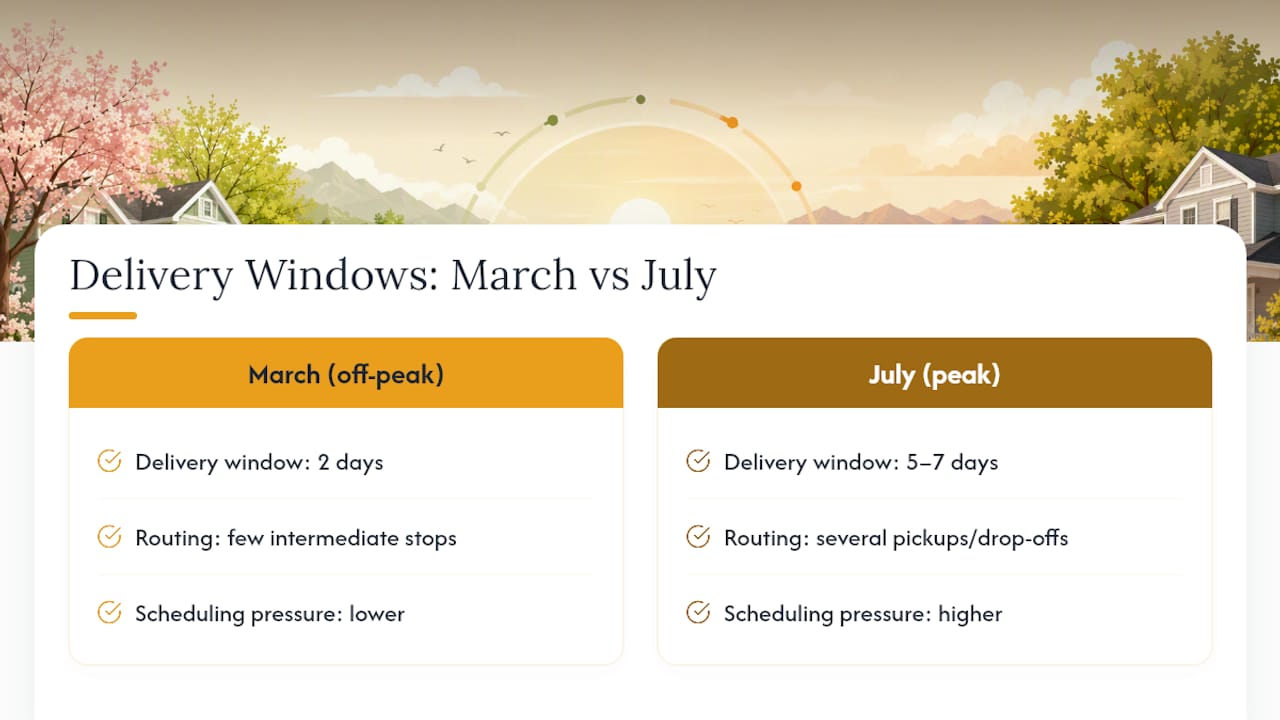
Third, people underestimate how tightly delivery windows get during summer. A long-distance move that would deliver in a 2-day window in March might carry a 5 to 7 day window in July, because the truck is routed through several other pickups and drop-offs along the way. If you need your delivery window narrower than that, say so when you request quotes, not after you’ve already signed.
Finally, watch for the trap of locking in a date that falls on a peak micro-window (the last weekend of the month, for instance) simply because it’s the first available slot a mover offers. Ask about the next few days before and after. A one-or-two-day shift off the exact end-of-month rush can sometimes unlock a lower rate and a wider crew selection.
How Do You Coordinate Utilities and Address Changes During Peak Season?
Utility companies and change-of-address services don’t slow down just because moving companies are overbooked, but peak season adds its own timing pressure. Utility providers, especially in high-turnover rental markets, get flooded with connection and disconnection requests in the same late-May-through-August window that moving companies do. Waiting until the week of your move to schedule a shutoff or hookup risks a multi-day gap with no power, water, or internet.
Call to schedule utility disconnection at your old address and connection at your new one at least 2 to 3 weeks ahead during peak months, longer if you’re moving somewhere with a single regional provider that has less scheduling flexibility. Ask specifically whether they can guarantee same-day connection on your move-in date, since some providers only offer a window rather than a fixed time during their busiest months.
For your change of address, submit your U.S. Postal Service forwarding request online at least 2 weeks before your move date rather than in person at a counter, since peak-season mail volume backs up processing. Update your address with your bank, employer, and any subscription services around the same time. Doing it piecemeal after you’ve already moved means weeks of mail and packages routed to the wrong address during the exact stretch when moving trucks, movers, and everyone else’s schedule is already stretched thin.
Should You Just Pick the Cheapest Month and Call It Done?
Not quite. The smarter move is running the three-question filter first: which constraint is least flexible, your kids’ school calendar, your job start date, or your budget? Pick the season that protects whichever one you can least afford to compromise, then apply the mid-week, mid-month tactics inside that window. If you land in peak season no matter what, book as early as the calendar allows.
— Info
Get Peak-Season Moving Help Without the Guesswork
Using a moving coordinator who provides access to a vetted network of carriers meeting standards for licensing, insurance, and on-time performance offers an advantage during peak season, reducing risk of choosing an unfamiliar company in the busiest weeks.

Moves can be matched to carriers suited to your timeline, with peak-season surcharges disclosed before signing, and assistance with arranging split delivery if your date falls in a tight summer window. Review the full-service relocation benefits for families planning a summer move, work through our relocation checklist to see what needs to happen before moving day, and check the long-distance moving process overview if your move crosses state lines. Request a quote today and get a real answer on availability before your ideal date disappears.
Where This Article’s Numbers Come From
- FreightWaves supplied the peak-season window and the 20% to 30% cost premium figures.
- Mover Scorecard backed the tariff surcharge details and busiest-date patterns.
- MoveBuddha provided booking lead-time recommendations by move type.
- MyMove confirmed mid-week and mid-month pricing advantages.
Sources
- When Is Peak Moving Season? | FreightWaves
- When is the Best Time of Year to Move? | Mover Scorecard
- Peak moving season | MoveBuddha
- What is peak moving season? | MyMove