
The Federal Motor Carrier Safety Administration, operating under U.S. Department of Transportation authority, regulates interstate household goods moves. Every mover and broker crossing state lines needs an active USDOT number registered with FMCSA. Before you sign anything or hand over a deposit, verify that registration, and get the mover’s written estimate, the “Your Rights and Responsibilities When You Move” booklet, and a copy of the bill of lading.
TL;DR:
- All interstate movers and brokers must have an active USDOT number registered with FMCSA, verified before signing any agreements or deposits.
- Interstate moves include shipments passing through multiple states or international territories, even if the truck remains in one city, with exceptions for local metropolitan zones.
- Movers are legally required to provide specific documentation, including a written estimate, rights booklet, tariff, and arbitration summary, before the move begins.
- Using non-binding estimates is riskier, as charges can exceed 110 percent of the initial estimate at delivery, unless a more accurate in-home or video survey has been conducted.
- Complaints should be filed through FMCSA for regulatory violations, while tariff or valuation disputes go to the Surface Transportation Board, with documentation essential for claims.
Table of Contents
- What Legally Counts as an Interstate Move
- Who Regulates Interstate Moving and Where the Rules Come From
- Registrations and Documents Every Mover Must Give You
- Estimates, Pricing Rules, and Liability Coverage
- The Bill of Lading, Tariffs, and How Claims Actually Work
- Verify a Mover Before You Sign Anything
- What Happens If a Mover Breaks the Rules
- How a moving coordination service approaches compliance for clients
- Get a vetted carrier match without doing the legwork yourself
- Sources
What Legally Counts as an Interstate Move
Federal jurisdiction doesn’t hinge on whether the truck itself crosses a state line. Under 49 CFR Part 375, a move counts as interstate when goods travel between two states, or even between two points in the same state if the shipment’s route passes through another state or crosses international territory. A move from Chicago to a Chicago suburb might still trigger federal rules if the carrier routes the truck through Indiana on the way.
Intent and routing matter as much as the map. A shipment sent through another state for warehouse consolidation or carrier network logistics can fall under FMCSA authority for that leg, even if the customer never notices the detour. There’s a carve-out, though: the commercial zone exemption. Moves entirely within a defined metropolitan area, say, a relocation confined to the greater St. Louis commercial zone, can stay classified as intrastate even when the zone technically spans two states. That distinction changes which rules and which agency actually apply to your shipment.
Who Regulates Interstate Moving and Where the Rules Come From
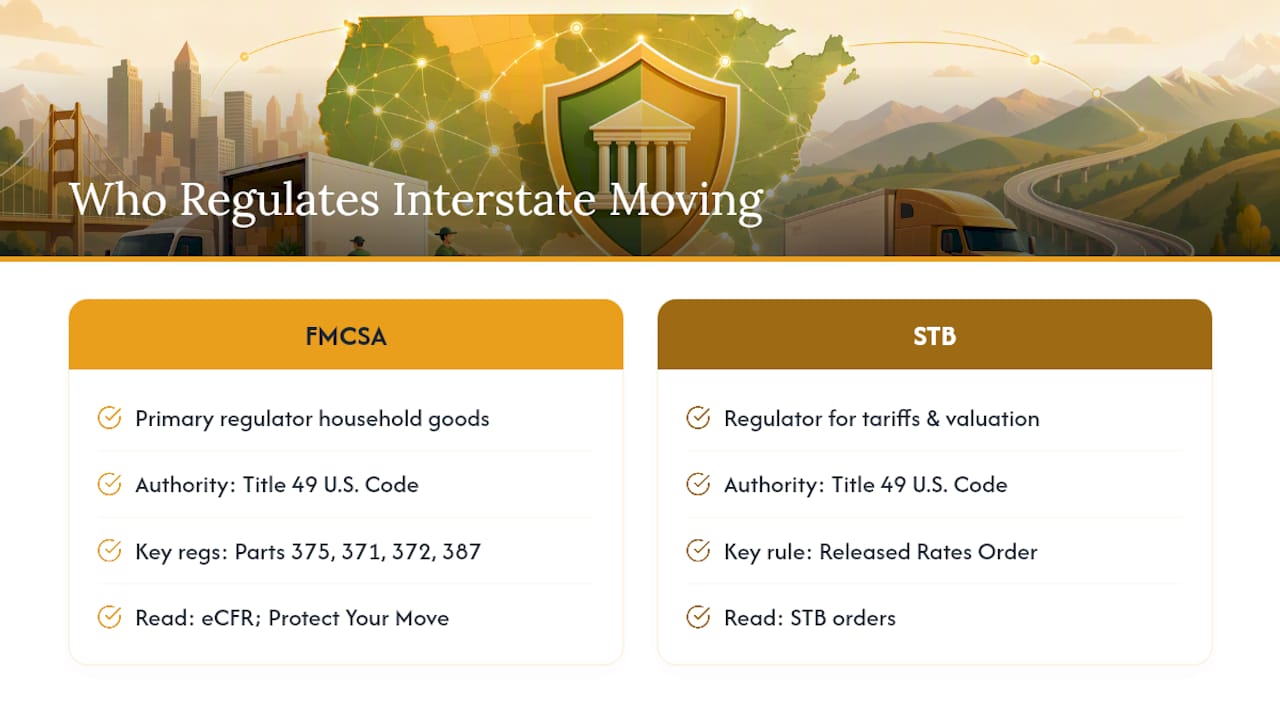
FMCSA is the primary federal regulator for interstate household goods carriers, and its consumer protection framework lives in Part 375. Beyond that single part, FMCSA’s regulatory structure covers broker registration under Part 371, commercial zone exemptions under Part 372, and carrier financial responsibility under Part 387. The Surface Transportation Board handles a narrower but important lane: tariffs and cargo valuation, including the Released Rates Order that sets the legal basis for liability coverage options movers must offer.
Both agencies trace their authority to Title 49 of the U.S. Code, the federal statute governing transportation. If you want to read the actual rule text rather than a paraphrase, the eCFR hosts the current version of Part 375, and FMCSA’s own Protect Your Move hub explains it in plain language. Knowing which agency handles what saves you a wasted complaint call: FMCSA polices carrier conduct and licensing, STB governs tariff and valuation disputes.
Registrations and Documents Every Mover Must Give You
Any company transporting household goods across state lines needs an active USDOT number filed with FMCSA. Confirm that number is live, not just issued, before you commit to a date. FMCSA’s ProtectYourMove.gov lookup tool lets you check registration status in under a minute, and a mover that hesitates to give you that number is telling you something.
Federal rules also require specific paperwork before the move happens, not after:
- The “Your Rights and Responsibilities When You Move” booklet, explaining your legal protections in writing.
- The “Ready to Move” brochure, covering practical prep steps.
- A written estimate for the shipment, delivered before loading begins.
- Access to the carrier’s tariff, the document that governs rates and rules.
- A summary of the arbitration program the carrier participates in, provided before you sign the bill of lading.
These aren’t formalities. The booklet spells out what happens if your goods are damaged; the tariff summary tells you what “extra charges” actually means before you’re staring at a bill. A mover skipping any of these has already violated federal consumer protection rules, which is a useful thing to know before you argue about a price.
Estimates, Pricing Rules, and Liability Coverage
Two kinds of estimates exist, and the difference determines what you owe on delivery day. A binding estimate locks the price; you pay exactly that number regardless of actual weight. A non-binding estimate can shift once the shipment is weighed on certified scales, and federal rules cap what the carrier can demand at delivery at 110% of the original estimate, with the remainder due within 30 days.
Pro Tip: Insist on an accurate in-home or video survey before accepting any estimate. A rushed phone quote is the single biggest source of “surprise” weight charges on delivery day.
Liability coverage is a separate decision from the estimate type. Released value protection, sometimes called the waiver option, caps the carrier’s liability at roughly 60 cents per pound per article, meaning a damaged 40-pound television gets you around $24. Full Value Protection covers current replacement value but costs more and often carries a deductible. Watch for accessorial charges, too: long carries, extra stops, shuttle service, and storage-in-transit all show up as line items on the tariff, and a mover that won’t itemize them in writing is one you should question before, not after, loading day.
- Get every estimate in writing, itemized, not verbal.
- Confirm whether weighing happens before and after loading, and ask to witness it.
- Ask directly which liability option applies by default if you don’t choose one.
The Bill of Lading, Tariffs, and How Claims Actually Work
The bill of lading is the contract. Whatever the salesperson promised verbally counts for nothing if it isn’t written on that document, which the carrier must issue at or before loading. Read it before you sign; once it’s signed, it governs pricing, delivery dates, and liability terms, full stop. The tariff, meanwhile, is the carrier’s published rulebook for rates and service conditions. It sounds bureaucratic, but it’s the reference point for disputing an accessorial charge that seems inflated.
If something goes wrong, here’s the practical sequence:
- Document everything at pickup: inventory sheets, photos of high-value items, and a signed copy of the bill of lading.
- File a written claim with the carrier as soon as damage or loss is discovered, referencing the bill of lading number.
- Track the carrier’s response window; FMCSA’s rules reference a 120-day period for claims processing, so follow up in writing if you hear nothing.
- Escalate to the arbitration program named in your pre-move paperwork if the carrier denies or lowballs the claim.
Keep every document until the claim closes. A missing inventory sheet is the most common reason a legitimate damage claim gets denied.
Verify a Mover Before You Sign Anything
Run the USDOT number through ProtectYourMove.gov and confirm the authority status reads active, not revoked or pending. Ask point-blank whether the company you’re talking to is the actual carrier or a broker reselling the job to someone else; brokers must disclose this, and the distinction affects who’s liable if things go wrong.
Insist on a physical or video survey rather than a square-footage guess over the phone. FMCSA’s own guidance flags a refusal to survey the home as a warning sign, right alongside these red flags:
- No USDOT number listed on the estimate, website, or contract.
- Reluctance or refusal to provide a written estimate.
- Demands for a large cash deposit before the move.
- Vague, verbal-only promises about pricing or delivery windows.
Pro Tip: Before move day, collect and store digital copies of your written estimate, the Rights and Responsibilities booklet, the signed bill of lading, your inventory list, and the carrier’s insurance certificate. If a dispute arises, this folder is your entire case.
What Happens If a Mover Breaks the Rules
File a complaint through FMCSA’s Protect Your Move portal if a carrier skips required documents, misrepresents its authority, or violates estimate rules. Include your bill of lading, written estimate, and any correspondence showing the violation. FMCSA can pursue enforcement action against the carrier’s operating authority, but it does not adjudicate individual disputes or force a refund.
For tariff or valuation disagreements specifically, the Surface Transportation Board is the right venue. For fraud or deceptive practices, your state attorney general’s consumer protection division can act where federal agencies can’t. When a carrier stonewalls a legitimate claim past its arbitration deadline, that’s the point to consult a consumer attorney rather than keep waiting.
How a moving coordination service approaches compliance for clients
Moving coordination services can check USDOT and FMCSA registration status on carriers before matching them to clients, along with active insurance coverage. Carriers may be required to provide the Rights and Responsibilities booklet, a written estimate, and a clear arbitration summary before any bill of lading is signed. For a checklist to run these checks yourself, see the relocation checklist.
— Info
Get a vetted carrier match without doing the legwork yourself
Checking USDOT numbers, comparing tariffs, and chasing down arbitration summaries takes hours most people moving across state lines don’t have. Some services handle vetting before you talk to a carrier, matching you with movers who already meet FMCSA’s documentation requirements instead of leaving you to verify each one solo.

Carriers are often checked for active USDOT registration and insurance before clients get quotes, and written estimates, the Rights and Responsibilities booklet, and arbitration disclosures may be required during initial conversations. For moves with tight timelines, coordination needs, or to minimize disruption during the transition, see the relocation planning guide for what a well-coordinated move looks like. You can start by requesting a quote to be matched with a vetted carrier for your route.
Sources
- What is an interstate move? | FMCSA Protect Your Move
- Your Rights and Responsibilities When You Move (FMCSA booklet) | 2022 update
- Protect Your Move | FMCSA
- Surface Transportation Board Released Rates Order (household goods moving)