
Released value protection pays you $0.60 per pound, per item, no matter what that item is actually worth. Full value protection requires your mover to repair the item, replace it, or pay its current cash value instead. If you own anything worth more than a few dollars per pound, which is nearly everything in a typical household, full value protection is the safer choice. Released value only makes sense for near-worthless loads, like a garage full of old furniture headed to the dump.
Before you sign anything, walk through your home and build a rough inventory of what’s going on the truck, then ask your mover to put the valuation terms in writing on your estimate and bill of lading. That single document determines what you’ll actually get paid if a moving truck tips over or your antique dresser cracks in transit.
Key Takeaways
Full value protection pays repair, replacement, or cash value for your belongings, while released value protection pays a flat $0.60 per pound regardless of an item’s actual worth.
| Point | Details |
|---|---|
| Know the payout formula | Released value pays $0.60 per pound per article; full value protection pays repair, replacement, or cash value. |
| Watch light, expensive items | Electronics, jewelry, and art suffer the worst under released value’s per-pound math. |
| Get terms in writing | Federal rules require your valuation choice to be signed on the bill of lading before the move. |
| Check for exclusions | Self-packed boxes and undeclared high-value items are commonly excluded from full value claims. |
| Document before you move | Build inventory, photos, and video proof to support a claim under either coverage type. |
| Work with a coordinated mover | Movecraftmoving connects you with carriers that disclose valuation terms clearly and assist with inventory documentation. |
Table of Contents
- What Is the Difference Between Released Value and Full Protection?
- What Is Released Value Protection and How Does It Pay Out?
- What Does Full Value Protection Actually Cover?
- Released Value vs. Full Value: Side-by-Side Comparison
- How Much Does Full Value Protection Cost?
- How Do You Choose the Right Coverage for Your Move?
- How Does the Claims Process Actually Work?
- When Should You Buy Third-Party Moving Insurance?
- A Moving Coordinator’s Take on Picking the Right Coverage
- Get Help Choosing and Documenting the Right Coverage
- Sources
What Is the Difference Between Released Value and Full Protection?
Moving valuation is not insurance. It’s a contractual liability limit built into your contract with the carrier, and federal law requires interstate movers to offer you exactly two versions of it: released value protection and full value protection, according to the FMCSA. Your mover has to explain both options and get your signature on the bill of lading confirming which one you picked.
That distinction between valuation and insurance trips up a lot of people. Valuation is what the moving company itself is on the hook for if it damages or loses your stuff. Insurance is a policy you buy separately from a licensed insurer, and it can cover things your mover’s valuation won’t touch at all, including items you packed yourself. Homeowners and renters policies sometimes offer limited coverage for items in transit, but many exclude moving damage entirely or cap payouts well below replacement cost, so don’t assume your existing policy has you covered.
Here’s the number that matters: if you don’t actively sign a waiver electing released value, federal rules require full value protection to apply by default. Movers who skip that signature, or bury it in vague paperwork, are cutting corners on a consumer protection built specifically to stop you from ending up with coverage you never agreed to.
What Is Released Value Protection and How Does It Pay Out?
Released value protection caps what a mover owes you at $0.60 per pound, per article, and it’s the option built into your quote at no additional charge, according to 49 CFR Part 375. It sounds reasonable until you do the math on anything electronic.
Take a 50 inch television that weighs 25 pounds and cost $800 new. If it gets smashed in the truck, released value pays you $15. A laptop weighing 4 pounds, worth $1,200, nets you $2.40. This is not a rounding error in the formula. It’s the entire point of released value protection: it exists to limit the carrier’s liability, not to make you whole, according to Moving Support.
Released value protection isn’t worthless for every scenario, though. Consider the tradeoffs:
- No extra cost. It’s the default option baked into your moving estimate, so there’s nothing to budget for upfront.
- Fine for low-value, heavy loads. Old furniture, bulk storage bins, or items you were planning to replace anyway suffer little real loss under this formula.
- Terrible for light, expensive items. Anything dense in value but light in weight, electronics, jewelry, art, cameras, gets crushed by the per-pound math.
- No claim paperwork battle, but no real payout either. Settlements are fast because there’s nothing to negotiate. $0.60 per pound is $0.60 per pound.
Pro Tip: Before you pick released value to save money, weigh your electronics and divide their replacement cost by the pounds. If the answer is anywhere north of a dollar or two per pound, you’re not saving money, you’re gambling it.
What Does Full Value Protection Actually Cover?
Full value protection obligates your mover to repair the damaged item, replace it with a comparable one, or pay you a cash settlement equal to its current market value, per the FMCSA’s consumer brochure. That’s a fundamentally different promise than released value’s flat per-pound formula.
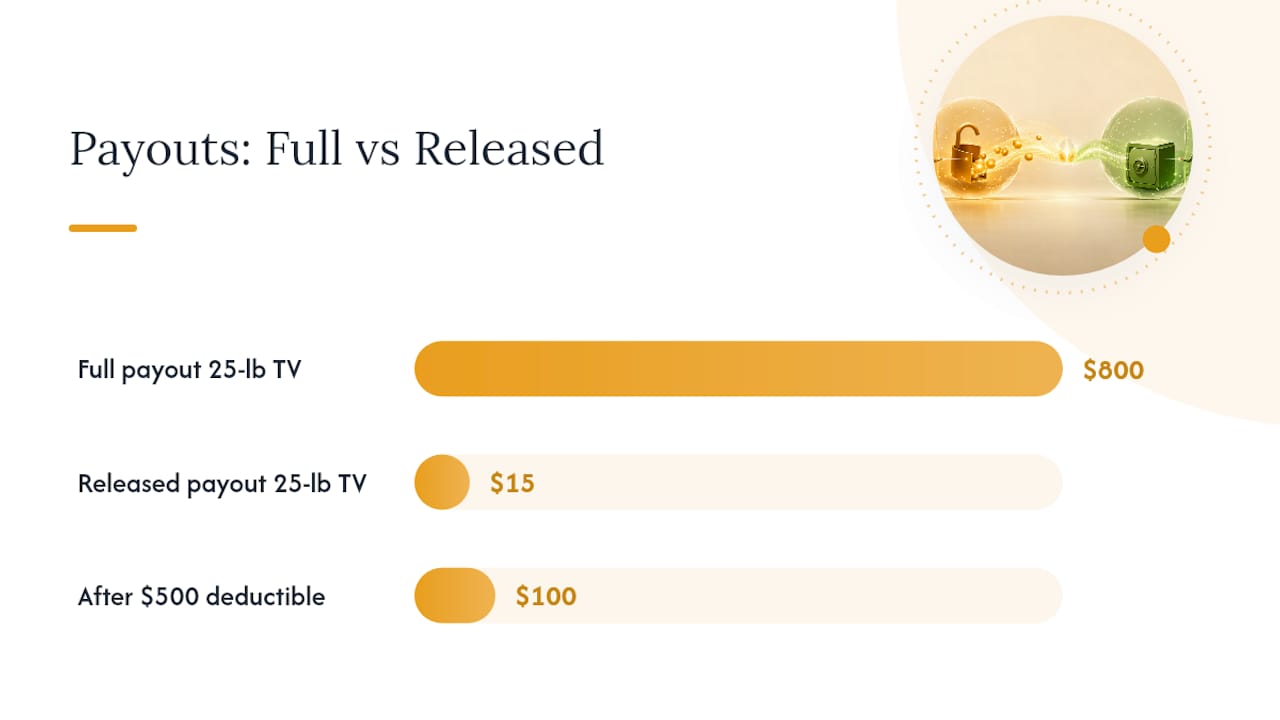
Go back to that 25 pound television worth $800. Under full value protection, a total loss gets you a check for something close to $800, not $15. The gap isn’t marginal, it’s the difference between an inconvenience and a real financial hit. Movers typically charge a premium for this protection based on your total declared shipment value, and you’ll usually get to pick a deductible that trades a lower premium for a bit more out-of-pocket risk on a claim.
Full value protection comes with real strings attached, and they catch people off guard more often than the coverage itself does:
- Self-packed boxes are frequently excluded. If you packed it yourself instead of the movers, many carriers won’t cover damage to the contents unless the box itself shows visible exterior damage, according to Moving Support.
- High-value items need special declaration. Anything unusually valuable for its weight, jewelry, fine art, rare collectibles, generally has to be listed in writing before the move or it may not be fully covered.
- Deductibles reduce your payout. A $500 deductible on a $600 claim leaves you with $100, even under full coverage.
- Depreciation can apply to older items. Cash settlements are often based on current value, not what you originally paid, so a ten-year-old couch won’t fetch its original price tag.
Ask your mover for the exact declared value figure they’re using, what deductible options exist, and get the written tariff, the document spelling out these terms, before moving day. If your movers are also doing the packing, our guide on long distance packing service benefits explains why that choice protects your full value coverage in ways self-packing simply can’t.
Released Value vs. Full Value: Side-by-Side Comparison
| Factor | Released Value Protection | Full Value Protection |
|---|---|---|
| What it pays | $0.60 per pound, per article | Repair, replacement, or current cash value |
| Typical cost to customer | Included at no extra charge | Premium based on declared value, weight, or a flat rate |
| Best fit | Low-value, heavy, replaceable items | Electronics, furniture, anything with real replacement cost |
| Claim outcome | Small fixed cash payout | Repair, replacement item, or a market-value check |
| Common limits/exclusions | No exceptions, formula is fixed regardless of item value | Self-packed boxes, undeclared high-value items, deductibles |
| Who is responsible | Carrier liability limited by federal formula | Carrier liability tied to declared shipment value |
Three quick calculations make the gap concrete:
- A 60 pound antique vase worth $2,000: released value pays $36. Full value protection, assuming no deductible, pays close to full market value, potentially the full $2,000 minus any deductible.
- A 15 pound laptop worth $1,500: released value pays $9. Full value protection covers repair or replacement, likely $1,000 to $1,500 depending on depreciation.
- A 200 pound sofa worth $600: released value pays $120, full value protection pays closer to $600. This is the rare case where released value isn’t catastrophically low, because the item is heavy relative to its value.
The verdict is consistent across all three: the lighter and more valuable an item is relative to its weight, the worse released value performs, and the more full value protection matters. Heavy, low-value items are the only place released value comes close to reasonable.
How Much Does Full Value Protection Cost?
Full value protection premiums typically run as a percentage of your declared shipment value, often somewhere around 1% to 2%, though some carriers price it as a flat fee or a weight-based charge instead, according to Moving Support. Your deductible choice moves that number up or down.
A few factors shape what you’ll actually pay:
- Declared shipment value. Higher declared value means a higher premium, but also a higher payout ceiling if something goes wrong.
- Deductible level. Options like $0, $250, or $500 deductibles trade premium cost against your out-of-pocket exposure on a claim.
- Carrier pricing model. Some movers price by percentage of value, others by weight tier, so get quotes in writing to compare apples to apples.
- Regional replacement costs. Prices for repairs and replacement goods vary meaningfully across the country. The Bureau of Economic Analysis tracks regional price parities showing that states like California, Hawaii, and New Jersey run well above the national average, which pushes real replacement costs higher in those markets even when your declared value looks generous on paper.
Run the break-even math yourself. Say you declare $50,000 in shipment value and pay a 1.5% premium, that’s $750. If you’d otherwise face a claim of $2,000 on a damaged dining set with no coverage, or worse, a $15 released value payout on an $800 television, the premium pays for itself the moment a single meaningful claim happens. For most households moving furniture, electronics, and anything sentimental, that math favors full value protection more often than not.
How Do You Choose the Right Coverage for Your Move?
Start with three questions: what’s your shipment actually worth, do you own anything disproportionately valuable for its weight, and are you letting the movers pack or doing it yourself? Those three answers point you toward the right option faster than any generic rule of thumb.
If your total shipment value is modest and everything is heavy, durable, or already headed for donation, released value can be defensible. If you own electronics, art, jewelry, or furniture you’d actually miss, full value protection is the one that protects your wallet.
When you’re on the phone with a mover, ask these questions directly:
- What declared value are you using to calculate my full value protection premium?
- What deductible options do you offer, and how does each affect my premium?
- What’s your process for declaring high-value items separately, and is there a cutoff weight or value threshold?
- Will you provide the valuation terms in writing on my estimate before moving day?
- Are self-packed boxes excluded from full value protection under your tariff?
Watch for red flags that suggest a mover is cutting corners on disclosure. Rushed paperwork at the last minute, a bill of lading with vague or missing valuation language, reluctance to quote a written full value protection rate, or pressure to sign before you’ve had time to read the terms all point toward a carrier you should reconsider. Our guide on avoiding long distance moving scams covers more of these warning signs in detail. If you’re weighing whether to let the mover pack everything, full service versus partial service moving breaks down how that choice interacts with your coverage.
How Does the Claims Process Actually Work?
Claims under released value protection tend to move fast, mostly because there’s nothing to argue about. You report the damage, the mover applies the $0.60 per pound formula, and you get a check. Full value protection claims involve more steps: an inspection, sometimes an adjuster, and a settlement negotiation over repair versus replacement versus cash.
Documentation is what separates a smooth claim from a drawn out fight, regardless of which coverage you picked. Build this before moving day, not after:
- Create a full inventory listing every item going on the truck, room by room.
- Photograph everything, especially electronics, furniture, and anything fragile, from multiple angles.
- Keep purchase receipts or bank statements showing what you paid, especially for big-ticket items.
- Note existing condition, including scratches, dents, or wear that predates the move, so you’re not blamed for old damage.
- Record video during loading and unloading, walking through each room as items go on and off the truck.
- File your claim promptly, ideally within days of noticing damage, and follow up in writing if you don’t hear back within the timeframe stated in your contract.
For your inventory, capture at minimum: item description, approximate weight, purchase date, purchase price, and serial number for electronics. That last field matters more than people expect, insurers and movers alike often ask for it to confirm identity on a replacement claim.
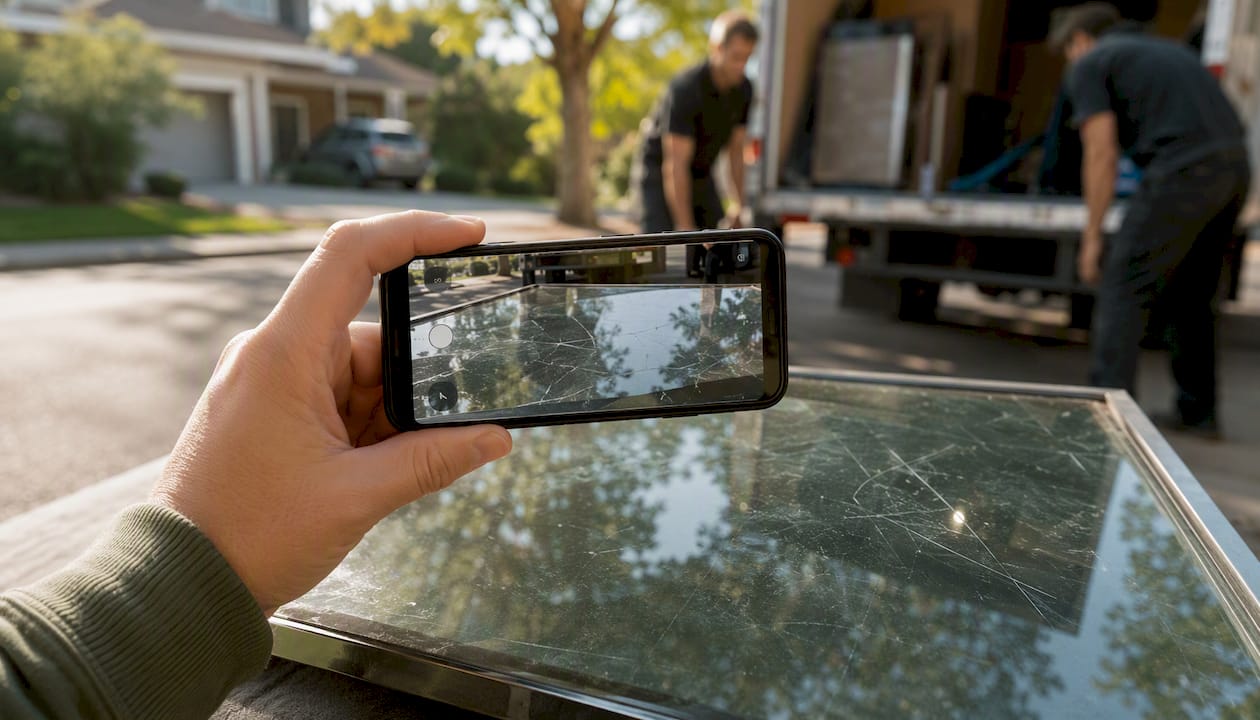
Pro Tip: Record continuous video during loading and unloading, and make sure your phone’s timestamp is visible or turned on. A dated video showing your flat screen going onto the truck without a crack, and coming off with one, settles disputes faster than any written inventory ever will.
The FMCSA’s Rights and Responsibilities booklet spells out your formal rights during this process, including timelines movers must follow when acknowledging and resolving a claim. Keep a copy of your written estimate and bill of lading on hand. You’ll reference both if a dispute drags on. For a structured starting point, our long distance moving inventory checklist walks through exactly what to log before the truck arrives.
When Should You Buy Third-Party Moving Insurance?
Carrier valuation, released value or full value protection, is a contractual liability limit, not an insurance policy. If you need true insurance protections, replacement cost coverage, broader coverage for self-packed boxes, or protection against acts of God like floods and fires, you buy that separately from a licensed insurance company, according to the FMCSA.
Third-party insurance tends to make sense in a few specific situations: when you’re packing your own boxes and want coverage the mover’s tariff excludes, when you own fine art, jewelry, or collectibles worth more than a standard full value protection declaration comfortably covers, or when you want protection against catastrophic events that carrier valuation typically doesn’t address at all.
Before buying a policy, verify the coverage limits match your actual shipment value, read the exclusions closely (some policies exclude the same self-packed items carrier valuation does), confirm the deductible, and ask how claims get filed and how long settlements typically take. Our long distance moving insurance guide walks through how to evaluate a policy against your specific move.
A Moving Coordinator’s Take on Picking the Right Coverage
I’ve watched a lot of people pick released value protection because it’s free, then call two weeks later asking why their $1,000 television only earned them a $15 check. It’s never malice on the mover’s part, it’s usually just a signature nobody explained clearly enough at the kitchen table during a stressful, rushed estimate appointment.
My honest advice: don’t let coverage selection be the last five minutes of a long conversation about moving dates and truck sizes. Ask about valuation first, before you’ve mentally checked out of the paperwork. Confirm in writing which option applies to your shipment, get the declared value figure in ink, and don’t assume “full protection” on a verbal quote means anything until it’s on the bill of lading. A mover who wants your business will walk you through this without hesitation.
Get Help Choosing and Documenting the Right Coverage
Picking between released value and full value protection is only half the battle. The other half is making sure your declared value, your inventory, and your high-value item list are accurate enough that a claim actually pays out if something goes wrong. That’s where a coordinated move, rather than a rushed one, pays off.

Movecraftmoving connects you with vetted carriers who disclose valuation terms clearly and in writing, before you ever sign a bill of lading. Our coordination process includes inventory assistance so your high-value items get properly declared, guidance on tariff terms so you’re not guessing at deductibles, and support if you ever need to file a claim. If you’re moving a full household, our guide on full-service relocation benefits shows how professional packing keeps more of your belongings eligible for full value coverage in the first place. Request a written quote today and get valuation terms clarified before moving day, not after.
Sources
- Liability & protection | FMCSA
- 49 CFR Part 375 — Household goods and other property; transportation by household goods carriers; publication of tariffs and rates
- Regional Price Parities (RPPs) — BEA
Recommended
- Moving Companies Full Valuation Coverage Options Explained – Move Craft Moving Solutions LLC
- Full-Service Relocation Benefits for Families in 2026 – Move Craft Moving Solutions LLC
- Long Distance Moving Insurance Guide for Your Move – Move Craft Moving Solutions LLC
- Transparent Pricing From Licensed Movers: What You Need to Know – Move Craft Moving Solutions LLC