
A business relocation strategy is a structured plan that aligns a company’s operational, financial, and workforce goals with the physical act of moving to a new location. It goes well beyond booking movers and signing a new lease. The plan covers everything from site selection and budget forecasting to employee communication, regulatory compliance, and post-move stabilization. Done right, it turns a potentially disruptive event into a deliberate business decision that supports long-term growth.
The core components of a solid relocation plan include:
- Clear business case: A defined reason for moving, whether cost reduction, market access, talent availability, or infrastructure upgrades
- Financial planning: A full budget covering lease termination, construction, IT setup, moving services, and potential downtime
- Stakeholder coordination: Early involvement from HR, IT, Finance, and operations leadership
- Employee communication: A transparent, ongoing plan that keeps staff informed and engaged throughout the transition
- Regulatory compliance: Licensing, permits, tax registration, and foreign qualification filings for any new state
- Timeline and milestones: A sequenced schedule with assigned responsibilities and built-in buffer time
- Post-move evaluation: A structured review of costs, employee feedback, and operational performance after the move
Companies that treat relocation as a strategic business transformation rather than a logistics project consistently achieve better outcomes across cost, retention, and productivity.
What factors should you evaluate before relocating a business?
The decision to relocate deserves the same rigor as any major capital investment. Rushing past the evaluation phase is where most costly mistakes originate.

Financial and tax considerations
The budget for a business move must account for more than rent. Comprehensive budgeting includes lease termination penalties, construction and renovation costs, furniture, IT infrastructure, moving services, and the revenue impact of any operational downtime. Underestimating these line items is the most common reason relocations run over budget.
Tax environment is another lever worth pulling. Nine U.S. states levy no state income tax: Alaska, Florida, Nevada, New Hampshire, South Dakota, Tennessee, Texas, Washington, and Wyoming. For businesses with significant payroll or owner distributions, relocating to one of these states can produce meaningful annual savings.
Workforce and talent
- Talent pool: Does the new market have the skilled workers your business needs? A city with a strong university pipeline or a specialized industry cluster matters more than low rent if you can’t hire.
- Employee retention risk: Moving too far from where your current team lives will cost you people. Survey staff early and be honest about who will and won’t make the transition.
- Relocation support: Offering relocation packages or remote-work options for key employees reduces attrition during the move.
Market and customer access
Proximity to your primary customers, key suppliers, and distribution networks directly affects operating costs and service quality. A location that looks cheap on paper can get expensive fast if it adds two days to your shipping cycle or puts you an hour from your top accounts.
Infrastructure and real estate
- Facility fit: Square footage, ceiling height, loading docks, and parking all need to match your operational requirements before you sign anything.
- IT and telecom: Fiber availability, data center proximity, and backup power capacity are non-negotiable for most businesses. These have long lead times.
- Workspace design: Floor plan flexibility affects collaboration, productivity, and the ability to grow into the space.
Quality of life
Talent recruitment does not stop at salary. Employees weigh commute times, school quality, housing costs, and walkability when deciding whether to follow a company or accept a new offer. A location that scores well on quality-of-life metrics gives you a recruiting advantage that compounds over time.
How to plan a business relocation step by step
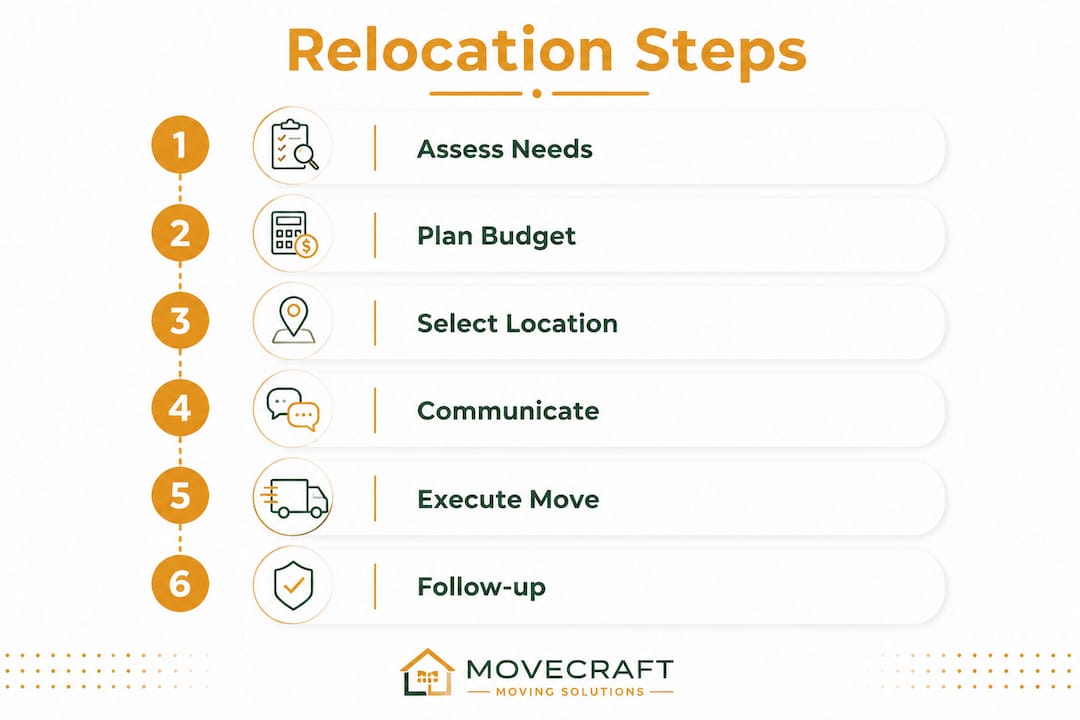
The office relocation planning checklist most businesses need covers five distinct stages, each with its own deliverables and decision points. Start earlier than you think you need to. Smaller offices with one to five employees typically need two to three months of lead time; larger moves with specialized equipment or interstate logistics often require four to six months.
Stage 1: Define the business case and assemble your team
- Clarify the reason for moving. Growth, cost reduction, market access, or infrastructure upgrade? The answer shapes every decision that follows.
- Assemble a cross-functional leadership team. Include HR, IT, Finance, and operations from day one. Engaging key departments early reduces friction and keeps operations uninterrupted throughout the process.
- Assign a move manager. One person needs to own the overall timeline and serve as the single point of accountability.
Stage 2: Build the budget and timeline
- Create a full-cost budget. Account for lease termination, construction, furniture, IT, moving services, and a contingency reserve for downtime.
- Build a sequenced timeline with milestones. Assign each task to a named owner and set realistic deadlines. Renovations and IT infrastructure consistently take longer than planned.
- Decide on a staggered or single-move approach. Maintaining both locations briefly while moving assets in phases can protect workflow continuity, especially for manufacturing or retail operations.
Pro Tip: Build at least 20% buffer into your timeline. Businesses routinely underestimate how disruptive the transition period is, and some moves take weeks or months before operations fully stabilize.
Stage 3: Site selection and vendor engagement
- Research and evaluate locations. Weigh labor markets, economic incentives, real estate options, customer access, and quality of life. Visit shortlisted sites with employees before committing.
- Negotiate the lease or purchase agreement. Bring a commercial real estate attorney. The lease terms you accept now will constrain your flexibility for years.
- Engage vendors early. Movers, IT contractors, furniture suppliers, and signage vendors all need lead time. Locking them in late is a common source of delays.
- Confirm compliance requirements. Permits, safety codes, and accessibility standards must be resolved before construction begins, not after.
Stage 4: Communication and risk management
- Launch your employee communication plan. Transparent communication, including clear timelines and transition support, reduces attrition during moves. Hold in-person meetings, not just email updates.
- Conduct a risk assessment. Identify operational, compliance, and talent-retention risks. Assign mitigation steps and owners for each.
- Handle regulatory filings. If you are moving to a new state, file for foreign qualification by submitting a Certificate of Authority. Many businesses assume existing registrations carry over. They do not.
Stage 5: Move execution and post-move follow-up
- Coordinate move day at both ends. Assign point leaders at the old and new facilities. Secure sensitive equipment, update access credentials, and provide employee orientation on day one.
- Build up inventory before the move. Extra stock on hand protects against supply disruptions during the transition window.
- Close out old contracts. Resolve the prior lease, utilities, and vendor obligations promptly to avoid carrying unnecessary costs.
- Run a post-move punch list. Fix technology hiccups, installation issues, and layout problems quickly. Monitor employee feedback and adjust workflows as needed.
- Reconcile the budget. Compare projected versus actual costs. The gap, whatever it is, informs your planning accuracy for any future move.
For detailed guidance on managing the sequencing and timing of your move, the commercial moving timeline resource from Movecraftmoving covers the critical scheduling decisions most businesses get wrong.
Strategic alignment and common pitfalls in business relocation
The biggest mistake businesses make is treating relocation as a purely logistical event. Moving trucks, floor plans, and IT cables are the visible part. The real work is organizational, and it starts months before a single box gets packed.
Why strategic alignment matters from day one
Companies that coordinate their talent and business strategies retain more top performers and see higher employee performance than those that do not. That gap does not appear because of better moving trucks. It appears because aligned organizations make the relocation part of a broader story about where the business is going, and employees buy into that story.

The practical implication: HR, IT, Finance, and operations leadership need to be in the room during the planning phase, not brought in to execute decisions already made. Each department carries risks the others cannot see. IT knows the infrastructure lead times. HR knows which employees are flight risks. Finance knows which cost assumptions are unrealistic.
Common pitfalls to avoid
- Starting too late. Waiting until space constraints become a crisis leaves no room for thoughtful site selection or employee engagement.
- Underestimating compliance. Operating in a new state without foreign qualification exposes the business to penalties and tax liability. This is a filing requirement, not a formality.
- Treating communication as an afterthought. Employees who hear about a relocation through rumors, or who receive vague updates, start updating their resumes. The institutional knowledge they carry walks out with them.
- Ignoring post-move stabilization. The first four to six weeks after a move are when productivity dips, IT problems surface, and employee frustration peaks. A dedicated help desk and a clear process for reporting workspace issues can contain the damage.
- Skipping the financial reconciliation. Comparing actual costs to the original budget is not just accounting hygiene. It reveals which assumptions were wrong and prevents the same overruns from happening again.
What good communication actually looks like
Transparent communication during a business relocation means sharing timelines, transition support options, and the reasoning behind the move in in-person meetings, not just email blasts. Employees who understand why the move is happening and what support they will receive are far more likely to stay through the transition and perform well on the other side of it.
The businesses that handle relocation well treat it as a change management project with a moving component, not a moving project with some HR paperwork attached. That reframe changes which decisions get made first, who gets involved, and how the outcome looks six months after move day.
For a deeper look at managing employee communication during relocation, Movecraftmoving has published practical guidance on keeping staff informed and engaged from announcement through post-move stabilization.
For complex moves involving multiple sites or specialized logistics, the multi-site logistics guide covers the coordination decisions that tend to break down under pressure.
Ready to plan your business move?

Movecraftmoving works with business owners and operations teams to plan and execute commercial relocations that stay on schedule, on budget, and on strategy. From vendor coordination to long-distance logistics, the team at Movecraftmoving brings the same standard of transparency and precision to every move.
Start with the long-distance moving process overview to understand what a well-managed business relocation actually looks like from start to finish.
Key Takeaways
A business relocation strategy succeeds when operational, financial, and workforce planning are aligned from the earliest stage of the process, not bolted on after site selection is complete.
| Point | Details |
|---|---|
| Define the business case first | Clarify whether you are moving for cost, talent, market access, or infrastructure before evaluating any sites. |
| Budget for the full cost | Include lease termination, construction, IT, moving services, and downtime, not just rent. |
| Align HR, IT, and Finance early | Engaging key departments from day one reduces friction and keeps operations uninterrupted. |
| Communication drives retention | Transparent timelines and in-person updates reduce attrition; companies that coordinate talent and business strategies retain 30% more top performers. |
| Post-move stabilization is part of the plan | A dedicated help desk and structured feedback process in the first weeks after the move protect productivity. |
Recommended
- Data Center Relocation Service: What IT Leaders Must Know – Move Craft Moving Solutions LLC
- Commercial Move Vendor Coordination Checklist for 2026 – Move Craft Moving Solutions LLC
- The Role of Employee Communication During Relocation – Move Craft Moving Solutions LLC
- Commercial Moving Timeline: What Businesses Need to Know – Move Craft Moving Solutions LLC