Employee communication during relocation is defined as the structured exchange of timely, accurate information between HR teams and relocating staff to reduce uncertainty and maintain workforce engagement throughout a move. The role of employee communication during relocation goes far beyond logistics updates. Relocating employees typically require 15–30 hours of support and ask 25–50 questions per move. Managing that volume well generates up to 6,600 hours of annual operational efficiency across an HR department. The industry term for this discipline is relocation communication management, and in 2026, it centers on three pillars: personalization, timing, and channel alignment.
What is the role of employee communication during relocation?
Effective relocation communication management reduces anxiety, prevents operational errors, and keeps employees productive during one of the most disruptive events in a career. Clear, timely communication reduces employee anxiety, prevents delays, and improves employer brand reputation. That last point matters more than most HR leaders expect. Employees who feel informed during a relocation are far more likely to speak positively about their employer during and after the process.

The impact of staff communication in relocation also shows up in hard numbers. When HR teams fail to manage the 25–50 questions a relocating employee generates, those questions pile up into reactive support demands. Reactive support is slower, more expensive, and more error-prone than proactive communication. The difference between a smooth relocation and a chaotic one often comes down to whether HR answered the right question before the employee had to ask it.
What are the main communication challenges HR faces during employee relocations?
HR professionals managing relocations face a specific set of obstacles that generic internal communication plans do not address.
- Information overload: Employees receive policy documents, vendor contacts, housing checklists, and tax guidance all at once. The volume alone causes paralysis, not clarity.
- Channel mismatch: A senior executive may prefer formal email briefings. A Gen Z hire may expect instant messaging updates. Sending the same format to both groups reduces engagement for both.
- Multi-vendor coordination: A single relocation typically involves a moving company, a temporary housing provider, an immigration attorney, and an HR platform. Each vendor communicates differently, and employees absorb the inconsistency as confusion.
- Time zone complexity: International relocations add scheduling friction. A check-in call that works for Chicago may be 11:00 PM in the destination city.
- Over-communication risk: Flooding employees with updates is as damaging as silence. Over-communicating overwhelms relocating employees; best practice is precise, timely information rather than high volume.
Pro Tip: Build a single communication hub, such as a shared portal or dedicated Slack channel, where all relocation updates live. Employees should never have to search across five inboxes to find their move date.
The coordination problem compounds when HR teams use multiple platforms that do not share data. An employee who updates their new address in the HRIS should not have to repeat that update to the relocation vendor. Every duplicate data entry is a potential error and a signal to the employee that the process is disorganized.
How can HR structure a communication strategy across the relocation timeline?
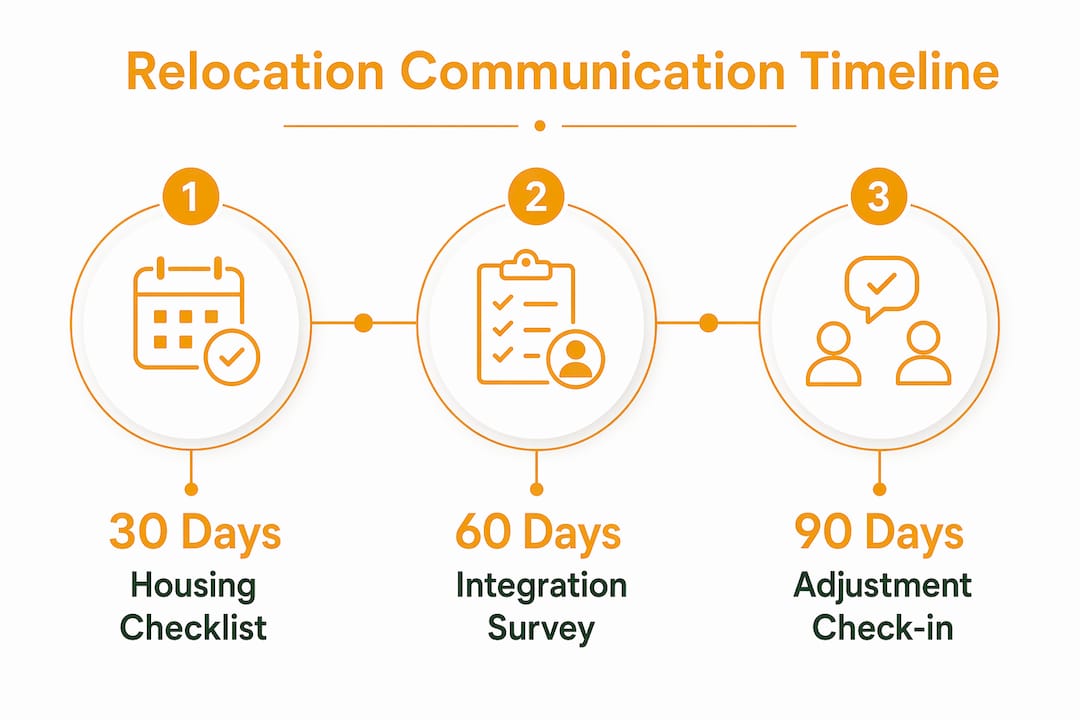
The most effective framework for employee relocation communication is the 30-60-90 day post-move model. It divides communication into three phases, each targeting a different employee need.
- Days 1–30: Logistics and settling in. Focus on housing confirmation, utility setup, unboxing timelines, and local service contacts. Employees at this stage need answers, not inspiration. Keep messages short, specific, and task-oriented.
- Days 31–60: Social integration. Shift focus to community connection. Share information about local professional networks, neighborhood resources, and team social events. Employees who feel socially isolated at the 60-day mark are at elevated resignation risk.
- Days 61–90: Career and emotional well-being. Address career trajectory, performance expectations in the new location, and personal adjustment. This is the stage where partner career concerns and family stress surface most visibly.
Structured post-move check-ins at 30, 60, and 90 days guide employees from logistics to social and emotional adjustment. Each check-in should be a two-way conversation, not a status report. HR teams that treat the 90-day check-in as a feedback loop rather than a formality catch retention risks before they become resignations.
| Phase | Primary focus | Communication format |
|---|---|---|
| 30 days | Housing, logistics, unboxing | Task checklists, FAQ documents |
| 60 days | Social integration, community | Event invites, local resource guides |
| 90 days | Career satisfaction, well-being | One-on-one check-in, survey |
Pro Tip: Pair each check-in with a short three-question survey. Ask what is working, what is unclear, and what the employee needs next. The answers will tell you more than any status update.
A commercial moving timeline built around these phases gives HR teams a concrete schedule to follow rather than a vague commitment to “stay in touch.”
What are best practices for using technology in relocation communication?
Technology does not replace human empathy in relocation communication. It handles volume so that humans can focus on the conversations that matter.
- AI-driven chatbots answer the 25–50 routine questions per relocation instantly, at any hour, in multiple languages. That frees HR coordinators to handle the complex, emotionally charged conversations that require judgment.
- HRIS and relocation platform integration eliminates duplicate data entry. API integration between HRIS and relocation platforms eliminates delays and improves the accuracy of every communication that follows. When systems share data automatically, employees receive consistent information regardless of which team member they contact.
- Automatic meeting summarization ensures that employees who miss a briefing receive an accurate record. This is especially valuable for international relocations where time zone conflicts make live attendance difficult.
- Channel personalization is the single most underused tactic in relocation communication management. The Golden Rule of mobility communication is to communicate the way your employee prefers. High-level executives and Gen Z employees require systematically different channel strategies.
“The goal is not to communicate more. The goal is to communicate better. Right information, right person, right time, right channel. Everything else is noise.”
Multi-channel communication with clear points of contact improves both coordination and employee satisfaction. Designating a single named HR contact for each relocating employee removes the ambiguity of “who do I call?” That one structural decision reduces inbound support volume significantly.
Balancing automation with human connection requires deliberate design. Automate the routine: status updates, document reminders, FAQ responses. Reserve human contact for the moments that carry emotional weight, such as the first week in a new city or the 90-day career conversation.
How does effective communication affect retention, morale, and business outcomes?
The business case for investing in relocation communication is direct. Poor communication during a relocation does not just frustrate employees. It generates measurable costs.
| Communication quality | Employee outcome | Business outcome |
|---|---|---|
| Proactive, personalized | Lower anxiety, higher focus | Fewer last-minute issues, lower HR workload |
| Reactive, inconsistent | Elevated stress, disengagement | Higher support demand, resignation risk |
Addressing partner careers and family concerns first before discussing relocation perks establishes trust and increases acceptance rates. This finding challenges the instinct to lead with benefits. Employees who feel their personal concerns are heard are more likely to commit to the move and to the employer.
The employer brand effect is real and lasting. Employees who experience a well-managed relocation become internal advocates. They describe the process to colleagues, mention it in reviews, and reference it when recommending the company to candidates. A 30-60-90 day communication strategy that addresses logistics, social integration, and emotional well-being improves retention at each stage. Retention at the 90-day mark is the clearest signal that the relocation succeeded.
HR productivity also improves when communication is proactive. Teams that answer questions before they are asked spend less time in reactive mode. That time shifts to higher-value work: policy development, talent planning, and the human conversations that technology cannot replicate.
Key Takeaways
Effective employee relocation communication requires a structured timeline, channel personalization, and the right balance of automation and human contact to protect both employee well-being and business outcomes.
| Point | Details |
|---|---|
| Start with personal concerns | Address partner careers and family stress before presenting relocation perks to build trust. |
| Use the 30-60-90 framework | Structure post-move check-ins around logistics, social integration, and emotional well-being. |
| Match channels to employees | Personalize communication format for executives versus early-career employees to improve engagement. |
| Automate routine, humanize critical | Use AI tools for FAQ responses and updates; reserve human contact for high-stakes conversations. |
| Measure and adjust | Collect feedback at each check-in stage and use it to refine the communication plan in real time. |
What most HR teams get wrong about relocation communication
The most common mistake I see is treating relocation communication as a logistics checklist rather than a relationship-building process. HR teams send the housing confirmation, the moving date, and the benefits summary, then wonder why employees still feel lost at week six.
The research is clear: listening to personal stressors first builds the trust that makes every subsequent communication land better. A relocating employee whose spouse just turned down a job offer to support the move does not want to hear about the relocation bonus first. They want to know that HR sees the full picture of what this move costs them personally.
The technology conversation also gets distorted. I have watched organizations spend months selecting AI platforms and zero time training coordinators on when not to use them. Automation is a force multiplier for good communication habits. It amplifies bad ones just as efficiently. The teams that get the most value from AI tools are the ones that have already defined what a good human conversation looks like.
My honest recommendation: before you build a communication technology stack, write out the 10 most important conversations your HR team needs to have with a relocating employee. Then decide which of those conversations a chatbot should handle and which ones require a person. The answer will surprise you. Most of the high-value conversations are the ones that happen at 60 and 90 days, long after the logistics are settled and the real adjustment begins.
— Info
How Movecraftmoving supports HR teams through complex relocations
HR teams managing multiple employee relocations simultaneously need more than a moving company. They need a logistics partner who communicates with the same standards they hold themselves to.
Movecraftmoving works with corporate HR teams to coordinate carrier scheduling, vendor communication, and move timelines with the transparency that keeps employees informed and operations on track. Every relocation is assigned a dedicated coordinator who serves as the single point of contact your employees can actually reach. For teams managing complex multi-location moves or coordinating across vendors, Movecraftmoving provides the operational backbone that makes your communication strategy work in practice. Visit Movecraftmoving to discuss a relocation plan built around your team’s timeline and communication standards.
FAQ
What is the role of employee communication during relocation?
Employee communication during relocation reduces uncertainty, prevents operational errors, and maintains workforce engagement by delivering timely, accurate information at each stage of the move. It is the primary factor separating smooth relocations from costly, disruptive ones.
How many questions does a relocating employee typically ask?
Relocating employees ask 25–50 questions and require 15–30 hours of support per move. Managing this volume proactively generates up to 6,600 hours of annual operational efficiency for HR teams.
What is the 30-60-90 day relocation communication model?
The 30-60-90 day model structures post-move communication around three phases: logistics and housing in the first 30 days, social integration at 60 days, and career satisfaction and emotional well-being at 90 days.
How does technology improve relocation communication?
AI-driven chatbots handle routine questions instantly in multiple languages, while HRIS and relocation platform integration eliminates duplicate data entry and keeps all communications accurate and consistent.
Why does over-communication hurt relocating employees?
Sending too many updates creates information overload, which increases stress rather than reducing it. Best practice is precise, timely communication targeted to the employee’s current stage in the relocation process.
Recommended
- Data Center Relocation Service: What IT Leaders Must Know – Move Craft Moving Solutions LLC
- Commercial Move Vendor Coordination Checklist for 2026 – Move Craft Moving Solutions LLC
- Why East Coast Relocations Are Complex: 2026 Guide – Move Craft Moving Solutions LLC
- Residential Move Walkthrough: What Every Renter Must Know – Move Craft Moving Solutions LLC