You don’t always need a moving truck permit in Boston, but a one-day permit that reserves two parking spaces from 7 a.m. to 5 p.m. is usually the fastest way to avoid delays and fines. A non-metered permit costs $69, while a metered version costs about $109. Skipping it works fine on a quiet suburban street; it’s a gamble almost anywhere near downtown, Back Bay, or a triple-decker block in Dorchester.
TL;DR:
- Applying online between 15 days and 8 weeks out ensures timely approval, while in-person applications are necessary within 3 to 14 days before moving day.
- Permits only cover two adjacent spaces for one day and cost $69 non-metered or $109 if metered, excluding additional towing or cleanup fees.
- The permit does not apply on state-controlled roads, seasonal restrictions in the North End, or areas like Storrow Drive with height limits; routing checks are essential.
- Coordinating signage, route planning, and permit timing is vital, as delays or miscommunications often cause move-day issues despite having a valid permit.
Table of Contents
- Who Needs a Moving Truck Parking Permit in Boston
- What a Boston Moving Permit Actually Costs
- How to Apply for a Boston Moving Truck Permit
- Where Boston Moving Permits Don’t Apply
- Posting Signs and Handling Move-Day Enforcement
- Containers, PODS, and Multi-Day Permits
- The Move Craft Checklist for a Smooth Permit Process
- Boston Moving Permit Contacts and Resources
- Getting the Timing Right Matters More Than the Permit Itself
- Sources
Who Needs a Moving Truck Parking Permit in Boston
Not every move requires a city permit. A personal car parked briefly outside your building doesn’t need one. Once you’re bringing in a box truck, a rental like a 26-footer, or a moving container that will sit on the street for hours, the calculus changes fast.
The City of Boston recommends a permit any time you’re moving in a dense neighborhood, on a narrow street, or during a commercial relocation where a truck might block a lane for most of a workday. Here’s why that recommendation is worth taking seriously:
- Without a reserved spot, you’re competing with residents for street parking, and losing that fight mid-move stalls everything.
- A permit gives you legal standing if a parking enforcement officer questions why a truck is idling in a travel lane.
- Neighbors are far more forgiving of a truck blocking their driveway when a printed permit and a heads-up flier explain it’s temporary.
- Commercial movers, in particular, avoid liability disputes over blocked loading zones or fire lanes when the permit clearly marks the reserved space.
Office managers coordinating a multi-vendor move should treat the permit as one line item in a larger vendor coordination checklist rather than an afterthought.
What a Boston Moving Permit Actually Costs
The city’s fee structure is simple, but it trips people up because the “two-space” detail matters more than most movers realize. A standard permit covers two adjacent parking spaces, since trucks typically need loading room on both sides.
- Non-metered permit (two spaces, one day): $69
- Metered permit (two spaces, one day): $109, reflecting the cost to cover meter revenue
- Permits include two printed signs for posting at the reserved spots
- Multi-day permits can run up to five consecutive days, but the city requires a 48-hour public parking break before you can reserve the same spot again
That $69 to $109 range, confirmed by Boston’s Parking Clerk office, covers the permit itself, not towing, cleanup, or damage. Payment is accepted by major credit or debit card online, or cash in person at City Hall. Budget a little extra time if you’re paying in person during a busy week, since the physical permit still needs to be mailed to you afterward.
How to Apply for a Boston Moving Truck Permit
Your application path depends entirely on how much lead time you have. Boston splits the process into two tracks, and picking the wrong one can cost you your moving date.
- Apply online if your move is 15 days to 8 weeks out. The online moving truck portal is the faster, more reliable route, and it’s the only option once you’re inside that window on the early end.
- Apply in person if your move is 3 to 14 days away. Head to the Parking Clerk’s office at Boston City Hall, Windows 4 and 5, during regular business hours. Bring your move date, the exact address where you need the space reserved, and whether the spot is metered or non-metered.
- Fill out the required details accurately. The application asks for the specific block, the date, and space count, so double-check your address against the city’s street records before submitting; errors here are the top cause of permit delays.
- Wait for mail delivery. Approved permits are typically mailed within 7 to 10 business days. If your move is close and nothing has arrived, contact the Parking Clerk at least three days before moving day.
- Request a replacement if the permit doesn’t show up. Call the Parking Clerk’s office directly rather than waiting, since a missing permit on move day leaves you with no legal claim to the space.
Pro Tip: If your move date is uncertain, apply online as early as the 8-week window allows. Adjusting a confirmed date later is far easier than scrambling for a last-minute in-person appointment.
Where Boston Moving Permits Don’t Apply
The city’s permit system has real gaps, and they catch people off guard almost every summer. Boston cannot issue permits for state-owned roads, which means the Parking Clerk’s authority stops at certain borders.
- Sections of Boylston Street, Charlesgate, Fenway, the Arborway, and Jamaicaway fall under state control, not the city. You’ll need to contact the DCR (Department of Conservation and Recreation) directly for those stretches.
- The North End has a seasonal restriction: moves between July 1 and August 31 require advance permission from the Boston Transportation Department, separate from the standard permit process.
- Outdoor dining blocks can eliminate available curb space in some neighborhoods during the warmer months, so check current public notices before assuming a spot is open.
- Storrow Drive carries a 10-foot height clearance limit that has stranded more than one rental truck. This isn’t a permit issue at all. It’s a routing issue, and no permit will save you from a truck wedged under an overpass. Map your route before move day, not the morning of.
Posting Signs and Handling Move-Day Enforcement
Your permit only works if people can see it. Boston requires signs to go up at least 48 hours before your move, though posting three days ahead gives you a safety margin if weather or vandalism takes one down early.
- The city provides two signs with your permit. It’s smart to photocopy fliers for cars parked within a half-block of your reserved spot.
- If your spot is metered, note that on your fliers. Metered spaces attract more turnover traffic, so drivers need a clear, visible reason not to pull in.
- If someone still parks in your reserved space on move day, call Boston Police through the non-emergency line rather than trying to handle it yourself. The permit authorizes the city to have the vehicle removed. It does not give you the right to tow anyone privately.
Pro Tip: Take a timestamped photo of your posted signs the moment they go up. If enforcement gets called over a dispute, that photo is your proof the notice period was met.
Containers, PODS, and Multi-Day Permits
Standard moving trucks aren’t the only vehicles that need street space, and the rules shift once a shipping container enters the picture.
- Storage containers generally require an in-person application, along with a letter of authorization from the container company confirming the drop-off and pickup dates.
- PODS moves specifically require coordination with a Permit Puller, a separate process from the standard city portal, since the container sits on the street far longer than a same-day truck.
- Consecutive-day permits can run up to five days in a row, but the city enforces a 48-hour public parking break afterward before you can reserve that same block again. Plan around that gap if your move stretches longer than a work week.
The Move Craft Checklist for a Smooth Permit Process
A permit is only as useful as the plan around it. Here’s the sequence that keeps most Boston moves from hitting a wall:
- 8 weeks out: Confirm your move date is firm, then submit the online application the moment you’re inside the 15-day-minimum window.
- 10 days before move day: Check your mail for the physical permit. If it hasn’t arrived, call the Parking Clerk immediately rather than waiting for the deadline.
- 3 days before move day: Post your signs, copy fliers for neighboring cars, and confirm your truck’s height clears any route that touches Storrow Drive or similar restricted stretches.
- 1 day before move day: Print or gather a permit folder: the physical permit, your neighbor fliers, and the mover’s DOT and insurance paperwork, in case a building manager or officer asks for it on site.
- Move day: Arrive early enough to claim the space before street cleaning or morning traffic complicates things.
Pro Tip: If you’re flying in from out of town and can’t post signs yourself 48 hours ahead, hire a local sign-poster or ask your moving coordinator to handle it. A missed posting window is one of the most avoidable reasons permits fail on move day.
For larger commercial relocations, a move-day, hour-by-hour planner helps keep the permit timeline synced with vendor arrivals, elevator reservations, and building access windows. Coordinating all of that manually is exactly where a relocation strategist earns their fee, catching conflicts between your permit block and a building’s loading dock schedule before they become a stalled truck.
Boston Moving Permit Contacts and Resources
Reach the Parking Clerk’s office at 617-635-2560 or movingtrucks@boston.gov for application questions, or visit Windows 4 and 5 at City Hall in person. Apply through the online moving truck portal, and review the city’s moving permit FAQs before submitting. Check the Street Occupancy database for conflicts, like scheduled construction or events, before locking in your date.
If you need printed signage that holds up to weather and stays legible from across the street, Caymil Printing’s guide to temporary parking permit examples is a useful reference for formatting fliers that neighbors and enforcement can actually read.
Getting the Timing Right Matters More Than the Permit Itself
The permit paperwork isn’t the hard part of moving in Boston. The timing is. Most of the horror stories that circulate about moving day disasters trace back to a permit that arrived late, not a permit that was denied. Boston’s process is genuinely straightforward once you understand the two application tracks, but the eight-week window on one end and the three-day minimum on the other leave almost no room for procrastination.
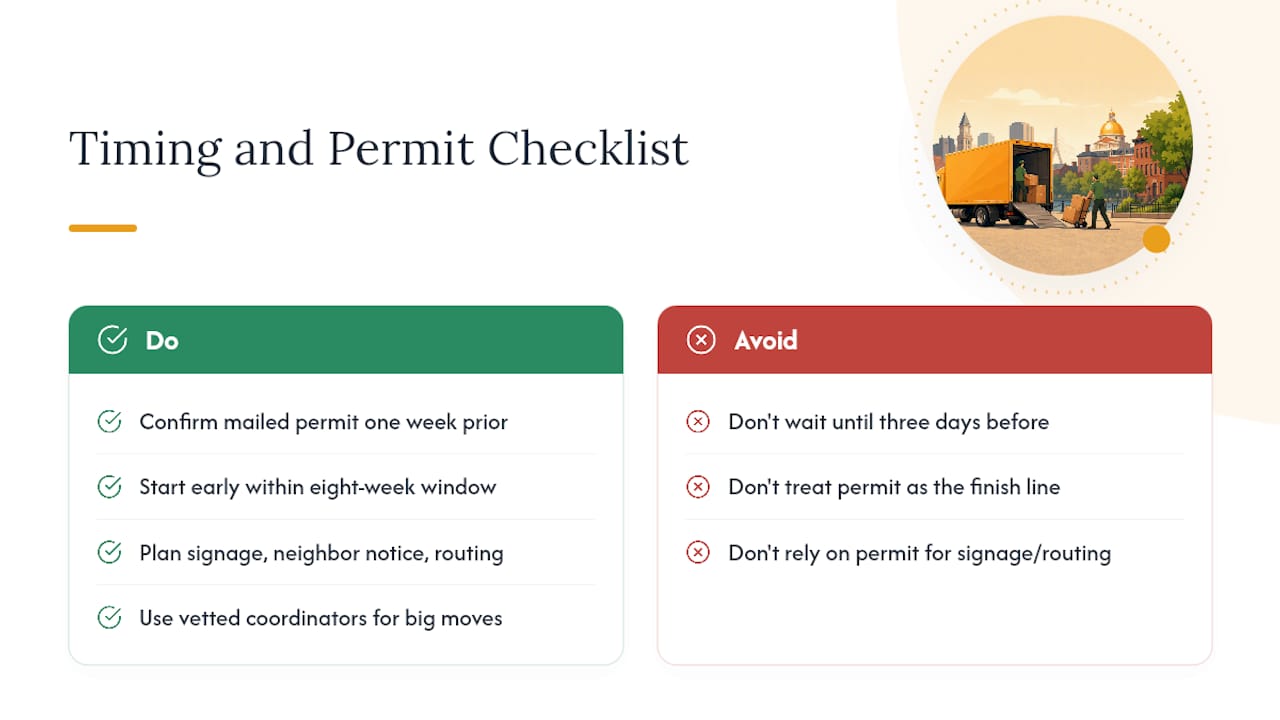
What conventional advice gets wrong is treating the permit as the finish line. It’s not. A permit sitting in your mailbox doesn’t stop a truck from getting stuck under Storrow Drive’s ten-foot clearance, and it doesn’t post itself 48 hours in advance. The permit is a legal reservation. Everything else, the signage, the neighbor communication, the route planning, is operational work that has nothing to do with the city at all.
If there’s one priority worth fixing first, it’s confirming your mailed permit a full week before moving day rather than three days before. That single habit closes the gap where most Boston moves go sideways.
— Info
For office moves and larger relocations where a delayed truck means lost productivity, minimizing productivity loss during a relocation starts with exactly this kind of permit and logistics coordination. Some moving coordinators connect you with vetted, licensed carriers who handle the parking permit timeline as part of a coordinated move, so a missed mail delivery or a Storrow Drive routing mistake doesn’t become your problem to untangle alone.