
If your building requires a Certificate of Insurance, get a broker-issued ACORD 25 showing your mover’s actual limits and additional-insured language before move day, not on it. The certificate proves coverage exists; it doesn’t create coverage. If your mover can’t produce one with the wording your building demands, pause the move until the building gives written acceptance.
TL;DR:
- A certificate of insurance only confirms coverage exists but does not provide coverage; verify the broker’s contact details and policy limits carefully.
- Buildings typically require specific policy limits, effective dates, and either additional-insured endorsements or proof of endorsement pages before moving day.
- Being listed as an certificate holder means notice only, whereas added as an additional insured grants actual coverage rights through policy endorsement.
- Movers should provide a COI with accurate legal entity names, policy numbers, and endorsement references, confirmed directly with the broker before move day.
- Relying on Move Craft simplifies compliance by vetting carriers and verifying endorsements, reducing the risk of rejected certificates and move delays.
Table of Contents
- What is a certificate of insurance for movers?
- What fields on a moving COI actually matter?
- Which buildings require a COI, and why?
- Certificate holder vs. additional insured: the distinction that changes everything
- How do you request, verify, and submit a COI before move day?
- What happens if a COI is missing or gets rejected?
- How Move Craft handles COI verification for you
- Why most COI advice misses the real risk
- Let Move Craft coordinate your COI so you don’t have to
- Where to verify the details yourself
- Sources
What is a certificate of insurance for movers?
A certificate of insurance movers show you is a one-page summary, not the insurance policy itself. It’s typically issued on the ACORD 25 form, the standard document that insurance brokers across the country use to summarize a company’s active coverage. The producer field, which lists the broker’s name and contact information, matters more than most people realize. That’s the person you call to confirm the certificate is real.
Here’s the part that trips people up: a COI doesn’t grant anyone insurance. ACORD itself states that the certificate is informational only and does not amend, extend, or alter the underlying policy. It’s a snapshot, not a contract.
A mover’s COI usually lists several coverage lines together:
- General liability — covers property damage and bodily injury during the move
- Workers’ compensation — covers injuries to the moving crew on your premises
- Commercial auto — covers the truck and any accidents involving it
- Cargo (motor truck cargo) — covers your belongings while in transit, a category ForwarderOne explains in more detail
- Umbrella or excess liability — extra coverage layered on top of the primary policies, when a building demands higher limits
Each line has its own policy number, carrier, and expiration date, which is exactly why the next section matters.
What fields on a moving COI actually matter?
Most people glance at a COI, see it looks official, and forward it along. That’s how rejected certificates happen on move day. Before you send a COI to a building or accept one from a mover, check these fields specifically:
- Producer/broker contact — a real broker name, phone number, and email, not the mover’s own sales line
- Named insured — the exact legal entity name of the moving company, matching your contract
- Carrier and policy numbers — the actual insurer (not the broker) and a policy number for each coverage line
- Effective and expiration dates — the policy must be active on your move date, not expired or not-yet-started
- Policy limits — general liability commonly runs $1 million per occurrence and $2 million aggregate, though cargo limits often sit lower and vary widely by carrier
- Description of operations — language specifying moving/hauling services, not a generic catch-all
- Additional insured status and certificate-holder name — whether the box is checked, and whether the address matches your building exactly
Quick check: Mismatched entity names across the contract, the certificate-holder box, and any endorsement are one of the most common reasons buildings kick a COI back for correction. A typo in a suite number can cause the same delay as a missing endorsement.
Which buildings require a COI, and why?
Not every landlord asks for a COI. But in dense urban markets, most do, and the pattern isn’t random.
- Class A high-rises and luxury residential towers typically require higher limits because of elevator liability, marble lobbies, and shared freight access
- Condo and co-op boards (HOAs) often mandate additional-insured status because the building’s own master policy won’t cover a contractor’s negligence
- Office landlords frequently require COIs for both the moving company and any subcontractor handling IT equipment or furniture
- Universities and institutional campuses tend to have their own risk management offices reviewing every COI line by line
- Storage and loading-dock facilities often add cargo and auto minimums beyond what a residential building would ask for
The reasoning is consistent: shared elevators, shared hallways, and hundreds of other tenants raise the property’s overall exposure. A building with a single freight elevator serving many floors has a lot more at stake than a two-family house with a driveway. That’s why a doorman building in Manhattan might demand $2 million in aggregate liability and a named additional-insured endorsement, while a suburban single-family move might not ask for a COI at all.
Certificate holder vs. additional insured: the distinction that changes everything
This is the single most misunderstood part of the entire process, and it’s the reason more COIs get rejected than any other issue.
Being listed as the certificate holder means you receive notice. That’s it. If the mover’s policy gets canceled, the insurer typically notifies the certificate holder, and that’s the extent of the relationship. ACORD’s own guidance confirms that certificate-holder status confers no rights under the policy, whether that’s the right to a defense, the right to file a claim, or the right to anything else.
Being listed as an additional insured is a different animal entirely. It means the building, HOA, or landlord is actually added to the mover’s policy by endorsement, an amendment to the policy itself. That status carries real coverage rights: if the mover damages the lobby floor, the additional insured can potentially draw on the mover’s own liability policy rather than relying solely on its own.
Bramble’s compliance guidance puts it plainly: certificate holder is notice only, additional insured is coverage by endorsement, and confusing the two is one of the most consequential gaps in commercial insurance compliance. A building that requires additional-insured status and receives a certificate showing only certificate-holder status has every right to reject it, and often will.
Here’s how to confirm which one you actually have:
- Read the certificate holder box. If your building’s name and address appear there, that only proves notice.
- Look for an endorsement reference number on the certificate itself, something like “CG 20 10” or similar language indicating additional-insured status has been added to the policy.
- Request a copy of the endorsement page, not just the certificate. This is the actual policy amendment.
- Call the broker listed in the producer field and ask them to confirm, verbally or in writing, that additional-insured status is active for your specific building and move date.
Pro Tip: Never accept a mover’s word that “we’ll add you as additional insured” without asking for either the endorsement page or written confirmation from the broker. A verbal promise from a salesperson isn’t binding on the insurance carrier, and it won’t hold up if something goes wrong on move day.
How do you request, verify, and submit a COI before move day?
Getting this right is a timeline problem as much as a paperwork problem.
- Get the building’s requirements sheet in writing. Every serious property manager has one listing exact limits and endorsement language.
- Forward it to the mover’s operations team 7 to 10 business days before the move. Broker turnaround typically runs 24 to 48 hours, but buildings often need extra time to review and sometimes kick back a first draft for correction.
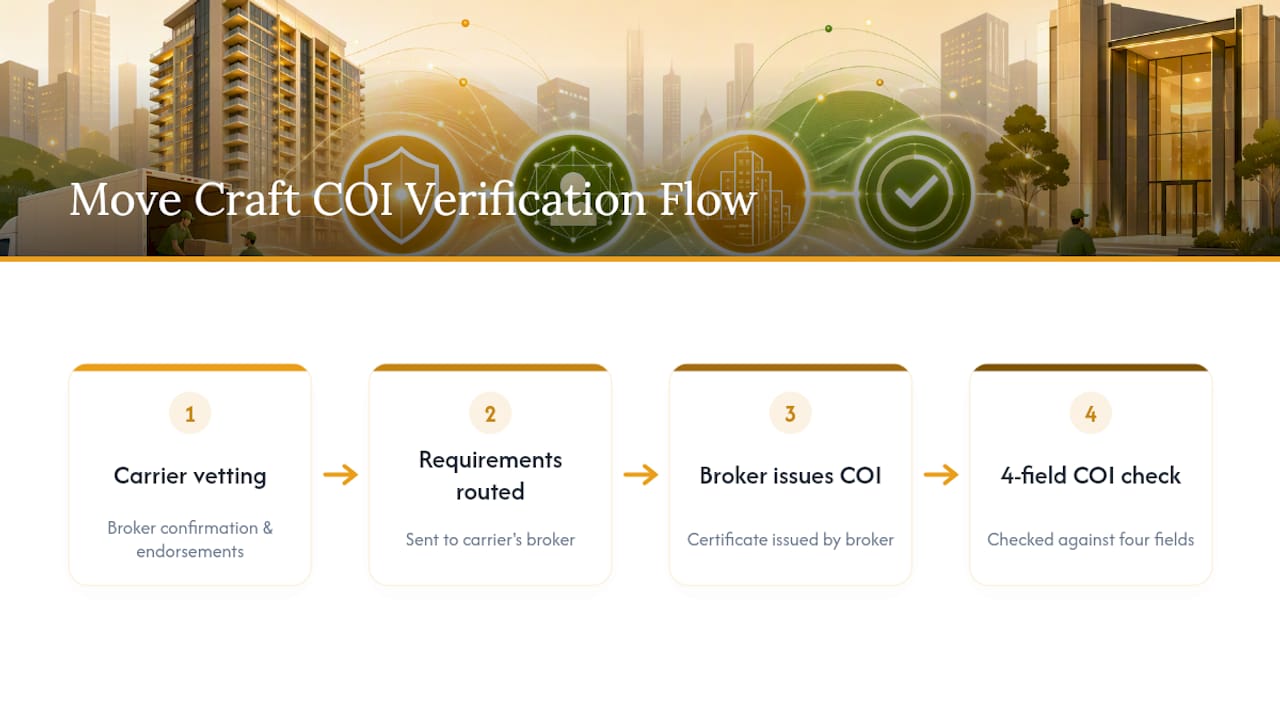
- Run the four-field quick review the moment the certificate arrives.
- Get written acceptance from the building, not just a verbal “looks fine” from the front desk.
The four fields to check every time:
- Policy limits match or exceed the building’s stated minimums
- Effective dates cover the actual move date
- Additional-insured language appears (if required) with an endorsement reference
- Certificate-holder name and address match the building’s exact legal entity
If something’s off, contact the broker directly, not the mover’s sales rep, and loop in the building’s insurance or management contact before the truck is loaded.
What happens if a COI is missing or gets rejected?
Stop the move. That’s not dramatic advice, it’s the practical one. A rejected or missing COI on move day means the building can legally deny access, and you’ll be paying for a truck and crew sitting idle at the curb.
- Request an immediate broker re-issue rather than accepting a mover’s promise to “fix it later.”
- Require written acceptance from the building before the crew starts loading, every time.
- Watch for red flags: a mover that lists itself as the producer instead of a licensed broker, refuses to share broker contact information, shows inconsistent legal entity names across documents, or can’t produce an endorsement page when additional-insured status is required.
- Check regulatory filings for interstate movers through FMCSA’s SAFER system, which shows active USDOT and MC numbers separate from any building-specific COI.
Pro Tip: A mover who can’t get you a real broker’s phone number in under five minutes usually can’t get you a real COI either. Treat that hesitation as your answer.
How Move Craft handles COI verification for you
Move Craft vets every carrier in its network before a move ever gets booked, which means broker confirmation and endorsement checks happen as standard practice, not as a scramble the week before your move. When a building sends over its requirements sheet, that document gets routed straight to the carrier’s actual insurance broker, not a sales department, and the resulting certificate gets checked against the same four fields covered above before it’s forwarded anywhere.
For readers who want the deeper mechanics, Move Craft’s guides on why movers need liability insurance, workers’ compensation requirements, and licensed mover contract language go further into the specifics building managers and tenants tend to ask about.
Why most COI advice misses the real risk
Most guidance on this topic treats the COI like a box to check: get the piece of paper, hand it to the building, move on. That’s backwards. The certificate itself is the least interesting part of the process. The endorsement, the actual policy amendment that grants additional-insured coverage, is where the real protection lives, and it’s the piece almost everyone skips verifying.
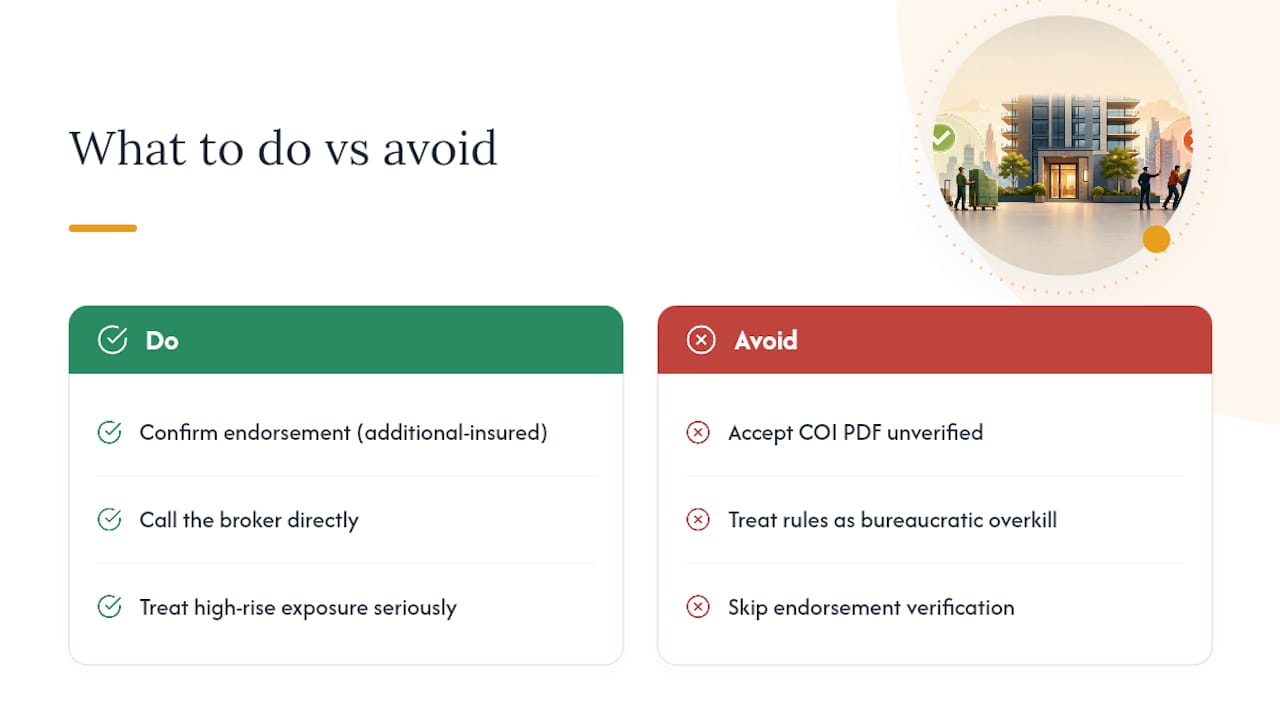
I’d also push back on the idea that a building’s strict requirements are bureaucratic overkill. A high-rise with one freight elevator and 300 units has legitimate exposure that a suburban driveway move doesn’t. Treating that request as an obstacle rather than a legitimate risk filter is how tenants end up arguing with a doorman at 9 a.m. with a truck double-parked outside.
If there’s one habit worth adopting, it’s calling the broker directly instead of trusting whatever PDF the mover’s sales team emails over. That single phone call catches more problems than any checklist. The paperwork matters less than the five minutes it takes to confirm it’s real.
— Info
Let Move Craft coordinate your COI so you don’t have to
Move Craft is the alternative to chasing brokers and re-forwarding rejected PDFs yourself: every carrier in the network is already vetted for insurance compliance, and coordination teams handle the back-and-forth between the mover’s broker and your building’s management office directly.

That means fewer surprises on move day, whether you’re coordinating a residential move into a high-rise with strict elevator rules or a full office relocation with its own landlord requirements. Move Craft’s team confirms endorsement language before the truck is scheduled, not after a rejected certificate stalls your move at the loading dock. If you’re planning a move that needs this kind of coordination, start with Move Craft’s long-distance moving process overview to see how carrier vetting and insurance verification fit into the full timeline, and request a quote to get the process moving.
Where to verify the details yourself
A few sources are worth bookmarking if you want to double-check anything in this guide independently. ACORD’s official site explains what the standard certificate form is and, just as importantly, what it isn’t: proof of coverage rights beyond notice. FMCSA’s SAFER lookup lets you verify a mover’s USDOT and MC filings directly, which matters for any interstate move regardless of what a building-specific COI shows.
For deeper reading on related insurance topics, Move Craft’s guides on long-distance moving insurance and licensed mover contract best practices cover the contract language and valuation questions that come up alongside COI requirements, particularly for moves crossing state lines.
Sources
- Certificate of Insurance (COI) for Movers | Mover Scorecard
- ACORD (Association for Cooperative Operations Research and Development)
- FMCSA SAFER (Safety and Fitness Electronic Records)
- Certificate holder vs. Additional Insured | Bramble