
File your USPS Change of Address as a bridge, not a fix, then work down a priority list: utilities, landlord or HOA, insurer, employer, and bank accounts come first. Within a few weeks, submit IRS Form 8822, update Social Security through My Social Security if you’re eligible, and handle your DMV and voter registration. Everything else, from streaming subscriptions to pet licenses, can wait until those seven are done.
TL;DR:
- Updating critical accounts like IRS, Social Security, voter registration, and DMV should be prioritized within the first few weeks after moving, as delays can cause legal or financial issues.
- USPS forwarding only moves individual mail pieces and does not update the records held by banks, insurers, or government agencies, which require separate notifications.
- Timing is crucial; coordinate utility disconnects, service start dates, and address updates simultaneously to prevent lapses and ensure all systems are operational upon arrival.
- Maintaining proof of all notifications and confirmations helps resolve potential disputes if senders claim they were never informed of the address change.
- Using professional moving coordination services can help align move logistics with address updates, reducing the risk of missed payments, service outages, or delayed mail.
Table of Contents
- Change of Address Guide: Your Priority Checklist and Timeline
- How Do You Update Government Records After Moving?
- What Does USPS Forwarding Actually Do?
- Updating Banks, Loans, and Insurance Without Missing a Payment
- Coordinating Utilities, Internet, and Deliveries
- How Do You Verify Your Address Change Went Through?
- A Relocation Strategist’s Notes on Avoiding Address-Change Failures
- Address Change for Pet Licenses and Veterinary Records
- Why Most Change of Address Checklists Get the Order Wrong
- Let Move Craft Handle the Coordination While You Handle the Paperwork
- Official Pages Worth Bookmarking
- Sources
- FAQ
Change of Address Guide: Your Priority Checklist and Timeline
Most people treat every address update as equally urgent. It isn’t. A missed streaming bill is an inconvenience; a missed insurance renewal notice or a lost Social Security letter can cost real money. This change of address guide breaks the work into three windows so nothing critical falls through the cracks.
Before you move (2 to 4 weeks out):
- Build a master list of every account, subscription, and agency tied to your current address.
- Notify your landlord or HOA in writing, following your lease’s notice requirements.
- Schedule utility disconnect and connect dates around your move window.
- Tell your employer’s HR department and payroll about the new address for tax documents.
- Contact your auto and health insurers so policy documents route correctly.
Move day:
- Submit your USPS Change of Address online or at a Post Office.
- Confirm your mover’s arrival window and make sure someone can grant access at the new address.
- Verify new utilities are active before the truck unloads.
First two weeks after arrival:
- Update your driver’s license and vehicle registration with your state DMV.
- Re-register to vote if you moved across county or state lines.
- File IRS Form 8822 for your federal tax address.
- Update Social Security through My Social Security if applicable.
- Log into every bank and credit card portal to update your mailing address.
- Keep checking your old mailbox for anything that slipped through.
How Do You Update Government Records After Moving?
Government agencies don’t share databases, so each one needs its own separate update. USPS forwarding will not touch your IRS file, your SSA record, or your voter rolls.
- IRS: File Form 8822 for a personal address change, or Form 8822-B if you run a business. Mail the form to the address listed in the instructions for your state, and expect about 4 to 6 weeks of processing time before it shows up in IRS systems.
- Social Security and Medicare: Eligible beneficiaries can update their address through My Social Security in a few clicks. The online tool isn’t available to everyone, though. Many SSI recipients and people without a U.S. mailing address have to call SSA directly or work through a representative payee.
- Voter registration: Use your state’s election website to update your registration, and always verify the change went through after submitting it. Deadlines vary widely by state, and if you moved to a new state entirely, you need to register there rather than just updating an old one.
- DMV: Every state sets its own deadline for updating a driver’s license and vehicle registration after a move, usually within a few weeks. Check your new state’s DMV site for the exact timelines and required documents.
Pro Tip: File Form 8822 and your DMV update in the same week. Both take weeks to process, and starting them together means you’re not stuck waiting on one while the other lapses.
What Does USPS Forwarding Actually Do?
USPS forwarding moves mail piece by piece. It doesn’t rewrite anyone’s database, which is exactly why it works as a temporary bridge and nothing more. Banks, insurers, employers, and retailers all still have your old address on file until you tell them otherwise.
A few details trip people up:
- Family vs. Individual filings. Use the Family option only when everyone in the household shares the same last name. Otherwise, file individual requests for each adult, or mail addressed to a different surname may not forward correctly.
- Identity verification. If the online tool can’t verify your identity, don’t turn to a third-party website that charges extra for the same service. Go to a Post Office with a photo ID instead, which costs the standard USPS fee.
- Duration and exceptions. Standard forwarding runs for a set period and varies by mail class. First-class mail forwards longer than periodicals or standard mail, so a magazine subscription may stop forwarding well before your bank statements do.
- Extended Mail Forwarding. If you need more time, USPS offers an extended option worth requesting before your standard window closes.
Updating Banks, Loans, and Insurance Without Missing a Payment
Financial accounts carry the highest risk of a costly mistake, so they deserve their own pass through your checklist, separate from the general list above.
- Update your mortgage or landlord’s rent portal, auto loan servicer, and credit card issuers first. These are the accounts most likely to trigger a missed payment notice or a paper statement you’ll never see.
- Log in through the official bank or insurer app or website rather than calling a number from an email. Some updates, especially to a mortgage escrow account, may require in-branch verification.
- Confirm autopay dates and billing addresses match your new one, since a mismatch can flag a card for fraud review.
Pro Tip: Set a calendar alert for your first bill cycle after the move. If a payment doesn’t show up when expected, that’s your signal something didn’t update.
Coordinating Utilities, Internet, and Deliveries
Utilities and recurring deliveries need their own timeline because providers work on business-day schedules, not moving-day schedules.
- Book your disconnect date for the old address and connect date for the new one a few days apart, giving yourself a buffer in case the mover’s arrival window shifts.
- Contact your internet, cable, and phone provider early. Many require several business days’ notice to schedule a technician.
- Update your address with prescription pharmacies and any recurring delivery service, from meal kits to pet food.
- Pause or redirect subscriptions you don’t need during the transition rather than letting boxes pile up at your old address.
How Do You Verify Your Address Change Went Through?
Keep everything in one move folder: confirmation codes, screenshots, lease or closing documents, and account numbers. This is your proof if a sender claims they never received your update.
- Log back into your state’s voter registration lookup and DMV account a week or two after submitting each change to confirm it processed.
- Scan a bank or credit card statement for your billing address once the next cycle posts.
- Keep an eye on your old mailbox for 6 to 8 weeks. If anything important keeps arriving there, call that sender directly instead of assuming forwarding will catch it forever.
A Relocation Strategist’s Notes on Avoiding Address-Change Failures
The most common failure point isn’t forgetting a sender. It’s timing mismatches, like a utility connect date that lands after move-in, or a mail forward that expires before every account catches up. Move Craft’s relocation checklist is built around syncing those windows instead of treating each task as independent.
Coordinate your mover’s confirmed arrival time with your landlord or HOA’s access instructions and your new utility activation, all landing within the same day or two. A utility transfer guide helps map out which providers need the longest lead time so you’re not left without power or internet on night one. When carriers are vetted and scheduled properly, the windows where mail or services could lapse shrink dramatically, which is the entire point of doing this work in order rather than all at once.
Address Change for Pet Licenses and Veterinary Records
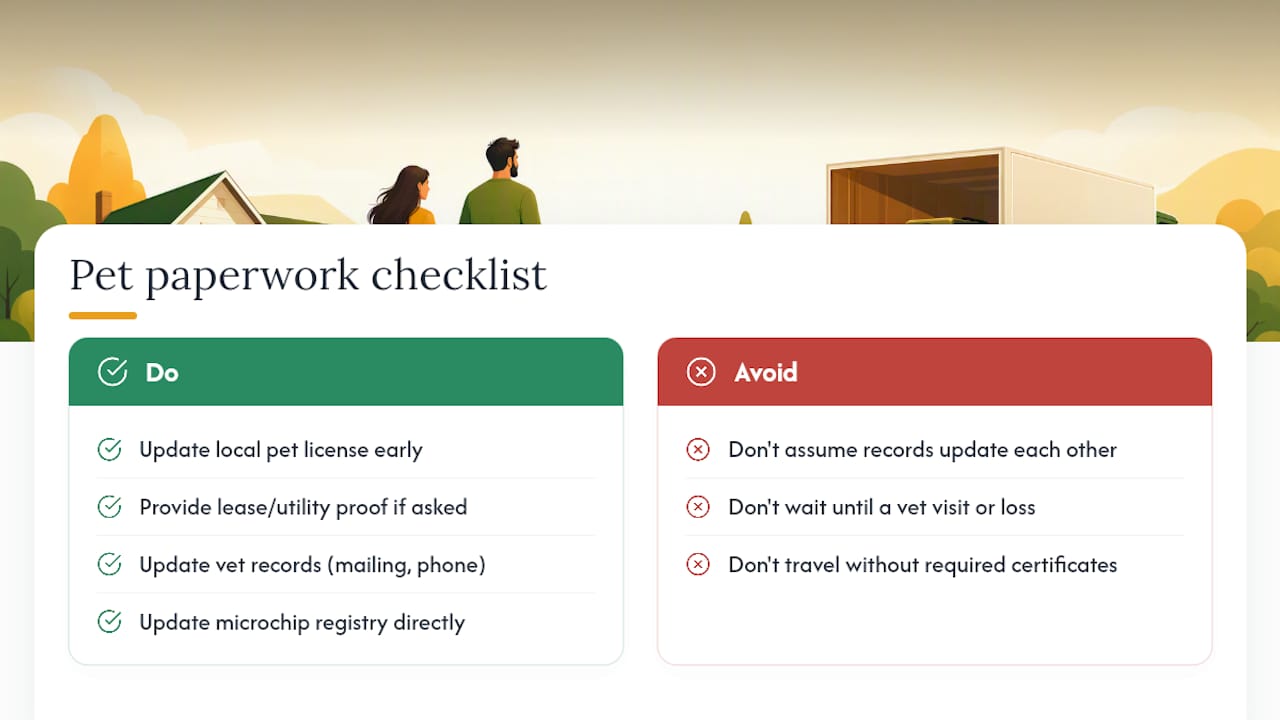
Pets need their own paperwork trail, and it’s easy to overlook until a vet visit or a lost-pet situation makes it urgent. Most city and county pet licenses are tied to your home address, so contact your local animal control office or county clerk to update the license once your move is final. Some jurisdictions require proof of residency, like a lease or utility bill, before they’ll process the change.
Your veterinarian’s office keeps a separate record from the license itself. Call or email to update your mailing address and phone number so vaccination reminders, prescription refill notices, and recall alerts reach you. If your pet’s microchip is registered with a company like HomeAgain or a similar registry, that database needs a direct update too. A license change or a vet record change does not automatically update a microchip registry, and vice versa.
If you’re moving across state lines, check whether your new state requires a new rabies tag or license entirely, separate from what you already have. Some states also require a health certificate from a vet within a set window before travel, particularly for long-distance moves. Handle this early if your move involves flying or a multi-day drive, since certificates typically expire after 10 to 30 days depending on the destination.
Why Most Change of Address Checklists Get the Order Wrong
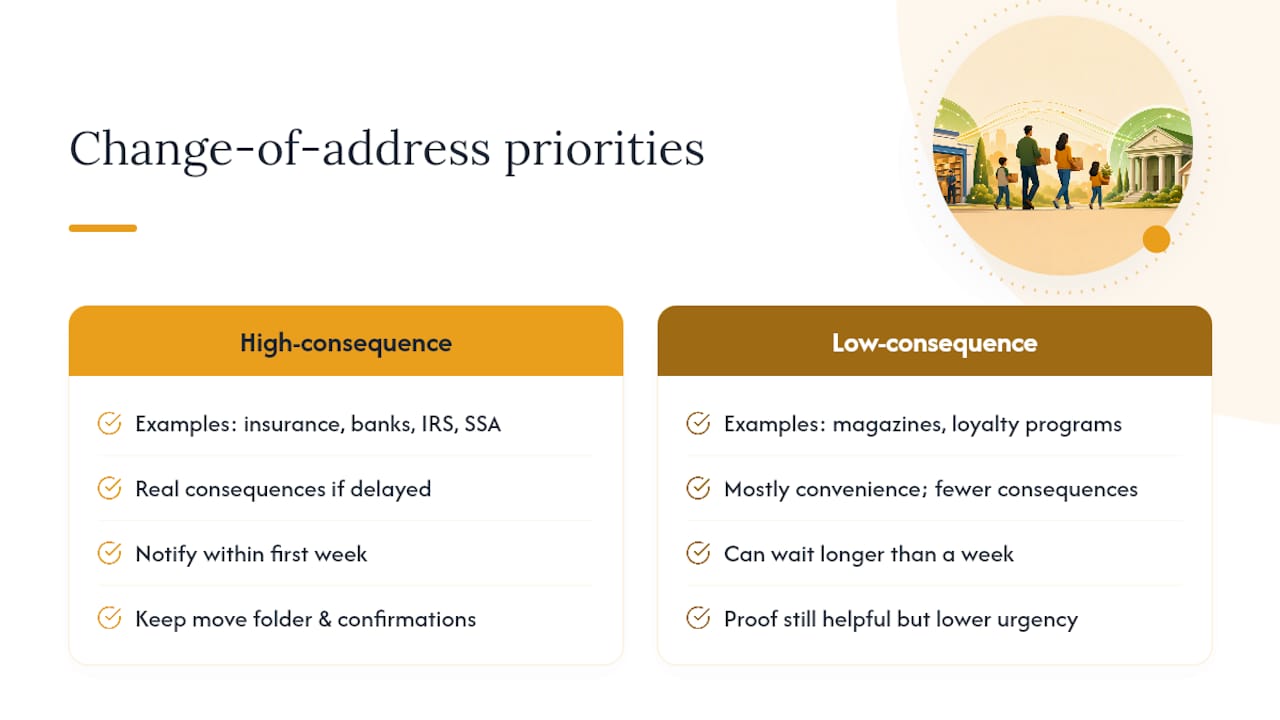
Most guides treat every notification as equally urgent and hand you a flat list of 30 things to do. That’s backward. The research behind this piece points to a clear ranking: things tied to money and legal status (insurance, banks, IRS, SSA) carry real consequences if delayed, while things tied to convenience (magazines, loyalty programs) don’t.
The overrated step is worrying about USPS forwarding as if it solves the problem. It buys time. It doesn’t update a single database. The underrated step is the move folder. Nobody wants to spend twenty minutes saving confirmation numbers on a day already packed with boxes and exhaustion, but that folder is what saves you when a sender claims you never told them.
If you do only three things well: file with USPS immediately, notify anyone who touches your money within the first week, and keep proof of every notification you send. The rest of this checklist matters, but it can happen on a slightly longer runway.
— Info
Let Move Craft Handle the Coordination While You Handle the Paperwork
You can manage every address update yourself with this checklist and still run into the one thing no form prevents: bad timing between your movers, your landlord, and your utility company. There are services that connect you with vetted carriers and coordinate the logistics side of your move so your mail forwarding, utility start dates, and moving day actually line up instead of colliding.

If you’re managing a long-distance move, a full household relocation, or simply don’t have the bandwidth to juggle a dozen moving parts on top of this checklist, Move Craft’s residential and long-distance moving services are built to remove that friction. We handle carrier vetting, scheduling, and move-day logistics so the address-change side of your move stays on schedule instead of becoming an afterthought. Request a quote today and see how a coordinated move compares to doing it all solo.
Official Pages Worth Bookmarking
Save these directly rather than relying on search results, since agency URLs change and third-party sites often charge for services that are free at the source.
- USPS Change of Address basics for forwarding rules and identity verification.
- IRS Form 8822 (personal) and Form 8822-B (business) for tax address updates.
- My Social Security address change guidance for eligibility and alternate contact methods.
- Usa for which federal and state records need separate updates, including voter registration.
Sources
- Change of Address – The Basics | USPS
- Usa
- Change of address via My Social Security | SSA
- Form 8822 (Change of Address) | IRS (PDF)
FAQ
What Is the First Thing I Should Do When I Move?
File your USPS Change of Address right away, then notify your landlord or HOA, utilities, insurer, employer, and bank in the same week. USPS forwarding buys you time, but it doesn’t update any of those accounts directly.
Does USPS Forwarding Update My Address Everywhere?
No. USPS only forwards individual pieces of mail, and it does not change the records senders keep on file. You still need to update each bank, insurer, and subscription separately.
How Long Does It Take the IRS to Process an Address Change?
Filing Form 8822 generally takes about 4 to 6 weeks to process. File it as soon as you have your new address confirmed rather than waiting until tax season.
Can Everyone Update Their Address Through My Social Security?
Not everyone. Most beneficiaries can use My Social Security online, but many SSI recipients and people without a U.S. mailing address need to contact SSA directly or work through a representative payee instead.
Can Move Craft Help Coordinate My Move Alongside Address Changes?
Yes. Move Craft connects you with vetted carriers for residential and long-distance moves and helps time your mover’s arrival with utility activation and access instructions, reducing the gaps where mail or services could lapse.