
When one earring, one candlestick, or one dining chair out of a set gets damaged, your insurer doesn’t have to pay for the whole collection. The pair-or-set clause lets it choose between fixing or replacing the damaged piece or paying you the difference between what the full set was worth before the loss and what the remaining pieces are worth now. Scheduled endorsements and theft sublimits can push that number up, down, or off the table entirely, and most U.S. homeowners policies borrow this language straight from the ISO HO-00-03 form.
TL;DR:
- The insurer can choose to repair, replace, or pay the diminished value of a damaged item within a set, often leaning toward the least costly option.
- Replacement typically costs less when matching pieces can be produced, but depreciation and policy endorsements heavily influence the payout amount.
- Accurate pre-loss documentation, such as appraisals, photographs, and receipts, is essential to maximize settlement in pairs-and-sets claims.
- Theft sublimits usually apply only to theft, not to other perils like fire or water damage, and scheduling valuable items can remove these caps entirely.
- Moving high-value sets requires early preparation, including inventorying, photographing, and confirming valuation choices to prevent disputes and streamline claims.
Table of Contents
- What Does the Pair-or-Set Clause Actually Say?
- How Insurers Calculate the Payout: A Worked Example
- Sublimits, Categories, and Scheduling: Where Coverage Gets Capped
- Does Pair-or-Set Cover Dwelling Components Too?
- Building the Paper Trail That Wins a Pairs-and-Sets Claim
- How to Dispute a Low Settlement Offer
- Protecting High-Value Pairs and Sets Before and During a Move
- Where Claimants Go Wrong (and How to Avoid It)
- How Move Craft Supports Your Pairs-and-Sets Documentation During a Move
- Sources
- FAQ
What Does the Pair-or-Set Clause Actually Say?
Homeowners policies built on the ISO HO-00-03 form include a Conditions section provision that most adjusters call the pair-or-set clause. It exists for one reason: to stop a policyholder from claiming a total loss on an entire collection because a single piece got destroyed. Lose one cufflink from a matched set, and the insurer isn’t writing you a check for the full pair as if both vanished.
The controlling phrase in nearly every version of this language is some variation of “we may elect to.” That phrase hands the decision to the insurer, not to you. According to Justia’s definition, the clause lets the company pick between two paths, and it’s the insurer’s call which one applies to your claim.
The two options break down like this:
- Repair or replace the damaged piece so the set is restored to its original condition, matching finish, pattern, and function as closely as possible.
- Pay the diminished value, meaning the difference between the actual cash value (ACV) of the complete set immediately before the loss and the ACV of what’s left immediately after.
Insurers usually lean toward whichever option costs less, and replacement is often cheaper when a manufacturer or jeweler can still produce a matching piece. When that’s not possible, LawInsider’s clause language shows insurers frequently reserve the right to pay only the proportional value of the lost item rather than the full diminished-value calculation, depending on how the specific policy is worded.
ACV factors in depreciation; replacement cost does not. Whether your policy pays one or the other for the underlying items depends on the endorsement you carry, and that distinction becomes critical once you start doing the math on what you’re actually owed.
How Insurers Calculate the Payout: A Worked Example
The math behind a pair-or-set settlement follows a formula that sounds simple until you watch depreciation eat into it. LegalClarity’s breakdown of the clause lays out the core calculation in three steps.
- Establish the ACV of the complete set immediately before the loss. This requires an appraisal, receipt, or comparable market value for the full, matched collection.
- Establish the ACV of the remaining pieces immediately after the loss. A single earring, one chair from a dining set, or three of four matching vases is worth far less per-item than its share of the whole.
- Subtract the second figure from the first. The difference is the diminished-value payout, assuming the insurer elects that option instead of repair or replacement.
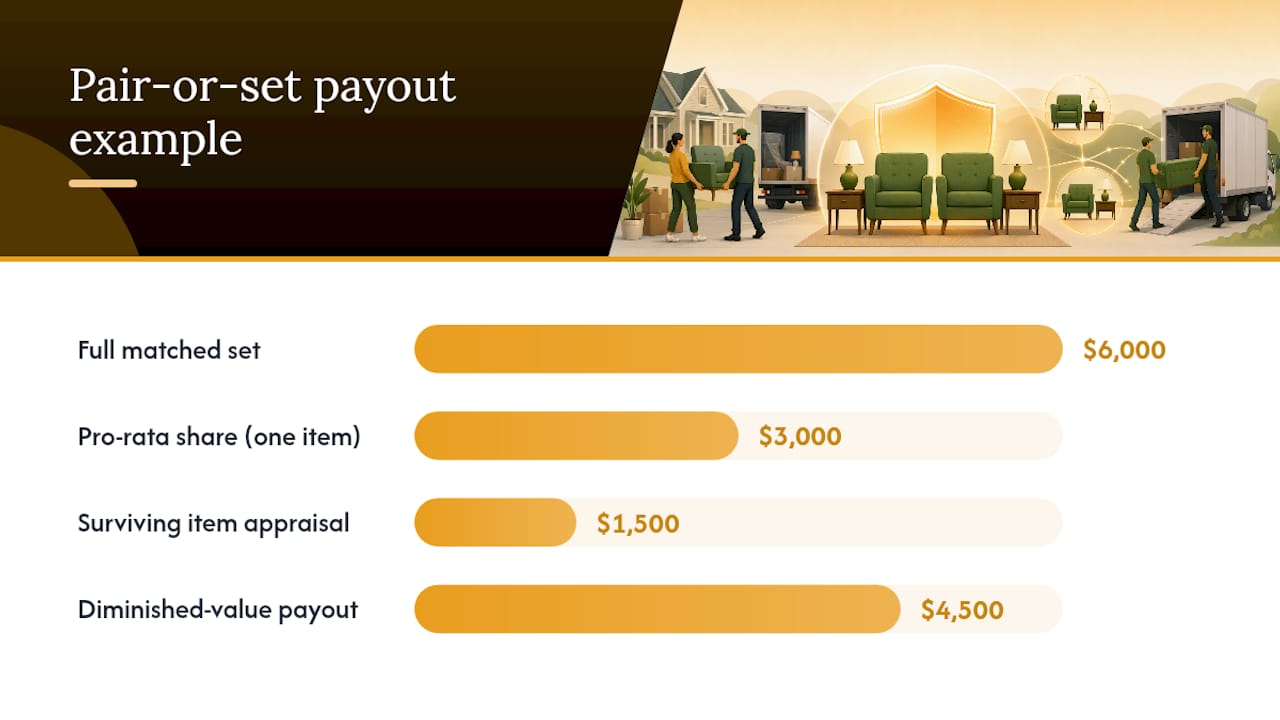
Here’s how that plays out with numbers. Say you own a matched pair of diamond earrings appraised at $6,000 for the set. One earring is lost. If the surviving earring, now unmatched, appraises at $1,500 (a single stone has far less resale value than half of a matched pair), the diminished-value payout is $6,000 minus $1,500, or $4,500. That’s more than half the total value, even though only one item was lost, because “matched” carries real market weight.
A quick statistic to hold onto: in diminished-value scenarios like this, the surviving piece is commonly appraised at 20% to 30% of its pro-rata share of the original set’s total value, not 50%, precisely because a single unmatched item loses buyer appeal in the resale and jewelry markets.
Depreciation inputs shift these numbers further. If your policy pays ACV rather than replacement cost, the insurer subtracts age-based depreciation from both the before and after figures, which usually shrinks your payout compared to a replacement-cost policy. This is exactly why a current, professional appraisal matters more here than in almost any other claim type.
Sublimits, Categories, and Scheduling: Where Coverage Gets Capped
Pair-or-set disputes cluster around a predictable list of property types. Anything valuable, hard to replace, and typically sold or displayed as part of a matched grouping falls into this zone:
- Jewelry sets (earrings, bracelets, matched rings)
- Sterling silverware and flatware sets
- Firearm pairs or matched collections
- Coin and currency collections
- Fine art pairs or numbered series
- Custom-built or matched furniture sets
Standard HO-3 policies cap theft losses on jewelry, watches, and furs at limits that commonly run in the $1,500 to $2,500 range on base policies, though the exact figure varies by insurer and state. Silverware and firearms often carry their own separate, similarly modest theft sublimits. Here’s a detail a lot of homeowners miss: those sublimits typically apply to theft specifically, not to fire, water damage, or other covered perils, so a set destroyed in a house fire may face a completely different, often higher, coverage ceiling than the same set stolen from a jewelry box.
Scheduling a personal property endorsement changes this picture entirely. Adding a scheduled personal property rider (sometimes called a floater) removes the category sublimit and insures the item at its own agreed or appraised value. The tradeoff shows up on your premium bill, and there’s a second catch worth knowing before you file a claim: if the insurer pays the full scheduled value for a lost item, LawInsider’s clause language confirms the policy can require you to surrender the surviving pieces as salvage. Get a full payout on a lost diamond from your engagement ring, and you may not get to keep the ring setting.
Does Pair-or-Set Cover Dwelling Components Too?
Pair-or-set and “matching” sound like the same problem, but they’re legally distinct issues. Pair-or-set governs personal property, items you own and could theoretically insure individually. Matching disputes usually involve dwelling components: siding, roofing, flooring, cabinets, or shutters where a repair to one damaged section leaves the rest visibly mismatched.
The overlap gets messy because some HO-3 forms place pair-or-set language in a spot broad enough to arguably capture built-in items. PropertyCasualty360’s analysis of this exact question, shutters and sconces specifically, found courts and adjusters split on whether the clause extends beyond personal property into fixed dwelling components. The outcome often hinges on specific policy wording and how well the claimant documents the loss.
A few things tend to decide these disputes:
- Whether the item in question is classified as personal property or a permanent fixture under the policy’s own definitions.
- Whether the completeness of the group is what drives its market value, not just its function. A single working shutter still does its job; a single shutter on an otherwise symmetrical facade does not look right.
- Whether comparable replacement materials are commercially available.
The practical test worth remembering: ask whether the group’s value or usefulness depends on staying complete. If four matching cabinet doors need to look identical and one is destroyed in a kitchen fire, that’s a stronger pair-or-set argument than a single broken window pane that can be replaced with off-the-shelf glass.
Building the Paper Trail That Wins a Pairs-and-Sets Claim
Winning a fair settlement on a pairs-and-sets claim comes down almost entirely to documentation you gathered before anything happened. Adjusters lean on comparables, appraisals, and provenance records to justify the “before” side of the ACV math, and if you don’t have that evidence ready, the insurer sets the baseline instead.
Before a loss occurs, keep these records current:
- Professional appraisals updated every two to three years for jewelry, silverware, and collectibles, since market values shift.
- Original receipts, maker’s marks, and serial numbers for firearms, watches, and manufactured sets.
- High-resolution, dated photographs showing the complete set together, not just individual pieces.
- Provenance documents for inherited or estate items, since these often carry value that receipts alone can’t establish.
After a loss, the sequence matters just as much:
- Photograph the damage and the surviving pieces immediately, before cleanup or repair attempts.
- Build a detailed inventory listing every item in the original set alongside its current condition.
- Get a third-party condition report from an independent appraiser rather than relying solely on the insurer’s inspector.
- Request written repair estimates from at least two qualified specialists.
- If the insurer requires surrender of surviving pieces, document chain of custody with photos, receipts, and written confirmation of what was surrendered and when.
Pro Tip: Never sign a settlement acceptance form until you’ve confirmed in writing whether the payout requires surrendering the remaining pieces. Once you cash that check, getting the surviving item back is nearly impossible.
If damage happens during a move rather than at home, the same documentation logic applies, and a coordinator who builds condition reports before pieces ever leave the house gives you a much stronger starting position than trying to reconstruct value after the fact.
How to Dispute a Low Settlement Offer
Most homeowners policies include an appraisal clause specifically designed for disagreements over value, and it’s the fastest, cheapest path to a fair number when the insurer’s diminished-value math looks low. Either side can invoke it.
Here’s how the process typically runs:
- You demand appraisal in writing, and each side selects a competent, independent appraiser.
- The two appraisers try to agree on the loss amount, usually within a few weeks to a couple of months depending on how complex the valuation is.
- If they can’t agree, they select a neutral umpire, whose decision on the disputed points becomes binding when it matches either appraiser’s figure or falls between the two.
Cost allocation follows a fairly standard pattern: you pay your own appraiser, the insurer pays theirs, and both sides split the umpire’s fee. Public adjusters, by contrast, typically work on contingency, commonly in the range of 5% to 15% of the settlement, and they can be worth hiring when the dispute is complex or the insurer has already denied part of the claim outright.
Appraisal works best when the disagreement is purely about value, how much the set was worth before and after. It’s the wrong tool when the dispute is about coverage itself, whether the clause applies at all, or whether the insurer acted in bad faith. Those situations call for mediation or, in persistent cases, litigation, where case law on constructive loss sometimes supports a fuller recovery than the standard diminished-value formula would suggest, particularly when the completeness of the set is what gave it commercial value in the first place.
Protecting High-Value Pairs and Sets Before and During a Move
Relocation is one of the highest-risk moments for pair-and-set losses, and the damage often isn’t discovered until after the truck is unloaded. A relocation coordinator who inventories high-value items before transit, flagging matched jewelry sets, sterling silverware, firearm collections, and custom furniture individually, gives you a documented “before” condition that becomes essential if a claim ever needs the ACV math worked out.
If carrier damage happens, move fast. Note the damage on the delivery paperwork immediately, before the crew leaves. Photograph both the damaged piece and the surviving pieces from the same set. Build a separate inventory line for anything affecting a matched group, since generic “one box damaged” notes rarely hold up when an adjuster is trying to determine whether a full set was compromised. Contact an independent appraiser early rather than waiting for the mover’s insurer to schedule inspection on its own timeline.

Scheduling high-value pairs and sets before the move, and confirming upfront whether you want ACV or replacement-cost valuation on the moving company’s liability coverage, closes most of the gaps that turn a routine claim into a drawn-out dispute.
Where Claimants Go Wrong (and How to Avoid It)
The single costliest mistake in pairs-and-sets claims is accepting the first number an adjuster offers without independently verifying the “before” value. Insurers calculate off whatever comparable data they have on hand, and that data is rarely as generous as a current professional appraisal.
The second mistake is treating theft sublimits as universal. Many claimants assume a $2,000 jewelry cap applies to fire or water damage too, when it often applies to theft alone, and missing that distinction can cost thousands.
The third is ignoring the surrender clause until after signing. Confirm salvage terms in writing before you cash any settlement check.
The fix for all three is the same: schedule anything genuinely valuable, keep appraisals current, and photograph complete sets long before you ever need to file a claim. Move Craft’s own moving insurance guidance walks through valuation choices that matter well before moving day.
— Info
How Move Craft Supports Your Pairs-and-Sets Documentation During a Move
Some moving coordinators offer groundwork that makes a real claim easier to win: pre-move inventories, item-by-item condition reports, and documentation support that captures your matched sets in their complete, undamaged state before a truck ever pulls away from the curb.

That distinction matters because most disputes over pair-or-set valuation come down to who has better “before” evidence, and a coordinator who photographs and logs your silverware, jewelry, and custom furniture ahead of transit gives you exactly that. If damage happens anyway, a moving coordination service may help connect you with independent appraiser referrals and organize the inventory records adjusters ask for, cutting down the back-and-forth that stalls settlements for weeks.
If you’re planning a move that involves valuable matched sets, whether it’s a full-service residential relocation or a long-distance move across state lines, get your inventory and valuation choices settled before the crew arrives. Start with a free moving quote and ask about pre-move documentation for high-value items.
Sources
The clauses, worked examples, and case discussions referenced throughout this guide draw on the following primary and practitioner sources:
- Justia — pair or set clause
- LawInsider — Loss to a Pair or Set clause
- PropertyCasualty360 — The Pair or Set Clause: shutters, sconces or both?
- Adjusters International — Making the policyholder whole
This article is general information, not a substitute for advice from a qualified lawyer. Consult a qualified legal professional about your own circumstances before acting on anything here.
FAQ
What Is a Pair-or-Set Clause in Insurance?
It’s a standard homeowners policy provision that limits how much an insurer pays when only part of a matched pair or set is damaged, letting the company repair or replace the piece or pay the difference in the set’s actual cash value before and after the loss. It exists to prevent claims for a full set’s value when only one item was lost.
What Is the 80% Rule in Homeowners Insurance?
The 80% rule refers to a dwelling coverage requirement, not pair-or-set coverage: many policies require you to insure your home for at least 80% of its replacement cost to avoid a coinsurance penalty on partial losses. It doesn’t directly govern personal property sublimits or pair-or-set valuation, which are separate policy provisions entirely.
Which Coverage Is Not Excluded on the HO-3 Policy?
HO-3 policies cover the dwelling on an open-perils basis, meaning all perils are covered unless specifically excluded, while personal property is typically covered on a named-perils basis. Theft, fire, and windstorm are commonly covered perils for both structure and contents, though sublimits on jewelry, silverware, and firearms still apply within that coverage.
What States Have Matching Laws?
Several states, including some with insurance department guidance addressing matching disputes for siding, roofing, and flooring, have taken regulatory positions on when insurers must address visible mismatch after a partial repair. Matching statutes and regulatory bulletins vary significantly by state, so check your own state insurance department for the current rule where you live.
How Do I Know If My Set Qualifies for Scheduled Coverage?
Anything individually valuable enough that a standard theft sublimit wouldn’t cover it in full, such as fine jewelry, sterling silverware, or a firearm collection, is generally a candidate for a scheduled personal property endorsement. Getting a current appraisal is the first step toward scheduling it correctly.