
A moving certificate of insurance (COI) is a one-page proof that your mover carries the liability and related coverage your building requires for the move date. The first move: get your building’s COI requirements in writing from the property manager, then forward that exact language to the mover’s operations team so their broker can issue the ACORD 25.
TL;DR:
- Building requirements for COI typically include specific liability limits, exact wording for additional insured status, and precise policy or certificate-holder names.
- Most COI rejections occur due to mismatched coverage limits, incorrect policy dates, or discrepancies in the certificate-holder details, not because of the insurance coverage itself.
- Requesting the COI at least seven to ten business days before the move and confirming policies are active via phone significantly reduces the risk of last-minute issues.
- A COI only covers building infrastructure and liability during the move; it does not include protection for personal belongings, which requires separate valuation coverage options.
- Coordinate directly with the mover’s broker and build the certificate request into your move timeline to avoid delays and ensure building acceptance before move day.
Table of Contents
- What Is a Certificate of Insurance (COI) for a Move?
- Who Issues a COI and What Fields Actually Matter?
- When Do Buildings or HOAs Actually Require a COI?
- How to Request a COI: A Step-by-Step Workflow
- The Four Checks Every Building Runs on a COI
- What a COI Doesn’t Cover: Protecting Your Own Belongings
- How Move Craft Handles COI Coordination for Clients
- Why Most Move-Day COI Problems Are Preventable
- Let Move Craft Handle Your Move-Day Paperwork
- Sources
What Is a Certificate of Insurance (COI) for a Move?
A certificate of insurance is a summary document, not a policy. It confirms that a mover’s insurance was active on a specific date, spelled out on the ACORD 25 form, the industry standard used across nearly every commercial insurance transaction in the country. Buildings, property managers, and commercial landlords rely on it because verifying insurance one policy at a time would take days; a COI condenses everything onto a single sheet.
The document typically summarizes four types of coverage:
- General liability — covers property damage and bodily injury caused by the mover’s crew
- Workers’ compensation — covers injuries to the movers themselves while on the job
- Commercial auto — covers the moving truck and any accidents involving it
- Cargo coverage — covers goods while they’re in transit, separate from valuation coverage for your belongings
A COI doesn’t create new coverage or change any policy terms. It’s a snapshot, and that snapshot expires the moment the policy listed on it lapses or renews with different limits.
Who Issues a COI and What Fields Actually Matter?
The mover doesn’t issue a COI. Their insurance broker does, acting as the “producer” listed at the top of the ACORD form. That distinction matters because a letter typed up by the moving company’s sales team carries no legal weight with a building manager. Only a document generated by the broker, on ACORD letterhead, counts.
The fields that matter most on the form:
- Producer name and contact info — the broker who issued it, and the number a building can call to verify authenticity
- Underwriting carrier — the actual insurance company backing the policy
- Policy numbers and effective/expiration dates — proof the coverage was active on your move date
- Limits of liability — the dollar amounts of coverage for each policy type
- Description of operations — sometimes includes the specific address or job being covered
A building manager who’s seen a few forged or outdated certificates will always call the producer’s number before accepting anything. That’s the entire point of listing it.
When Do Buildings or HOAs Actually Require a COI?
Not every move needs one. A single-family home with a driveway and no shared property almost never triggers a COI request. The requirement shows up when a mover’s crew has to interact with shared infrastructure that a landlord or HOA is responsible for protecting.
Common triggers include:
- High-rise and mid-rise apartment buildings, especially anything using a shared elevator
- Commercial office buildings and coworking spaces
- Condo associations and HOAs with insurance clauses in their governing documents
- Self-storage facilities requiring loading dock access
- Delivery of oversized or specialty items (pianos, safes, large appliances) into commercial venues
Some buildings, particularly luxury high-rises in cities like New York, Boston, or Chicago, set minimums well above standard industry limits and require exact certificate-holder wording, right down to the legal entity name on the deed. Skipping the check on a building like that is how movers get turned away at the loading dock.
How to Request a COI: A Step-by-Step Workflow
Getting a COI issued isn’t hard, but the timing catches people off guard when they wait until the week of the move. Follow this sequence:
- Get the building’s requirements in writing. Ask your property manager or leasing office for their COI requirement sheet, which lists exact limits, the certificate-holder name, and any required additional-insured language. Buildings like Columbia Residential publish these sheets specifically so tenants don’t guess.
- Send it to the mover’s operations team, not sales. Sales reps often don’t know what the broker needs. Operations coordinators handle certificate requests daily.
- Ask the mover to request the COI from their broker directly. A reputable broker can often turn one around in 24 to 48 hours.
- Have the mover send the COI straight to the building. Don’t let it sit in your inbox. Ask for confirmation that the building received and accepted it.
Pro Tip: Start this process the moment you book your move date, not the week before. Building reviewers sometimes reject a first draft over a wording mismatch, and a second round of back-and-forth can eat several days on its own.
Even though brokers move fast once asked, build in 7 to 10 business days from your first request to written building acceptance. That cushion covers slow email chains, wrong certificate-holder names, and the occasional building manager who’s out of office.
The Four Checks Every Building Runs on a COI
Before move day, verify the certificate yourself instead of assuming the mover got it right. Buildings reject certificates most often over four specific mismatches, and catching them early avoids a standoff at the front desk.
- Coverage limits match or exceed what the building’s requirement sheet specifies
- Policy dates cover your actual move date, not just the date the certificate was printed
- Additional insured language names the building or management company exactly as required, not a close approximation
- Certificate-holder name and address match the building’s legal entity name character for character
Mismatched certificate-holder names or missing additional-insured wording cause the majority of last-minute rejections buildings report. Once you have the certificate in hand, call the producer’s phone number listed on the ACORD, not the mover’s office, to confirm the policy is genuinely active. That single call resolves most doubts faster than any email chain.
What a COI Doesn’t Cover: Protecting Your Own Belongings
A COI protects the building’s elevator, hallways, and floors, plus anyone who might get hurt during the move. It does nothing for the dining table that gets a gouge on the way out the door. That’s a separate conversation entirely, and confusing the two is one of the more expensive mistakes movers make.
Protection for your belongings comes from valuation coverage, which movers are required to offer and which shows up on the bill of lading driver roles and duties, not the COI. Two standard options:
- Released value protection — minimal coverage, often just cents per pound, usually included at no charge
- Full value protection — repair, replacement, or cash value for damaged or lost items, priced based on your shipment’s declared value
If you want real protection for your furniture and boxes, ask your mover directly about valuation options or third-party moving insurance before signing the bill of lading, not after.
How Move Craft Handles COI Coordination for Clients

Move Craft Moving Solutions vets every carrier in its network for insurance compliance before a job is ever booked, which means the COI conversation starts early instead of becoming a scramble. When a client’s building has specific requirements, Move Craft coordinates directly with the mover’s operations team and broker, tracks the request through issuance, and confirms the building has formally accepted the certificate before move day. That coordination role, checking carrier compliance and following up until paperwork clears, is where clients feel the difference between a broker who just books a truck and one who manages the whole process.
Why Most Move-Day COI Problems Are Preventable
The conventional advice on this topic treats a COI like paperwork you request once and forget. That’s backwards. The research is clear that certificates get rejected almost entirely over small, avoidable mismatches, a wrong certificate-holder name, missing additional-insured wording, dates that don’t quite line up. None of that is complicated. It’s just easy to skip when you’re juggling boxes, utility transfers, and a dozen other moving parts.
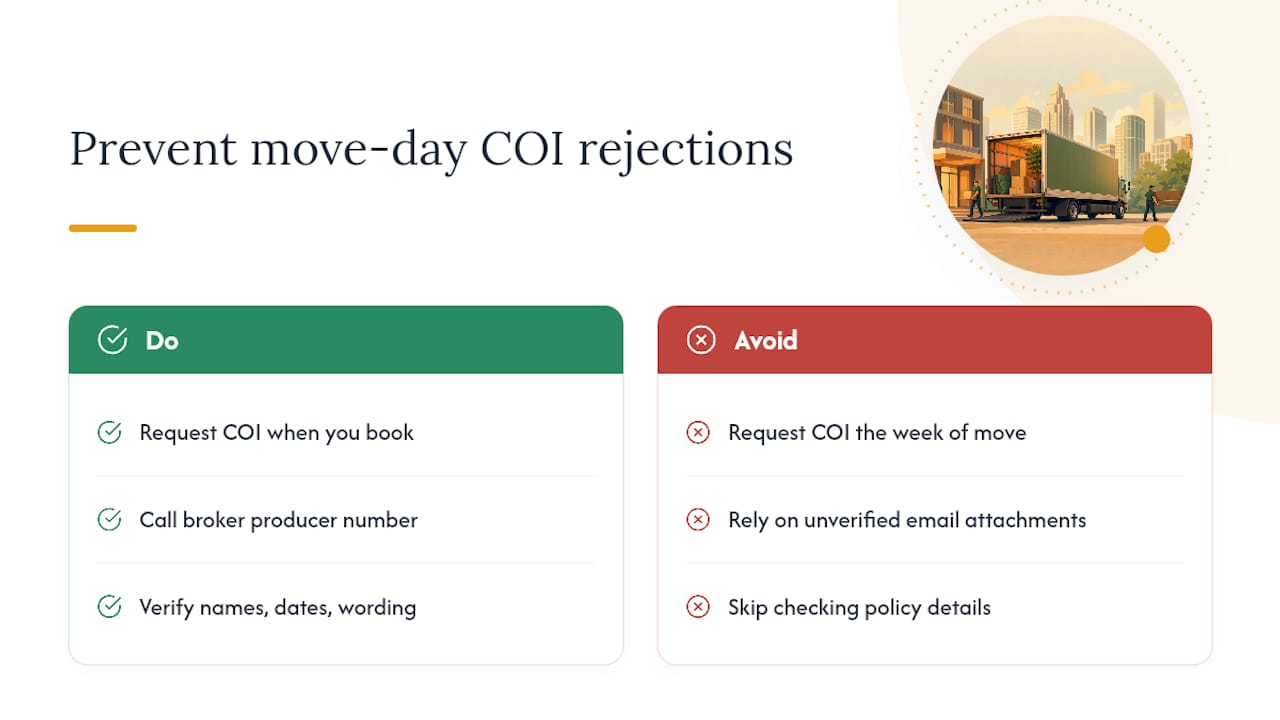
The bigger failure isn’t the COI itself. It’s timing. People request certificates the week of the move, when a broker needs a few days and a building needs a few more to review. Building the request into your moving timeline the day you book, not the week before, solves most of the anxiety around this entirely.
What gets underestimated is how much a phone call to the broker’s producer number resolves. Buildings reject email attachments they can’t verify. A thirty-second call confirming the policy is active does more than any amount of re-reading the form yourself. Prioritize that step, and the rest of this process stops feeling uncertain.
— Info
Let Move Craft Handle Your Move-Day Paperwork
Chasing down a mover’s broker for the right certificate language, while also packing a house and transferring utilities, is exactly the kind of task that falls through the cracks. Move Craft coordinates COI requests directly with each carrier’s operations team, follows up with the broker until the certificate is issued, and confirms your building has accepted it in writing before your move date arrives.

That kind of hands-on coordination is built into how Move Craft manages every long-distance relocation, not treated as an afterthought once a truck is booked. If you’re planning a move into a building with insurance requirements, start by reviewing the long-distance moving process Move Craft coordinates from booking through move-in, and let the team handle the broker follow-up so you don’t have to.
Sources
Readers can review the Mover Scorecard COI breakdown, Columbia Residential’s certificate requirements, and a sample bill of lading to compare against their own building’s paperwork before forwarding requirements to a mover.
- Certificate of Insurance (COI) for Movers | Mover Scorecard
- Certificate of Liability Insurance (COI) – Columbia Residential