
A broken chain of custody during an office move can make your records inadmissible in court, trigger a HIPAA investigation, and void an insurance claim before you finish unpacking. The fix is not complicated, but it requires three things from the start: one named accountable owner, a timestamped inventory with unique IDs and tamper-evident seals, and a signed transfer log at every handoff.
Before move day, lock in these controls:
- Assign a single move owner with authority to pause the move, reject unsigned handoffs, and escalate custody disputes.
- Build an asset register that captures serial numbers, photos, department ownership, and destination for every item in scope.
- Require escorted handoffs at loading, transit, and delivery, with a signed log recording who released, who received, the time, and the condition of each item.
These three steps do not eliminate every risk, but they create the paper trail that keeps your organization defensible when a regulator, insurer, or opposing counsel asks what happened to a specific file or device.
Key Takeaways
A defensible chain of custody during an office move requires one accountable owner, a timestamped asset register, signed transfer logs at every handoff, and vendor contracts that include liability clauses and audit rights.
| Point | Details |
|---|---|
| Assign one move owner | A single named person with authority to pause the move prevents the “someone else’s job” failure. |
| Three required controls | Timestamped inventory with unique IDs, tamper-evident seals, and signed transfer logs at every handoff. |
| Legal and regulatory stakes | Gaps in custody can make records inadmissible under Fed. R. Evid. 901 and trigger HIPAA exposure for PHI. |
| Vendor contracts matter | Require liability clauses for custody gaps, audit rights, BAAs for PHI, and a named authorized signer. |
| Movecraftmoving’s model | Movecraftmoving’s three-checkpoint process delivers a signed, photographic custody record from packing through same-day reconciliation. |
Table of Contents
- Why chain of custody matters during an office move
- The legal, regulatory, and financial consequences of a broken chain
- Where custody typically breaks down during a relocation
- How to enforce chain of custody from planning through post-move reconciliation
- Physical records vs. digital assets: different risks, same standard
- What to require from moving vendors and contractors
- Documentation standards, required form fields, and retention guidance
- Who owns what: roles, responsibilities, and governance
- Timeline phases and cost drivers for defensible custody controls
- How Movecraftmoving operationalizes chain of custody for office relocations
- What most teams get wrong about custody during a move
- Movecraftmoving keeps your custody chain intact from first box to final reconciliation
- Sources
Why chain of custody matters during an office move
Chain of custody is the chronological documentation of custody, control, transfer, analysis, and disposition of physical and digital assets. That definition comes from NIST’s CSRC glossary, which extends it explicitly to digital evidence, making it directly applicable to the laptops, servers, and backup media that travel alongside paper records in any office relocation.
In a relocation context, the standard covers:
- Paper records, client files, HR documents, and legal files
- Laptops, workstations, servers, and network hardware
- Backup media, USB drives, and portable storage
- Storage containers, locked cabinets, and safes
- Access credentials, keys, and physical security tokens
It does not cover furniture, general office supplies, or items with no regulatory, legal, or financial significance. The standard applies from the moment an item is packed to the moment it is confirmed received and reconciled at the destination.
Three frameworks give this standard its teeth. ISO 22095 establishes the general principles for chain of custody in supply chains. NIST guidance covers digital asset custody. And Federal Rule of Evidence 901 requires that any party offering an item as evidence must authenticate it, which in practice means showing an unbroken custody record.
The legal, regulatory, and financial consequences of a broken chain
The stakes here are concrete, not theoretical.
Legal admissibility. Under Fed. R. Evid. 901, authentication is a threshold requirement. A documented chain of custody is the standard mechanism for meeting it. The NIJ’s forensic training guidance is direct on this point: the documented chain is the primary defense against claims that evidence was planted, substituted, or tampered with, and any gap gives opposing counsel grounds to challenge authenticity. Courts weigh discrepancies as a reliability issue, so even a minor gap can reduce evidentiary weight without fully excluding the item.
Regulatory exposure. For organizations handling protected health information, HIPAA compliance during a move requires pre-move inventory of PHI locations, tamper-evident lockable containers, limited authorized handlers, Business Associate Agreements with any vendor touching PHI, and same-day reconciliation. State privacy laws in California, Virginia, and New York impose similar documentation obligations for personal data. A move that lacks these controls is not just operationally risky; it is a reportable event waiting to happen.
Insurance and financial exposure. Insurers require a pre-move asset register and defensible custody logs to process claims. Missing asset registers and poor tracking during moves lead directly to uninsured losses and extended recovery timelines. If you cannot prove an item existed, was in your possession, and was damaged or lost in transit, the claim is denied.
Operational impact. Beyond legal and regulatory risk:
- Downtime from missing or misplaced equipment can last multiple days when no inventory exists to guide recovery.
- Reputational damage from a disclosed data incident during a move is difficult to quantify and harder to reverse.
- Recovery costs for reconstructing lost records or replacing untracked devices routinely exceed the cost of the controls that would have prevented the loss.
Where custody typically breaks down during a relocation
Office moves fail custody standards at predictable points. Knowing them in advance lets you place controls where they actually matter.
-
Packing and labeling errors. Boxes leave without unique identifiers, serial numbers go unrecorded, and non-unique labels (“Box 12 — Finance”) create ambiguity when two boxes from the same department go to different floors. A single mislabeled container of HR files can create a compliance gap that takes weeks to close.
-
Unsupervised handoffs to movers or subcontractors. The moment a mover’s crew takes possession of a pallet without a signed transfer log, custody is broken. GRM Document Management notes that moves and consolidations are among the most frequent triggers of records-handling failures, precisely because handoffs happen fast and informally.
-
Transit gaps. Vehicles stop overnight. Trucks are unmarked. A driver makes an unscheduled stop. Without a vehicle manifest and GPS tracking, you cannot prove where an item was between loading and delivery.
-
Temporary warehousing. Items placed in interim storage are particularly vulnerable. Mixed inventories, shared warehouse space, and rotating warehouse staff create conditions where items are retrieved without documentation or commingled with another client’s assets.
-
Personnel turnover mid-move. A records manager who leaves two weeks before move day takes institutional knowledge with them. If the inventory lives in their head or a personal spreadsheet, the custody record has a gap before the first box is packed.
-
Ad-hoc retrievals. An executive needs a file from a sealed box the night before the move. The seal is broken, the item is removed, and no one logs it. That box now has a custody gap that will surface in an audit.
-
Split paper and digital inventories. When the IT team tracks devices in one system and facilities tracks physical records in another, reconciliation at the destination is nearly impossible without a unified manifest.
How to enforce chain of custody from planning through post-move reconciliation
This is an executable checklist, not a policy document. Adapt it to your organization’s scale.
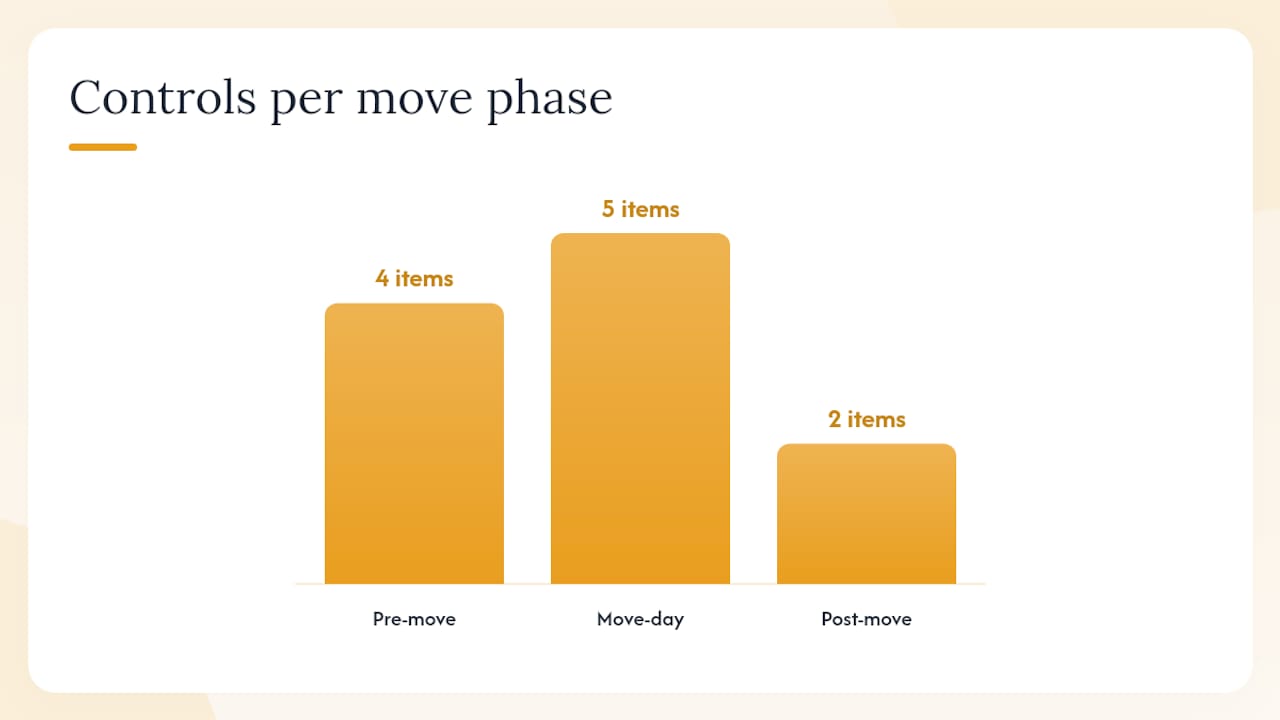
Pre-move controls
-
Appoint a single move owner. This person has authority to halt packing, reject unsigned handoffs, and escalate disputes. Assigning a named IT owner and a named records owner reduces the ambiguity that causes custody gaps. One person per domain, one escalation path.
-
Build the asset register. Every item in scope gets a unique ID, a photo, a serial number where applicable, the owning department, and the destination location. Use a long-distance moving inventory checklist as a starting template and adapt it for regulated items.
-
Classify items by sensitivity. Separate regulated items (PHI, financial records, legal files, data-bearing devices) from general office assets. Regulated items get dedicated containers, separate handling protocols, and a shorter authorized-handler list.
-
Source tamper-evident materials. Numbered tamper-evident seals, lockable containers, and non-descriptive external labels (no “Patient Records” on the outside of a box) are minimum requirements for regulated items.
Move-day protocol
-
Packing checkpoint. Before any box is sealed, verify the unique ID is affixed, the seal number is logged, and the contents match the register. A second person confirms and signs.
-
Transfer log at loading. The releasing party and the receiving mover both sign a transfer log that records: item IDs transferred, seal numbers, condition at handoff, date and time, and names of both parties. No signature, no movement.
-
Vehicle manifest. Every vehicle carries a manifest listing every item ID loaded, the seal numbers, and the driver’s name. The manifest travels with the load, not separately.
-
Escorted transport for high-risk items. Regulated records and data-bearing devices should travel with an authorized escort, or in a dedicated locked vehicle with GPS tracking and a documented chain of possession for every stop.
-
Transfer log at delivery. The receiving party inspects each item against the manifest, notes condition, confirms seal integrity, and signs. Any discrepancy is flagged immediately, not at end-of-day reconciliation.
Post-move reconciliation
-
Same-day scan and reconcile. Every item ID is scanned or checked against the register before the move is declared complete. Discrepancies trigger a hold on the affected items pending investigation.
-
Retain custody records. Signed transfer logs, vehicle manifests, seal logs, and the asset register are retained for the applicable audit period (see documentation standards below). Store them in a secure, immutable format.
Pro Tip: Packing speed is the enemy of accuracy. Build a 15-minute checkpoint into the packing schedule for every 20 boxes. It feels slow on the day and saves days of recovery afterward.
Physical records vs. digital assets: different risks, same standard
The custody standard is identical for paper and digital assets, but the controls look different.
Physical records face contamination, unauthorized access during transit, and the straightforward risk of a box going to the wrong floor or into the wrong truck. The controls are primarily procedural: sealed containers, unique labels, signed handoffs, and escorted transport.
Digital assets and devices carry a different threat profile. A laptop without full-disk encryption is a data breach waiting to happen if it goes missing in transit. A server moved without a verified backup is an operational catastrophe if it is damaged. For IT-specific controls:
- Verify full-disk encryption on every device before it leaves the origin site.
- Capture IMEI and serial numbers for all mobile devices; asset-tag every workstation and server.
- Complete and verify backups before any device is physically moved. Cybersecurity guidance for commercial moves emphasizes validated backups and tested recovery procedures as non-negotiable pre-move steps.
- Use tamper-evident packing for drives and storage media.
- Log all privileged access during the migration window and rotate credentials immediately post-move.
- Validate cloud data transfers before wiping any local storage.
- For decommissioned equipment, use WEEE-compliant certified data destruction and retain the destruction certificate as part of the custody record.
IT equipment moving specialists can manage the device-level custody chain for organizations without dedicated IT relocation staff.
One area where the two converge: access credentials. A move creates temporary security gaps at both the origin and destination. Security planning for moves requires early decisions on access control, camera coverage, and removal of old credentials. Treat credential rotation as a custody event, not an afterthought.
What to require from moving vendors and contractors
Vendor selection is a custody decision. A mover who cannot demonstrate documented handling procedures is a custody gap waiting to open.
Vendor vetting checklist:
- Active USDOT license and FMCSA registration (verify at safer.fmcsa.dot.gov).
- General liability and cargo insurance with limits appropriate to the value of assets being moved.
- Background checks on all personnel who will handle regulated items.
- References from at least two secure or records-sensitive moves.
- Written standard operating procedures for chain-of-custody handling.
- A clear subcontracting policy: no substitution of personnel or vehicles without prior written approval.
Contract and SOW requirements:
- Escorted handling for regulated items, with named authorized handlers.
- Vehicle manifests required for every load.
- Tamper-evident seals on all regulated containers, with seal numbers logged.
- Liability clause for custody gaps: the vendor bears financial responsibility for items that cannot be accounted for due to missing transfer documentation.
- Audit rights: your organization retains the right to inspect custody records for 12 months post-move.
- Retention of all transfer logs for a minimum of three years.
- Confidentiality agreement and, for PHI, a signed Business Associate Agreement before any work begins.
For a complete vendor coordination checklist, use it as the basis for your RFP scoring criteria. Contract best practices for licensed movers cover the clause language in more detail.
On move day: verify IDs of all personnel against the approved handler list, confirm chain-of-custody training has been completed, and establish who is authorized to sign transfer logs on the vendor’s behalf.
Documentation standards, required form fields, and retention guidance
A chain-of-custody form is only as good as its fields. The table below covers the minimum required fields and the reason each one matters.
| Field | Why it matters |
|---|---|
| Unique item ID | Ties the physical item to the register entry; prevents substitution claims |
| Description and condition at origin | Baseline for damage claims and authenticity challenges |
| Seal number (if applicable) | Proves the container was not opened between checkpoints |
| Releasing party name and signature | Establishes who last had authorized possession |
| Receiving party name and signature | Establishes who accepted custody and when |
| Date and time of transfer | Creates the chronological record required by NIST and courts |
| Location of transfer (origin/destination) | Narrows the window if an item goes missing |
| Method of transport / vehicle ID | Ties the item to a specific vehicle for transit accountability |
| Discrepancies noted | Documents condition changes or missing seals at receipt |
Retention guidance. For general business records, retain custody logs for a minimum of three years. For records subject to HIPAA, retain for six years from the date of creation or last effective date. For items involved in or reasonably anticipated for litigation, apply a litigation hold and retain indefinitely until the hold is released. For financial records subject to SEC or IRS requirements, follow the applicable retention schedule (typically seven years).
Standards to cite in procurement and audit packs:
- ISO 22095 for general chain-of-custody principles.
- NIST CSRC glossary for digital asset custody definitions.
- Fed. R. Evid. 901 for authentication requirements in legal proceedings.
- HIPAA Security Rule for PHI-specific handling obligations.
Store custody records in a secure, immutable format: a cloud system with audit logging and access controls, or locked physical records with a documented access log. Export formats for audits should be PDF or CSV with hash verification where the system supports it.
Who owns what: roles, responsibilities, and governance
A custody chain with multiple owners is a custody chain with no owner. Assign these roles before the planning phase begins.
-
Move owner (single accountable). Holds final authority over all custody decisions: approves the asset register, signs off on vendor selection, and has authority to pause the move if custody controls are not met. This role coordinates employees and enforces temporary access rules across the organization.
-
Records manager. Owns the paper records inventory, classifies items by sensitivity, and signs transfer logs for regulated documents. Responsible for post-move reconciliation of physical records.
-
IT lead. Owns the device inventory, verifies encryption and backup status pre-move, and signs transfer logs for all data-bearing devices. If no internal IT owner exists, a dedicated IT relocation coordinator should be engaged.
-
Security officer. Approves the authorized-handler list, manages credential rotation, and reviews access control changes at both sites. Responsible for physical security during the move window.
-
Facilities coordinator. Manages logistics: packing schedules, vehicle coordination, and space readiness at the destination. Supports the move owner on operational decisions.
-
Vendor lead. The mover’s designated point of contact, authorized to sign transfer logs on the vendor’s behalf. Named in the contract before move day.
Governance flow. Any custody exception (broken seal, missing item, unauthorized handler) escalates to the move owner within one hour. The move owner decides whether to pause the move, require re-inspection, or accept the discrepancy with documentation. No exception is resolved informally. All decisions are logged.
Authority levels: only the move owner or records manager may authorize opening a sealed container post-packing. Only the move owner may authorize resuming a paused move. Vendor personnel may not open any container without a named organizational representative present.
Timeline phases and cost drivers for defensible custody controls
Planning for chain-of-custody controls adds time and cost to a move. The table below gives realistic ranges for each phase and the primary cost drivers.
| Phase | Typical duration | Primary cost drivers |
|---|---|---|
| Planning and inventory | several weeks | Staff time for asset register, tagging materials, classification |
| Vendor selection and contracting | 1–2 weeks | RFP process, legal review of BAAs and liability clauses |
| Pre-move validation | several days | Encryption verification, backup confirmation, seal procurement |
| Move day checkpoints | the day of the move | Escorted transport premium, overtime for checkpoint staff |
| Same-day reconciliation | several hours | Staff time, scanning equipment, discrepancy investigation |
| Post-move audit | 1–2 weeks | Records review, custody log filing, IT credential rotation |
Where to accept cost trade-offs. For general office assets with no regulatory significance, a basic inventory and signed manifest is sufficient. The premium controls (escorted transport, GPS tracking, dedicated vehicles, on-site security officers) are justified when the move involves regulated data, items under litigation hold, or assets whose loss would trigger a reportable incident.
A commercial moving timeline that does not include custody checkpoints as named milestones is a timeline that will miss them under pressure. Build them in as hard stops, not optional reviews.
How Movecraftmoving operationalizes chain of custody for office relocations
Movecraftmoving uses a three-checkpoint custody model that maps directly to the controls described above.

Packing checkpoint. Before any container is sealed, a Movecraftmoving coordinator verifies that every item has a unique ID, the asset register entry is complete, and the tamper-evident seal number is logged. High-risk items (regulated records, data-bearing devices) are packed separately with dedicated seal series. Photographic evidence is captured for items above a defined value threshold.
Vehicle checkpoint. At loading, the vehicle manifest is reconciled against the packing checkpoint log. The releasing party and the Movecraftmoving carrier representative both sign the transfer log. No vehicle departs without a complete, signed manifest.
Delivery checkpoint. At the destination, every item ID is scanned against the manifest. Seal integrity is verified before any container is opened. The receiving party signs the transfer log, and any discrepancy is flagged immediately for investigation before the move is declared complete.
Same-day reconciliation is a standard deliverable, not an optional add-on. The asset register is updated in real time, and the custody record is retained and available for client audit.
What to prepare before Movecraftmoving scopes your move. A clean asset register (even a spreadsheet with item descriptions, serial numbers, and owning departments) lets the scoping team accurately price the custody controls your move requires. A list of regulated or sensitive items and any access restrictions at origin or destination allows the team to plan authorized-handler lists and vehicle assignments before move day. The more complete your register, the more accurate the quote and the tighter the custody controls on the day.
What most teams get wrong about custody during a move
The single most common avoidable failure is not a missing form or the wrong seal. It is the assumption that custody is someone else’s job. A records manager assumes IT is tracking devices. IT assumes facilities is managing the records. The mover assumes the client has a manifest. Nobody does.
The simplest policy fix is a one-page RACI that names one person for each custody domain before the planning phase opens. Not a committee. One person per domain, with a phone number and the authority to say no.
If you were called into a risky move with two weeks to go, here is where to start:
- Freeze the asset register. Stop any ad-hoc packing and require every item to be logged before it moves.
- Identify the regulated items immediately and assign a dedicated handler to each category.
- Get a signed BAA from every vendor who will touch PHI before they set foot on site.
- Build the transfer log template and brief every person who will sign one on what it means and why it cannot be skipped.
- Run a tabletop exercise the day before the move: what happens if a seal is broken at delivery? Who calls whom? What gets paused?
The organizations that handle custody well during moves are not the ones with the most sophisticated technology. They are the ones where every person involved knows exactly what they are responsible for and has the authority to enforce it.
Movecraftmoving keeps your custody chain intact from first box to final reconciliation
Office moves are where custody chains break, and the consequences show up months later in an audit, a claim denial, or a court filing. Movecraftmoving’s three-checkpoint model (packing, vehicle, delivery) gives you a documented, signed custody record at every transfer point, with same-day reconciliation and photographic evidence for high-risk items.

Movecraftmoving vets every carrier for integrity, documented handling procedures, and compliance with custody expectations before they touch your assets. For organizations moving regulated records or data-bearing devices, that vetting is the difference between a defensible move and an incident report. The business relocation strategy starts with the right partner, not the lowest bid.
To get an accurate quote, have your asset register, regulated-item list, and preferred move window ready. Request a quote from Movecraftmoving and get a custody-focused move plan built around your timeline and compliance requirements.
Sources
- NIJ-hosted training: chain of custody (NIJ)
- Chain of Custody – StatPearls (NCBI Bookshelf)
- NIST CSRC glossary: chain of custody
- Federal Rules of Evidence 901 (Cornell LII)
- The Complete Guide to IT asset tracking during a move (Cloudswitched)
This article is general information, not a substitute for advice from a qualified lawyer. Consult a qualified legal professional about your own circumstances before acting on anything here.
Recommended
- How to Coordinate Employees During an Office Move – Move Craft Moving Solutions LLC
- Commercial Move Vendor Coordination Checklist for 2026 – Move Craft Moving Solutions LLC
- Interstate East Coast Moving Paperwork: 2026 Guide – Move Craft Moving Solutions LLC
- How to Label Boxes for a Residential Move – Move Craft Moving Solutions LLC