
Relocating to Seattle makes sense if you can handle high housing costs and gray winters in exchange for strong tech and healthcare wages, real transit options, and zero state income tax. It’s a tougher call if you need cheap rent or can’t stomach rain from November through March. Start with three moves today: set a housing and moving budget, pick two or three target neighborhoods based on your likely commute, and begin the Washington driver’s license process, since the state gives new residents only 30 days after establishing residency to get licensed.
- Set your number first: King County’s median home price sits near $859,618, and one-bedroom rents typically run $2,000 to $3,200.
- Shortlist neighborhoods by commute, not vibe alone. You can research culture after you’ve ruled out a two-hour round trip.
- Start your WA DOL paperwork now. It’s the one bureaucratic step with a hard clock attached.
Key Takeaways
Relocating to Seattle works best when you sequence your budget, neighborhood shortlist, and DMV paperwork before you fall in love with a specific block.
| Point | Details |
|---|---|
| Budget with real numbers | King County’s median home price is near $859,618, with 1BR rents running $2,000 to $3,200. |
| Shortlist by commute first | Pick a transit-rich option like Capitol Hill and an affordability option like Beacon Hill, then compare travel times. |
| Watch the 30 day clock | Washington requires new residents who drive to get a license and register a vehicle within 30 days of establishing residency. |
| Book movers before peak season | Summer demand drives up prices and shrinks available delivery windows for long-distance moves. |
| Coordinate through Movecraftmoving | Movecraftmoving vets carriers for licensing and insurance and manages delivery timing against your lease and utility dates. |
Table of Contents
- Which Seattle Neighborhoods Fit Your Life?
- What Does It Cost to Live in and Move to Seattle?
- How Do You Rent or Buy a Home From Out of Town?
- Is Seattle Livable Without a Car?
- What Utilities Do You Need to Set Up Before Move-In?
- What’s the Full Timeline for Moving to Seattle?
- What Do Locals Wish New Residents Knew?
- How Does Move Craft Reduce Relocation Risk?
- What Should You Prioritize When Relocating to Seattle?
- Get Move Craft Coordination for Your Seattle Move
- Where Can You Verify These Steps?
- Sources
Which Seattle Neighborhoods Fit Your Life?
Seattle isn’t one housing market. It’s a dozen small ones stitched together by hills, water, and a light rail line that’s still filling in gaps. Where you land should depend on your commute tolerance and your budget ceiling more than which neighborhood sounds coolest on Instagram.
Downtown and Belltown suit people who want to walk to work and don’t mind paying for it. Expect the top end of the rent range, dense high rises, and constant street noise. Good for singles or couples without cars.
Capitol Hill is transit rich and nightlife heavy, with a light rail station and dense bus routes. It fits renters in their 20s and 30s who want walkability and don’t need a yard.
Ballard draws families and young professionals who want a neighborhood feel, breweries, and a Sunday farmers market, though it’s a longer bus or car commute downtown without a direct rail link yet.
Beacon Hill and Columbia City offer some of the city’s more affordable pockets alongside genuine ethnic and economic diversity, plus a direct light rail line downtown. This is often the best value-to-commute tradeoff in the city.

West Seattle feels like its own small town on a peninsula, but the West Seattle bridge closures over the past few years have made car commutes unpredictable. Check current bridge status before committing here.
South Lake Union sits next to Amazon’s campus and other tech offices, making it ideal for a short walk-to-work life, though it’s short on grocery stores and green space.
The U District skews younger and cheaper, built around the University of Washington, with solid light rail access north and south.
If you’re unsure where to start, pick one transit-rich option like Capitol Hill or Columbia City and one affordability-focused option like Beacon Hill, then compare commute times from each before you sign anything.
What Does It Cost to Live in and Move to Seattle?
Budget for two separate expenses: the move itself and the higher baseline cost of living once you’re here. King County’s median home price runs around $859,618, and one-bedroom rents generally fall between $2,000 and $3,200 depending on neighborhood and building age. That’s a wide range, and the difference between the low and high end usually comes down to whether you’re paying for a light rail station at your doorstep.
The upside: Washington has no state income tax, which meaningfully changes your math if you’re coming from a high-tax state like California or New York, where a comparable salary can lose a noticeable chunk to state withholding. That gap can offset a good portion of Seattle’s higher rent, especially for dual-income households or anyone in tech, healthcare, or finance where local pay tends to run above the national median.
Movers typically charge more locally for smaller in-city moves than for long-distance runs priced per mile, and rates climb further during peak moving season from May through September. Budget for these line items beyond the movers themselves:
- Security deposit plus first month’s rent, often equal to two to three months of rent up front.
- Moving company costs, higher if you book during summer without advance notice.
- Temporary lodging if your move-in date and departure date don’t line up.
- Utility deposits, especially if you have no local credit history.
- Renters or homeowners insurance, often required before you get keys.
How Do You Rent or Buy a Home From Out of Town?
Securing housing before you’ve physically seen it is the single riskiest part of relocating to Seattle, and it’s also completely manageable if you follow a sequence instead of winging it.
- Book virtual tours and 3D walkthroughs before you rule out a place. Ask the leasing agent specifically about noise levels, building maintenance response times, and storage, since photos never show any of that.
- Line up a trusted local agent or property manager who can walk a unit for you and give you an honest read on the building and block.
- Gather your application documents early: photo ID, recent pay stubs, and rental references. Most Seattle landlords want income at 2.5 to 3 times the monthly rent, and application fees plus turnaround times vary by building, so ask upfront.
- If you’re buying, get a fully underwritten pre-approval, not just a pre-qualification letter, before you start touring. Remote closings with mobile notaries are routine in this market now, and a rising inventory has created a real window for buyers, though mortgage rates remain the binding constraint on what you can actually afford.
- Give yourself three to six months of prep time if you’re buying, and start attaching to a local buyer’s agent early in that window.
Pro Tip: If you’re signing a lease sight unseen, protect yourself with a short first term (six to nine months instead of a full year), confirm your deposit is held in a separate account as Washington law requires, and ask for timestamped walk-through photos before you take possession.
Is Seattle Livable Without a Car?
You can go car-free in Seattle, but where you live decides whether that’s comfortable or miserable. Sound Transit’s light rail line runs from the airport through downtown, Capitol Hill, and up toward the University District, with expansions in progress that keep shifting which neighborhoods get direct rail access. King County Metro buses fill in nearly everywhere else, and Washington State Ferries connect West Seattle, Bainbridge Island, and other water-locked spots to downtown.
The ORCA card works across light rail, buses, and ferries, so get one in your first week rather than buying single-ride tickets. Load it through a transit app and check real-time arrivals with OneBusAway or the Transit app before you leave the house.
Commute reality check: I-5 and SR-520 back up hard during rush hour, and the West Seattle bridge’s repair history has made that crossing unpredictable for years. Before you sign a lease, look up the walking radius from the nearest light rail station and factor in ferry schedules if your route crosses water.
What Utilities Do You Need to Set Up Before Move-In?
Seattle splits utilities across three separate providers, so budget lead time for each before your move-in date.
- Seattle City Light handles electricity. Set up service a week or two ahead so power is live the day you arrive.
- Puget Sound Energy covers natural gas in most Seattle neighborhoods, separate from electric.
- Seattle Public Utilities manages water, sewer, and garbage, typically billed together.
- Internet and cable availability varies block by block, so confirm coverage at your exact address before signing a lease, not after.
- Watch for phishing texts and robocalls claiming to be city billing. The city’s own Newcomer’s Guide warns residents to verify any payment request directly through seattle.gov rather than clicking a link in a text.
What’s the Full Timeline for Moving to Seattle?
Work backward from your move date and this gets far less chaotic.
Three to six months out:
- Research neighborhoods and, if you have kids, school boundaries.
- Start a relationship with a local agent, whether renting or buying.
- Begin decluttering and get a mortgage pre-approval if you’re buying.
Six to eight weeks out:
- Finalize housing and sign paperwork.
- Book your moving company, especially if you’re moving during summer’s peak demand window with reliable Seattle Group Transportation | Luxury Van & SUV Service for smooth transport arrangements.
- Arrange storage if your old and new dates don’t align.
The week before and move day:
- Confirm utility start dates.
- Gather passports, birth certificates, medical records, and lease or closing documents in one folder.
- Pack a first-night essentials bag: toiletries, chargers, medication, one change of clothes per person.
First week and first month after arrival:
- Get your Washington driver’s license within 30 days of establishing residency and register your vehicle at the same visit.
- Set up renters or homeowners insurance and photograph your unit’s condition before unpacking, in case of a deposit dispute later.
- Find and register with a primary care provider near your new address.
What Do Locals Wish New Residents Knew?
Seattle’s weather reputation is half wrong. It’s rarely a downpour, more a persistent drizzle from November through March, punctuated by real sun in July and August. If gray skies drag on you, invest in a light therapy lamp and keep an outdoor routine going even in the wet months. Layering matters more than a heavy coat.
Property crime, especially car break ins, is a real concern in some commercial districts and near light rail stations. Park in monitored garages when you can and stay aware walking alone at night, without treating every block as a threat.
The city’s outdoor access is genuinely one of its best features, from urban trail systems to nearby mountains, and locals build entire weekend routines around it. Coffee culture here is a real ritual, not a cliché, and ferries double as a daily commute and a scenic reset.
Pro Tip: Tour any neighborhood you’re considering on a weekday morning and again on a weekend evening. Both visits show a different, truer version of the block than a single Saturday afternoon walk-through ever will.
How Does Move Craft Reduce Relocation Risk?
Most relocation failures aren’t dramatic. They’re a mover who doesn’t show up on the promised day, a delivery window that slides by a week with no warning, or paperwork that goes missing between your old state and Washington. Any one of those turns a manageable move into a scramble for temporary housing and replacement furniture.
Movecraftmoving works as a relocation strategist layer between you and the carrier network, vetting movers for licensing, insurance, and track record before matching you to one. That vetting step is the difference between hoping a mover shows up and knowing they will, because someone already checked their complaint history and insurance status for you.
- Carrier vetting for licensing, insurance, and performance history.
- Logistics orchestration across pickup, transit, and delivery windows.
- Timeline management so utility start dates, lease dates, and delivery dates actually line up.
Radical transparency and punctuality aren’t marketing language here. They’re the standard Move Craft holds every vetted carrier to before a single box gets loaded.
[brand_signal] [author_bio]
What Should You Prioritize When Relocating to Seattle?
The conventional advice treats a Seattle move like a spreadsheet exercise: compare rent, compare commute times, pick the highest score. That misses the real failure point, which is timing. People lock in a lease six weeks before their movers can actually book a summer slot, or they schedule a driver’s license appointment for week four and forget the 30-day clock started the day they signed their lease, not the day they unpacked the last box.
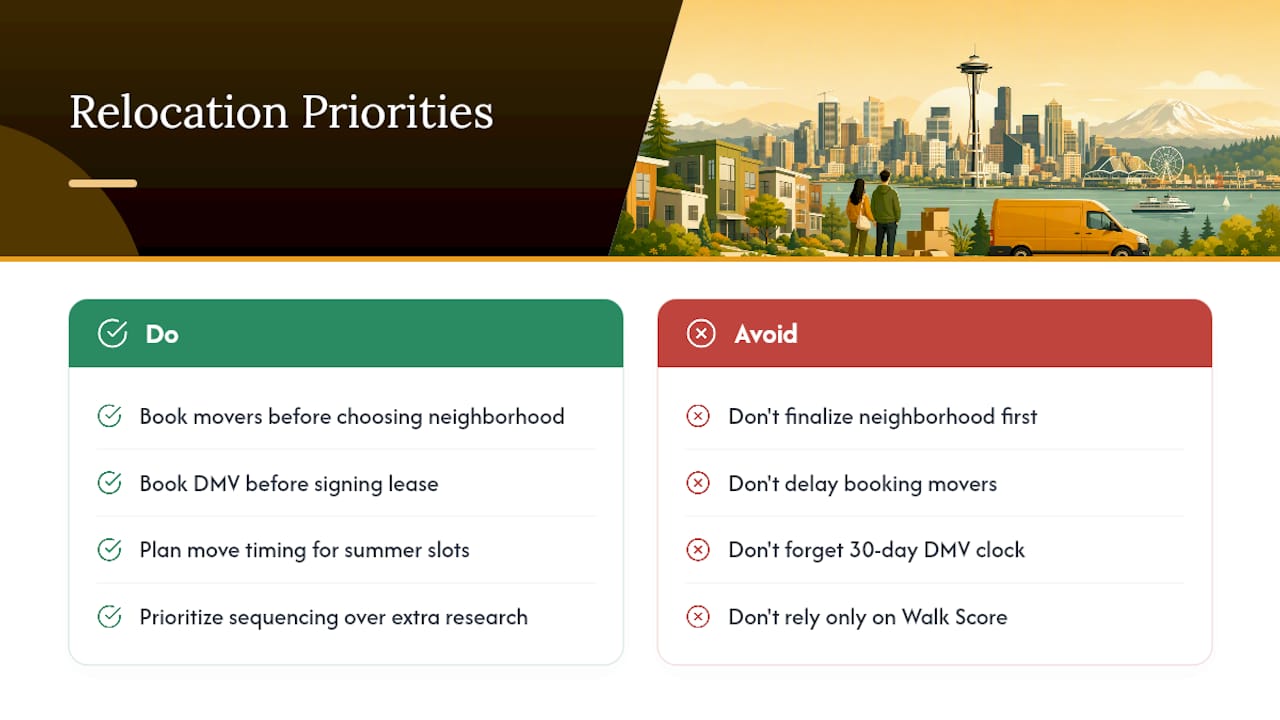
My honest read, based on how these moves typically break down, is that sequencing beats research. A mediocre neighborhood choice with a well-timed move beats a perfect neighborhood choice paired with a scrambled, last-minute logistics chain. Renters obsess over Walk Score and bus frequency, then get blindsided by a mover who quotes a two-week delivery window during peak season.
If you take one thing from this guide, take this: book your movers and your DMV appointment before you finalize your Instagram-perfect neighborhood shortlist. The neighborhood forgives a slow decision. The moving truck and the state’s paperwork deadlines do not.
— Info
Get Move Craft Coordination for Your Seattle Move
Movecraftmoving exists for exactly the scramble described above, when a lease start date, a mover’s schedule, and a DMV deadline all need to land in the same narrow window without colliding. Instead of calling five moving companies yourself and hoping the cheapest quote isn’t hiding a bait-and-switch, Movecraftmoving vets carriers for licensing and insurance first, then matches you to one built for your timeline and load size.

That matters most for long-distance moves into Seattle, where a missed delivery window can mean paying for temporary housing you never budgeted for. If your move involves crossing state lines, the rules and timing differ enough from a local move that it’s worth understanding before you book anything. Whether you’re relocating solo, with a family, or coordinating an employee move for work, start with a clear checklist so you know exactly what needs to happen and when, then get matched with a vetted carrier through Movecraftmoving.
Where Can You Verify These Steps?
Bookmark these before your move so you’re never guessing which office handles what.
- Seattle Newcomer’s Guide: utilities, transit contacts, and a phishing warning for city payment scams.
- WA Department of Licensing: driver’s license timing and the voter registration distinction.
- King County Metro: bus routes, schedules, and service alerts.
- Sound Transit: light rail trip planning and expansion updates.
- Bureau of Labor Statistics Seattle MSA profile: regional income and labor market data for budgeting.
Sources
- Seattle Newcomer’s Guide — City of Seattle
- Bureau of Labor Statistics — Seattle MSA profile
- PNW Residences — Seattle relocation guide
- Sound Transit
Recommended
- Should You Really Move to Florida in 2026? – Move Craft Moving Solutions LLC
- States with Highest Relocation Rates: 2026 Guide – Move Craft Moving Solutions LLC
- Full-Service Relocation Benefits for Families in 2026 – Move Craft Moving Solutions LLC
- Why East Coast Relocations Are Complex: 2026 Guide – Move Craft Moving Solutions LLC