
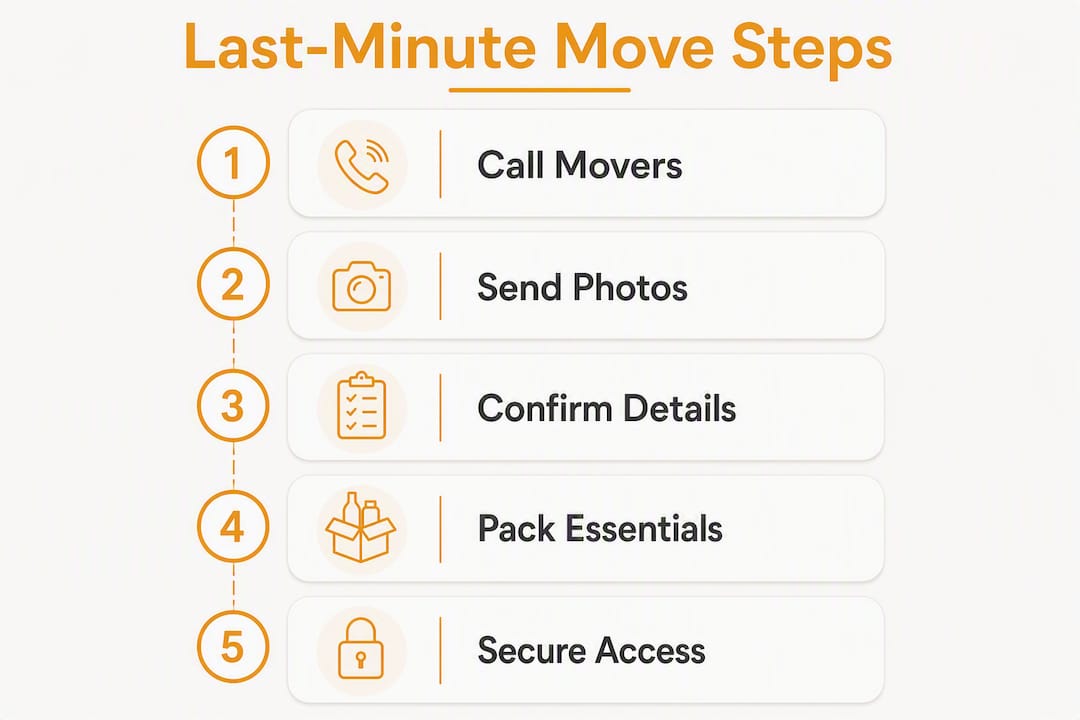
Call a vetted same-day mover right now with these six pieces of information: your move date, exact pickup and drop-off addresses, floor numbers, elevator or stair access, rough inventory size, and your cell number. That single call, made in the next 15 minutes, is the highest-leverage action in any last-minute local move booking. Everything else in this guide builds around it.
Before you dial, lock down these priorities:
- Confirm your move-out deadline (lease end date, landlord notice, or court order)
- Check building rules at both addresses (loading dock hours, elevator reservations, parking restrictions)
- Pack a 48-hour essentials bag first: medications, ID, phone chargers, two days of clothes, and any child or pet supplies
- Get written confirmation of rates, arrival window, and crew size before anyone loads a single box
- Note large or specialty items (piano, gun safe, sectional sofa) so dispatchers can send the right truck
Keep this list on your phone. The sections below walk you through each step in order, from the first 60 minutes through day-of coordination.
Table of Contents
- Your last-minute local move booking guide: the first 60 minutes
- How do you find and book last-minute local movers fast?
- How late can you actually book movers for same-day or next-day moves?
- What drives the price of an urgent local move?
- Packing triage: what to grab now and what to leave for the crew
- Building access is usually the real last-minute blocker
- How do you vet a mover quickly when you’re short on time?
- What are your options if movers aren’t available?
- Your booking script and final pre-arrival checklist
- Movecraftmoving handles the coordination so you don’t have to
- Key Takeaways
- The part most last-minute moving guides get wrong
- Helpful sources for verifying mover credentials and pricing
Your last-minute local move booking guide: the first 60 minutes
Speed and sequence matter here. Work through this in three blocks.
Minutes 0–10: Confirm the hard constraints
- Pull up your lease or move-out notice and write down the exact deadline time, not just the date.
- Call your building manager or super at the origin address. Ask: What are the allowed move windows? Is the freight elevator available today or tomorrow? Do you require a certificate of insurance from the moving company?
- Repeat that call for the destination building.
- Write both sets of answers on a notepad or in your phone notes. You will read these back to every mover you call.
Minutes 10–30: Do a photo run of both buildings
Walk every access point and photograph it. Send these images to dispatchers before they quote you — it cuts quoting time significantly and prevents day-of surprises.
Capture:
- Front door width and any step or lip at the entrance
- Stairwell turns and ceiling height on each landing
- Freight elevator interior dimensions (height, width, depth) and the door width
- Loading dock or parking zone, including any “No Parking” signs and their hours
- Any tight hallway corners between the elevator and your unit door
Compress the photos into a single text or email. Most dispatchers prefer a quick photo text over a long description.
Pro Tip: Take a short video walking the path from the parking zone to your front door. Dispatchers can spot a low ceiling or tight turn in seconds, and it saves a back-and-forth call.
Minutes 30–60: Start calling and packing simultaneously
- Call movers directly using the phone script in Section 3. Aim for three calls in this window.
- While you wait for callbacks, pack your essentials bag with medications, documents, chargers, a 48-hour clothing set, and kids’ or pet supplies.
- Pull furniture away from walls in the main rooms so movers can walk straight to each piece.
- Identify any items that need special handling (large mirrors, TVs, artwork) and set them aside with padding.
- Once a mover confirms availability, get a written estimate by text or email before you hang up.
How do you find and book last-minute local movers fast?

The fastest channel is a direct phone call to a local dispatch line. Web forms and booking apps often have processing delays that make them impractical when you need a crew within 24–72 hours. Calling movers directly lets a dispatcher check real-time truck and crew availability and confirm on the spot.
Channels ranked by speed
- Direct phone call to local dispatch: Fastest confirmation, real-time availability, best for same-day or next-day needs
- Labor-only apps (TaskRabbit, Dolly, HireAHelper): Good for load/unload help when trucks aren’t needed; availability varies by city
- Local Facebook groups and Nextdoor: Surprisingly fast for referrals, but vet anyone you find here carefully
- Movecraftmoving’s quick-match service: Vetted partner network with logistics coordination built in — useful when you want a single point of contact instead of calling five companies yourself
- Web chat on local mover sites: Slower than phone but faster than email forms; use only if phone lines are busy
- Email or online quote forms: Last resort for urgent moves — typical response windows make them impractical for same-day needs
Phone script: what to say and what to have ready
Open with: “Hi, I need to book a local move for [today/tomorrow] and I’m calling to check availability.”
Then give these fields in order:
- Move date and preferred start time
- Pickup address (street, city, floor number, elevator or stairs)
- Drop-off address (same details)
- Rough inventory: number of rooms or a quick list of large items
- Any access constraints: loading dock hours, elevator reservation status, parking situation
- Your cell number for same-day coordination
Ask back: “Can you confirm the hourly rate, minimum hours, any stair or long-carry fees, and send me a written estimate by text or email?”
Pro Tip: Have your photos ready to text the moment the dispatcher asks. Movers who can see the access points quote faster and arrive better prepared — fewer surprises mean fewer delays.
For a deeper list of questions to ask before you commit, the 15 questions to ask local movers resource covers rates, insurance, and cancellation terms in detail.
How late can you actually book movers for same-day or next-day moves?
Same-day means the crew arrives and loads on the same calendar day you call. Next-day means you book today for a move tomorrow. “Last-minute” in the industry typically covers anything under two weeks, but the real pressure zone is 72 hours or less.
Typical availability windows
| Urgency | Realistic availability | Typical response time |
|---|---|---|
| Same-day (call before 10 AM) | Moderate on weekdays; low on weekends and peak months | 30–90 minutes to confirm |
| Next-day | Good on weekdays; moderate on weekends | 1–4 hours to confirm |
| 48–72 hours out | High on weekdays; moderate on weekends | Same day confirmation usually possible |
A few patterns worth knowing:
- Weekday mornings are your best window. Dispatchers fill afternoon slots first; calling by 9 AM gives you the widest pick of crews.
- Weekends in May through September are the hardest. Summer is peak moving season, and Saturday slots fill days in advance.
- Month-end dates (the 28th through the 1st) are nearly as competitive as summer weekends. If your deadline falls here, call the night before and be ready to move early.
- Smaller local operators often have more flexibility than large national franchises for same-day work. They can reroute a single truck without a corporate approval chain.
If you call after noon for a same-day move and the first two companies are booked, pivot immediately to next-day options or the alternatives in Section 9.
What drives the price of an urgent local move?
Short notice costs more. Companies may reroute trucks, pull in extra labor, or apply a flat short-notice fee on top of standard hourly rates. Knowing the levers helps you control the bill.
Primary cost drivers
- Hourly rate and minimum hours: Most local movers charge a 2–3 hour minimum. Short-notice jobs rarely waive this.
- Crew size: A two-person crew handles most one-bedroom moves; three or four people are standard for larger homes or tight access.
- Stairs and long carry: Expect a per-flight fee or a flat surcharge if movers must carry items more than 75 feet from the truck.
- Elevator and shuttle runs: If the freight elevator is unavailable or the truck can’t park close, a shuttle van adds time and cost.
- Heavy or specialty items: Pianos, safes, and large appliances typically carry a flat add-on fee.
- Short-notice or emergency surcharge: Some companies add 10–25% on top of standard rates for same-day bookings.
Example price ranges for emergency local moves
| Home size | Typical emergency range | Main cost escalators |
|---|---|---|
| Studio / small apartment | $300–$600 | Stairs, minimum hours, short-notice fee |
| 1–2 bedroom home | $800–$1,500 | Crew size, elevator wait, long carry |
| 3+ bedroom home | $1,500–$3,000+ | Multiple trips, shuttle, specialty items |
Cost reality check: These ranges assume a local move (under 50 miles). Access problems — a freight elevator that needs a reservation, a loading dock with a two-hour window, or a long carry from a distant parking spot — can push any job toward the top of its range or beyond it.
Three ways to cut the bill right now
- Be fully packed before movers arrive. Every minute they spend waiting for you to finish a box is billed at the hourly rate. Getting packed before the crew shows up is the single most effective cost control on a same-day job.
- Move small loose items in your own car. Lamps, plants, small boxes, and anything fragile you want to handle personally should go in your vehicle. This reduces truck volume and loading time.
- Get the written estimate with line items. Ask for hourly rate, minimum hours, stair fees, and overtime policy in writing before the crew arrives. Disputes over surprise charges are far harder to resolve after the truck is unloaded.
Packing triage: what to grab now and what to leave for the crew
You don’t have time to pack everything perfectly. Sort into three categories and move through them in order.
Category 1: Pack yourself, right now (go-bag)
These items leave with you, not on the truck:
- Prescription medications and medical devices
- Passports, Social Security cards, birth certificates, and lease documents
- Phone, laptop, and all chargers
- 48-hour clothing set (two days, one bag)
- Cash, credit cards, and checkbook
- Kids’ comfort items, formula, or medications
- Pet food, leash, carrier, and vaccination records
Category 2: Ready for the crew
Large furniture, appliances, and sealed, labeled boxes go here. Pull furniture away from walls. Stack boxes near the door in the order you want them loaded (heaviest first, fragile last). Label each box with a room name and a priority number so the crew knows what goes on the truck first.
For fragile items you’re leaving to movers, wrap them now in clothing, towels, or bubble wrap and mark the box “FRAGILE — THIS SIDE UP” in large letters. The packing service guide covers when it makes sense to pay for professional packing on short notice.
Category 3: Leave, ship, or store later
Nonessential items — off-season clothes, books, decorative objects — can go into short-term storage or ship via USPS or UPS after the move. Don’t let these slow down the main move.
Pro Tip: Photograph every electronic device before you disconnect it. A quick photo of the back of your TV stand takes 10 seconds and saves 20 minutes of guessing which cable goes where at the new place.
Building access is usually the real last-minute blocker

Packing gets all the attention, but building access rules stop more short-notice moves than anything else. A freight elevator that requires 48 hours’ notice, a loading dock with a two-hour window, or a parking permit that takes a day to process can halt a same-day move before a single box is loaded.
Building checklist: make these calls before you book movers
- Call the building manager or super at both addresses. Ask specifically: What are the allowed move hours? Is the freight elevator available, and does it need a reservation? What insurance certificate does the moving company need to provide?
- Ask about parking. Is there a designated loading zone? Does it require a temporary permit? How long can a moving truck park there?
- Get the answers in writing. A text from the super or a confirmation email from the management office is enough. Forward it to your moving crew.
Quick fixes when building rules create a conflict
- Request a temporary parking permit from your city’s transportation department or parking authority. Many cities process these within a few hours online.
- Book the freight elevator immediately, even before you confirm a mover. Elevator slots fill fast on busy move days.
- If the loading dock has a narrow window (say, 8–10 AM only), build your entire move schedule around that window and tell movers the hard start time upfront.
- When parking is genuinely impossible close to the building, plan for a short shuttle: a cargo van parks on a nearby side street and ferries loads to the truck. It adds time but keeps the move legal.
Pro Tip: Reserve the elevator or loading dock in writing and screenshot the confirmation. Send that screenshot to your moving crew the night before or the morning of the move. It eliminates the “we didn’t know about the elevator window” delay that costs an hour of billable time.
For commercial moves with more complex vendor coordination, the vendor coordination checklist covers multi-party logistics in detail.
How do you vet a mover quickly when you’re short on time?
Speed pressure is exactly when scammers and unreliable crews count on you to skip due diligence. A five-minute vetting check is worth it every time.
Rapid vetting checklist
- Ask for the company’s full legal name and a physical street address (not a P.O. box).
- For any move that crosses state lines, ask for their USDOT number and verify it at the FMCSA mover search tool.
- Ask for proof of liability insurance and workers’ compensation coverage. A legitimate company sends this without hesitation.
- Request a written estimate with itemized fees: hourly rate, minimum hours, stair fees, long-carry charges, and cancellation policy.
- Ask for the crew arrival window and a direct contact number for the crew lead.
- Do a quick Google Maps search on the company address. If it doesn’t match a real business location, that’s a problem.
Red flags: walk away if you see any of these
- Cash-only payment demands, large upfront deposits, or no written estimate before the move
- Unmarked trucks with no company name or logo
- Vague or evasive answers when you ask about insurance
- Pressure to sign a contract immediately without time to read it
- A quote that seems dramatically lower than every other company you called
When the crew arrives, photograph the truck (license plate and company name), the crew lead’s ID, and any paperwork they hand you before loading begins. These photos are your protection if a dispute arises later. The licensed mover contract best practices guide explains what a legitimate moving contract should include.
What are your options if movers aren’t available?
When same-day full-service movers are booked out, you have four realistic fallbacks. Choose based on your timeline, budget, and how complex the job is.
Fallback options
- Labor-only crew + truck rental: You rent the truck (U-Haul, Penske, Budget) and hire local labor through an app or platform to load and unload. Works well for a studio or one-bedroom with straightforward access. Under tight deadlines with a small apartment, this is often the fastest DIY path.
- Short-term storage as a bridge: If you can’t move everything in one shot, move the essentials now and store the rest. A climate-controlled unit near your origin address buys you days or weeks to arrange a second trip. The East Coast storage guide covers how to book quickly.
- Partial service (load-only or unload-only): Some companies will send a crew just to load your truck or just to unload at the destination. This is cheaper than full service and often has better same-day availability.
- Friends and family: Reliable for small moves if you have enough people and a vehicle large enough. The risk is injury, damaged items, and the social cost of a chaotic day. Reserve this for truly small loads.
Quick decision guide
| Situation | Best fallback |
|---|---|
| Studio or 1-bed, under 72 hours, simple access | Truck rental + labor-only crew |
| Larger home or tight access, hard deadline | Short-term storage + staged move |
| Truck secured, just need muscle | Load-only or unload-only crew |
| Very small load, trusted helpers available | Friends/family + personal vehicle |
Your booking script and final pre-arrival checklist
Phone script (copy and use right now)
“Hi, my name is [Name] and I need to book a local move for [today/tomorrow, date]. I’m moving from [full address, floor, elevator/stairs] to [full address, floor, elevator/stairs]. It’s roughly a [studio / 1-bed / 2-bed / 3-bed] with [any large items: piano, safe, sectional]. I have photos of the access points I can text you right now. Can you confirm availability, give me an hourly rate with minimum hours and any extra fees, and send me a written estimate by text or email? What’s the earliest arrival window you can offer?”
That’s it. Keep it under 90 seconds. If they can’t answer the rate and arrival window question on the call, they’re not ready to commit.
Written confirmation template
Send this by text or email immediately after the call:
Final checklist before the crew arrives
- [ ] Elevator or loading dock reservation confirmed in writing
- [ ] Parking or loading zone secured (permit obtained if required)
- [ ] Crew arrival time confirmed with a direct contact number
- [ ] Minimum hours and overtime rate confirmed in writing
- [ ] All rooms cleared of obstacles; furniture pulled from walls
- [ ] Fragile items wrapped and labeled
- [ ] Go-bag packed and in your vehicle
- [ ] Written estimate saved (screenshot or email)
- [ ] Crew lead’s ID and truck photographed on arrival
Handling last-minute changes
If the crew is running late, call the direct crew number first, not the main office. If a large item won’t fit through a door, ask the crew lead for options before assuming it can’t move. If the truck is blocked by a parking enforcement issue, call the building manager immediately — they often have a direct line to resolve it faster than you can on your own.
Movecraftmoving handles the coordination so you don’t have to
When you’re 24 hours from a deadline and three movers haven’t called back, the coordination itself becomes the problem. Movecraftmoving’s managed booking service is built for exactly this situation: you submit your move details once, and the team matches you with a vetted local carrier, confirms elevator and parking logistics, and stays on as a single point of contact through move day.

Every partner in the Movecraftmoving network is screened for licensing, insurance, and performance history. That vetting step alone eliminates the most common last-minute risk: booking a crew that shows up unprepared or not at all. The team also handles the documentation — written confirmations, rate agreements, and access coordination — so you’re not chasing five different companies for paperwork while you’re trying to pack.
For readers managing a move alongside work obligations, the productivity guide for urgent relocations covers how to keep disruption minimal when time is short.
Ready to lock in a vetted crew? Submit your move details at movecraftmoving.com and get a confirmed match, typically within a few hours.
Key Takeaways
A last-minute local move succeeds or fails in the first hour: call a vetted mover with your access details ready, secure building logistics in writing, and pack your go-bag before anything else.
| Point | Details |
|---|---|
| Call first, form later | Phone calls to local dispatch confirm same-day availability in real time; web forms are too slow for 24–72 hour moves. |
| Building access is the top blocker | Confirm elevator reservations, loading dock hours, and parking permits before booking any crew. |
| Emergency cost ranges | Small apartment moves generally fall in the $300–$600 range, with medium homes typically costing $800–$1,500, and large homes $1,500–$3,000+ depending on factors like access and distance. |
| Written confirmation is non-negotiable | Get rates, minimum hours, and extra fees in writing before the crew arrives to avoid day-of disputes. |
| Movecraftmoving as managed fallback | Movecraftmoving vets partners, coordinates building logistics, and provides a single point of contact for urgent local moves. |
The part most last-minute moving guides get wrong
Most guides treat last-minute moves as a packing problem. Pack faster, label better, declutter more. That advice isn’t wrong, but it misses where most same-day moves actually break down.
The real failure point is building access. A crew that shows up to find a locked freight elevator, a loading dock with a two-hour window that started 90 minutes ago, or a parking situation that requires a permit nobody got — that crew is standing still on your dime. The packing was fine. The logistics weren’t.
The second thing guides underestimate is the value of a single point of contact. When you’re coordinating a same-day move yourself, you’re managing the mover, the building manager, the parking situation, and your own packing at the same time. One person calling you back late cascades into everything else. A managed service that handles the building and parking coordination isn’t a luxury for urgent moves. It’s the thing that keeps the whole operation from stalling at 9 AM.
The phone script and building checklist in this guide exist because of that reality. Use them in order. The building calls come before the mover calls, not after.
Helpful sources for verifying mover credentials and pricing
Use these directly to confirm what any mover tells you before you sign anything.
- FMCSA Protect Your Move search tool: Enter a company’s USDOT number or name to verify registration, insurance status, and complaint history. Required for any move that crosses state lines; useful for local movers too.
- Better Business Bureau (BBB): Search a company’s name and city to check accreditation status, complaint history, and rating. Takes under two minutes.
- Movecraftmoving.com: Submit your move details for a vetted carrier match with written confirmation and logistics coordination included.
Before move day, save:
- Screenshot of the written estimate (rates, minimum hours, extra fees)
- Screenshot or email of elevator/loading dock reservation
- Photo of the crew lead’s ID and truck license plate on arrival
- The direct cell number for the crew lead
These four items resolve the vast majority of same-day disputes before they escalate.
Recommended
- 15 Questions to Ask Local Moving Companies Before You Hire – Move Craft Moving Solutions LLC
- Greystonerelocation.com Alternatives: Top Luxury LA Movers – Move Craft Moving Solutions LLC
- Minimize Productivity Loss During Relocation: A Practical Plan – Move Craft Moving Solutions LLC
- Long Distance Packing Service Benefits: Your 2026 Guide – Move Craft Moving Solutions LLC