
Moving fraud is a federal offense under FMCSA regulations, yet thousands of Americans lose money to it every year. To avoid long distance moving scams, you need to recognize the tactics before a single box gets packed. The most common schemes include bait-and-switch pricing, unlicensed operators, and hostage loads, where movers hold your belongings until you pay inflated fees. This guide walks you through every verification step, contract requirement, and on-the-day strategy you need to protect your move.
What are the common warning signs of moving scams?
Moving fraud follows predictable patterns. Recognizing those patterns early is the fastest way to protect yourself.
The most dangerous scam type is the bait-and-switch estimate. A mover quotes a low price over the phone, loads your belongings, then demands a much higher payment at delivery. Phone quotes without an onsite or video survey are not legally binding and are the primary tool scammers use to set this trap. That means any quote given without a full inventory review carries zero price protection.

A second major red flag is an upfront cash demand. Legitimate movers are restricted in how much they can collect before your belongings are loaded. Any mover asking for full payment or a large cash deposit before the truck is loaded is operating outside federal rules.
Watch for these additional warning signs:
- Unmarked or unbranded trucks. Licensed interstate movers are required to display their USDOT number on their vehicles. A plain rental truck is a serious red flag.
- No written estimate. Movers refusing written estimates or asking you to sign incomplete paperwork are operating outside legal requirements.
- Blank or incomplete contracts. Never sign a contract with empty fields. Scammers fill them in after you sign.
- No physical address. A company with only a phone number and a website is not verifiable.
- Pressure to decide immediately. Legitimate movers give you time to review all documents.
Pro Tip: Search the company name with the word “complaint” or “scam” before you book. A pattern of unresolved complaints on the FMCSA’s National Consumer Complaint Database (NCCDB) is a stronger signal than any single review.
Scammers target peak moving seasons like may, when stress and tight timelines make people less careful. That timing pressure is a deliberate tactic.
How do you verify mover credentials before signing?
Credential verification takes less than 20 minutes and eliminates the majority of fraudulent operators.
Follow these steps in order:
- Look up the USDOT number. Every licensed interstate mover must have one. Use the FMCSA SAFER system at safer.fmcsa.dot.gov to confirm the number is active and the company holds valid operating authority.
- Confirm insurance filings. FMCSA-required insurance includes at least $750,000 in public liability and cargo coverage. A mover without valid filings is operating illegally.
- Match the legal entity name. The name on the FMCSA record must match the name on the estimate, the contract, and the bill of lading. Any mismatch is a red flag.
- Confirm a physical address. Call the number listed on the FMCSA record, not just the website. If no one answers or the address is a virtual office, walk away.
- Request an onsite or video survey. Only binding written estimates based on a full inventory review provide real price protection.
Pro Tip: A clean FMCSA license alone does not guarantee safe service. Confirm that the crew arriving at your door works for the licensed entity, not a subcontractor with different credentials.
The table below shows the key difference between estimate types and what each means for your final bill.
| Estimate type | Price protection | Risk level |
|---|---|---|
| Binding estimate | Final price is locked at signing | Low |
| Non-binding estimate | Price can increase up to 110% at delivery | High |
| Phone quote only | No legal protection whatsoever | Very high |
Non-binding estimates allow price increases of up to 110% upon delivery. That means a $3,000 quote could legally become $6,300 by the time the truck arrives. A binding estimate shifts that risk entirely to the carrier.
What must your moving contract include to prevent fraud?
The bill of lading is the legal contract for your move. Every detail matters.
A valid moving contract must contain:
- Total price or estimate type clearly stated. If the document does not specify whether the estimate is binding or non-binding, do not sign it.
- Pickup and delivery windows. Vague language like “within a few weeks” is not acceptable. Specific date ranges protect you legally.
- Complete inventory list. Every item being moved should be listed. Gaps in the inventory give movers room to dispute damage claims later.
- Carrier’s legal name and USDOT number. These must match the FMCSA record exactly.
- Valuation coverage details. Federal law requires movers to offer two levels of liability coverage. Make sure your choice is documented.
- No blank spaces. Cross out or fill in every empty field before signing. A blank line is an open invitation for alteration.
Contracts must include complete pricing, inventory, pickup and delivery windows, and carrier identification to be legally enforceable. Keep a signed copy of every document, including the inventory sheet, and photograph it before the truck leaves.
Retain all written communication with the mover, including emails and text messages. If a dispute arises, this paper trail is your strongest asset.
What should you do if a mover holds your belongings hostage?
A hostage load is one of the most distressing scams in long distance moving. The mover loads your belongings, then refuses to deliver until you pay fees that were never in the original contract.
Take these steps immediately:
- Stay calm and document everything. Photograph the truck, the driver’s identification, and any written demands. Note the time and location.
- Do not pay the inflated amount. Paying validates the scam and gives you less legal recourse.
- Contact the FMCSA directly. File a complaint at the FMCSA National Consumer Complaint Database. This creates an official record.
- Call local police. Holding goods for unauthorized payment is theft under most state laws. A police report strengthens your case.
- Tell the mover you have contacted authorities. Alerting the mover that you have contacted regulatory and law enforcement authorities often prompts release of goods without additional payment.
“When faced with a hostage load, consumers who immediately notify the mover of FMCSA and police involvement consistently see faster resolution. Scammers rely on isolation and panic. Removing both removes their leverage.” — FMCSA guidance on interstate moving fraud
Calling FMCSA and local police often prompts scammers to release goods without collecting the inflated fees. The threat of a federal complaint is a powerful deterrent.
What are the best practices to prevent moving scams from start to finish?
Prevention is far less costly than recovery. A structured approach from the first phone call to final delivery closes most of the gaps scammers exploit.
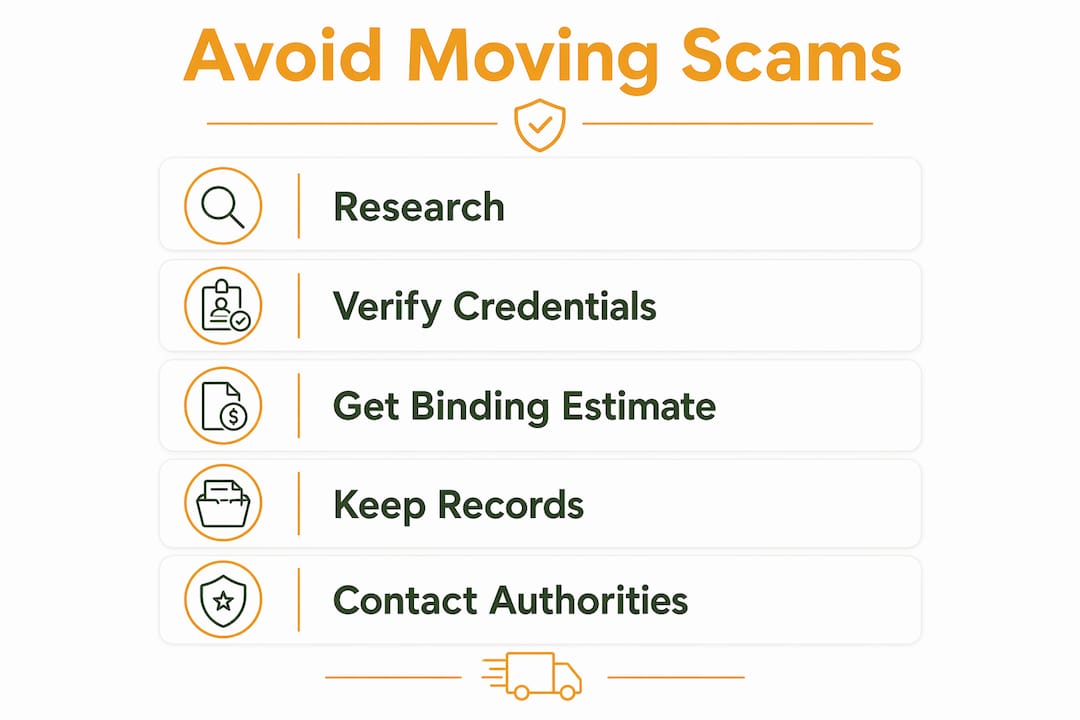
- Get at least three written estimates. Each must be based on an in-person or video survey, not a phone call. This gives you a realistic price range and exposes outliers.
- Research reviews across multiple platforms. Check Google, the Better Business Bureau, and the FMCSA’s NCCDB. Due diligence before hiring reduces scam risk significantly. One platform alone can be gamed.
- Confirm the company’s physical address. Drive by or use Google Street View. A real office with signage is a meaningful trust signal.
- Avoid large upfront payments. Pay a small deposit at most, and use a credit card so you have chargeback protection.
- Place AirTags or similar tracking devices in select boxes. Tracking devices in selected boxes help you monitor your shipment and detect unexpected detours or delays.
- Photograph every item before it is loaded. Timestamped photos document condition and support any damage or loss claims.
Pro Tip: Ask the mover for their MC number in addition to the USDOT number. The MC number confirms they hold active interstate operating authority. A company with a USDOT number but no MC number cannot legally move your goods across state lines.
| Verification step | Why it matters |
|---|---|
| FMCSA SAFER system check | Confirms active license and insurance filings |
| Binding written estimate | Locks in final price before loading |
| Physical address confirmation | Proves the company is a real, traceable entity |
| Signed contract copy | Provides legal recourse in disputes |
| Timestamped item photos | Supports damage and loss claims |
Key Takeaways
Avoiding moving fraud requires verifying FMCSA credentials, securing a binding written estimate, and reviewing every line of your contract before signing.
| Point | Details |
|---|---|
| Binding estimates protect you | Non-binding estimates allow price increases up to 110%, so always demand a binding quote. |
| FMCSA verification is non-negotiable | Confirm USDOT number, operating authority, and insurance filings before signing anything. |
| Contracts must be complete | Never sign a document with blank fields, missing inventory, or no specified delivery window. |
| Hostage loads have a clear response | Contact FMCSA and local police immediately; notifying the mover of this often resolves the situation. |
| Prevention beats recovery | Three written estimates, physical address confirmation, and upfront photo documentation stop most scams before they start. |
What I have learned after watching too many moves go wrong
Moving scams persist for one simple reason: they exploit a moment when people are already stretched thin. You are tired, you are on a deadline, and the last thing you want is to slow down and read the fine print. Scammers count on exactly that.
The pattern I see most often is not the dramatic hostage load. It is the quiet bait-and-switch, where a low quote gets a family to sign a non-binding estimate without realizing what that means. By delivery day, the price has jumped and the family pays because they have no other option. The fix is not complicated. It is a binding estimate and 20 minutes on the FMCSA SAFER system.
What I tell anyone planning a long distance move is this: treat the verification process like a job interview for the mover. Check their credentials, ask hard questions, and walk away if anything feels off. The right mover will welcome your scrutiny. A scammer will push back against it.
Documentation is your insurance policy. Photograph everything, keep every email, and retain every signed document. If something goes wrong, that paper trail is the difference between a resolved dispute and a total loss. Preparation is not paranoia. It is the only rational response to a high-stakes transaction.
— Info
Movecraftmoving: a moving partner you can verify and trust
Protecting yourself from moving fraud starts with choosing a carrier that operates transparently from day one.

Movecraftmoving is fully registered with the FMCSA, carries all required insurance filings, and provides binding written estimates on every long distance move. Every contract includes complete pricing, a full inventory, and specified delivery windows. There are no blank fields and no hidden fees. Movecraftmoving vets every carrier partner for licensing, insurance, and performance before they handle a single customer move. If you want a reliable moving service that meets every federal standard and gives you a clear paper trail from booking to delivery, Movecraftmoving is built for exactly that. Review the move contract terms before you book so you know exactly what is covered.
FAQ
What is a binding estimate in long distance moving?
A binding estimate is a written contract that locks in your final moving price before loading begins. Non-binding estimates can increase up to 110% at delivery, so a binding estimate is the strongest price protection available.
How do I check if a mover is licensed?
Use the FMCSA SAFER system to look up the mover’s USDOT number and confirm active operating authority and valid insurance filings. Any mismatch between FMCSA records and the company’s documents is a disqualifying red flag.
What should I do if a mover holds my belongings hostage?
Contact the FMCSA and local police immediately and inform the mover you have done so. This approach often prompts release of goods without additional payment.
What are the biggest red flags when hiring a mover?
The clearest red flags are large upfront cash demands, phone-only quotes with no written estimate, unmarked trucks, and contracts with blank spaces. Any one of these signals a high risk of fraud.
Is it safe to move during peak season?
Moving during may or summer is higher risk because scammers exploit peak season stress and time pressure. Verify credentials more carefully during these periods, not less.