
Moving insurance is defined as financial protection that covers your belongings against loss or damage while they are in transit during a relocation. Every long distance move carries real risk. Items shift, trucks brake hard, and weather happens. The Federal Motor Carrier Safety Administration (FMCSA) requires all interstate movers to offer at least two valuation coverage options, but those options are not the same as true insurance. This long distance moving insurance guide breaks down what each coverage type actually pays, how third-party insurance fills the gaps, and exactly how to buy the right protection before your moving truck leaves the driveway.
What are the federally mandated valuation coverage options for long distance movers?
Federal law requires every interstate moving company to offer two valuation options. Understanding both is the foundation of any solid long distance move protection plan.
Released Value Protection
Released Value Protection is free, but it pays almost nothing. The liability cap is 60 cents per pound per item. A 50-pound flat-screen television worth $1,200 would net you $30 in a claim. That gap between payout and actual value is where most movers get burned.
Full Value Protection
Full Value Protection (FVP) is the paid option, and it is the only carrier-provided coverage worth serious consideration for a long distance move. Under FVP, the carrier must repair the damaged item, replace it with a similar item, or pay you its current market value. FVP typically costs 1–3% of the declared shipment value, which translates to roughly $500–$1,500 on a $50,000 shipment. That cost is real, but so is the protection.

Carriers calculate FVP premiums based on the total declared value you assign to your shipment. If you understate your shipment’s value to lower the premium, your payout ceiling drops accordingly. Always declare the full replacement value of everything you own.
| Coverage type | Cost | Liability limit | Best for |
|---|---|---|---|
| Released Value Protection | Free | 60 cents per pound per item | Very low-value shipments only |
| Full Value Protection | 1–3% of declared value | Repair, replace, or cash value | Most long distance moves |
| Third-party insurance | 1–2% of declared value | Policy-defined, broader perils | High-value or specialty items |
Pro Tip: Ask your mover for the FVP deductible amount before signing the Bill of Lading. Some carriers offer a $0 deductible FVP option for a higher premium. For a move with antiques, electronics, or art, that upgrade is usually worth it.
How does third-party moving insurance differ from carrier valuation coverage?
The distinction between valuation and insurance is one of the most misunderstood points in any moving insurance guide. Valuation is a contractual liability limit, not an insurance product. It governs how much the carrier owes you under the Bill of Lading. True moving insurance is sold separately by state-licensed insurers and regulated by state insurance commissioners. That regulatory difference matters because insurance policies carry broader legal obligations to pay valid claims.
Third-party moving insurance covers perils that carrier valuation ignores entirely. Coverage often includes risks like certain natural disasters and owner-packed box damage, two categories that FVP typically excludes. If you pack your own boxes and something inside breaks, your carrier owes you nothing under standard FVP. A third-party policy may cover that loss, depending on the terms.
Here is what third-party moving insurance typically adds to your protection:
- Broader peril coverage. Policies can include flood, earthquake, and mechanical failure of the moving vehicle, none of which appear in standard carrier valuation.
- Owner-packed box protection. Some policies cover contents of boxes you packed yourself, subject to deductible and documentation requirements.
- Flexible deductibles. Deductibles commonly run $250, $500, or $1,000, letting you balance premium cost against out-of-pocket risk.
- Independent claims process. You file with the insurer directly, not the mover, which removes a conflict of interest from the claims equation.
Pro Tip: Compare the exclusion lists of your carrier’s FVP policy and any third-party policy side by side. Comparing exclusion lists reveals coverage gaps far more reliably than comparing prices alone.
Third-party premiums typically run 1–2% of the declared shipment value. On a $60,000 shipment, that is $600–$1,200 for a policy that may cover risks your carrier will never touch. For high-value shipments or moves involving specialty items like wine collections, musical instruments, or fine art, third-party coverage is not optional. It is the responsible choice.
What are the steps to determine how much moving insurance you need?
Buying the right coverage starts with knowing exactly what you own and what it is worth. Skipping this step is the single most common reason claims fall short.
-
Create a room-by-room inventory. List every item, its estimated replacement value, and its current condition. Spreadsheets work well. Apps designed for home inventory work even better. The goal is a document you could hand to an insurer today and have them understand your claim tomorrow.
-
Photograph everything before the move. Detailed inventories and before-and-after photos are the most effective tools for substantiating damage claims. Photograph serial numbers on electronics, existing scratches on furniture, and the condition of fragile items before they are wrapped.
-
Check your homeowners or renters insurance policy. Most homeowners insurance policies provide limited, if any, protection for property in transit. Call your agent and ask specifically about transit coverage. Do not assume your existing policy covers a cross-country move.
-
Request Full Value Protection quotes from at least two movers. Prices and deductible structures vary. Get the FVP cost in writing as part of your binding estimate, not as a verbal add-on at pickup.
-
Research third-party insurance providers. Look for insurers that specialize in moving coverage and are licensed in both your origin and destination states. Read the policy document before you pay, not after.
-
Declare the correct shipment value. Add up your inventory totals and use that number as your declared value. Undervaluing saves a small amount on premiums and costs a large amount when you file a claim.
| Step | Action | Why it matters |
|---|---|---|
| Inventory | List all items with replacement values | Sets your declared value accurately |
| Photography | Photograph condition before packing | Supports damage claims with evidence |
| Policy check | Verify homeowners transit coverage | Avoids false assumptions about existing coverage |
| FVP quotes | Compare mover FVP costs in writing | Prevents surprise charges at pickup |
| Third-party research | Review policy exclusions before buying | Identifies gaps before they become losses |
What common mistakes should you avoid with long distance moving insurance?
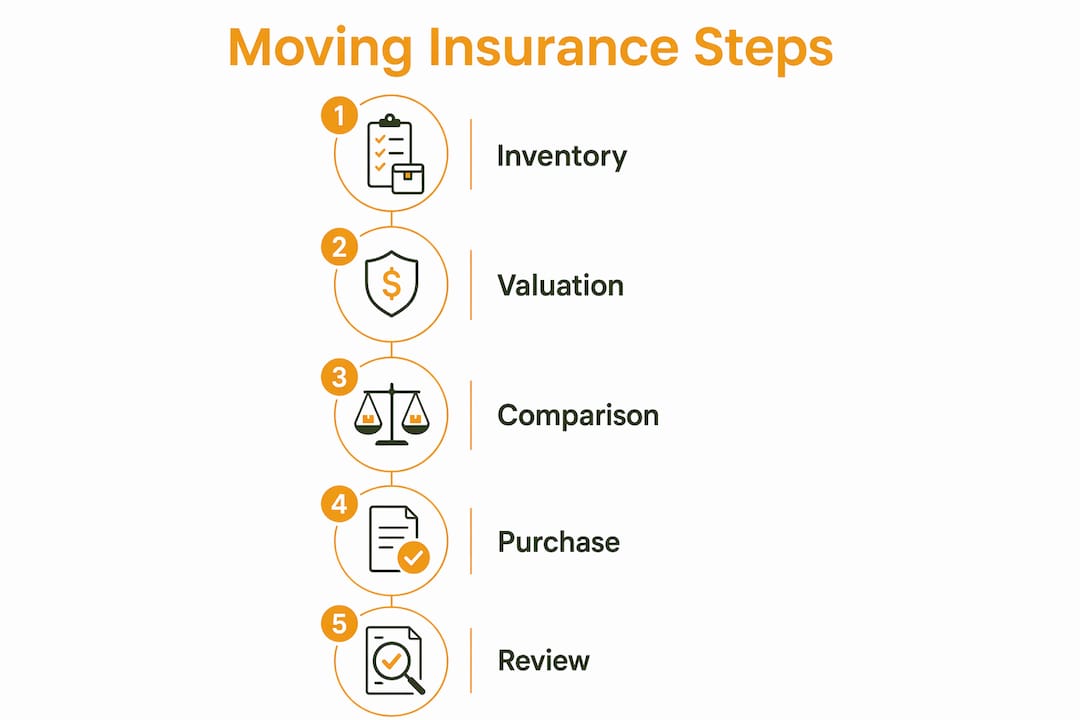
Most coverage failures are not bad luck. They are predictable errors made before the truck ever arrives.
Assuming homeowners insurance covers the move. Many consumers mistakenly assume their existing homeowner or auto insurance covers moving losses. Standard homeowners policies are written for property at a fixed address, not property bouncing down a highway. Verify your transit coverage in writing before moving day.
Ignoring storage-in-transit gaps. This is one of the most expensive blind spots in long distance moves. A mover’s liability often terminates once items are moved to a customer-arranged storage facility. If your new home is not ready and your belongings go into a storage unit you arranged, your mover’s coverage may end at that handoff. Ask your insurer explicitly whether your policy covers the storage period.
Filing claims late or without documentation. Most moving contracts require written notice of damage within a specific window, often nine months for interstate moves under federal rules. Missing that deadline can void your claim entirely. File promptly, in writing, and attach your photos and inventory.
- Undervaluing your shipment to reduce FVP costs creates a payout ceiling below your actual losses.
- Skipping the mover’s license check leaves you exposed. Verify your mover’s FMCSA registration number at the FMCSA website before signing anything.
- Relying on Released Value Protection for a move with any item worth more than a few hundred dollars is a financial risk that rarely pays off.
“The difference between valuation and insurance is not just technical. It is the difference between a $30 check and a $1,200 replacement for a single damaged television.”
Key takeaways
Choosing the right moving insurance requires understanding that carrier valuation and third-party insurance are separate products with different costs, coverage scopes, and claim processes, and combining both often provides the most complete protection for a long distance move.
| Point | Details |
|---|---|
| Released Value Protection pays very little | At 60 cents per pound, it rarely covers actual item value for any significant possession. |
| Full Value Protection is the baseline for most moves | FVP costs 1–3% of declared value and covers repair, replacement, or cash settlement. |
| Third-party insurance fills critical gaps | It covers perils like owner-packed box damage and some natural disasters that FVP excludes. |
| Documentation drives successful claims | Detailed inventories and photos taken before packing are your strongest claim evidence. |
| Storage-in-transit needs explicit coverage | Mover liability often ends at customer-arranged storage, so verify your policy covers that period. |
What I have learned from watching moves go wrong on the insurance side
After years of working in the relocation space, the pattern I see most often is not fraud or negligence. It is overconfidence. People assume their existing insurance handles everything, or they sign the Bill of Lading without reading the valuation section, or they pack their own boxes and never think about what happens if those boxes arrive damaged.
The uncomfortable truth is that Released Value Protection exists because it is profitable for carriers, not because it protects you. Sixty cents per pound is a legal minimum, not a reasonable standard. A mover who offers only that option without explaining Full Value Protection is technically compliant and practically unhelpful.
My strongest advice is to treat the insurance decision the same way you treat the mover selection. Spend time on it. Read the exclusion list. Ask what happens to your coverage if your items go into storage for two weeks between your old home and your new one. That question alone will reveal whether your coverage is real or just paperwork.
Third-party insurance is not a luxury for people with expensive art collections. It is a practical tool for anyone moving a household worth more than a few thousand dollars across state lines. The premium is modest. The peace of mind is not.
— Info
How Movecraftmoving supports your insured long distance move
Movecraftmoving was built on the principle that you should never have to guess what is covered when your belongings are in someone else’s hands.

Every move Movecraftmoving coordinates includes a transparent walkthrough of your valuation options under federal FMCSA requirements. The team explains the difference between Released Value Protection and Full Value Protection in plain language, helps you calculate an accurate declared shipment value, and connects you with reputable third-party insurance options when your shipment warrants broader coverage. You can review the full terms of coverage and carrier liability disclosures at Move Craft Moving Solutions. When you are ready to plan a move that treats your belongings with the same care you do, Movecraftmoving is the place to start.
FAQ
What is moving insurance, exactly?
Moving insurance is a policy sold by a state-licensed insurer that covers your belongings against loss or damage during a move. It is separate from carrier valuation, which is a contractual liability limit, not an insurance product.
Is Released Value Protection enough for a long distance move?
Released Value Protection pays only 60 cents per pound per item, which rarely covers actual replacement costs. Full Value Protection or a third-party policy is the better choice for any move involving items of real value.
Does homeowners insurance cover a long distance move?
Most homeowners insurance policies provide limited or no coverage for property in transit. Contact your insurer before moving day to confirm whether transit coverage applies to your specific policy.
How much does Full Value Protection cost?
Full Value Protection typically costs 1–3% of the declared shipment value, adding roughly $500–$1,500 to the cost of a $50,000 move, depending on the carrier and deductible you choose.
What is storage-in-transit coverage and why does it matter?
Storage-in-transit coverage protects your belongings during a temporary storage period between your origin and destination. Mover liability often ends when items transfer to a customer-arranged storage facility, so you need a policy that explicitly covers that gap.